

Overview: Global spare parts pricing is the practice of setting and managing spare part prices across multiple countries, accounting for currency, tax, duty, and dealer margin differences while keeping pricing accurate and consistent. OEMs that sell through dealer networks in many countries cannot use one price list for every market. Exchange rates shift, import duties vary, local taxes differ, and dealer agreements are negotiated per region. Traditional methods, such as spreadsheets, printed catalogs, and disconnected ERP exports, cannot keep pace with these variables, which leads to pricing errors, dealer disputes, and revenue leakage. Centralized digital parts catalog software, such as Intelli Catalog, addresses this by managing regional price lists, currencies, and dealer-specific pricing from a single system with real-time updates and full audit trails.

Key Takeaways:
- Global OEMs cannot maintain one universal price for a spare part because of currency, tax, duty, and logistics differences between markets.
- Spreadsheets, printed catalogs, and manual ERP exports create pricing errors that are hard to catch before they reach a dealer.
- Inconsistent regional pricing leads to dealer disputes, ordering mistakes, and revenue leakage.
- Centralized pricing software lets OEMs manage multiple regional price lists, currencies, and dealer-specific rates from one dashboard.
- Real-time updates and audit trails give OEMs control over who changed a price, when, and why.
- Digital parts catalog platforms like Intelli Catalog reduce administrative workload while improving pricing accuracy across geographies.
Book a Demo and simplify global spare parts pricing with Intelli Catalog.
Global spare parts pricing is the process OEMs use to set, adjust, and distribute part prices across every country where they operate, in a way that reflects local currency, tax, duty, and dealer conditions. A single spare part rarely carries the same price in two countries. A brake caliper priced for a dealer in Germany will have a different landed cost in Brazil after accounting for currency conversion, import duties, and local taxes. For OEMs running dealer networks across dozens of countries, this is not a small pricing detail: it is an operational challenge that touches revenue, dealer trust, and compliance.
Several factors drive this complexity: exchange rates, import duties, regional taxation, logistics costs, dealer agreements, local market competition, regulatory requirements, and inflation. Each factor changes independently and at a different pace, which means a price list that was accurate last quarter can be outdated today. OEMs that still manage this manually, through spreadsheets or static price lists, struggle to keep pricing consistent, and dealers end up working from different versions of the same catalog.
Why Do Global OEMs Need Regional Pricing?
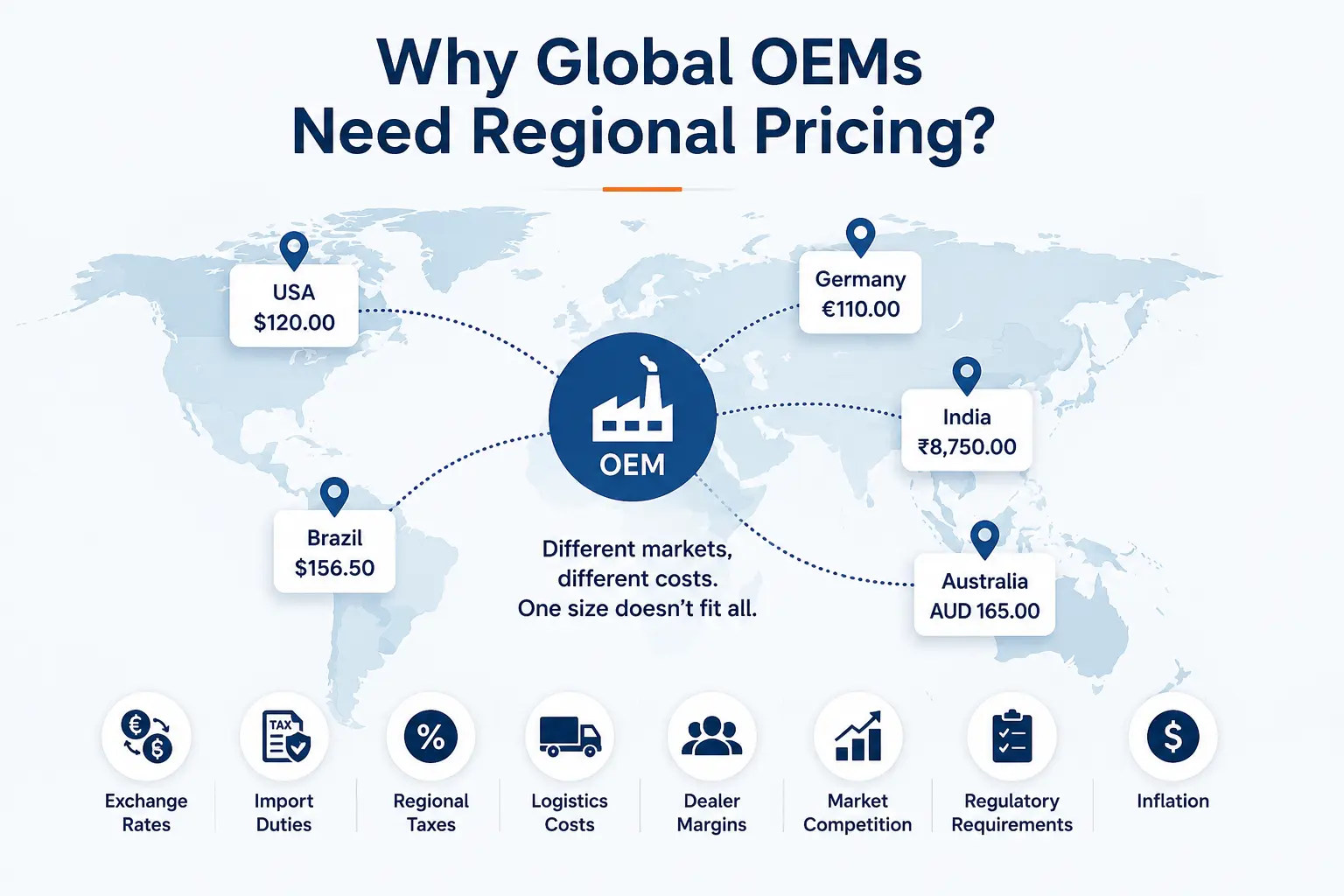
OEMs need regional pricing because a single global price cannot account for differences in currency exchange rates, import duties, local taxes, and dealer margins across markets. Setting a single price across all countries either erodes margins in high-cost markets or makes the part too expensive for price-sensitive ones.
Every country an OEM sells into has its own cost structure and market conditions. A single global price list assumes these differences do not exist, which rarely holds in practice. The main factors that push OEMs toward regional pricing include:
- Exchange rates: currency fluctuations change the local cost of an imported part from month to month.
- Import duties: customs duties vary by country and by part classification.
- Regional taxation: VAT, GST, and sales tax rates differ widely between markets.
- Logistics and freight: air freight to a landlocked country costs more than sea freight to a coastal hub.
- Local market competition: prices need to stay competitive against local aftermarket suppliers.
- Regulatory requirements: some markets cap markups on safety-critical parts.
- Inflation: high-inflation markets need more frequent price revisions than stable ones.
OEMs that ignore these factors either lose margin in high-cost markets or lose sales volume in price-sensitive ones. Regional pricing is not a discount strategy; it is a profitability strategy that helps OEMs protect margins while remaining competitive in every market.
What Makes Spare Parts Pricing Different Across Countries?
Spare parts pricing differs across countries because taxes, currency values, transportation costs, duties, purchasing power, dealer margins, and compliance rules vary by market, and each of these inputs changes the final price a dealer or customer pays for the same part.
Two dealers in different countries can order the identical part number and receive very different landed prices, even before the OEM adds its own margin. From an OEM operations perspective, the price of a part is built from several layers:
- Base manufacturing or import cost
- Currency conversion at the time of shipment or invoicing
- Import and export duties specific to the part category
- Local taxation (VAT, GST, or the equivalent)
- Freight and transportation cost to the region
- Local purchasing power, which affects what the market can absorb
- Dealer margin and any negotiated discount
- Promotional or seasonal pricing specific to that market
- Regional demand for that part
- Compliance requirements, such as price caps on safety parts
Each layer is set and adjusted independently, often by different teams: finance, logistics, sales, and compliance. Keeping all of them synchronized for every part, in every region, is where most OEMs start running into trouble.
Why Manual Pricing Management Doesn’t Scale
Manual pricing management, using spreadsheets, disconnected ERP exports, or printed catalogs, does not scale because it cannot keep pace with frequency, currency, tax, and cost changes across many countries, which leads to outdated prices reaching dealers.
Most OEMs did not choose manual pricing on purpose. It is what grew out of a smaller, single-market operation and was never redesigned for global scale. Common tools still in use include:
- Spreadsheets maintained by regional teams, updated on different schedules
- Disconnected ERP exports that go stale the moment they are downloaded
- Printed catalogs, which cannot reflect a price change until the next print run
- Manual updates entered by hand into multiple systems
- Email communication used to inform dealers of price changes
- Static price lists that do not account for real-time currency movement
The operational consequence is a widening gap between the price in the system and the price a dealer or customer actually sees. EY research in 2025, cited by pricing software provider Zilliant, found that companies improving pricing execution can increase EBIT by two to five percentage points of sales. For OEMs still relying on spreadsheets and disconnected pricing workflows, manual processes are one factor that can make consistent pricing execution more difficult.
What Are the Business Risks of Inconsistent Spare Parts Pricing?
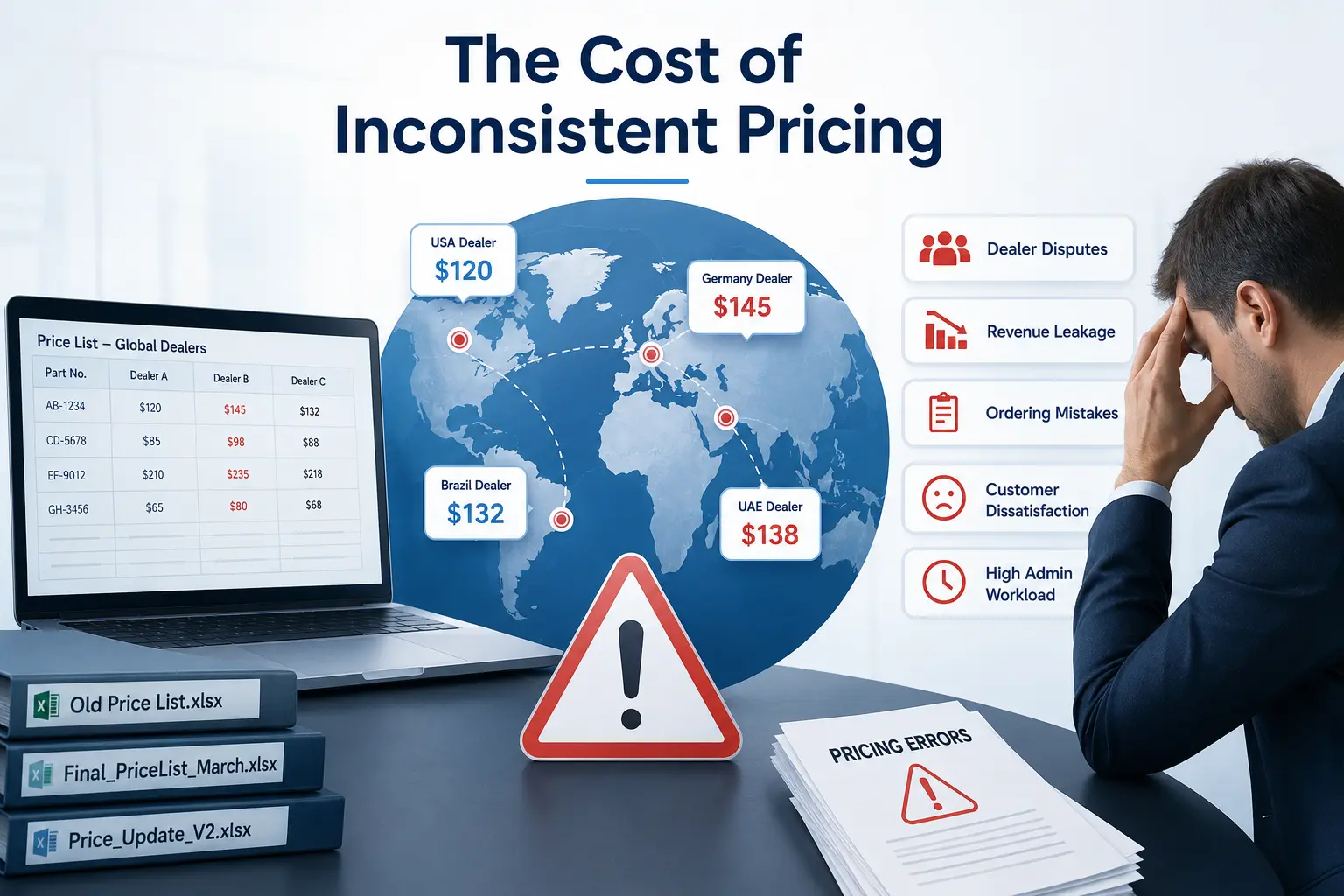
Inconsistent pricing creates dealer disputes, customer dissatisfaction, ordering mistakes, and revenue leakage, and it adds administrative workload as OEM teams spend time correcting prices instead of running the business.
- Inconsistent dealer pricing: two dealers in the same region quoting different prices for the same part erodes trust in the OEM’s price list.
- Customer dissatisfaction: end customers notice when a price at one dealer does not match another, or does not match an earlier quote.
- Outdated price lists: a dealer working from an old spreadsheet or printed catalog may quote a price that is no longer valid.
- Ordering mistakes: wrong prices lead to wrong invoices, which then require manual correction.
- Pricing disputes: dealers push back when the price they were shown does not match what they are billed.
- Revenue leakage: undetected pricing errors, especially underpricing, quietly reduce margin over time.
- Reduced dealer confidence: dealers who repeatedly encounter pricing errors lose confidence in the OEM’s systems.
- Administrative workload: pricing teams spend hours reconciling errors instead of working on strategic pricing decisions.
Manual parts ordering increases the likelihood of incorrect part numbers, quantity errors, duplicate orders, and pricing discrepancies. At the scale of an OEM dealer network, even a small number of ordering mistakes can create unnecessary returns, credits, rebilling, and repair delays.
How Can OEMs Centralize Global Spare Parts Pricing?
Electronic parts catalog software centralizes global spare parts pricing management by letting OEMs maintain multiple regional price lists, currencies, and dealer-specific rates in one digital parts catalog, with changes published instantly to every authorized dealer.
Instead of maintaining separate spreadsheets or printed catalogs per region, OEMs using software like Intelli Catalog manage pricing from a single dashboard. Regional teams can set country-specific price lists, apply local tax and currency rules, and publish updates that reach dealers immediately, without a new print run or a batch ERP export.
This does not remove the underlying complexity of global pricing: currency, duty, and tax differences are still real. What changes is how that complexity is managed, moving from scattered files and manual coordination to one system that keeps every region’s pricing accurate and traceable.
What Features Help OEMs Manage Regional Spare Parts Pricing?
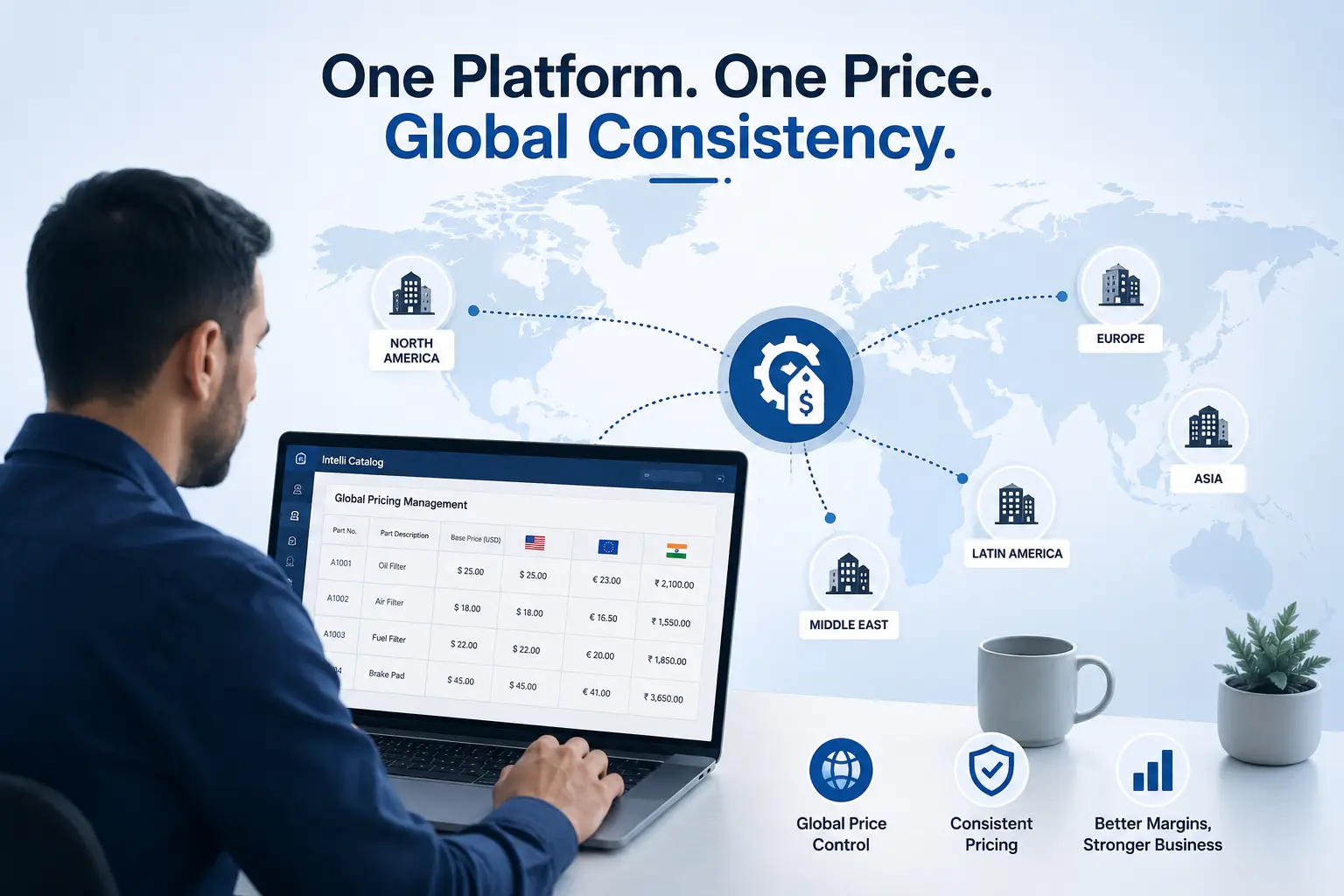
Intelli Catalog, an electronic parts catalog software, supports centralized pricing management, multiple regional price lists, dealer-specific pricing, multi-currency support, tax configuration, role-based access, version control, real-time updates, ERP integration, audit trails, and cloud deployment, so OEMs can manage global pricing without manual reconciliation.
- Centralized pricing management: all regional price lists live in one system, so pricing teams are not chasing files across email threads.
- Multiple regional price lists: each country or dealer group can have its own price list without duplicating the entire catalog.
- Dealer-specific pricing: negotiated margins and volume discounts apply automatically to the right dealer, without manual overrides.
- Multiple currencies: prices display and calculate in local currency, which reduces conversion errors at the point of sale.
- Tax configuration: VAT, GST, and other regional tax rules are built into the price calculator instead of added manually afterward.
- Role-based access: regional teams can update their own price lists without touching pricing in other markets.
- Pricing version control: every price change is tracked, so OEMs can see what changed, when, and who approved it.
- Real-time updates and instant publishing: a price change reaches every connected dealer immediately, without a new catalog print or batch upload.
- ERP integration: pricing data stays synchronized with the OEM’s core systems instead of living in separate, disconnected files.
- Audit trail: a complete history of price changes supports internal review and compliance requirements.
- Cloud deployment and APIs: dealers and internal systems can access current pricing through the platform or through API connections, without manual data transfer.
For example, a single spare part, such as a fuel filter, can carry three different published prices: one for a dealer in India, one for a dealer in the UAE, and one for a dealer in Germany, each reflecting local tax, currency, and duty. In Intelli Catalog, these three price points exist as separate entries tied to the same part number, so a currency shift or tax change in one region does not require touching the other two.
What Are the Benefits of Centralized Global Spare Parts Pricing?
OEMs benefit from fewer pricing errors, faster price updates, and stronger dealer trust, while dealer networks benefit from accurate, consistent pricing they can rely on when quoting customers, which reduces disputes and improves order accuracy.
- Fewer manual errors, since pricing rules apply automatically instead of being re-entered by hand
- Faster response to currency and tax changes, since updates publish instantly across regions
- Reduced dealer disputes, since every dealer works from the same current price list
- Better visibility into pricing history, useful for audits and internal reviews
- Lower administrative workload for pricing and finance teams
- A more consistent customer experience across the dealer network
Conclusion
Global spare parts pricing will always be complicated by currency, tax, duty, and market differences between countries. That complexity does not go away with better tools, but the operational cost of managing it does. OEMs that continue to rely on spreadsheets, printed catalogs, and disconnected ERP exports will keep facing dealer disputes, pricing errors, and revenue leakage as they expand into more markets. Centralized digital parts catalog platforms, such as Intelli Catalog, give OEMs one place to manage regional price lists, currencies, dealer-specific rates, and real-time updates, with a full audit trail behind every change. For OEM teams managing pricing across multiple geographies, that combination directly addresses the risks covered earlier: inconsistent pricing, outdated price lists, and the administrative burden of manual reconciliation.
See how Intelli Catalog can centralize your global spare parts pricing. Request a free demo to walk through regional price lists, dealer-specific pricing, and real-time publishing with our team.
FAQ
How do OEMs price the same spare part differently in different countries?
OEMs build each country's price from the same base cost, then add currency conversion, import duty, local tax, freight, and dealer margin specific to that market. Two countries rarely share identical duty rates or tax structures, so the final price differs even though the part number is the same. Centralized pricing software applies these regional rules automatically, so the price stays accurate without manual recalculation for every market.
What is the biggest problem with using spreadsheets for global parts pricing?
Spreadsheets do not update automatically when currency rates, taxes, or duties change, and different regional teams often maintain separate versions with no shared source of truth. This creates outdated price lists, inconsistent pricing between dealers, and errors that are hard to catch before they reach a customer. As an OEM adds more countries and dealers, spreadsheet-based pricing becomes harder to keep accurate and difficult to audit.
Can a digital parts catalog handle dealer-specific pricing and discounts?
Yes. Platforms like Intelli Catalog let OEMs set negotiated margins, volume discounts, and promotional pricing for individual dealers or dealer groups within the same catalog. These rates apply automatically when a dealer views or orders a part, so sales and pricing teams do not need to manually apply discounts for every transaction. This keeps dealer-specific terms consistent and reduces the chance of a dealer being billed the wrong rate.
How often should OEMs update regional spare parts pricing?
There is no single fixed schedule, since currency volatility, tax changes, and cost shifts happen at different rates in different markets. High-inflation or currency-volatile markets typically need more frequent review, sometimes monthly, while stable markets may only need quarterly updates. The more relevant question is how quickly an OEM can publish a price change once it is needed. Centralized pricing systems let updates reach dealers immediately, rather than waiting for the next print cycle or batch export.
Does centralizing global pricing require replacing an OEM's existing ERP?
No. Digital parts catalog platforms are generally designed to integrate with an OEM's existing ERP rather than replace it. Pricing, tax, and inventory data can sync between the two systems, so the catalog reflects current ERP data without duplicate manual entry. This lets OEMs centralize pricing management and dealer-facing catalog features while keeping their core financial and inventory systems unchanged.


Explore More Insights







.webp)


About the Author


Chandra Shekhar
Chandra Shekhar is the Senior Manager, Strategy & Business Development at Intellinet Systems. With over a decade of experience in the automotive industry, Chandra Shekhar has led digital transformation and aftersales strategy initiatives for OEMs across multiple markets. His background combines deep industry knowledge with a practical understanding of how technology can solve real operational challenges. He focuses on making complex ideas clear and relevant for automotive and aftermarket professionals navigating ongoing change.


