


For OEMs in automotive, EV sectors, agriculture, industrial, and heavy equipment, inventory management is not just a back-office task. It directly affects how fast dealers can order parts, how accurately technicians identify components, and how profitably OEMs can run aftermarket operations.
Poor inventory management leads to stockouts, wrong parts being ordered or shipped, excess carrying costs, and frustrated dealer networks. Strong inventory management habits protect OEMs' margins, improve parts fill rates, and give their aftermarket business a competitive edge.
Here, we bring 8 practical inventory management habits OEMs should follow for a profitable and smarter aftermarket business.
Why Inventory Management Matters for OEM Aftermarket Operations

The aftermarket is the highest-margin revenue stream for OEM, but it is where inventory failures lose revenue and damage the relationship. Effective inventory management in the aftermarket context means:
- Parts data is always current and accurate
- Faster parts identification using VIN or serial number
- Visibility into what dealers & distributors have in stock
- Automated updates when parts are superseded or discontinued
- Demand signals that help OEM stock the right quantities
The McKinsey report on OEM aftermarket operations highlights that maximizing fill rates is the core of aftermarket inventory management, because equipment downtime leads to customer and financial loss.
8 Fundamental Inventory Management Best Practices
1. Build Real-Time Inventory Visibility Across All Locations
OEMs with multi-dealer or multi-warehouse networks often have a fragmented inventory system. Real-time inventory visibility gives OEMs, dealers, and distributors access to knowing what is in stock, where it is, and what is moving, at a given time.
Real-time visibility prevents overstocking and stockouts, reduces emergency procurement costs, and helps OEMs make faster fulfillment decisions. It even enables OEMs with smarter decisions around restocking thresholds and safety stock levels.
Intelli Catalog, an electronic parts catalog software, provides real-time inventory visibility for both OEM teams and dealer networks. Inventory levels are automatically updated, so dealers get a view of accurate stock data before placing orders, reducing back-and-forth and order cancellations.

2. Use VIN and Serial Number Lookup to Eliminate Wrong Parts Orders
One of the biggest sources of challenge in aftermarket operations is incorrect parts orders. When dealers have to guess part numbers or rely on outdated catalogs, wrong parts get ordered, shipped, returned, or reordered, which inflates logistic costs.
VIN-based and serial number-based parts identification removes guesswork from the ordering process, ensuring the right part is matched to the right equipment configuration every time. This reduces return rates and improves order accuracy.
Intelli Catalog supports VIN and serial number-based lookup, which eliminates catalog ambiguity and reduces costly returns across automotive, heavy equipment, and agriculture equipment OEM operations.
3. Manage Parts Supersessions Proactively
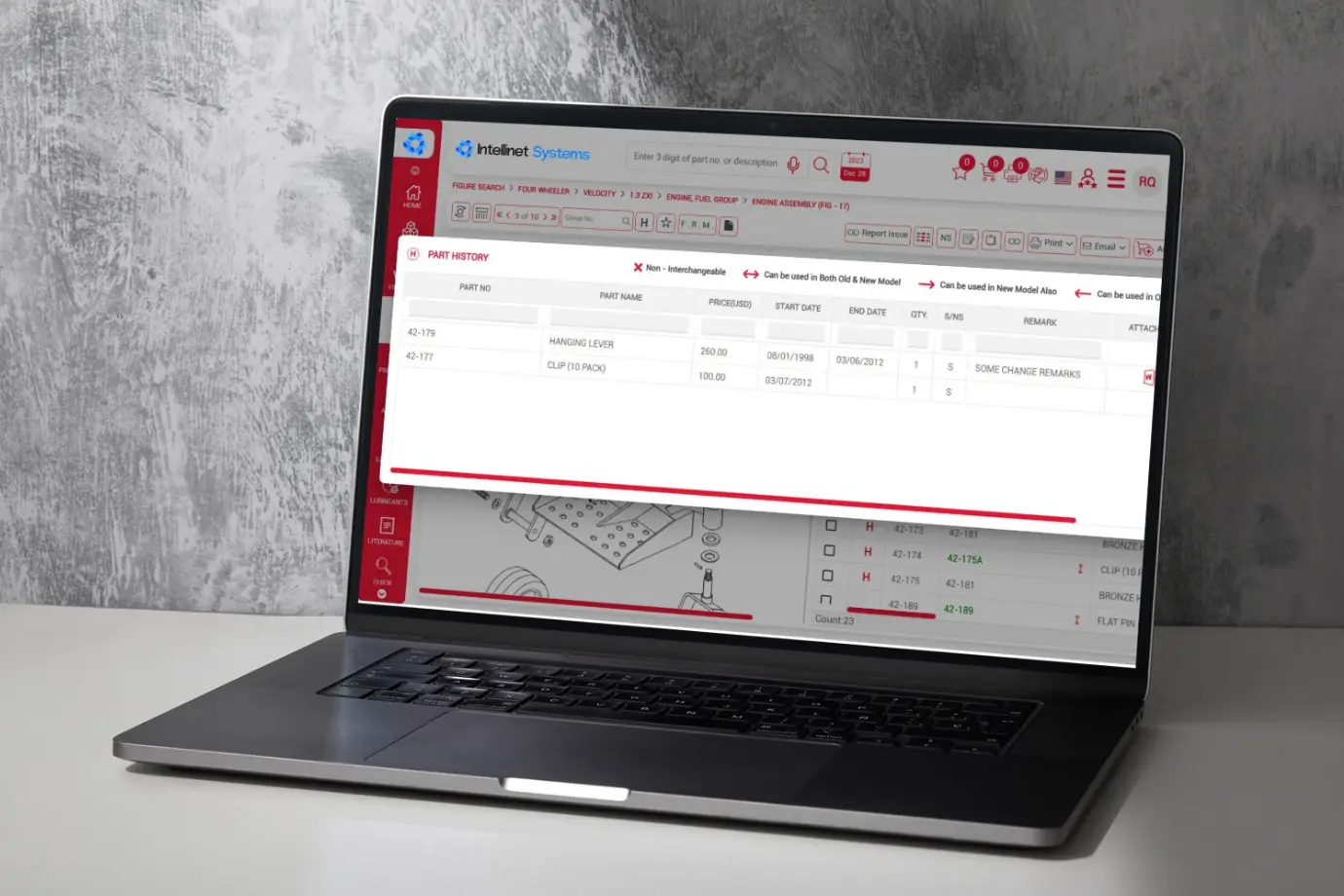
Parts evolve, manufacturers update designs, or discontinue older components. However, in the absence of a system to track supersession chains, dealers continue ordering obsolete part numbers, creating fulfilment failures and inventory deadstock.
Proactive suppersession management ensures that when a part is updated or replaced, the entire dealer network is automatically pointed to the correct current part number. This built-in feature included in Intelli Catalog keeps inventory data clean, reduces catalog confusion, and prevents lost sales.
4. Use Data-driven Demand Forecasting & Planning
Inventory management best practices include not just knowing what you have, but also anticipating what you will need, as demand forecasting across several dealer networks is more complicated. Accurate demand forecasting with predictive analytics uses historical sales data, seasonal patterns, and equipment population data to predict which parts will be needed and when, thereby reducing excess inventory and stockouts.
Intelli Catalog provides an analytics dashboard that gives OEM teams visibility into parts ordering trends across dealer networks, which helps lower carrying costs, improve warehouse space utilization, and ensure high-demand parts are always available during peak seasons.
5. Track Inventory Across Multiple Locations and Dealer Networks
OEMs dealing with dealers across multiple states or countries have limited visibility into what dealers are holding, leading to an imbalance in stock distribution and service delays.
Multi-location inventory tracking allows OEMs to see a dealer's stock levels, identify underperforming inventory sitting in one location, and proactively rebalance parts across the network before shortages occur.
Intelli Catalog gives OEMs real-time dealer inventory visibility, so both the OEM and the dealer can see what parts are available at which locations, thereby reducing duplicate orders and helping OEMs identify inventory imbalances before they become customer service problems.
6. Integrate Your Parts Catalog With Your ERP System
Many OEMs have their parts data scattered, like parts catalog is one system, the ERP is another, and inventory levels live in a third. This disconnect creates data accuracy issues, delays order processing, and prevents real-time inventory updates.
ERP integration synchronizes parts data, inventory levels, and order information in real time. When a dealer places an order through the catalog, the ERP updates automatically. Pricing, availability, and fulfillment status stay consistent across all touchpoints.
Intelli Catalog supports ERP integration, connecting parts catalog data directly with ERP systems used by OEMs, eliminating manual data entry and preventing pricing discrepancies.
7. Enable AI-Powered Search to Speed Up Parts Identification
Dealers and service technicians spend significant time searching for the right part when working with large catalogs that cover multiple equipment models and configurations. Using an AI-powered search makes parts identification faster and more accurate, which means faster ordering, faster repairs, and higher dealer satisfaction.
Intelli Catalog uses AI-powered search to help dealers and technicians quickly identify the correct part, even with incomplete information. Its AI Visual Search works through standard smartphone cameras, AI Voice Search supports spoken queries in the technician’s native language, and MagicPic enhances warehouse photos into clear, catalog-quality images. Together, these capabilities improve parts identification accuracy, reduce ordering errors, and shorten the time between fault diagnosis and parts ordering.
8. Use Analytics Dashboards to Drive Smarter and Continuous Improvement
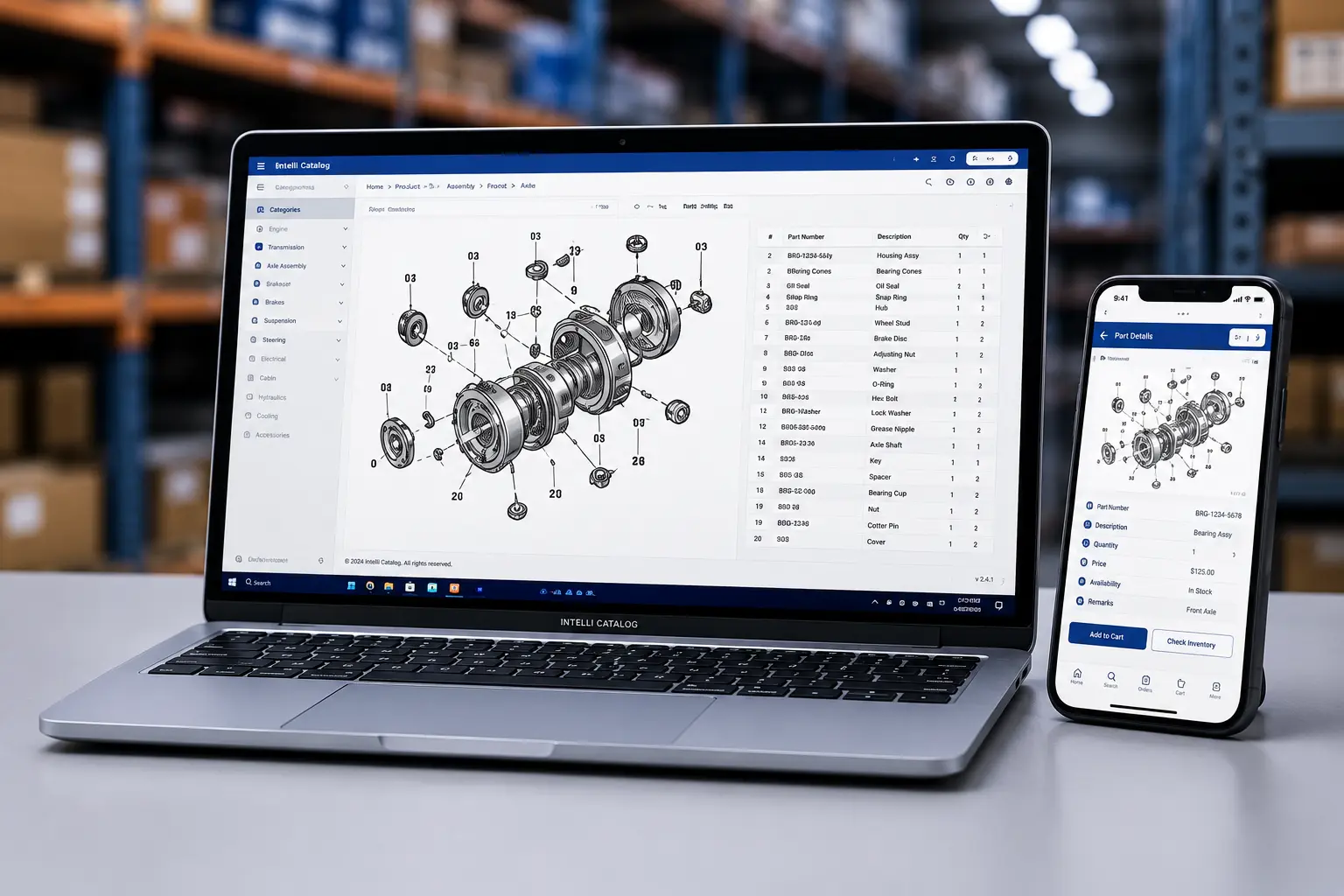
Analytics dashboards give OEM teams visibility into fill rates, parts order volumes, stockout incidents, slow-moving inventory, and dealer ordering behavior.
Data-driven inventory management helps OEMs identify problems before they escalate. Intelli Catalog's analytics dashboards provide OEMs with actionable data on parts ordering activity, dealer behavior, and inventory performance, which then help OEM aftermarket teams to make smarter stocking decisions, improve catalog accuracy, and identify which parts need priority attention across their dealer network.
The Bottom Line
Strong inventory management is one of the highest-impact investments an OEM can make in its aftermarket operation, where benefits go beyond cost reduction. They include faster dealer response times, higher parts fill rates, fewer wrong-parts returns, and stronger dealer relationships.
Each of the inventory management habits covered in this blog, from VIN-based parts identification to AI-powered search and ERP integration, represents a practical step OEMs can take today to build a more reliable, data-driven aftermarket operation.
Ready to move beyond manual processes and empower your inventory management with intelligent automation? Book a demo.
FAQ
What are the core objectives of inventory management for OEMs?
The core objectives of inventory management include stock availability, avoiding stockouts, reducing dead stocks, improving stock accuracy, and reducing costs.
Which tool helps OEMs reduce stock-outs and excess inventory to maximize supply chain efficiency?
Intelli Catalog helps OEMs reduce stockouts and excess inventory to improve supply chain efficiency.
What are the markers of poor inventory management?
Poor inventory management is an imbalance between keeping too much and too little stock. Poor stock management increases costs and thereby reduces profits.
What is supersession management in parts inventory?
Supersession management tracks when a part number is updated, consolidated, or replaced by a newer version.
How does VIN and serial number lookup improve inventory management?
VIN and serial number lookup matches a specific machine to the exact parts, which eliminates guessing, reduces incorrect orders, and speeds up the parts identification process for dealers and service technicians.


Explore More Insights








.webp)


About the Author


Chandra Shekhar
Chandra Shekhar is the Senior Manager, Strategy & Business Development at Intellinet Systems. With over a decade of experience in the automotive industry, Chandra Shekhar has led digital transformation and aftersales strategy initiatives for OEMs across multiple markets. His background combines deep industry knowledge with a practical understanding of how technology can solve real operational challenges. He focuses on making complex ideas clear and relevant for automotive and aftermarket professionals navigating ongoing change.


