

Overview: Aftermarket software for automotive OEMs is the set of systems that automate aftersales work between a manufacturer and its franchised dealers: parts identification, warranty claims, parts returns, and dealer ordering. The core issue is volume. Dealers process millions of repair orders, and every manual step adds delay and error risk. Automation helps most where decisions follow clear rules. It cannot fix weak catalog data, incomplete fitment logic, or poor integration with dealer systems. For U.S. OEMs, the practical path is to start with one high-friction workflow, clean the data behind it, and measure results before expanding.
Key Takeaways:
- Where it fits: Rule-based work such as part lookup, claim checks, and return tracking gains the most.
- Product mapping: Intelli Catalog, Intelli Warranty, and Intelli RMS cover identification, claims, and returns. Intelli Commerce, DMS, and PDI extend to distributors, dealer operations, and inspections.
- What it depends on: Catalog structure, VIN-level application data, and dealer system integration decide the outcome.
- Dealer reality: Dealers use tools that save time at the counter and in the service lane. Slow tools get bypassed.
- How to prove it: Track incorrect-part returns, first-pass claim acceptance, and time to identify a part.
Why Is Aftermarket Software for Automotive OEMs an Operational Necessity?
Aftermarket software for automotive OEMs matters because aftersales work repeats at huge volume across a dealer network. According to the NADA Data 2025 Full-Year Report, Franchised dealers wrote more than 276 million repair orders in 2025, with service and parts sales above $164 billion. Small manual delays on each order add up, and the OEM often cannot see where they happen.
Dealer staff do not wait on slow tools. When the OEM system is hard to use, they work around it. That usually looks like this:
- Parts counter staff call the OEM parts line or a regional contact to confirm a number.
- Advisors order from memory or from an old invoice and hope the part has not been superseded.
- Warranty administrators keep their own spreadsheets to track claim status.
- Dealers buy from non-OEM sources because the search is faster.
Each workaround moves activity outside the OEM’s view. The OEM then loses the search data that shows which parts dealers look for and cannot find, and sometimes loses the sale as well.

Which OEM Aftersales Workflows Benefit Most from Automation?
Parts identification, warranty claims, and warranty parts returns benefit most. Each follows defined rules and creates rework when handled by hand. Intellinet Systems covers them with Intelli Catalog for parts identification, Intelli Warranty for warranty claims and supplier recovery, and Intelli RMS for warranty parts returns management.
None of this guarantees savings. Software removes avoidable steps. Fewer wrong orders mean fewer returns and fewer repeat visits. Cleaner claims mean fewer resubmissions for dealer warranty administrators and for the OEM’s review team.
How Does an Illustrated Parts Catalog Improve Parts Identification?
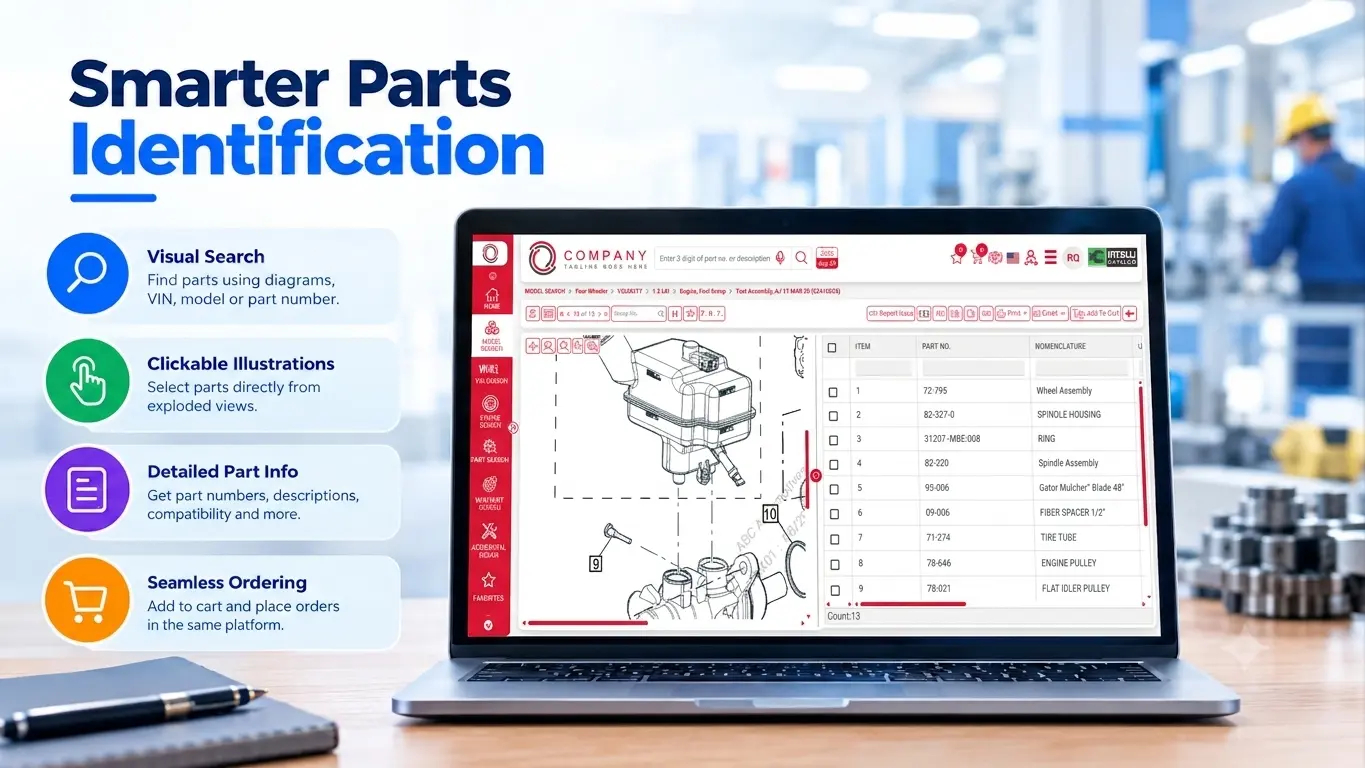
An illustrated electronic parts catalog lets dealers identify a part by VIN, model, or diagram rather than guessing from a number. Intelli Catalog provides hotspotted 2D and 3D illustrations, VIN and figure search, and carries supersessions and price updates, so counter staff sees current information before they place the order.
In a traditional catalog process, every engineering change starts a chain: part insertion, part number and drawing revisions, price revisions, then printing or PDF creation and distribution to the channel. Inteli-Catalog is positioned as the replacement for that chain, which supports parts-counter operations through the following features:
- Search paths: VIN or serial number, model, part number, or visual diagram. Customers often arrive with a symptom or a photo, not a number.
- Hotspotting: 2D diagrams highlight the selected part on the assembly, which helps an assembly and its components carry different part numbers.
- Supersessions: parts revised through value engineering are presented so users land on the current part, not the one on the old invoice.
- Ordering: dealers order and follow order status in the same system. Two-way integration with ERP or DMS syncs order submission and dispatch details.
- AI features: natural language search, MagicPic image enhancement, and a camera-based visual part identification aimed at users who do not know the part name.
These functions reduce the number of search steps only when the application data behind them is correct.
How Do Warranty Claims and Parts Returns Work Together?
Claims decide what the OEM owes the dealer. Returned parts decide what the OEM can recover from the supplier. Intelli Warranty handles claims and supplier recovery, and Intelli RMS manages warranty part returns. Running them together keeps each claim, part, and supplier chargeback traceable.
- Claim types and policy: OEM PDI, dealer PDI, post-sale, campaign, goodwill, and spare parts claims run in one system. Coverage by part and component, warranty terms, model versions, and reimbursement terms are configurable, so the rules live in the system, not in dealer memory.
- Dealer entry: claims are created from templates with document upload and validation checks, which catch gaps before an administrator sees the claim.
- Catalog and ERP link: Intelli Warranty integrates with its electronic parts catalog and OEM’s existing SAP or ERP software, so a claimed part can be validated against part and price data.
- Approval: an audit trail, auto-approval on programmable parameters, and partial approval for cases where only part of a claim qualifies.
- Supplier recovery and returns: supplier claims are generated when the dealer claim is approved, with manual regeneration when needed. Intelli RMS is built for warranty part returns, the step where recovery most often breaks down because parts are missing, untagged, or unmatched.
- Monitoring: Intelli Warranty dashboards and analytics provide visibility into claims, costs, and operational trends, helping OEMs identify unusual claim patterns, recurring defects, and regional trends for better decision-making.
Supplier recovery ultimately depends on contractual terms and complete, accurate failure and returned-part documentation. The software helps manage the recovery process and maintain supporting evidence, but it does not change the terms of the supplier agreement.
Where Do Intelli Commerce, Intelli DMS, and Intelli PDI Fit?
Intelli Commerce helps OEMs manage parts ordering across distributor and retailer networks. Intelli DMS connects dealership sales and service operations, while Intelli PDI digitizes inspections from the plant and port through pre-delivery. Each solution addresses a different operational need, so the right fit depends on how an OEM manages parts distribution, dealership operations, and product inspections.
- Intelli Commerce: A mobile and web-based distributor management system that supports parts ordering across secondary sales networks. Users can search for parts by VIN, QR code, barcode, or illustrated figure, and reorder parts using purchase history. Orders integrate with the OEM's ERP, while inventory and dispatch updates improve order visibility.
- Intelli DMS: Connects dealership sales and service workflows on one platform, covering customer inquiries, vehicle delivery, service appointments, job cards, parts and inventory, billing, and warranty workflows. It also integrates with other Intelli Suite products and supports ERP integration. For dealerships already using a DMS, integration requirements should be evaluated before considering replacement.
- Intelli PDI: A mobile inspection platform for internal plant checks, port inspections, and pre-delivery inspections. It supports configurable checklists, photo and video evidence, and real-time reporting to help teams document defects and coordinate resolution. Since Intelli Warranty supports OEM PDI and dealer PDI claims, OEMs should confirm how inspection records and supporting evidence can be linked to warranty claims in their specific implementation.
Intellinet also lists these products:
What Automation Cannot Fix Without Clean Data?
Automation applies rules to the data it receives. If catalog data is inconsistent, fitment logic is incomplete, or dealer systems do not share inventory and repair order data, the software produces faster errors, not better results. AI search has the same limit: it can interpret a query, but the catalog must hold the answer.
- Catalog structure: part numbers, supersessions, and application data by VIN, option code, and build date must be consistent. Mid-year production changes are where gaps usually appear.
- Fitment logic: production-split notes and region-specific parts need clear rules, not free-text comments.
- Integration: without a link to the dealer management system, staff re-key repair orders and inventory, and errors return.
- Human review: goodwill decisions, policy exceptions, and disputed claims still need experienced administrators.
On AI specifically: Natural-language search lets technicians describe a part, such as a “rear hatch strut,” and retrieve relevant parts from the catalog without knowing the exact part number. However, identifying the correct part for a specific vehicle still depends on accurate VIN-to-parts mapping and compatibility data. AI can speed up the search, but it cannot compensate for missing or incorrect catalog data.
Conclusion
Aftersales work at dealer scale rewards consistency. Parts identification, warranty claims, and returns follow rules, so automation can remove avoidable steps and rework. Intelli Catalog, Intelli Warranty, and Intelli RMS address those three workflows directly, and Intelli Commerce, Intelli DMS, and Intelli PDI extend the same approach to distributor ordering, dealer operations, and inspections. Results still depend on clean catalog data, sound fitment logic, dealer system integration, and administrators who handle exceptions. The sensible approach is to automate one measurable workflow, prove it with dealers, and expand from there.
Automate Your OEM Aftersales Workflows with Intellinet Systems
Simplify parts identification, streamline warranty claims, and improve warranty parts return tracking with Intellinet's integrated aftermarket software solutions. Book a Free Demo
FAQs
Can Intelli Warranty reduce warranty claim rejections for automotive OEMs?
Yes. Intelli Warranty helps reduce avoidable claim rejections through configurable warranty rules, claim validation, document checks, and approval workflows. These controls help identify missing information and policy mismatches before claims are submitted for approval.
Does Intelli Catalog integrate with a dealer management system?
Yes, Intelli Catalog connects directly with Dealer Management Systems (DMS) and Enterprise Resource Planning (ERP) platforms, so orders submitted in the catalog and dispatch details sync back.
Can Intelli Warranty help recover costs from suppliers?
Intellinet describes supplier claims generated automatically once a dealer claim is approved, with manual regeneration when needed. Actual recovery still depends on supplier agreements and the quality of failure and part-return documentation, which is why claims handling and returns tracking need to run together in the same process.
Does automation replace parts and warranty staff at dealerships?
No. It shifts time away from lookups, re-keying, and chasing status, and toward exceptions that need judgment. Experienced parts counter staff and warranty administrators still decide edge cases, deal with customers directly, and catch errors that rules cannot predict. Their time simply goes to better uses.


Explore More Insights





About the Author


Nishant Sharma
Nishant Sharma is the Head of Demand Generation at Intellinet Systems, specializing in B2B marketing, sales, digital transformation, and automotive aftermarket solutions. He shares insights on emerging technologies, industry trends, and strategies that help OEMs and businesses improve operational efficiency, customer experience, and aftermarket growth.


