

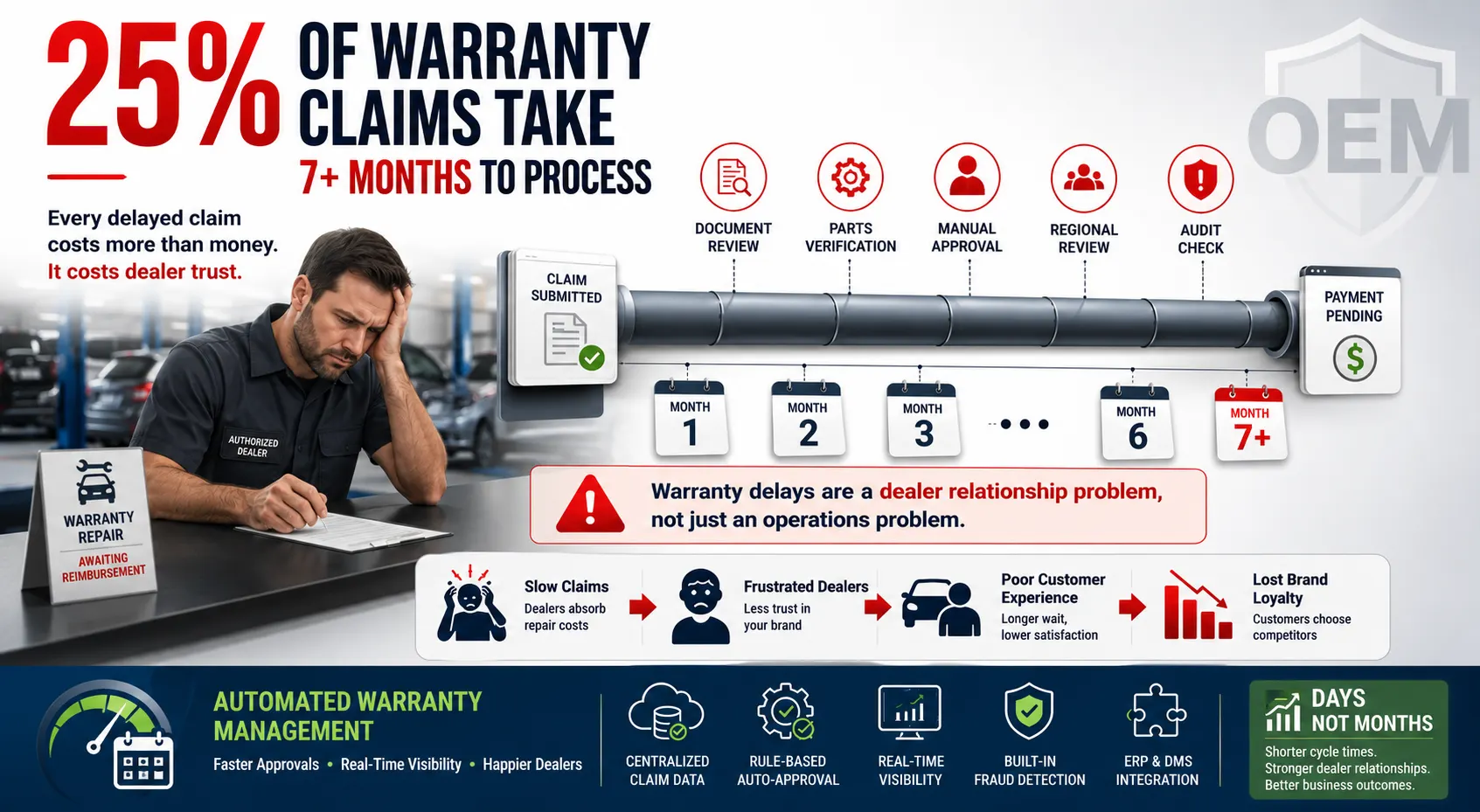
Overview: Most OEM warranty claims take 90+ days to process. Some take 7months. That’s not a process delay. That’s a dealer trust problem. Dealers absorbing repair costs while waiting for reimbursement don’t stay loyal. They steer customers to whoever pays faster. Three things drive most of the delay: • Claim data scattered across disconnected systems • No real-time visibility into where the claim stands • Manual validation on claims that should be auto-approved Automating warranty claim management fixes all three. Claim cycle times drop from months to days. What’s your current average claim-to-reimbursement time?

When a dealer submits a warranty claim and hears nothing for weeks or months they don’t just get frustrated. They start absorbing the repair cost themselves, deprioritizing your brand at the service counter, or quietly steering customers toward competitorswith faster reimbursement cycles.
Acc ssed. That’s not a delay that’s a dealer relationship problem. For OEMs managing hundreds or thousands of authorized service points across regions,multiply that across every delayed claim and the damage compounds fast.
Most OEM warranty processes weren’t designed to be slow. They became slow layered over with manual approvals, disconnected data systems, and claim workflows that haven’t changed since the spreadsheet era. The question isn’t whether your claim process is hurting dealer retention. It’s how much.
What Is Warranty Claim Management for OEMs?
Warranty claim management for OEMs is the end-to-end process of receiving, validating, approving, andreimbursing warranty repair claims submitted by authorized dealers. It covers claim submission, documentation review, fraud checks, parts verification, labor time validation, and final reimbursement typically across a multi-tier dealer network.
When this process is manual or fragmented, every step becomes a bottleneck. When it’s automated and integrated with dealer management systems (DMS) and ERP platforms, claim cycle times drop, fraud exposure decreases, and dealer satisfaction improves measurably.
What Causes Warranty Claims to Take So Long?
Most OEMs don’t have one big problem with claim management they have three overlapping ones that compound each other.
1. Claim Data Lives in Too Many Places
Warranty claims generate data from multiple sources: dealer DMS submissions, parts databases, labor rate tables, service bulletins, historical failure patterns, and customer records. In most OEM environments, this data sits in disconnected systems sometimes even spreadsheets or email threads.
When a claims processor has to manually pull information from five different sources to validate a single claim, they don’t do it faster. They do it slower, with more errors, and more callbacks to the dealer. Every touchpoint that requires manual reconciliation adds days, sometimes weeks, to the cycle.
2. There Is No Single View of the Claim
OEM claims teams often work without visibility into where a claim actually stands in the pipeline. Is itawaiting parts verification? Stuck with a regional approver? Flagged for audit? Dealers have even less visibility. This opacity forces dealers to follow uprepeatedly, which consumes time on both sides and still doesn’t move the claim forward.
In our experience working with OEM service networks, the biggest hidden cost of slow claim processing isn’t the claim value itself it’s the time service staff spend chasing status updates instead of working on the next repair.
3. The Customer Journey Is Fragmented Across the Dealer Channel
When a customer brings in a vehicle or piece of equipment for a warranty repair, their experience is determined entirely by how fast the dealer can get reimbursed. Dealers who wait seven months for reimbursement are not delivering the same customer experience as dealers who get paid in 30 days. Yet the OEM’s brand takes the hit eitherway.
Legacy claim systems often built for a single-country, single-currency, low-volume environment weren’t designed for the distributed, multi-region, multi-language dealer networks most OEMs operate today. The technology hasn’t kept pace with the network.
How Automated Warranty Claim Management Fixes This
Automated warranty claim management doesn’t just speed up the existing process, it restructures it so that delays become the exception, not the rule.
Here’s what changes when OEMs move from manual to automated claim workflows:
• Centralized claim data. All claim-related information, dealer submissions, partsrecords, labor codes, service history, approval status lives in one system.Claims processors see everything they need on one screen without switching between tools or calling the dealer.
• Rule-based auto-approval. Straightforward claims that meet predefined criteria(correct parts, valid labor time, matching service bulletin) are approved automatically without human review. This handles 60–70% of most OEMs’ claimvolume and frees up claims staff to focus on complex or flagged cases.
• Real-timestatus visibility for dealers. Dealers can see exactly where their claim stands at every stage. Fewer follow-up calls. Faster issue resolution. Better dealer satisfaction.
• Frauddetection built into the workflow. Automated systems flag anomalies duplicate claim submissions, labor time outliers, parts claims that don’t match failure codes before they reach the approver. This reduces fraudulent payouts without slowing legitimate claims.
• ERP and DMS integration. Claim data flows directly into existing SAP, Oracle, or Microsoft Dynamics environments. No manual data entry. No reconciliation delays at month-end.
The result, for OEMs that have made this transition, is a claim cycle time measured in days rather than months and a dealer network that trusts the process enough to keep submitting claims rather than absorbing costs silently.
Is Your Current Claim Management System Actually Working?
Before investing in new technology, it’s worth pressure-testing your current system against the questions that matter most for dealer performance:
• Can your claims team see the complete claim lifecycle from submission to reimbursement in a single view?
• Do dealers have real-time visibility into claim status without calling your support line?
• What percentage of your claims require manual intervention? (Industry benchmark: less than 30% for a well-configured system)
• How long does your average claim take from submission to payment? (Target: under 45days)
• Can your system flag potentially fraudulent claims automatically before human review?
If the answers reveal gaps,those gaps translate directly into dealer satisfaction scores, warranty costoverruns, and eventually, brand preference at the service counter.
What OEMs Should Prioritize When Evaluating Claim Management Software
Not all warranty management platforms are built for the complexity of OEM dealer networks. When evaluating options, these are the capabilities that separate genuinely effective platforms from basic claim-logging tools:
• Multi-tier dealer network support. Your platform needs to handle claims across authorized dealers, sub-dealers, and independent service centers each with different labor rates, currency requirements, and approval hierarchies.
• ERP integration depth. Surface-level integration isn’t enough. Look for platforms that write claim data directly back to your ERP in real time, not batch-processed overnight.
• Configurable business rules. Every OEM has different approval logic, warranty terms, and reimbursement policies. Your platform should adapt to your rules not force you to change your process to fit the software.
• Analytics and failure trend reporting. The best warranty systems don’t just process claims they surface patterns. Which parts fail most often? Which dealers have the highest rejection rates? Which failure codes are trending? This data has product quality and field service value far beyond the claim itself.
• Audit trail and compliance documentation. For OEMs in regulated industries, every claim decision needs to be documented and auditable. This is non-negotiable.
Book a demo today to see how Intelli Warranty streamlines warranty claim management across your dealer network.
Frequently Asked Questions: OEM Warranty Claim Management
1. How long should warranty claim processing take for OEMs?
Best-in-class OEM warranty claim processing takes 15 to 45 days from submission to reimbursement. Manualor disconnected systems often push this to 90 to 210 days. The difference is almost entirely driven by automation, data centralization, and real-time visibility — not claim complexity.
2. What is the most common reason warranty claims are rejected?
The most common reasons for warranty claim rejection are incomplete documentation, incorrect labor time codes, parts claims that don’t match the reported failure code, and claims submitted outside the warranty window. Automated systems catch most of these atsubmission, allowing dealers to correct errors before the claim enters the approval queue.
3. How does automated warranty claim management reduce fraud?
Automated systems apply rule-based checks to every claim at submission: duplicate detection, labor time benchmarking against industry standards, parts verification against the vehicle’s service history, and failure code matching. Claims that fall outside expected parameters are flagged for human review before approval not after payment.
4. Can warranty claim management software integrate with our existing ERP?
Yes, purpose-built OEM warranty management platforms integrate with major ERP systems including SAP, Oracle,and Microsoft Dynamics. The key is bidirectional integration claim data should flow into the ERP and ERP data (parts pricing, dealer master records) should flow into the claim system in real time.
5. What is the ROI of automating warranty claim management?
ROI varies by OEM size and claim volume, but common outcomes include 40–60% reduction in average claim cycle time, 25–35% reduction in fraudulent payout exposure, and significant reduction in claims processing headcount relative to volume growth. Dealer satisfaction improvements also reduce churn in the authorized service network.
Slow Claims Are a Business Problem, Not Just an Operations Problem
Warranty claims aren’t just a finance function. They’re a signal to your dealer network about how much you value the relationship. Slow reimbursements mean dealers carry repair costs ontheir balance sheet longer, trust the brand less, and eventually recommend alternatives when customers ask.
OEMs that have moved to automated warranty claim management report faster cycles, lower fraud exposure,and dealers who actually prefer working with them over competitors. Thetechnology exists. The business case is clear. The question is how long you wait to act on it.
How Intellinet Helps OEMs Fix Warranty Claim Processing
Intellinet’s warranty claim management system is built specifically for OEM dealer networks — not adapted from a generic claims platform. It handles multi-tier dealer structures, integrates with major ERP systems, and provides real-time claimvisibility for both OEM claims teams and dealers.
For OEMs carrying high claim volumes across distributed dealer networks, Intellinet reduces average claim cycle time, lowers fraudulent payout exposure, and gives claims staff the centralized view they need to work efficiently.
Ready to see how it works for your network? Request a demo →


Explore More Insights







.webp)


About the Author


Chandra Shekhar
Chandra Shekhar is the Senior Manager, Strategy & Business Development at Intellinet Systems. With over a decade of experience in the automotive industry, Chandra Shekhar has led digital transformation and aftersales strategy initiatives for OEMs across multiple markets. His background combines deep industry knowledge with a practical understanding of how technology can solve real operational challenges. He focuses on making complex ideas clear and relevant for automotive and aftermarket professionals navigating ongoing change.


