

Overview: Web parts catalog software is a web-based platform that helps OEMs organize spare parts information and gives dealers a searchable, up-to-date way to identify and order the right parts. It replaces static PDFs, printed catalogs, and manual lookup processes with structured digital data that dealers can search by model, variant, part number, keyword, or visual diagram. OEMs use this type of software to reduce wrong-part orders, cut returns, speed up parts identification, and give dealers direct visibility into applicability, alternate parts, superseded parts, inventory, and pricing. When connected to ERP and DMS systems, the catalog also helps keep parts data consistent across ordering, inventory, and service workflows. For OEMs evaluating this technology, the key considerations are search accuracy, parts applicability, supersession management, ordering workflows, integration, and the ability to keep dealer networks working from current parts data.

Key Takeaways
- Web parts catalog software replaces static PDFs and printed catalogs with a searchable, web-based system for parts identification and ordering.
- Dealers can look up parts by model, variant, part number, keyword, or visual diagram instead of relying on manual cross-referencing.
- Applicability filtering, alternate parts, and supersession information help dealers avoid ordering the wrong part.
- Real-time catalog updates keep parts information consistent across the entire dealer network.
- ERP and DMS integration connects the parts catalog to inventory, pricing, and order management systems.
- Accurate parts information helps dealers find the right part faster, reduce ordering errors, and improve genuine-parts sales.
What Is Web Parts Catalog Software?
Web parts catalog software is a digital platform that organizes an OEM’s parts data, including part numbers, descriptions, applicability, diagrams, and pricing, into a searchable web-based interface. Dealers, distributors, and service teams use it to find the correct part for a specific vehicle model and variant, then place an order directly through the system.
It typically works by pulling parts data from the OEM’s engineering and inventory records into a structured catalog, then presenting that data through a web interface that dealers can search or browse.
Who Uses It?
- OEM parts and product teams, who maintain and publish catalog data
- Dealer parts counter staff, who look up parts for walk-in and phone orders
- Service advisors and technicians, who confirm parts before starting a repair
- Distributors and regional parts hubs, who order on behalf of smaller dealers
Explore Intelli Catalog to see how OEMs can centralize parts data, improve parts identification, and connect catalog workflows with dealer ordering.
How Does It Differ From Traditional Catalogs?
Traditional parts catalogs are usually static PDFs, printed binders, or spreadsheets sent out on a fixed schedule. Web parts catalog software centralizes parts information, ensuring dealers across the network work from the same current data.
OEMs are moving away from static PDFs and printed catalogs because they can become outdated, are difficult to search, and are less practical to use on phones and tablets at the parts counter. With a web-based catalog, OEMs update the information centrally, and dealers see the changes immediately.
Why Do OEMs Need Web Parts Catalog Software?
OEMs need web parts catalog software because static PDFs and printed catalogs cannot keep pace with frequent part number changes, new models, and regional variants. Dealers are left guessing, calling OEM support teams, or ordering the wrong part, which creates delays, returns, and an inconsistent service experience across the network.
- Static PDF limitations: hard to search, not mobile-friendly, and quickly outdated once a part number changes.
- Printed catalog limitations: expensive to reprint and distribute, and impossible to update in real time
- Difficult part identification: dealers must manually cross-reference model, variant, and part identification
- Outdated parts information: dealers may work from an older version of the catalog without realizing it
- Dealer dependency on OEM support teams: parts counters call or email the OEM to confirm basic part details
- Wrong-part orders: unclear applicability or supersession information leads to avoidable mistakes
- Returns: incorrect orders have to be shipped back, adding cost and delay for both sides
- Service delays: a wrong or unavailable part stalls a repair and extends customer wait times
- Difficulty managing parts changes: tracking supersessions and alternates across many models becomes unmanageable in spreadsheets
- Difficulty distributing updates: getting the latest catalog version to every dealer at the same time is hard with printed or PDF formats
How Does Web Parts Catalog Software Improve Dealer Parts Ordering?
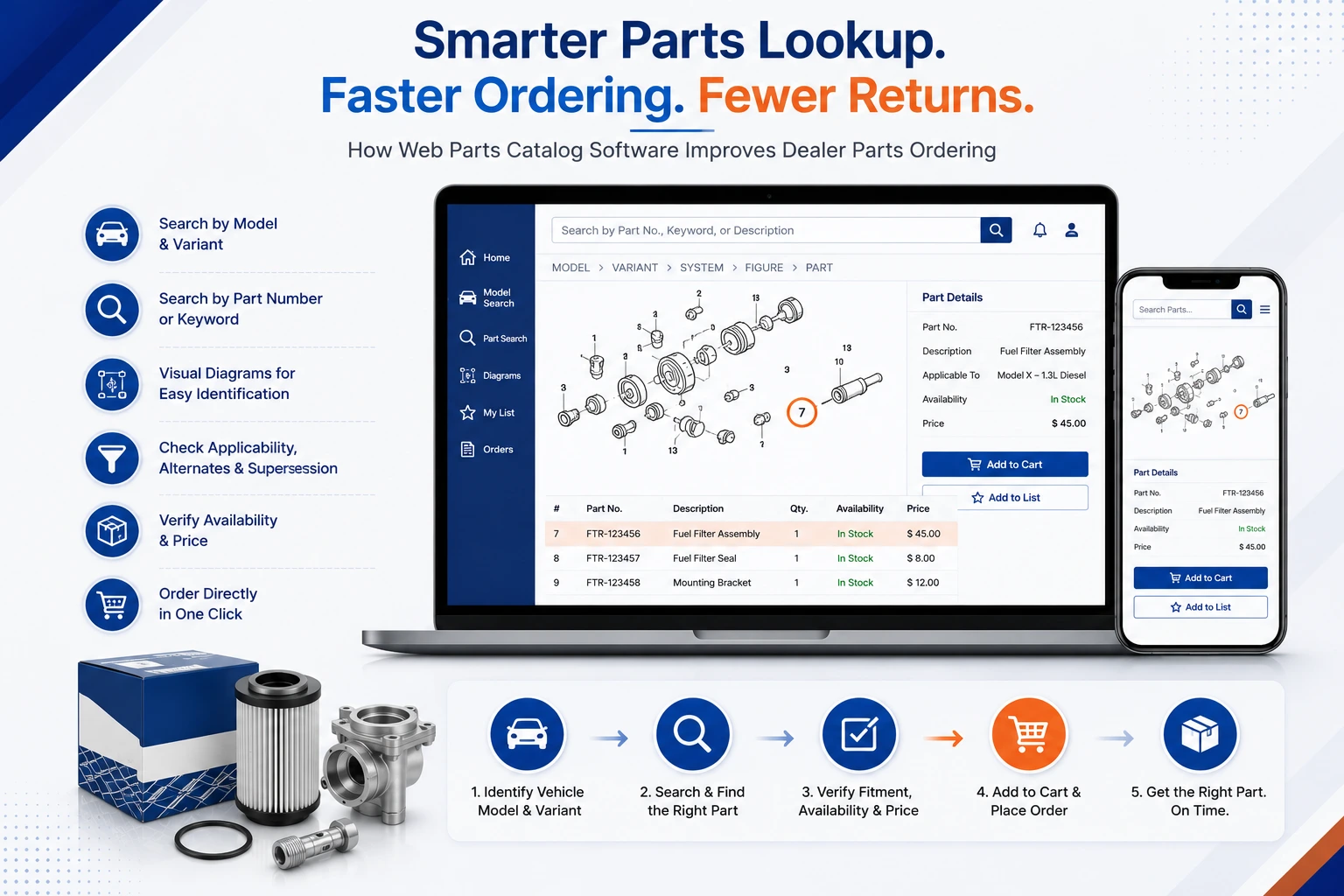
Web parts catalog software improves dealer parts ordering by giving dealers several accurate ways to find a part: browsing by model and variant, viewing exploded diagrams, searching by part number or keyword, and checking applicability, alternates, and supersession data before placing an order. This reduces guesswork and keeps orders aligned with what the vehicle actually needs.
An ICDP study of the independent automotive aftermarket found that the average parts return rate was 9%, with 77% of returned parts attributed to the wrong part being delivered.
A typical dealer parts counter interaction illustrates the value of having accurate, accessible parts information. A technician identifies a vehicle by model and variant, then the parts advisor searches for the needed component.
- Model and variant-based navigation narrows the catalog to only the parts that fit that specific vehicle configuration.
- Visual parts identification and exploded diagrams let staff confirm a part visually instead of relying on a text description alone.
- Part-number search gives an instant match when the number is already known from a repair order or old part.
- Keyword search helps when only a general description of the part is available.
- Applicability filtering removes parts that do not fit the vehicle's specific configuration.
- Alternate parts and supersession information shows the current, correct part when the original number has changed.
- Quantity and pricing information lets the dealer confirm cost and order size before submitting.
- Online ordering allows the dealer to place the order directly from the same screen used for identification.
Together, these steps create a clear chain: accurate parts identification leads to better parts selection, which leads to fewer wrong orders, fewer returns, and faster service for the end customer.
What Are the Key Features of Web Parts Catalog Software?
The core features of web parts catalog software include visual parts identification, model and variant filtering, part number and keyword search, applicability and supersession data, real-time updates, dealer-specific pricing, inventory visibility, and integration with ERP and DMS systems. Together, these let dealers self-serve accurate parts information instead of contacting OEM support.
- Visual parts identification: lets dealers confirm a part by sight, reducing description-based errors
- Model and variant filtering: narrows results to parts that actually fit the vehicle in front of the technician
- Part number search: gives an instant result when the number is already known
- Keyword search: supports lookup when only a general description is available
- Parts applicability: confirms whether a part fits a specific configuration before ordering
- Alternate parts: shows equivalent options when the original part is unavailable
- Superseded parts: points to the current replacement when a part number has changed
- Real-time catalog updates: keep every dealer working from the same, current data
- Dealer-specific pricing: shows each dealer the pricing that applies to their account
- Inventory visibility: tells the dealer whether a part is in stock before they order it
- ERP integration: keeps catalog data aligned with the OEM's core business records
- DMS integration: connects parts lookup to the dealer's own operational system
- Mobile and web accessibility: supports lookup from a service bay, parts counter, or the field
- Online ordering: lets the dealer submit an order the moment the correct part is confirmed
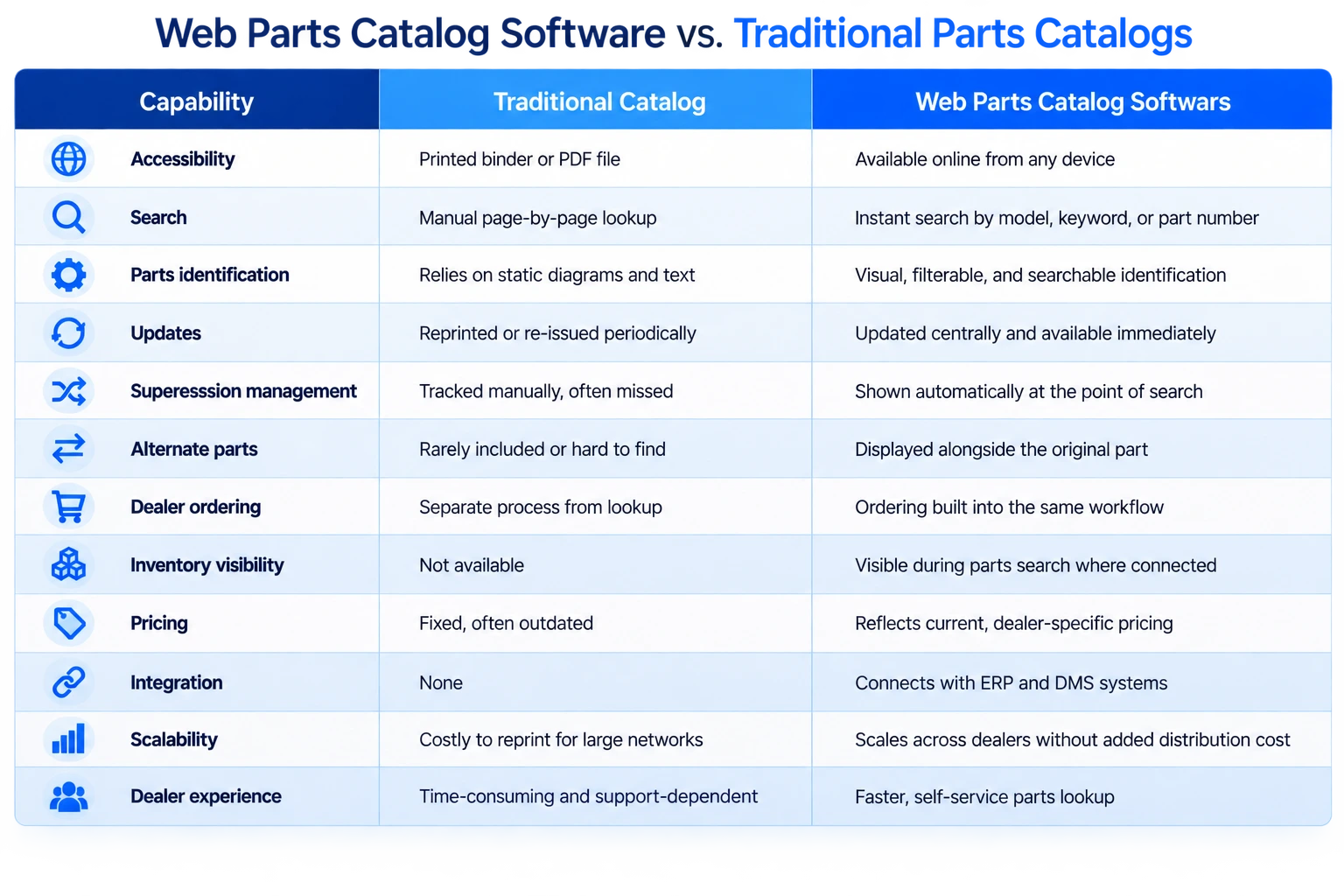
Web Parts Catalog Software vs. Traditional Parts Catalogs
The key difference between web-based and traditional parts catalogs is how information is managed and delivered. Paper and PDF catalogs require manual updates and redistribution, while web catalogs support centralized updates and integration with search, ordering, inventory, and pricing systems.
How Do OEMs Benefit From a Web-Based Parts Catalog?
OEMs benefit from a web-based parts catalog through fewer wrong-part orders, reduced returns, faster dealer response, and lower support workload, because dealers work from the same verified parts information the OEM maintains centrally rather than relying on memory, outdated documents, or phone calls to a support desk.
- Fewer Wrong-Part Orders and Returns
When applicability and supersession data are visible at the point of search, dealers are less likely to select the wrong part. Fewer wrong orders naturally means fewer returns to process.
- Faster Parts Identification and Dealer Response
Searchable catalogs shorten the path from vehicle identification to a confirmed part, helping dealers respond faster to service and ordering requests.
- Lower Support Workload
As dealers become able to self-serve parts information, OEM support teams field fewer basic lookup questions and can focus on more complex cases.
- Better Parts Availability Visibility and Genuine-Parts Adoption
Where the catalog is connected to inventory, dealers can see what is actually in stock before ordering. Easier access to accurate, genuine parts information also makes it more likely dealers choose OEM parts over aftermarket alternatives, which supports aftermarket revenue and a more consistent dealer experience.
How Does Web Parts Catalog Software Support After-Sales Service?
Web parts catalog software supports after-sales service by giving service teams and dealers faster access to the exact parts a repair requires, which shortens repair turnaround, reduces customer wait times, and keeps warranty and service workflows moving without delays caused by incorrect or unavailable parts information.
The average age of vehicles on U.S. roads reached 12.8 years in 2025, according to S&P Global Mobility, which means more vehicles are now in the age range where service and parts needs are highest. As dealer service volumes grow with this trend, accurate and fast parts identification becomes more important to keeping repair operations on schedule.
- Dealer service operations: technicians can confirm the correct part before a repair begins instead of after
- Repair turnaround: less time spent identifying parts means repairs move through the bay faster
- Parts availability: visibility into stock helps service advisors set realistic timelines for customers
- Customer wait times: fewer delays caused by wrong or unavailable parts
- Dealer productivity: parts staff spend less time on manual lookup and more time on customer-facing work
- Warranty and service processes: accurate part numbers support cleaner warranty claim documentation
- Customer experience: faster, more predictable service builds trust in the dealer and the OEM brand
How Does Web Parts Catalog Software Integrate With ERP and DMS?
Web parts catalog software integrates with ERP and DMS systems so that parts data such as inventory levels, pricing, and order status stays consistent between the catalog, the OEM's back-office systems, and the dealer's ordering workflow. Without integration, dealers may see parts information that does not match actual stock or pricing.
- ERP integration keeps catalog part numbers, descriptions, and pricing aligned with the OEM's core system of record
- SAP integration, where relevant, connects the catalog to an OEM's existing SAP-based operations without requiring a separate data process
- DMS integration connects parts lookup and ordering to the dealer's own day-to-day operational system
- Inventory system integration shows dealers realistic stock positions instead of static or assumed availability.
- Pricing system integration reflects current, dealer-specific pricing rather than a fixed catalog price.
- Order management integration routes a confirmed order directly into the OEM's fulfillment process.
- Real-time or controlled synchronization determines how quickly changes in one system appear in another, depending on the OEM's requirements.
The goal of integration is consistency: ensuring the parts catalog and the dealer’s own system show the same pricing and inventory information. The right level of integration depends on each OEM's existing technology environment and should be confirmed directly with a vendor during evaluation.
How Intelli Catalog Supports OEM Parts Operations?
Intelli Catalog is a web-based, illustrated electronic parts catalog built for OEMs that need dealers to identify and order parts accurately. It organizes parts data by OEM, model, and variant, while allowing dealers to search by part number or keywords, check part applicability, and identify alternate or superseded parts through a centralized web-based platform.
For OEMs working through the requirements covered in this article, Intelli Catalog is relevant to a few specific needs:
- Organizing digital parts information: Intelli Catalog centralizes parts data in a structured, searchable format instead of leaving it spread across PDFs or spreadsheets.
- Helping dealers identify the correct parts: visual, illustrated parts views support identification alongside text-based search.
- Navigating parts by OEM, model, and variant: dealers can narrow results to the exact vehicle configuration they are working on.
- Searching by part number and keyword: dealers can look up a part using whichever information they already have.
- Managing applicable, alternate, and superseded parts: the catalog is designed to reflect which parts apply, which alternates exist, and which numbers have been replaced.
- Supporting parts ordering workflows: like other web parts catalog platforms, Intelli Catalog is built to work alongside an OEM’s existing ERP and dealer systems. Specific integration scope and supported systems should be confirmed directly with the vendor for each OEM’s environment.
Intelli Catalog is one option among several web parts catalog software platforms available to OEMs, and it is best evaluated against the same checklist used for any vendor in this category.
Conclusion
OEMs that still rely on static PDFs or printed catalogs put their dealers in a position where parts identification depends on guesswork, manual cross-referencing, and calls to OEM support. Web parts catalog software gives dealers a centralized, searchable source for parts information, allowing them to find the right part by model, variant, part number, or keyword and verify applicability, alternatives, and superseded parts before placing an order. The result is fewer wrong-part orders, fewer returns, and faster service for the end customer. Platforms such as Intelli Catalog reflect how this category of software is applied in practice, organizing parts data and supporting dealer identification and ordering workflows. For OEMs evaluating how to modernize dealer parts operations, accurate, accessible parts information is one of the clearest starting points.
Book a demo to see how Intelli Catalog can help your organization simplify parts identification, improve dealer parts ordering, and manage digital parts information.
Frequently Asked Questions
What is web parts catalog software?
Web parts catalog software is a web-based platform that organizes an OEM's parts data so dealers can search for parts by model, variant, part number, or keyword. It replaces static PDFs and printed catalogs, giving dealers a faster, centrally updated way to identify and order the correct parts.
How does web parts catalog software help OEM dealers?
It helps dealers find the correct part faster by combining visual identification, applicability filtering, and search tools in one system. This reduces wrong-part orders, cuts down on calls to OEM support teams, and lets dealers move directly from identifying a part to ordering it.
What is the difference between a digital parts catalog and a web parts catalog?
A digital parts catalog can refer to any electronic version of a catalog, including a downloadable PDF. A web parts catalog specifically runs online, updates centrally, and lets dealers search and order in real time rather than working from a fixed file that can go out of date.
Can web parts catalog software integrate with a DMS or ERP?
Yes, most web parts catalog platforms are built to integrate with ERP and DMS systems, which keeps inventory, pricing, and order data consistent across systems. The exact integration options depend on the vendor and the OEM's existing technology environment, so this should be confirmed during evaluation.
How does a web parts catalog reduce wrong-part orders?
It reduces wrong-part orders by showing applicability, alternate parts, and supersession information at the point of search, so dealers see whether a part actually fits before ordering it. This replaces guesswork or outdated documentation with current, verified parts data.


Explore More Insights









.webp)


About the Author


Chandra Shekhar
Chandra Shekhar is the Senior Manager, Strategy & Business Development at Intellinet Systems. With over a decade of experience in the automotive industry, Chandra Shekhar has led digital transformation and aftersales strategy initiatives for OEMs across multiple markets. His background combines deep industry knowledge with a practical understanding of how technology can solve real operational challenges. He focuses on making complex ideas clear and relevant for automotive and aftermarket professionals navigating ongoing change.


