

Overview: Automated warranty processing is the use of software to manage warranty claims from submission through payment, replacing manual review, spreadsheets, and paper-based approval chains. For OEMs, dealers, and customers, it means faster claim resolution, fewer processing errors, and greater transparency into warranty costs. This article explains how automated warranty processing works, why manual claim handling still costs OEMs money, and what capabilities a modern warranty automation platform should include. It also introduces the key functions: claim validation, fraud detection, and workflow automation that support an efficient warranty process.

Key Takeaways:
- Automated warranty processing replaces manual claim review with rules-based validation, tracking, and payment workflows.
- Warranty claim automation shortens claim cycle time by removing manual data entry and email-based approvals.
- Warranty claim validation checks claims against service history, part usage, and coverage terms before approval.
- Warranty fraud detection uses pattern analysis across dealers and part numbers to catch abuse that individual reviewers miss.
- Warranty workflow automation streamlines claim submission, routing, parts returns, and supplier recovery into a single, auditable process.
- Platforms such as Intelli Warranty combine these capabilities for OEMs managing multi-brand, multi-region dealer networks.
Automate claim validation, approvals, fraud detection, and supplier recovery with Intelli Warranty. Book a personalized demo to see how it works.
What Is Automated Warranty Processing?
As warranty claim volumes grow, manual reviews, spreadsheets, and email approvals become difficult to manage consistently. Automated warranty processing replaces those disconnected steps with a single software-driven workflow that validates, routes, and tracks claims from submission through reimbursement.
In a traditional setup, a dealer submits a claim on paper or through a basic form, and someone at the OEM manually checks it against warranty terms, service history, and part usage before approving payment. This works at low volume; however, it breaks down once an OEM manages thousands of dealers, multiple brands, or products sold across regions with different warranty terms.
Automated warranty processing does not remove human judgement from the process. It removes repetitive, rules-based work so people can focus on exceptions, disputes, and supplier negotiations.
OEMs typically reach this point when claim volumes exceed what small warranty teams can review manually, dealers apply warranty policies inconsistently across regions, or finance teams lack a real-time view of warranty liabilities without consolidating data from multiple systems.
How Automated Warranty Processing Works
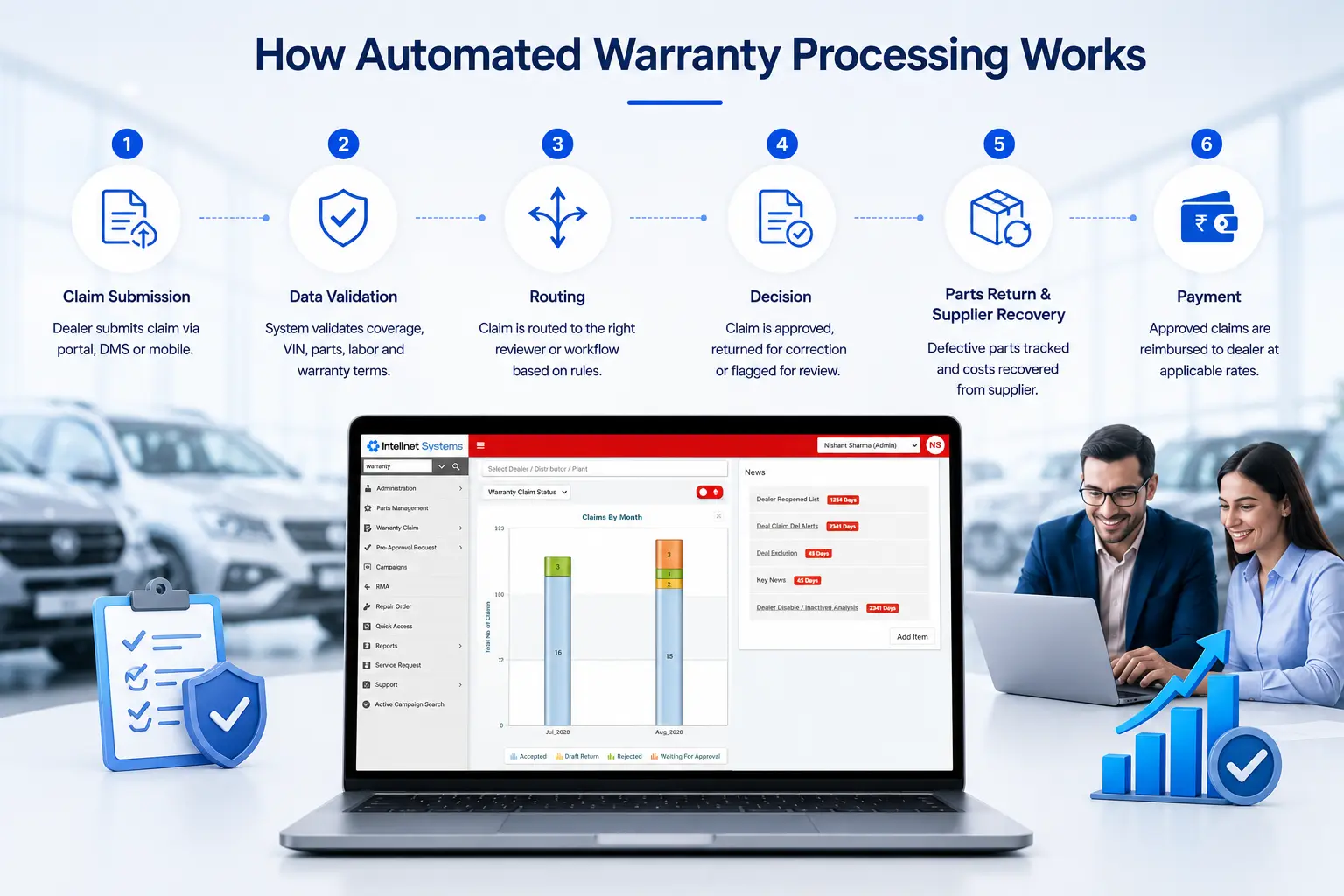
Every warranty claim moves through the same core stages: submission, validation, routing, approval, parts return, supplier recovery, and reimbursement. Automation unifies these steps into a single, continuous workflow instead of managing them as separate manual tasks.
- Claim submission: the dealer or technician files a claim from a mobile device, DMS, or web portal
- Data validation: the system checks the claim against VIN history, part numbers, labor codes, and coverage terms
- Routing: the claim moves automatically to the correct reviewer, job code, or region based on preset rules
- Decision: the claim is approved, returned for correction, or flagged for manual review
- Parts return and supplier recovery: defective parts are tracked back to the supplier for cost recovery
- Payment: approved claims are reimbursed to the dealer at the applicable rate
Why Manual Warranty Processing Still Costs OEMs Money
Manual warranty processing costs OEMs through claim errors, delayed reimbursement, and warranty fraud that is hard to spot without automated analysis. In 2025, US-based manufacturers paid $30.37 billion in warranty claims, a 4% increase from the prior year, according to Warranty Week's Annual Product Warranty Report, and the average claims rate reached 1.30% of product revenue, per Warranty Week's tracking of over 1,400 manufacturers.
Much of this cost sits in the process itself, not just the underlying repair. Every manual data entry step is a chance for an error. Every email-based approval is a delay dealers notice and remember. Claims that would have been caught by a validation rule instead get paid, corrected later, or disputed after the fact, and none of those outcomes are cheap.
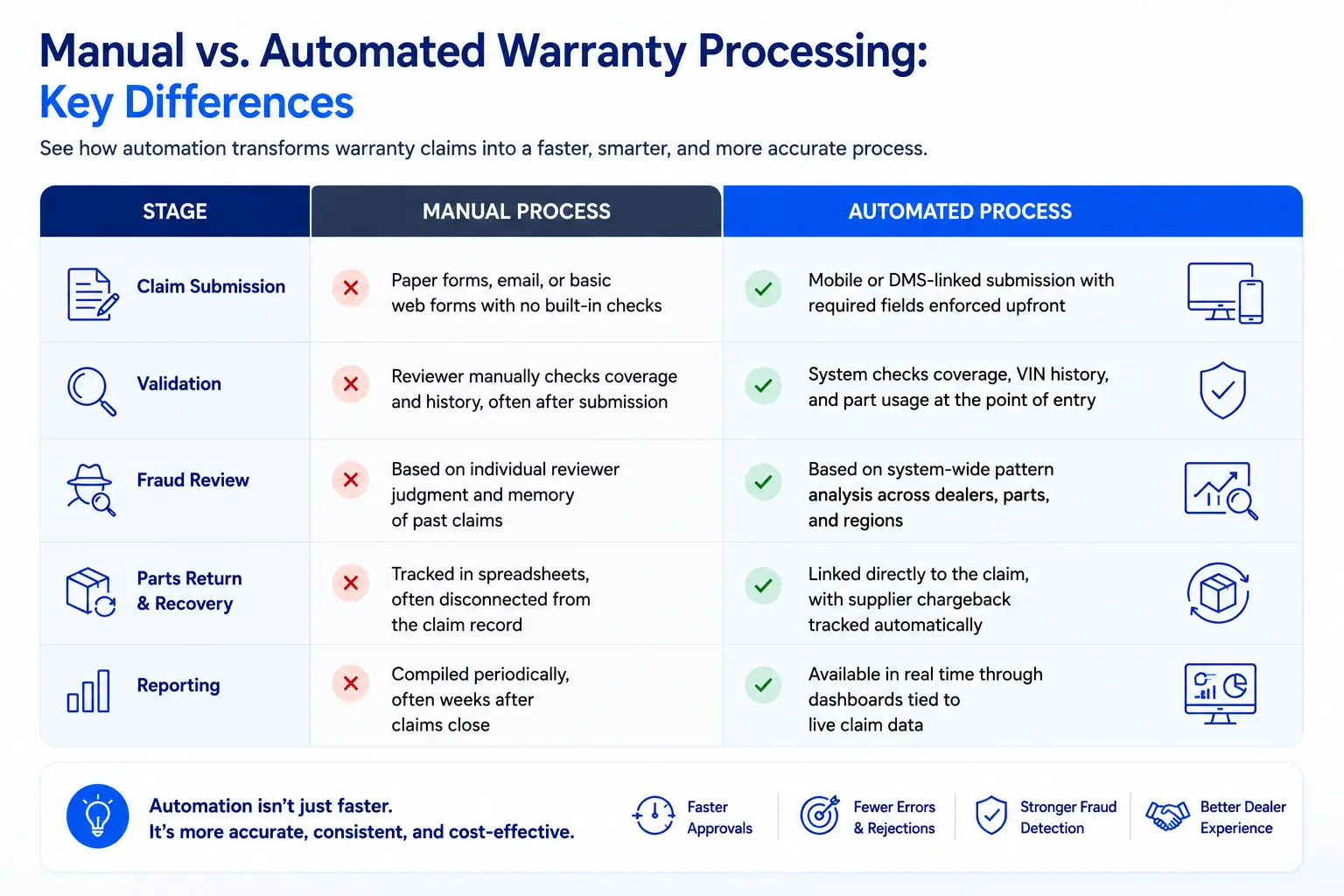
Manual vs. Automated Warranty Processing: Key Differences
The clearest way to see the case for automation is to line up the two approaches stage by stage. The gap is not just speed; it is consistency: an automated system applies the same validation rule to every claim, every time, regardless of who submits it or when.
Core Components of a Warranty Claim Automation System
A warranty claim automation system typically includes claim intake, validation rules, fraud detection, routing logic, parts return tracking, supplier recovery, payment processing, and a reporting dashboard. Together, these modules turn a linear paper process into a connected system that OEMs, dealers, and suppliers can all see into.
- Claim intake and mobile submission
- Rules-based validation against coverage, service history, and part usage
- Fraud detection and anomaly flagging by dealer, part, or region
- Automated routing by job code, brand or geography
- Parts returns and core tracking
- Supplier recovery and chargeback management
- Payment processing at claim-specific labor and parts rates
- Reporting and audit trail across the full claim lifecycle
OEM warranty management system such as Intelli Warranty bring these modules into a single system, rather than requiring OEMs to stitch together separate tools for validation, fraud screening, and supplier recovery.
Business Benefits of Automated Warranty Claims Processing for Dealers and Customers

Dealers benefit from faster reimbursements, fewer rejected claims, and real-time visibility into claim status. Automated validation reduces rework by catching errors before claims are submitted.
Customers benefit from quicker repairs, fewer delays caused by claim corrections, and clearer communication throughout the warranty process.
OEMs reduce administrative costs, improve claim accuracy, detect fraud earlier, and gain consistent warranty processes across dealer networks.
- Faster claim turnaround: dealers get paid sooner without following up by phone or email
- Fewer claim rejections: validation catches missing information before submission, not after
- Lower administrative cost: less manual entry means less headcount tied to routine claim review
- Better fraud control: dealer- and part-level pattern analysis flags abuse earlier
- Improved dealer trust: transparent status tracking replaces black-box claim review
- Cleaner data for product decisions: claim data feeds back into engineering and quality teams
- Consistent claims policy across regions and brands, which reduces disputes
Warranty Claim Validation: How Automation Reduces Errors and Delays
The fastest way to reduce claim errors is to prevent invalid claims from entering the approval workflow. Automated warranty claim validation verifies warranty coverage, service history, labor standards, and parts usage at the point of submission, eliminating many errors before manual review is ever required.
Without automated validation, these checks happen manually, one claim at a time, often after the claim has already been submitted and queued for review. That is where delays build up. Automated validation moves the check to the point of submission, so dealers know within minutes, not days, whether a claim is complete.
Warranty Fraud Detection: Finding Patterns Humans Miss
Warranty fraud detection uses automated pattern analysis to compare claim rates, parts usage, and repair frequency across dealers, technicians, and regions, flagging anomalies that would be difficult to detect through individual claim reviews. It shifts fraud review from case-by-case judgment to statistical pattern recognition.
Fraud rarely appears obvious when claims are reviewed individually. A slightly elevated claim rate at one dealer or recurring claims involving the same part number can go unnoticed without system-wide visibility. Automation continuously analyzes these dealer-level and part-level patterns, flagging anomalies that warrant further investigation.
Warranty Workflow Automation: Connecting Submission to Supplier Recovery
Warranty workflow automation links every stage of the claim lifecycle- submission, validation, approval, parts return, supplier recovery, and payment- into one system instead of separate tools. This removes the handoff delays that occur when claim data must be re-entered at each stage.
- Claim submission and intake
- Validation and routing
- Approval or escalation
- Parts return and core tracking
- Supplier chargeback and recovery
- Reimbursement and reporting
Conclusion
Automated warranty processing turns a fragmented, manual claims cycle into a connected workflow that OEMs, dealers, and customers can all see. The core pieces- warranty claim validation, warranty fraud detection, and warranty workflow automation- work together to reduce errors, cut cycle times, and control the cost of warranty payouts. With US manufacturers paying over $30 billion in warranty claims in 2025 alone, staying on manual, spreadsheet-driven processes is not a neutral choice. It shows up in slower dealer payments, missed fraud patterns, and higher administrative overhead.
For OEMs evaluating a move to automation, the decision comes down to whether a platform can handle validation, fraud detection, and supplier recovery as one connected system rather than a set of disconnected tools.
Platforms such as Intelli Warranty are built for this, giving OEMs a single system for claims processing and supplier recovery across multi-brand, multi-region dealer networks.
Ready to automate your warranty claims process?
Schedule a free demo today to see how Intelli Warranty helps OEMs reduce claim processing time, improve validation accuracy, detect fraud, and accelerate dealer reimbursements.
FAQ
What is automated warranty processing?
Automated warranty processing is software-based handling of warranty claims, covering submission, validation, approval, parts return, supplier recovery, and payment, instead of manual review. It reduces errors, speeds up reimbursement, and creates an audit trail for every claim.
How does warranty claim automation reduce fraud?
Warranty claim automation applies pattern analysis across dealers, parts, and regions, flagging anomalies such as unusually high claim rates or repeated claims on the same part number. This catches patterns that a single reviewer working claim by claim would likely miss.
How long does it take to implement a warranty management system?
Timelines vary by OEM size and dealer network complexity, but most implementations move through process mapping, rule configuration, data migration, and a dealer pilot before full rollout. A phased rollout with a pilot group typically reduces risk and rework.
Can automated warranty processing integrate with an existing DMS or ERP?
Most modern warranty management platforms integrate with existing dealer management systems (DMS), ERP platforms, and parts catalogs through APIs, allowing OEMs to automate warranty claims without replacing their existing systems.
Does automation eliminate the need for manual claim review?
No. Automation handles rules-based validation and routing, but claims flagged as exceptions, disputes, or potential fraud still go to a human reviewer. Automation reduces the volume of routine review, not the need for judgment on edge cases.


Explore More Insights








.webp)


About the Author


Chandra Shekhar
Chandra Shekhar is the Senior Manager, Strategy & Business Development at Intellinet Systems. With over a decade of experience in the automotive industry, Chandra Shekhar has led digital transformation and aftersales strategy initiatives for OEMs across multiple markets. His background combines deep industry knowledge with a practical understanding of how technology can solve real operational challenges. He focuses on making complex ideas clear and relevant for automotive and aftermarket professionals navigating ongoing change.


