


Key Takeaways
- Construction OEMs can face parts management failures related to demand forecasting, catalog accuracy, inventory visibility, manual processes, dealer collaboration, and logistics.
- Poor parts management can contribute to equipment downtime, higher operating costs, lost aftermarket revenue, and dealer network friction.
- Accurate parts catalogs and real-time inventory visibility help dealers identify, order, and replenish the right parts more efficiently.
- Automation can reduce manual errors and improve coordination between OEMs, dealers, suppliers, and technicians.
- AI-powered capabilities such as demand forecasting, natural-language parts search, and visual search can further support spare parts management.
- A connected spare parts management platform can help construction OEMs manage parts data, inventory, ordering, and dealer operations from a centralized system.
Small failures in aftermarket operations often cause big field problems. Spare parts management operations in the construction equipment industry are quite similar. According to statistics, parts unavailability can lead to 20-40% of equipment downtime, and although OEMs put in their best efforts to create a fail-proof network of dealers and set up effective cataloging systems, some gaps still exist that leave entire operations vulnerable to risks and start a chain of losses and ineffectiveness in the long run.
Most of the time, neither OEMs nor dealers are at fault. However, with a proactive mindset and holistic approach, both parties can be better prepared to overcome any uncertainties and prevent operational failures. This resilience can be attained with the help of an all-encompassing spare parts management strategy that utilizes digital capabilities along with modern AI technologies.
In this blog, we have covered major part management failures, along with the recommended solutions to fix them.
Why Does Effective Parts Management Matter for Construction OEMs?
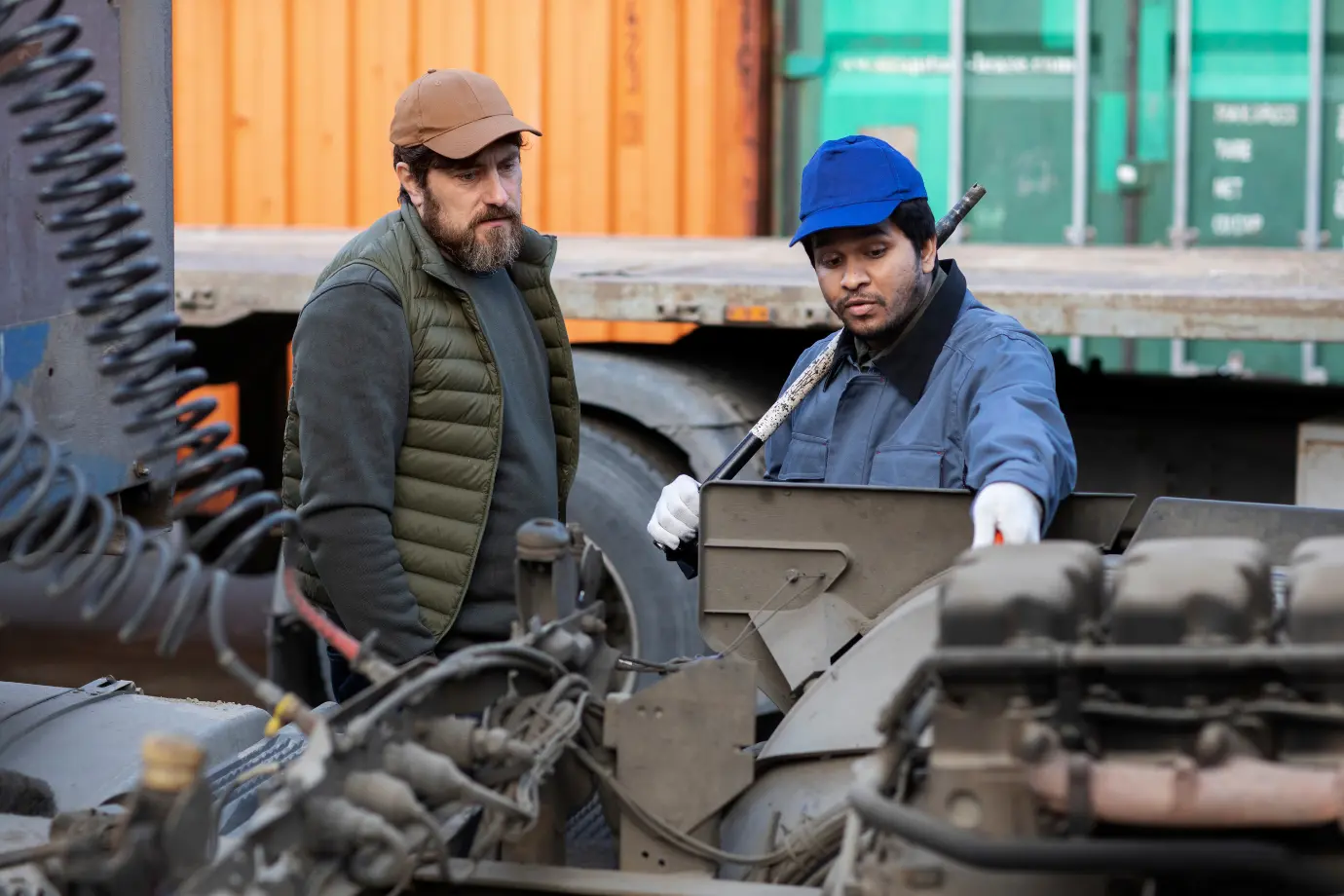
Before moving on to the failure, let’s take a brief overview of why OEMs and dealers need to rethink their parts management operations. A well-sought and effective spare parts management strategy can have the following benefits:
1. Controlled After-Service Costs
After-service costs can eat away at a major portion of an OEM’s profit. Part replacement, whether because of component breakdown or damage, adds direct parts costs as well as logistics, labor, administrative, and dealer-related expenses. Better parts planning and inventory management can help OEMs control these costs while keeping equipment available for customers.
2. Maintains Operational Efficiency
Unexpected maintenance requirements or equipment breakdowns can create operational silos and increase administrative work, labor requirements, and communication overhead. This means that where equipment maintenance would have taken 4 days, it will now take 8 days, and dealers will have to invest in more working hours. On one side, OEMs plan to streamline spare parts management operations, and on the other side, the entire work efficiency at the dealer takes continuous hits.
3. Improves Customer Satisfaction Levels
Providing reliable after-sales service is a major contributor to any construction OEM’s long-term success. It is an investment that generates more ROI than multiple marketing campaigns. To remain sustainable, ensuring high customer satisfaction levels is important. In the construction industry, negative word of mouth from high-profile clients can have a long-term impact on an OEM’s reputation.
Critical Failures to Avoid in Parts Management

Construction OEMs can leverage the aforementioned benefits and keep parts management operations streamlined by identifying and resolving the following failures.
1. Poor Demand Forecasting and Seasonal Planning
In case you are dealing with high logistic costs, inventory understocking, and low production, a critical failure is in your demand forecasting. With adequate demand forecasting, OEMs can analyze previous sales records, restocking patterns, and seasonal fluctuations to predict demand. With this, they can avoid any understocking or overstocking problems, reduce logistic costs, and provide faster repair times.
2. Inaccurate or Delayed Parts Catalog Updates
At times, dealers find discrepancies in the spare parts mentioned in the catalog vs what’s actually present in the equipment. This happens because of inaccurate entries or delayed updates. When handling complex catalogs, it is possible for similar spare parts to have multiple part numbers. This is known as part number proliferation and often leads to confusion. Another reason behind the inaccuracy is value engineering. When OEMs introduce engineering changes to a spare part, they should also update its version history so that technicians can find the right part.
3. Insufficient Visibility Across the Supply Chain
Order delays and miscommunication problems also happen because of siloes in which the OEM, dealers, and suppliers don’t have visibility across the supply chain. They continue to work in isolation because they lack real-time visibility into inventory, engineering changes, claims processing, and production. The end result is delays that cannot be fixed easily and will require a systematic change for resolution.
4. Overreliance on Manual Processes
If dealers are ordering incorrect parts or OEM teams are experiencing frequent manual errors, there’s a clear need for automation. However, even with automated operations, disconnected tools that do not communicate with each other can lead to manual errors. While some errors can be resolved quickly, others require constant back and forth. What makes these errors worse is that they are difficult to identify until the damage is already done.
5. Inefficient Inventory Management
Inventory understocking and overstocking are only a few of the problems that OEMs face because of poor inventory management. Others include demand forecasting problems, added logistic troubles, administrative challenges, and inaccurate profit estimations. With streamlined inventory, OEMs can avoid these problems. OEMs should look to automate inventory operations with accurate inventory level reports, and receive automated stock-replenishment alerts from dealers.
6. Lack of Collaboration with Dealers
Delays in repairs, servicing, and disjointed operations are key indicators that OEMs need to involve themselves more in dealer operations. This can be particularly challenging with dealers in distant locations, where regular monitoring is more difficult. While dealer audits can help identify such dealers, the root-level solution is integrating shared dashboards and strengthening service-level agreements (SLAs), especially with disconnected or underperforming dealers.
7. Poor Logistics and Last-Mile Connection
Spare parts management problems often lead to shipping delays, inaccurate ETAs, no rush-order workflows, and broken connections with last-mile dealers. Poor logistics become a major challenge in after-sales service and trigger other problems, such as increased equipment downtime, increased repair costs, customer frustrations, and even revenue loss.
Key Impact of These Failures on Construction OEMs

To sum it up, the aforementioned failures have the following adverse impact on construction industry OEMs:
1. Lost Aftermarket Revenue
The most adverse impact that OEMs want to avoid is a drop in revenue generation. Frequent stockouts compel dealers and customers to order from third-party suppliers and unauthorized dealers, leading to a direct drop in aftermarket sales. Moreover, this affects the overall demand for genuine parts in the market, creating market fluctuations.
Another way poor part management leads to revenue loss is by leading to overstocking problems and eventually creating an excess of slow-moving parts, which are nothing but dead stock. These parts are not going to sell, will sit on the shelf, occupy warehouse space, and lead to wastage.
Even unnecessary delays and customer frustration force customers to cancel jobs, and aftermarket revenue again suffers.
2. Lower Customer Retention Rates
Good after-sales service is the key to ensuring higher customer retention rates and increasing brand loyalty. When customers face challenges like equipment downtime or costly repairs because of unavailable parts, dealers often have to take the heat and face customer frustrations. Where OEMs expect good word of mouth, they have to face negative ones, which discourages future prospects as well.
Likewise, OEMs with no proper telematics system fail to detect critical parts breakdown, and this is when equipment customers lose trust in OEMs. At times, even large B2B contracts fail or aren’t renewed by the client after facing a delay in part replacement.
When customers upload negative ratings and reviews online, it becomes difficult for PR teams and ORM teams to help the OEM recover from PR crises.
3. Dealer Network Friction
In part management problems, it is often difficult to identify which party is at fault, whether the OEM or the dealer. This makes it difficult to hold accountability and leads to dealer relationship friction. Dealers lose confidence in OEM support and stop complying with OEM policies and regulations. This leads to operational inefficiencies in which OEMs can barely control dealer operations.
How Can Construction OEMs Fix These Parts Management Failures?

There are two approaches to refine this problem. The first one is conducting a manual analysis across all operations, figuring out roadblocks, and preparing a strategy to tackle every challenge. This approach is slow, time-consuming, and does not guarantee any results.
The other approach is bringing automation to their processes with the help of a dedicated spare parts management software. In today’s world, OEMs no longer need to opt for costly custom development and can instead invest in an off-the-shelf solution. This approach is more cost-effective, time-saving, and provides some assurance in results.
Moreover, with AI revolutionizing global industries, it is best to opt for an AI-powered solution that helps remove all complexities.
How Does Intelli Catalog Support Construction OEMs
Intelli Catalog is the world’s most advanced AI-powered solution that comes with all essential functionalities right out of the box. It helps OEMs improve their spare parts management by helping them create and distribute an Electronic Parts Catalog (EPC) that can be easily accessed from anywhere and helps dealers remove part identification issues, manage ordering, and timely communicate with OEMs. Even OEMs can check dealer inventory levels and replenish stocks faster with demand forecasting.
The best part, Intelli Catalog is available with two engagement models, which are an annual subscription and a monthly pay-per-user. OEMs can select a model as per their requirements to ensure their aftermarket budget or technology budgets don’t go overboard.
Let’s take a closer look at more features of Intelli Catalog.
Key Features of Intelli Catalog
- AI-Demand Forecasting: Intelli Catalog monitors part ordering history at all dealers, along with several other factors such as seasonal fluctuations, regional demand, consumer purchasing patterns, etc., to forecast accurate spare parts demand and help OEMs in restocking inventory across their entire dealer network.
- Real-Time Inventory Visibility: The OEM can also access dealer inventory levels and contact them to send reminders for restocking.
- AI-Part Search: During equipment servicing or repair, technicians can interact with the catalog using their natural language. They can ask spare part-related queries, order the system to show all parts for a particular equipment, and ask all other doubts, all using their voice in their native language.
- AI-Visual Search: Along with using voice search, technicians can use their smartphone cameras to search for replacement parts in the catalog.
- Multiple Search Options: Other part search options that Intelli Catalog provides are VIN search, part number search, model search, and figure search.
- 2D/3D Illustrations Support: For visualization, Intelli Catalog supports 2D/3D part illustrations. It even provides broader support for 3D models by supporting all popular formats, including .STEP, .OBJ, .3DM, .3DS, .3MF, .AMF, .BIM, .BREP, .DAE, and more.
- Part Hotspotting and Highlighting: Technicians can even drill down into 2D and 3D figures and quickly figure out the replacement part with advanced highlighting and hotspotting features.
- Order Management and Tracking Module: After figuring out the right part, technicians can directly place orders with the OEM right on the system and track them as well with the order management and tracking module.
- IntelliGPT: Dealers can also interact with the system and extract the required information using chat. They can ask for spare part data, pricing, inventory levels, and even other doubts as well.
- ERP Integration: To provide quick onboarding and deployment, Intelli Catalog supports all popular ERPs, DMs, PLM, payment gateways, and other business tools.
Conclusion
The construction industry is saturated with multiple players. Their clients, such as construction companies, mining companies, contractors, and government agencies, care more about the quality and longevity of the equipment instead of the brand. Thus, ensuring timely and fast servicing is absolutely essential in the construction industry. This is not possible without effective part management.
In the modern world, AI-enabled technology can help OEMs address many of these parts management challenges. AI can help OEMs with demand forecasting and replenishing inventory levels in time. It can also help dealers in part identification and ensure correct ordering every time. Likewise, technicians can also find relevant information on the system and reduce repair times.
For resolving all part management problems and avoiding the above-mentioned failures, we recommend booking a free one-to-one demo session of Intelli Catalog, the industry’s most advanced AI-powered spare parts management software.
Frequently Asked Questions (FAQs)
1. What are some common spare parts management problems for the construction OEMs?
Answer: Construction OEMs face several spare parts management troubles, including wrong part identification and ordering, longer shipping times, costly equipment repairs, repair delays, poor demand forecasting, understocking, overstocking, dealer friction, and more.
2. How can OEMs in the construction industry refine their spare parts management?
Answer: There are multiple approaches to refine your spare parts management and fix related issues. Bringing automation to the entire process is a highly reliable solution. With automation, construction OEMs can remove manual errors, track dealer inventory, prepare forecasting reports, and even help technicians speed up equipment repairs.
3. Which is the best spare parts management software?
Answer: Each software has its own benefits. For spare parts management, Intelli Catalog is reliable because of its out-of-the-box set of features and next-gen AI capabilities. It is already helping numerous OEMs across the globe simplify their spare parts management, overcome challenges, and save costs.
4. Do I need AI for spare parts management?
Answer: Yes, in today’s AI-enabled world, where your competitors are using AI to streamline operations, it is advised to introduce AI to your part management processes as well. Look for AI capabilities like voice search, visual search, chatbot, image cleaning, demand forecasting, etc. In case you need a software recommendation, try Intelli Catalog.


Explore More Insights







.webp)


About the Author


Chandra Shekhar
Chandra Shekhar is the Senior Manager, Strategy & Business Development at Intellinet Systems. With over a decade of experience in the automotive industry, Chandra Shekhar has led digital transformation and aftersales strategy initiatives for OEMs across multiple markets. His background combines deep industry knowledge with a practical understanding of how technology can solve real operational challenges. He focuses on making complex ideas clear and relevant for automotive and aftermarket professionals navigating ongoing change.


