

Overview: Warranty claims move through submission, review, correction, approval or rejection, credit, parts return, and sometimes supplier recovery. When that history is scattered across emails and disconnected systems, disputes take longer to resolve and internal reviews become harder to defend. This blog explains what a warranty claim audit trail actually is (and how it differs from a basic status log or security monitoring), walks through where it fits across the claim lifecycle, and outlines what it should track. It also covers the practical business value for OEM warranty teams: accountability, data integrity, compliance support, bottleneck detection, and stronger operational control, closing with where Intelli Warranty fits into that workflow.

Key Takeaways:
- A warranty claim audit trail records specific actions on a specific claim (who submitted, changed, approved, or rejected it, and when), not just a general status update.
- It is distinct from a basic status log (which shows position, not who changed what) and from security/access monitoring (which tracks system-level events, not claim decisions).
- Claims typically move through submission, review, correction, approval/rejection, credit or payment, RMA, and supplier recovery, and each stage is a decision point worth tracing.
- Without reliable claim history, disputes take longer, corrections are harder to track, supplier recovery charges are harder to defend, and policy exceptions become unexplainable later.
- A useful audit trail includes user-level attribution, before-and-after values, approval/rejection reasoning, cross-record linkages, and fast access.
- Audit trails provide the evidence needed to answer “who did what, and why” when a claim is questioned.
A dealer calls the warranty department about a claim rejected three weeks earlier. The service advisor insists the repair was approved verbally before the work was done. The warranty administrator pulls up the claim. There is no record of a verbal approval, but there is a record of who reviewed the claim, what was flagged, and when it was rejected. That record settles the dispute in minutes instead of turning into a drawn-out disagreement between the dealer and the OEM.
That is the practical reason audit trails matter in warranty management. Not because they sound impressive in a product brochure, but because warranty claims get corrected, resubmitted, questioned, and occasionally disputed, and someone eventually has to reconstruct what happened and why. For an OEM, a claim does not end when someone clicks approve or reject. The decision is only one part of the process. Warranty teams also need to know what information was submitted and what changed during review, who made those changes, and when each decision occurred.
What Is a Warranty Claim Audit Trail?
A warranty claim audit trail is a record of the specific actions taken on a specific claim: who submitted it, who reviewed it, what was changed and what the prior value was, who approved or rejected it, and when each of those events occurred. It is not a general description of system activity. It is tied to individual claims and individual decisions.
How Does It Differ From a Basic Status Log?
Many warranty systems show a status log: submitted, under review, approved, paid. That tells you where a claim is, but not who moved it there or what was changed along the way. A meaningful audit trail goes further. It shows that a labor time was adjusted from 1.5 hours to 2.2 hours, who made that change, and what justification, if any, was recorded. That level of detail is what actually holds up when a claim is questioned later.
How Does It Differ From Security or Access Monitoring?
Security or access monitoring tracks system-level events: failed login attempts, unusual access patterns, permission changes. That is a separate discipline from claim-level audit trails, even though both fall under the general idea of ‘logging.’ A warranty claim audit trail is about reconstructing decisions on a specific transaction, not detecting intrusion or unauthorized system access. Conflating the two makes both concepts less clear.
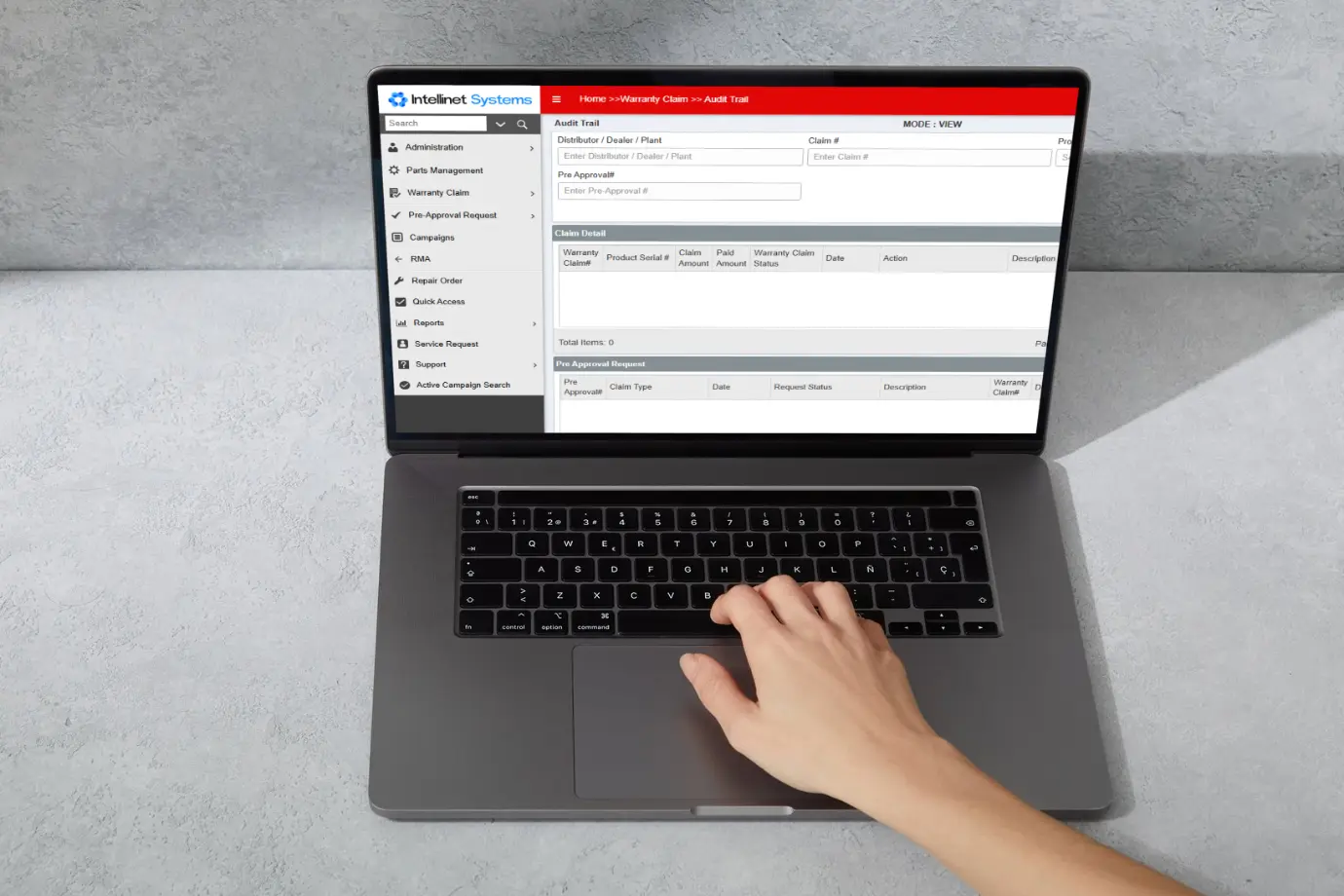
Where Do Audit Trails Fit Across the Warranty Claim Lifecycle?
A warranty claim moves through several stages, and the exact process varies by OEM, but the general sequence is familiar to anyone who has worked a claim:
Dealer Submission —> Claim Review —> Correction —> Approval or Rejection —> RMA —> Supplier Recovery
- A dealer submits a claim with repair details, parts used, and labor time.
- The claim is reviewed, and it may be corrected or sent back for supplementary information.
- The OEM approves, rejects, or requests a correction, sometimes more than once.
- Once approved, credit or payment is processed to the dealer.
- Parts may need to be returned for inspection, depending on the OEM’s policy.
- Supplier recovery may follow if the part failure is attributable to a supplier defect.
- Months later, the claim history may need to be pulled for a dispute, an internal review, or a supplier recovery challenge.
At every one of those steps, someone is making a decision, and an audit trail is what lets that decision be reconstructed later. Without it, the warranty department is relying on memory, email threads, and whoever happens to still work there.
What Should a Warranty Audit Trail Track?
Not every event that happens in a warranty system needs to be logged in detail. The objective is not to capture every minor system action. It is to capture enough to understand the important events in a claims history.
Why Are Audit Trails Important for OEM Warranty Teams?
Warranty claims contain information that can affect both the dealer and the OEM financially. Parts, labor, failure information, vehicle or product identification, warranty coverage, and supplier responsibility can all influence the outcome of a claim.
When that information changes during processing, the OEM needs to understand what changed and why.
An audit trail provides that visibility while giving warranty teams a more consistent way to review claim activity.
The financial stakes can be significant. A 2016 study in Procedia Computer Science cited an automotive-industry survey estimating that up to 10% of warranty costs were associated with warranty-claim fraud. The study also noted that such fraud could cost manufacturers billions of dollars.
- Improve Accountability Across the Warranty Claim Lifecycle
Warranty claims typically pass through several people before they close. A dealer submits the claim, a warranty processor reviews it, someone may request a correction, and an authorized user makes the final decision.
An audit trail provides a record of those actions.
For example, if a part number, labor information, or failure description changes after a claim is submitted, the warranty team can identify the change and the user associated with it.
This creates clearer accountability without requiring employees to maintain separate manual records.
- Improve Warranty Claim Data Integrity
Warranty decisions depend on accurate claim information: part numbers, failure descriptions, repair details, vehicle identification, labor information, and supporting documentation can all affect whether a claim is paid. Rather than controlling who can edit a claim, the audit trail preserves a record of those changes. That history helps warranty teams identify unexpected updates and understand how the information used in a claim decision evolved. For OEMs, this is particularly useful when reviewing unusual claims, investigating discrepancies, or analyzing activity across dealers.
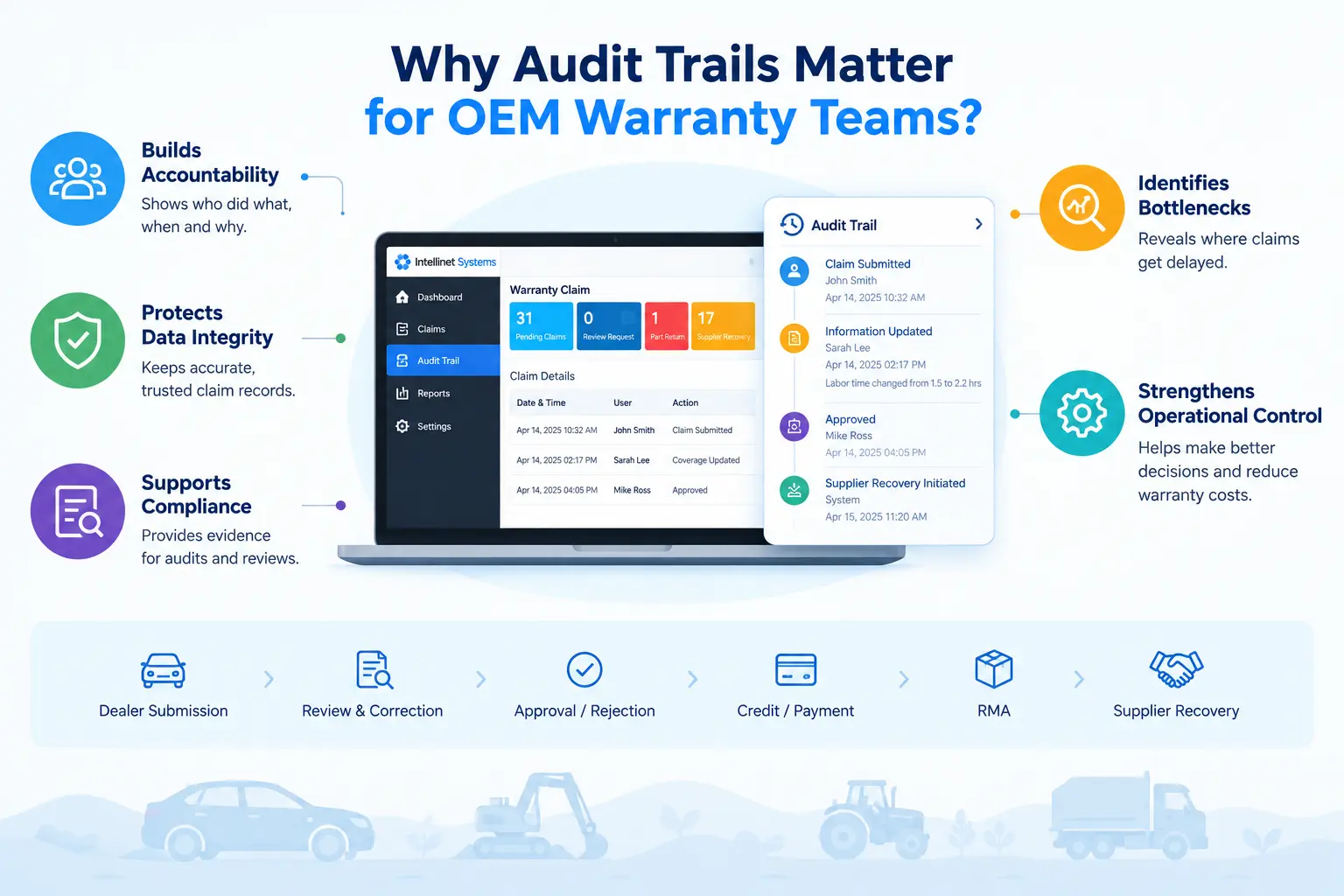
- Support Internal Reviews and Compliance Documentation
OEM warranty departments regularly review claims to ensure that policies and processes are being followed consistently. A documented claim history provides evidence of what happened during the workflow. It can show the sequence of relevant actions, changes, reviews, and decisions. Audit trails can therefore support internal audits and compliance efforts by giving teams a reliable record to review and demonstrate how a claim was handled.
- Identify Warranty Process Bottlenecks
Claim activity history can also help warranty managers understand where claims are getting held up. For example, an OEM may find that a large number of claims are repeatedly returned to dealers because required information is missing. Reviewing claim activity can help identify where those corrections occur and whether the problem is related to dealer training, claim requirements, or the workflow itself.
Other patterns may include claims that require repeated corrections, long gaps between submission and review, frequent requests for additional documentation, excessive manual intervention before approval, and high rejection rates concentrated at a specific stage.
- Strengthen Control Over Warranty Operations
Warranty expense is driven by claim volume, parts and labor costs, warranty policy decisions, repair activity, and the extent of supplier recovery.
By exposing the activity behind warranty costs, an audit trail gives managers a stronger basis for reviewing exceptions, investigating questionable claims, and identifying processes that contribute to unnecessary expense.
For an OEM managing a large dealer network, that operational visibility can be valuable.
How Do Audit Trails Help Resolve Dealer Disputes?
Dealer disputes are one of the clearest reasons to keep a detailed warranty claim history. Consider a claim rejected because the submitted repair information did not meet the applicable warranty policy. The dealer disputes the rejection and says the information originally submitted was different from what the warranty processor reviewed.
Without an audit trail, the warranty team is left searching through emails, comparing records manually, and asking staff to recall what happened weeks earlier. With a properly maintained audit trail, the team can instead review
- when the claim was submitted,
- what information it originally contained,
- whether it was modified afterward,
- who made any changes,
- when the review occurred,
- whether additional information was requested, and
- why the claim was ultimately approved or rejected.
The documented history gives the warranty team evidence to investigate the dispute rather than relying on emails, memory, or conflicting accounts. For departments handling high claim volumes across a dealer network, that makes disputes more consistent to resolve and less dependent on whoever happens to remember the details.
How Does Intelli Warranty Support Audit Trails in Warranty Management?
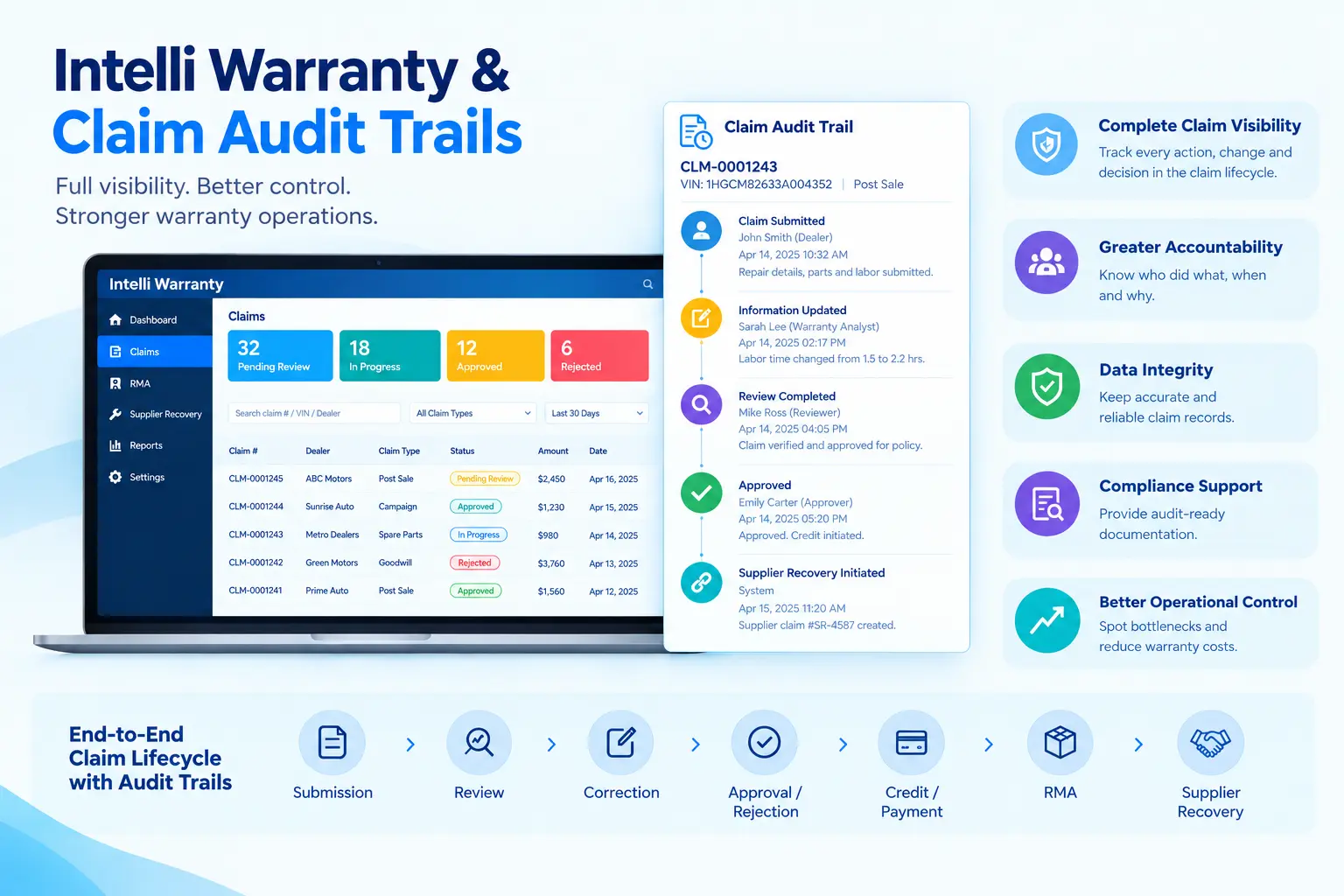
Intelli Warranty is designed to support OEM warranty operations across the dealer claim lifecycle, including claim submission, review, approval, rejection, correction requests, and related RMA processes. This warranty management system maintains claim-level history showing who submitted, reviewed, corrected, approved, or rejected a claim, along with before-and-after values on key fields and the reasoning recorded at each step. That history stays linked to the claim through parts return and supplier recovery activity, so a warranty administrator can reconstruct a claim's full path without piecing it together from separate systems or relying on someone's memory of what happened.
Intelli Warranty also integrates with enterprise systems such as ERP, SAP, and electronic parts catalogs. Connecting warranty operations with relevant parts, pricing, supplier, and accounting information can help OEMs manage warranty processes within a more connected operational environment.
The objective is straightforward: give warranty teams better visibility into the work already taking place across the claim lifecycle without relying on disconnected manual records.
Conclusion
Effective OEM warranty management requires more than processing claims and issuing payments. Warranty teams also need to understand what happened during the claim, who made important changes, and how the final decision was reached.
Audit trails provide that history.
They help OEM warranty teams improve accountability, investigate dealer disputes, support internal reviews, identify process bottlenecks, and maintain better control over warranty operations.
As warranty processes become more connected across dealers, suppliers, parts systems, and enterprise platforms, maintaining a reliable record of claim activity becomes increasingly important.
With Intelli Warranty, OEMs can build that visibility into the warranty workflow and give warranty teams a more structured way to track claim activity from dealer submission through resolution.
Ready to improve visibility and control across your warranty operations? Get a free demo to see how Intelli Warranty can support your warranty management process.
FAQs
What is a warranty claim audit trail?
It's a record of the specific actions taken on a specific claim, who submitted it, what was changed and what the prior value was, who approved or rejected it, and when each event occurred. It's tied to individual claims and decisions, not general system activity.
How is an audit trail different from a basic claim status log?
A status log shows where a claim currently stands (submitted, under review, approved, paid). An audit trail goes further, showing exactly what changed, who changed it, and any justification recorded, which is what actually holds up when a claim is questioned later.
Does an audit trail help with warranty fraud or system security?
Not directly. Security or access monitoring tracks system-level events like failed logins or unusual access patterns. A claim-level audit trail is a separate discipline focused on reconstructing decisions on a specific transaction, not detecting intrusion or unauthorized access.
How do audit trails help resolve dealer disputes?
When a dealer disputes a rejected or modified claim, the audit trail lets the warranty team review exactly when the claim was submitted, what it originally contained, what changed, who changed it, and why the final decision was made, rather than relying on emails or staff recollection.
What should OEMs look for in a warranty claim audit trail?
User-level attribution, before-and-after values on corrections, documented approval or rejection reasoning (not just a status change), linkage across related records like parts returns and supplier recovery, and fast accessibility when a claim needs to be reviewed.


Explore More Insights







.webp)


About the Author


Chandra Shekhar
Chandra Shekhar is the Senior Manager, Strategy & Business Development at Intellinet Systems. With over a decade of experience in the automotive industry, Chandra Shekhar has led digital transformation and aftersales strategy initiatives for OEMs across multiple markets. His background combines deep industry knowledge with a practical understanding of how technology can solve real operational challenges. He focuses on making complex ideas clear and relevant for automotive and aftermarket professionals navigating ongoing change.


