


For OEMs, the after-sales business is not just a support function. It is the untapped goldmines driving the highest revenue margins across the organization. According to McKinsey, aftermarket services generate an average EBIT margin of 25%, compared to just 10% for new equipment sales. Parts sales consistently deliver gross margins above 30%.
Yet for decades, managing that after-sales revenue depended heavily on printed catalogs, manual lookups, and dealer phone calls to head office to confirm whether a spare part number was still valid. However, with the introduction of the Electronic Parts Catalog, it has changed not incrementally, but structurally. Read this blog to know how.
1. Wrong Part Orders Became the Exception, Not the Rule
A printed parts manual is accurate as of the date it is printed. The next day, an engineer changes a component, a part gets upgraded, or a supplier changes. None of that reaches the manual. The technician picks it up, finds the part number, orders it, and the wrong part arrives. Not because the technician made a mistake, but because the information they were working from was already outdated.
This is the supersession problem. Every time a manufacturer retires one part number and replaces it with a newer version, any catalog still showing the old number becomes a source of wrong orders. The part may no longer be in production, may not fit correctly, or may fail prematurely due to the old specification.
Part applicability adds a second layer of complexity. A tractor built in 2019 has different components from one built in 2023. A truck configured for the US market has different parts from one for the UK. Without applicability filtering, a dealer selects a part that looks right but is built for a different variant.
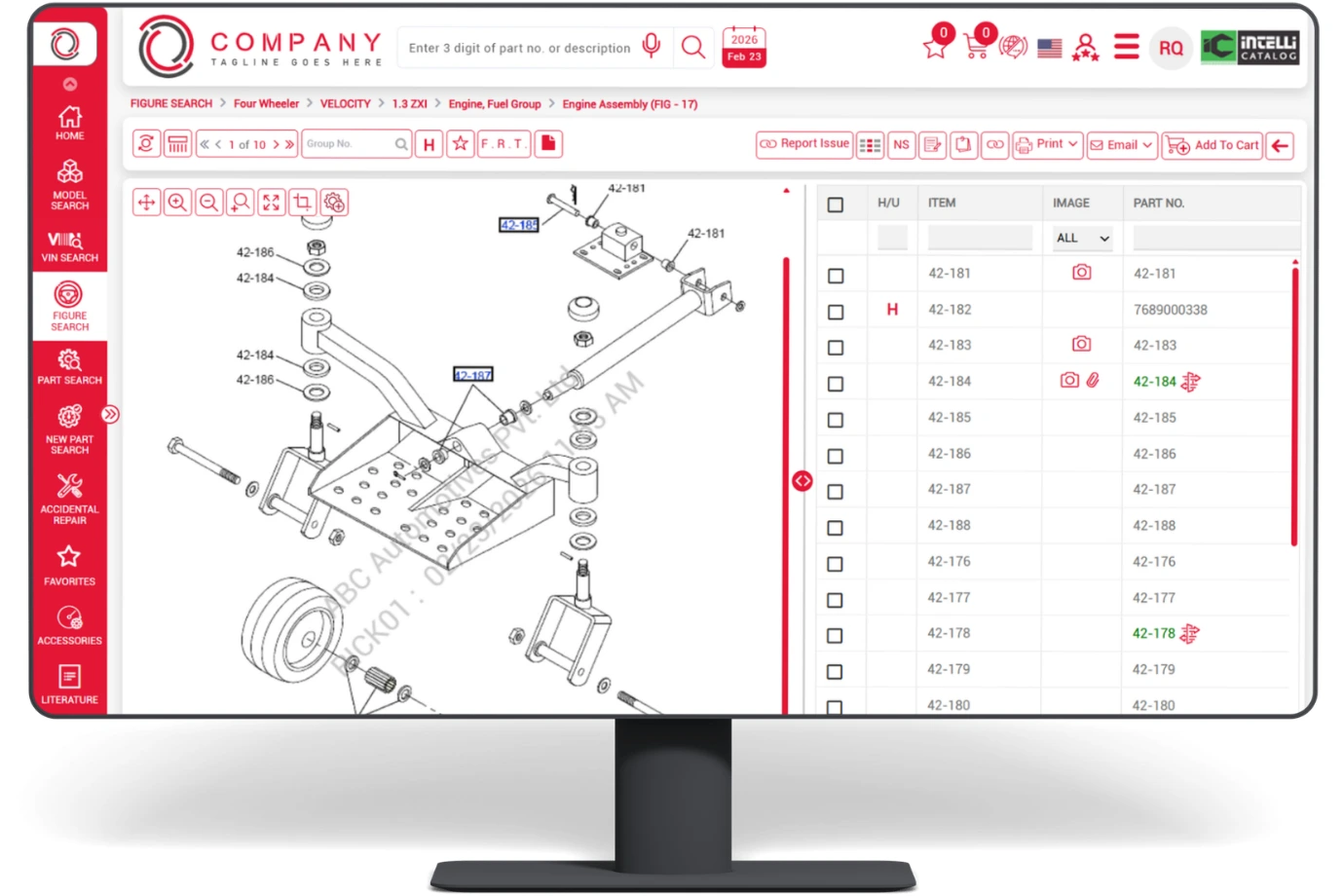
An electronic parts catalog software fixes both at the source. When an engineering change is made to spare parts, the catalog updates it automatically, and every dealer sees the correct current part immediately. Supersession chains are tracked centrally, so the right part always appears regardless of what the dealer originally searched for. Part applicability filtering ensures dealers only see parts relevant to their specific machine, model year, and market configuration, with no manual cross-referencing required.
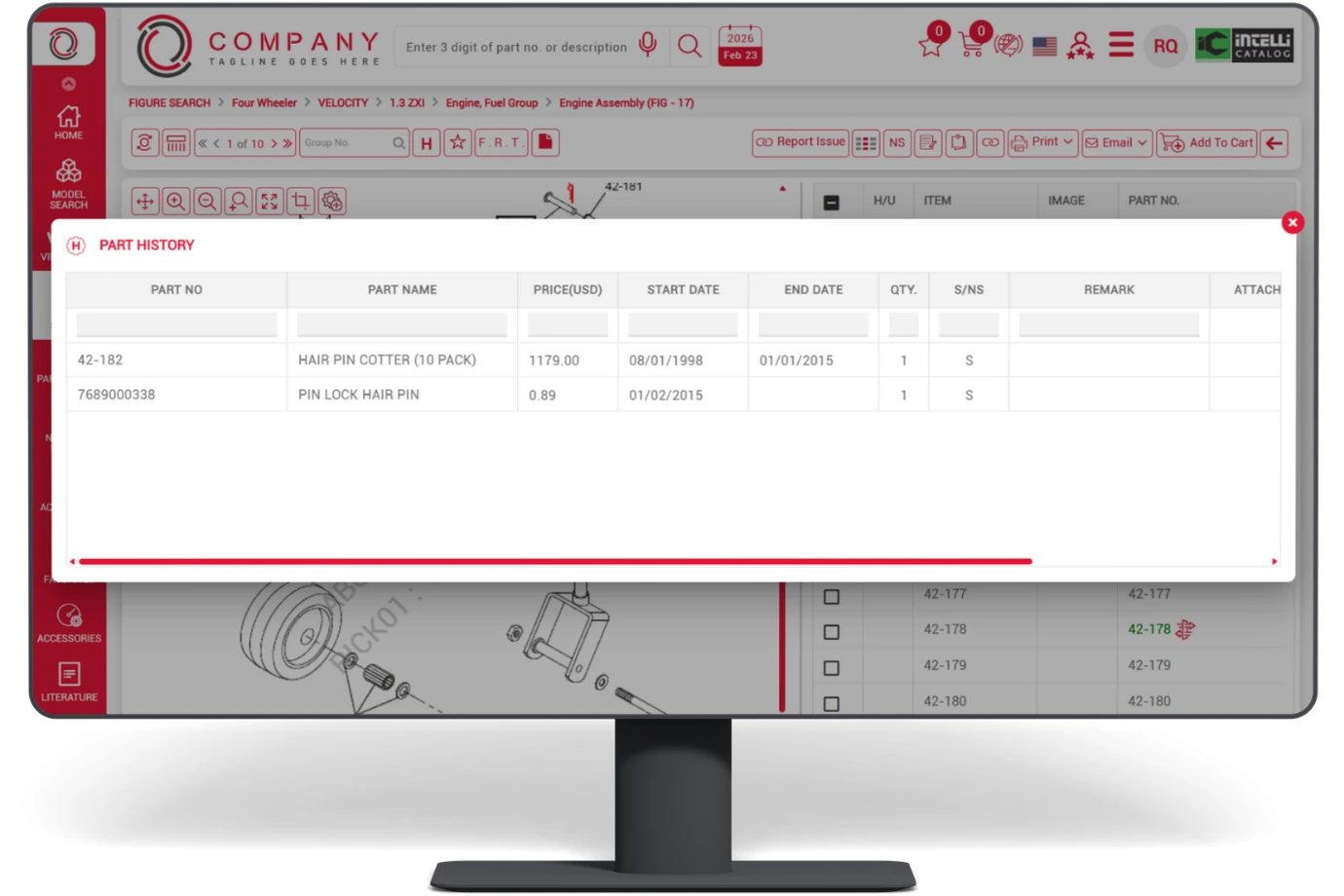
Intelli Catalog manages all of this centrally, pushing engineering change updates to every dealer in real time, as soon as a change is processed. A technician searching for a part automatically sees the correct current version, with no manual cross-referencing required.
2. Part Identification Went From Minutes to Seconds
Finding a part in a printed catalog was a multi-step process. The technician needed to already know the part number, locate the correct section in the appropriate manual, match it with a diagram, and then verify whether the part was still in production. For equipment with hundreds of variants, identifying a single part often took 20–30 minutes.
A modern automotive parts identification system eliminates those steps and can use any of the methods below to identify parts.
- If the technician has the VIN or serial number, they can enter it, and the system returns only the parts that apply to that exact machine. Nothing irrelevant appears.
- If they do not have a number, they search by model, description, or directly through the interactive equipment diagram.
- If the component is worn or unmarked with no visible number, technicians can photograph it with their smartphone, and AI-powered visual search will instantly identify it.
Intelli Catalog supports all of these methods within a single platform. Additionally, technicians can ask questions in their own language using voice, and AI-powered voice search interprets the query to deliver the correct result. IntelliGPT lets dealers ask anything through natural conversation, part availability, compatibility with their specific machine, and supersession history, without navigating a single menu. Interactive 2D and 3D illustrations allow technicians to click on the exact component on screen and navigate directly to the correct part.
For OEM dealer networks with frequent staff turnover or multilingual technicians, this depth of automotive parts lookup capability enables new technicians to identify the correct part from day one while reducing errors across the network.
Reading about how Intelli Catalog's automotive parts identification system is one thing. Watching a technician use it in a live dealer environment is another.
3. Pricing Errors Stopped Sending Dealers to Third-Party Suppliers
A printed price list is accurate once, the day it is published. After that, exchange rates move, import duties change, tax schedules update, and dealer-tier discount structures evolve. An OEM managing a multi-market dealer network with static pricing will inevitably generate continuous pricing errors. Every pricing error forces dealers to either raise a support query with the OEM or turn to third-party suppliers offering accurate, all-inclusive pricing, often resulting in lost orders.
An Electronic Parts Catalog with a dynamic pricing engine eliminates this. The correct price is calculated automatically at the point of transaction, incorporating current exchange rates, regional tax schedules, applicable duties, and that specific dealer's discount tier. The dealer sees one number. The correct number. No calls to the head office to confirm a price.
For UK dealers, post-Brexit import duties and VAT treatment are applied automatically based on product origin and category. For US dealers, the correct state tax and applicable federal tariff logic applies, eliminating the need for manual spreadsheet maintenance. Intelli Catalog's pricing engine handles all of this at the transaction level, so the right price appears for every dealer in every market, every time.
Read More: Handling Global Spare Parts Pricing with Intelli Catalog
4. The Catalog Became a Complete Automotive Parts Ordering System
The original purpose of a parts catalog was simple: help a technician find the right part. That was sufficient when ordering was handled separately through a different system. Every time a dealer switches from the catalog to an ERP to place an order, errors are introduced. A digit transposed, a quantity misread, a wrong variant selected. The order arrives wrong, gets returned, and the dealer sources the correct part elsewhere. The OEM absorbs the reverse logistics cost and loses the order.
A modern automotive parts ordering system integrates identification, ordering, fulfillment tracking, and returns into one workflow. Dealers identify a part, place the order, track delivery, and process returns without leaving the catalog interface. Organizations that have eliminated this system-switching typically see order accuracy improve within the first 60 days of deployment.
Beyond the primary dealer order, three additional revenue opportunities open up that most OEMs are not fully capturing:
- Dealer Online Storefronts: End customers searching for genuine parts online often end up on third-party platforms simply because the OEM channel is harder to navigate. Dealer Online Storefronts give each dealer a branded online presence where customers can find them and order directly, without the OEM losing margin or the dealer losing the relationship.
- Intelli Commerce: Provides distributors and retailers with structured catalog access and local inventory management, ensuring orders remain within the OEM ecosystem rather than shifting to independent suppliers.
- Accessory cross-sell: When a dealer selects a part, compatible accessories surface automatically at checkout. The dealer doesn’t have to think about it; the customer gets what they need, and the average order value goes up with no extra effort from anyone.
5. Demand Became Predictable Before It Became a Crisis
A printed catalog has no memory and no foresight. It shows parts. It does not know which parts are running low, which dealers are about to stock out, or which components are likely to fail across an aging fleet in the next 90 days.
An electronic parts catalog (EPC) with integrated demand forecasting changes this entirely. Spare parts demand behaves differently from regular product demand. A brake pad sells consistently week after week. A hydraulic pump seal may go two years without a single order, then suddenly be required by multiple dealers in the same month due to an engineering change in the equipment model.
Standard forecasting tools see years of zero demand and predict zero. They miss the spike entirely, leaving dealers with empty shelves and customers with equipment that cannot be repaired quickly.
Intelli Catalog's Intelli Forecast module combines historical ordering patterns by dealer and region, real-time ordering signals, equipment fleet age, seasonal fluctuation profiles, and IoT sensor inputs where available. OEM administrators can view every dealer’s inventory levels in real time on a unified dashboard and receive automatic alerts when stock falls below defined thresholds. The result is replenishment that happens before the stockout, not after the dealer has already sourced the part elsewhere.
Read More: Spare Parts Planning: Inventory Prediction and Demand Forecasting
The Catalog Is Now the Revenue Infrastructure
The five shifts above are not feature improvements. There are structural changes in how OEM after-sales revenue is generated, protected, and grown. An automotive parts identification system that focuses solely on part lookup delivers only a fraction of what modern technology is capable of.
For OEMs managing complex, multi-market dealer networks, the question in 2026 is not whether to use an Electronic Parts Catalog. It is whether the one you have is doing all five of these things, or leaving revenue, dealer confidence, and aftermarket market share on the table.
Intelli Catalog is deployed across 70+ countries with OEMs including Mahindra, MG Motor, Honda, Maruti Suzuki, Perodua, Ather Energy, and Escorts Kubota. It is ISO 27001:2022 certified and covers the full aftermarket workflow from AI-powered automotive parts identification and lookup to integrated ordering, demand forecasting, and geo-specific pricing within a single platform.
If your current catalog is falling short on any of the five dimensions above, connect with our experts to request a free demo today.


Explore More Insights







.webp)


About the Author


Chandra Shekhar
Chandra Shekhar is the Senior Manager, Strategy & Business Development at Intellinet Systems. With over a decade of experience in the automotive industry, Chandra Shekhar has led digital transformation and aftersales strategy initiatives for OEMs across multiple markets. His background combines deep industry knowledge with a practical understanding of how technology can solve real operational challenges. He focuses on making complex ideas clear and relevant for automotive and aftermarket professionals navigating ongoing change.


