


In the aftermarket sales, warranty claims processing for automotive OEMs is a financially demanding function. In 2024, global passenger car OEMs paid a combined $57.9 billion in warranty claims, which includes Tesla paying $1.45 billion and GM paying $4.47 billion.
For most OEMs, warranty represents between 1.5 to 2.5% of annual revenue, and that number keeps rising. Several reasons can be responsible for it, including inconsistent policy application, manual reviews that cannot scale, undetected warranty fraud, and incomplete supplier recovery.
Key Challenges in Manual Warranty Claims Processing:
- Time-Consuming Manual Processing: A dealer network of 500 dealers, each submitting 20 to 30 claims per month, generates up to 15,000 claims monthly. Reviewing all these claims manually will require multiple verifications, document reviews, and approvals. Manual reviewers cannot evaluate each claim with the same level of attention to detail to catch errors, inflated labor hours, or duplicate submissions. Delays in claim adjudication impact dealer cash flow and reduce overall after-sales efficiency.
- Error-Prone Submissions from Dealers: Dealers frequently submit claims with incomplete or incorrect information, which triggers an error that adds time and cost for both the dealer and the OEM review team. Without structured submission workflows and automated validation, back-and-forth between dealer and OEM drags on processing speed and accuracy.
- High Operational and Administrative Costs: Manual warranty processing requires dedicated headcount for document review, claim intake, validation, approval routing, and dispute resolution. As claim volume grows alongside product line expansion, the only way to maintain warranty claim processing speed without automation is to add staff proportionally. This makes operational costs a direct function of the claim volume rather than a scalable expense.
- Fraud and Duplicate Claims: Fraudulent warranty claims, inflated repair costs, altered supporting documents, duplicate VIN submissions, and claims timed suspiciously close to warranty expiry create significant financial exposure and are difficult to identify at scale when reviewing manually.
- Lack of Standardization Across Dealer Networks: Warranty claims submitted by different dealers often vary in format, documentation quality, and completeness. Without standardized submission workflows and validation rules, OEM warranty teams must interpret each claim individually. This inconsistency leads to variable adjudication outcomes, dealer disputes, and difficulty enforcing warranty policy uniformly across a global or multi-regional dealer network.
- Poor Dealer Satisfaction from Slow Settlements: Dealers depend on timely warranty reimbursements to maintain their working capital and sustain their business operations. When claim processing is inconsistent or slow, dealer satisfaction drops. Strained dealer relationships increase disputes, reduce collaboration, and affect the OEM’s ability to execute after-sales programs effectively. For OEM’s with large dealer networks, claim settlement speed is a measurable indicator of after-sales performance.
- No Visibility into Claims Data for Quality Decisions: Manual claims processing generates little usable data. Without structured analytics, OEMs cannot identify recurring part failures, track regional defect patterns, or measure cost-per-model trends. This prevents the kind of proactive quality intervention that could reduce future claims. Data from warranty claims, when properly captured and analyzed, is one of the most direct signals of product quality issues in the field.
Overview of Intelli Warranty
Intelli Warranty is OEM’s trusted warranty management system that handles the full warranty claims lifecycle, from dealer claim submission through OEM review, approval, settlement, and supplier recovery. It is an AI-powered warranty management system used across agriculture, automotive, aerospace, construction, and heavy equipment industries.
Intelli Warranty automates routine claims so they move through the process without manual intervention, allowing OEM teams to focus on complex claims that require review and judgment.
It gives warranty administrators full control to define warranty rules, configure approval workflows, and set validation checks through an easy-to-use admin panel. OEMs can update warranty policies, adjust approval steps, and automate claim decisions on their own, without relying on IT teams or developers.
How Can Intelli Warranty Automate Warranty Claims Processing?
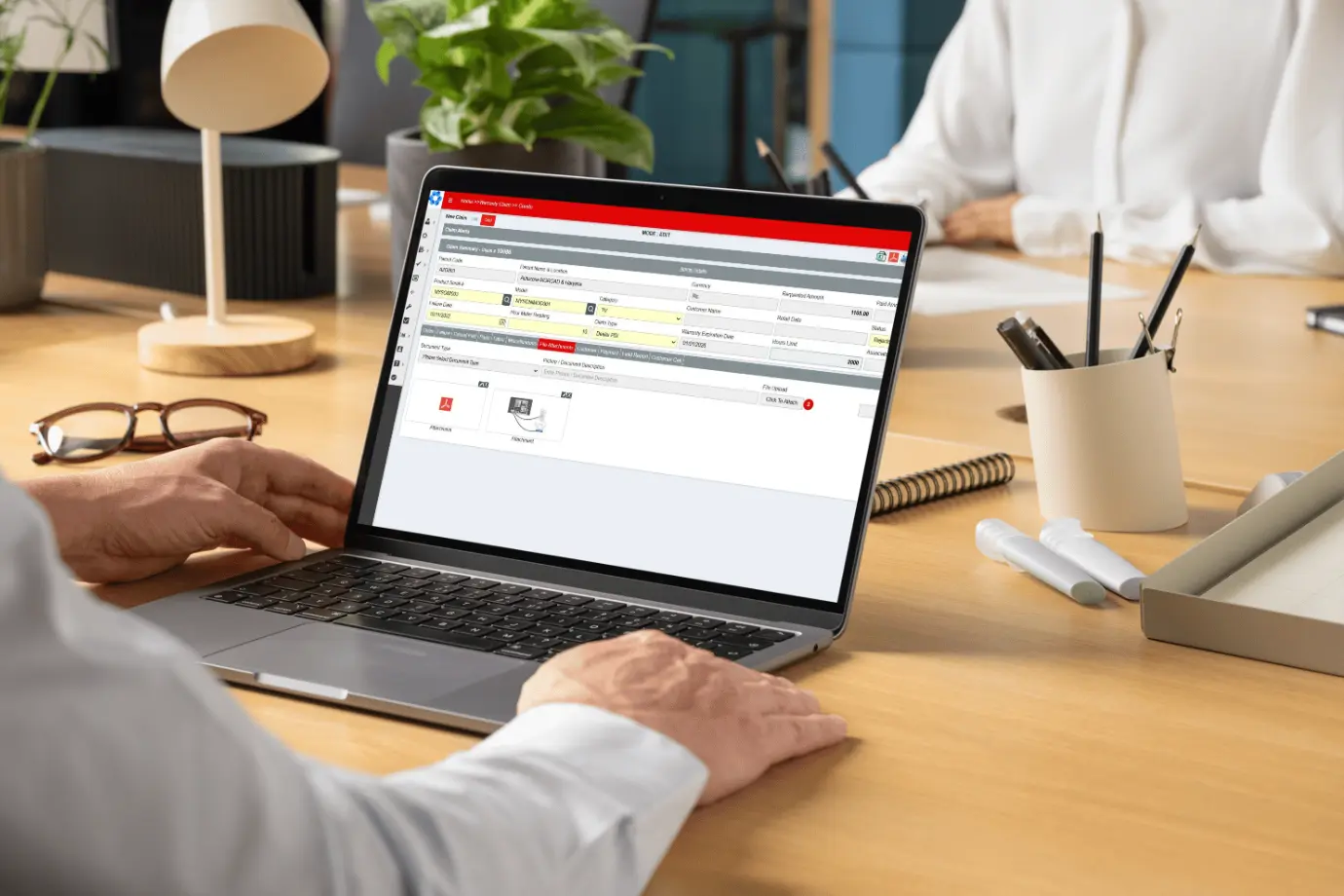
Intelli Warranty provides OEMs with multiple automation capabilities that work together to improve processing accuracy and lower the total cost of warranty operations. Here is how each capability addresses the claims processing challenge:
1. Claims Processing Through Configurable Business Rules
Whenever a dealer submits a claim through Intelli Warranty, the system checks the business rules defined by the OEM and routes that claim to the correct approver or processing queue automatically. These rules can be configured based on region, dealer, claim type, amount threshold, product model, or part category. OEMs with regional teams can ensure claims from specific geographies go to the designated reviewers. Claims above a certain value can be escalated to senior approvers. Intelli Warranty supports over 40 dynamic configurable parameters for work queue assignment, including product models, variants, claim costs, and regions. Claims move through a defined, consistent process rather than depending on who happens to be available to sort the inbox that day.
2. Auto Claim Processing for High-Volume Routine Claims
Intelli Warranty can be configured to automatically approve or reject claims that meet predefined warranty claims rules, without any OEM reviewer needing to act on them. This is particularly valuable for high-volume, lower-risk claims. If a claim type has a consistent historical approval pattern, falls below a defined value threshold, and comes from a dealer with a reliable compliance record, having a human reviewer spend time on it adds cost without adding control. Auto-processing rules in Intelli Warranty can vary by dealer, claim amount, product category, and other factors. The system executes these rules at scale, so OEMs can handle growing claim volumes without proportionally growing their review teams.
3. AI-Powered Claim Validation and Fraud Detection
Intelli Warranty uses AI-driven claim validation to analyze each claim against claim value, repair patterns, dealer history, service records, and supporting documents.
- AI detects anomalies and flags irregular submissions before they reach the approval stage.
- Moreover, warranty claims with inflated repair costs, unusual repair durations, or submissions timed close to warranty expiry are flagged early.
- AI checks every attachment with documents for duplicate images, altered files, metadata inconsistencies, and mismatched timestamps.
- Vehicle and part history is cross-checked to flag repeated failures and abnormal odometer readings.
- Dealer behavior is also monitored, including tracking billing patterns and labor charges against peer benchmarks so that AI-powered Intelli Warranty can find systematic irregularities before they compound into significant financial leakage.
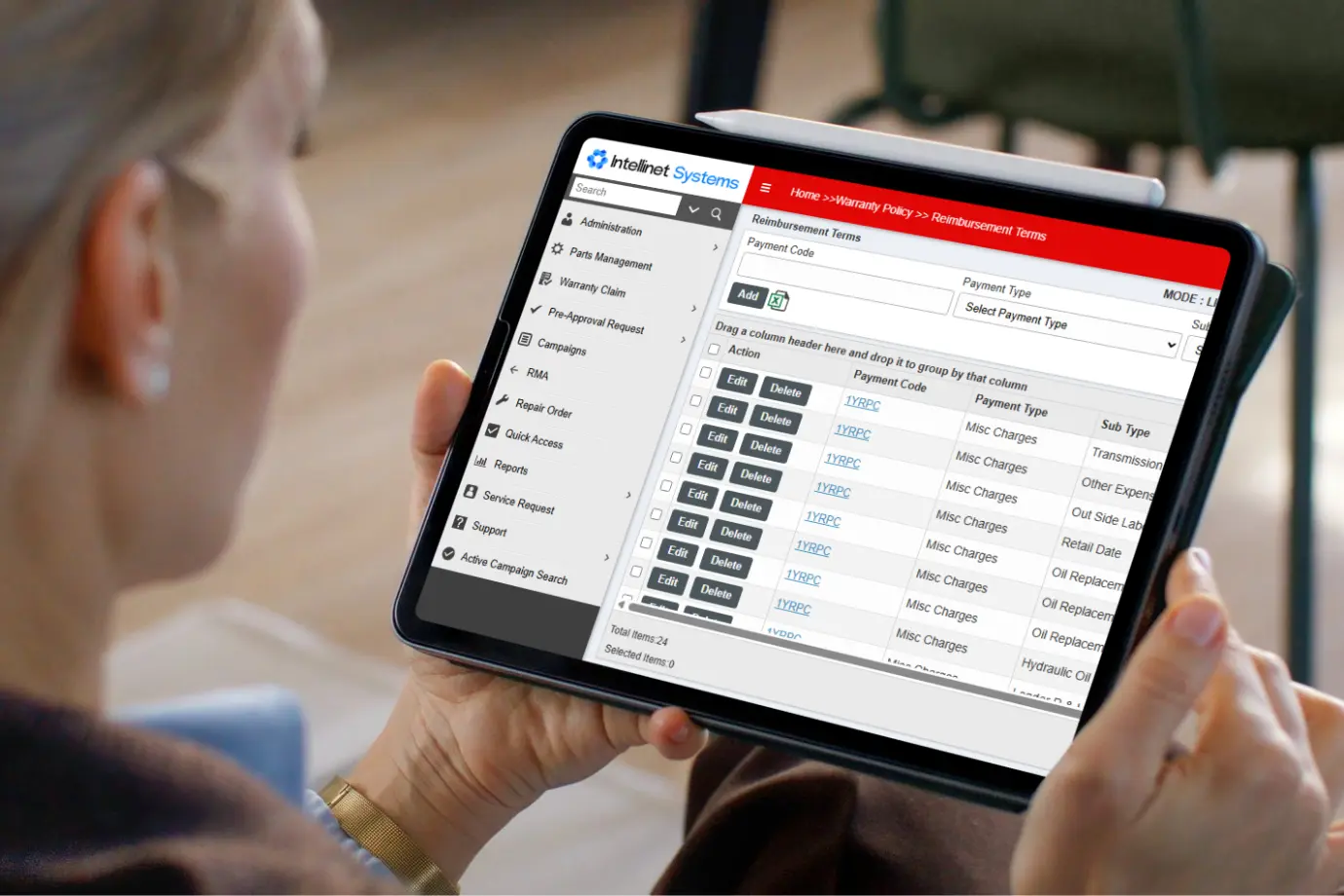
4. Streamlined Dealer Submission with Guided Workflows
Intelli Warranty simplifies the claim submission process for dealers through a structured, guided workflow. Dealers are walked through the required fields, document uploads, and parts return controls in a logical sequence that reduces submission errors from the start. This means fewer incomplete claims, fewer correction cycles, and faster initial processing. When dealers find the submission process clear and the settlement turnaround reliable, satisfaction with the OEMs after-sales service improves. A dealer network that trusts the warranty process operates more efficiently on both sides of the relationship.
5. Automated Supplier Recovery Linked to Approved Claims
When a warranty payout is tied to a part failure, the OEM should recover that cost from the responsible supplier. In practice, this recovery is often delayed or incomplete because the link between an approved claim and the responsible supplier is not made automatically. Intelli Warranty includes a fully integrated supplier recovery module that integrates with SAP, Oracle and other ERP systems, which proactively links approved claims to the responsible supplier and initiates the recovery process. The system also connects defect trends with supplier data, surfacing patterns where the same part from the same supplier is appearing across multiple claims, enabling both financial recovery and upstream corrective action.
6. Warranty Analytics That Convert Claims Data into Product Intelligence
Every claim processed through Intelli Warranty generates structured data. The platform transforms this data into actionable insights by identifying recurring defects, regional defect clusters, part-level failure rates, and cost-per-model trends. Predefined reports based on key industry metrics give warranty managers real-time visibility into claims performance and costs without requiring custom report builds. For product engineering and quality teams, this data is direct field evidence. When a specific part is surfacing in claims from multiple dealers across different regions, that pattern is early warning data for a supplier corrective action or a design change before the defect rate grows further.
Conclusion
Intelli Warranty automates warranty claims processing by replacing manual routing, review, and adjudication with configurable business rules, AI-powered validation, and auto-processing logic that can operate at scale. By addressing claim volume growth, reducing avoidable payouts, detecting fraud early, and connecting approved claims to supplier recovery, the platform gives OEMs the financial controls they need to manage warranty costs rather than absorb them.
Warranty costs for global automotive OEMs are at record highs, and the structural factors driving them, including vehicle complexity, expanding dealer networks, rising electronic content, and fraud risk, are not going away. OEMs that continue processing claims manually will see their operational costs grow in proportion to claim volume. Those that automate the process with a purpose-built system gain speed, consistency, and control at a cost that does not scale linearly with volume.
To see how Intelli Warranty can automate your warranty claims processing, book a free demo today.
FAQ
Can dealers benefit from automating warranty claims processing using Intelli Warranty?
Yes. Dealers get faster reimbursements, fewer rejections, and more clarity on claim submissions by automating warranty claims processing.
How does Intelli Warranty reduce warranty costs for OEMs?
AI-powered Intelli Warranty detects fraud, improves validation accuracy, prevents overclaims, and identifies high-risk parts or repairs early, reducing unnecessary payouts.
How does Intelli Warranty predict future faults or failures in automotive products?
AI-powered Intelli Warranty analyzes historical data trends and product performance metrics to identify patterns linked to failures, helping automotive OEMs prevent severe issues.


Explore More Insights






.webp)


About the Author


Chandra Shekhar
Chandra Shekhar is the Senior Manager, Strategy & Business Development at Intellinet Systems. With over a decade of experience in the automotive industry, Chandra Shekhar has led digital transformation and aftersales strategy initiatives for OEMs across multiple markets. His background combines deep industry knowledge with a practical understanding of how technology can solve real operational challenges. He focuses on making complex ideas clear and relevant for automotive and aftermarket professionals navigating ongoing change.


