


Warranty costs are not a fixed line item for global OEMs because they are determined by claim volume, supplier product quality, and dealer network. Moreover, it also depends on the speed at which the OEM's warranty team can identify and act on problems.
As per the Warranty Weeks report, in 2024, global automotive OEMs paid $72.5 billion in warranty accruals, an 11% increase from the prior year. This number reflects a structural cost problem that is getting harder to manage without the right warranty tracking system in place.
Most of this cost is driven by operational gaps that include claims that were paid without proper entitlement checks, approval delays that create downstream liability, and supplier chargebacks that were never recovered. The common factor in all these situations is a lack of claim visibility.
Real-time warranty claim tracking solves this problem directly. When OEM warranty teams can view the claim in real time as it moves through the pipeline, they can see where each claim is, check if the claim is valid before approving payment, and flag invalid claims the moment they appear. This makes warranty costs easier to control.
This blog explores where warranty costs leak, how warranty tracking software closes these gaps, and what OEMs should expect from a modern warranty claim management platform.
Where OEMs are Losing Money in Warranty Operations

Several dozen small failures and process gaps lead to warranty cost problems. Here are some failures from where money typically leaks.
Invalid Claims That Pass Undetected
Without an automated warranty check, the following claims pass through easily as reviews rely on manual lookups:
- Claims for out-of-warranty vehicles
- Expired coverage windows claim
- Claims on non-covered components
Each invalid claim that gets approved represents an unnecessary payment.
Delayed Claim Approvals
Slow warranty claims approvals create two issues:
- Increase administrative overhead as it sits in the queue and requires follow-up from dealers.
- Reduce dealer trust that can lead to inflated submissions and disputes that can add cost later in the process.
Manual Review Process Can’t Be Scaled
When the warranty team depends on traditional techniques, like spreadsheets and email threads for managing claim volumes, inconsistency will appear in the outcome. Moreover, different reviewers will apply for a warranty claim with different documentation and information, so the same type of claim may get a different decision. Some unusual or invalid claims get approved because no one has the time to dig into the details.
On top of that, while manually reviewing the claims, a limited number of claims get processed each day, resulting in piling up claims and backlogs growing.
Missed Supplier Recovery
Supplier recovery is the most under-captured area of warranty cost control. When claims linked to supplier-caused defects are not flagged, documented, and charged back systematically, they are absorbed by the OEMs.
Claim Data is Scattered Across Dealer Network
OEMs with large dealer networks face a coordination challenge because claim data is spread across too many disconnected systems. When claims are submitted through disconnected portals, reviewed in separate systems, and the claim history sits in different sources, it becomes impossible for the warranty team to get a clear view of what is happening. This makes it difficult to spot patterns of fraud, repeated claim issues, or early signs of product quality issues until the financial damage is already done.
Poor Claim Visibility
When warranty teams cannot see the real-time status of claims across the network, they cannot intervene early, which means escalations happen too late. Fraud patterns accumulate over months before they are detected; moreover, supplier recovery windows close before chargebacks are initiated. This is the core argument for real-time warranty claim tracking as a cost control tool.
Why Real-Time Warranty Claim Tracking Matters
Real-time warranty claim tracking means having visibility of every stage of the claim lifecycle, from when a claim is submitted to validation, approval, payment, and supplier recovery, along with the ability to act on what you see.
- End-to-End Claim Visibility
A claim that enters the OEM’s system should be traceable at every point, that include which dealer submitted it, what entitlement checks it passed or failed, and whether it is in the approval queue or has been flagged for review, including what payment was made and when. It means end-to-end visibility of warranty claim tracking eliminates the blind spots where cost leakage concentrates.
- Faster Decision-Making
When claims are visible in real time, warranty teams can make decisions based on current data rather than week-old reports. This implies that the high-value claims, unusual patterns, or high-risk dealer submissions can be escalated immediately rather than discovered in a quarterly audit.
- Better Dealer-OEM Coordination
Dealers need timely feedback on claim status to manage their own operations. When OEMs provide real-time claim visibility through a shared platform, dealers submit cleaner claims, which decreases OEM and dealer disputes, reducing the overall cost of administering the dealer network.
- Real-Time Alerts and Escalations
Automated alerts allow warranty teams to respond to anomalies without waiting for manual reports. A spike in claims from a specific dealer, an unusual concentration of failures on one component, or a pattern of out-of-warranty submissions can all trigger immediate review. Early intervention is significantly less expensive than late-stage dispute resolution.
- Better Control Over Claim Lifecycle
Real-time warranty claim tracking gives OEM leadership operational control that manual systems simply cannot provide. It shifts warranty from a reactive cost center to a function that can be actively managed, measured, and optimized.
McKinsey's operations research shows that advanced analytics applied to warranty processes can reduce warranty costs by approximately 15% for equipment manufacturers, with time to identify systemic field issues dropping by nearly half.

Intelli Warranty’s dashboard shows live claim pipeline, reserve exposure, fraud scores, and dealer performance, all in one view. Book a Demo to see real-time warranty claim tracking running on your claim data.
How Warranty Tracking Software Reduces Costs
Warranty tracking software like Intelli Warranty provides the infrastructure that makes real-time warranty claim tracking operationally viable at scale. Here is how it directly impacts a significant reduction in total warranty costs.
- Automated Claim Validation
Automated validation using Intelli Warranty checks every claim against the warranty coverage rules, VIN or serial number records, service history, and entitlement records to confirm whether the claim is valid before it reaches an approver.
If something doesn’t match in any claim, such as expired warranty coverage, wrong vehicle details, or missing service history, then they are automatically flagged, removing the need for teams to check everything manually while eliminating a significant portion of invalid claims before payment is approved.
- Rule-Based Approvals
Intelli Warranty allows OEMs to configure warranty rules to define what claims qualify for approval, what requires escalation, and what should be automatically rejected. This naturally eliminates the inconsistency of manual review and ensures that policy is applied uniformly across every claim in every region.
- Faster Claim Processing
An AI-powered warranty automation process 75% to 85% of claims, which significantly reduces end-to-end processing time, thereby reducing administrative overhead, improving dealer experience, and shortening the time between claim submission and payment resolution.

- Reduced Administrative Overhead
When claims are processed automatically through rules-based workflows, the warranty team's time shifts from data entry and manual review to exception management, pattern analysis, and supplier negotiations. The same team can manage a larger claim volume more effectively.
- Lower Claim Leakage
Warranty leakage occurs when payments are made outside policy terms, for ineligible claims, or for claims without proper documentation. Warranty tracking software closes leakage by validating claims at every checkpoint and preventing payout until all conditions are met. For OEMs spending hundreds of millions on warranty annually, even a modest reduction in leakage rate translates to high recoverable cost.
- Better Audit Readiness
A centralized warranty tracking software creates a complete, timestamped audit trail for every claim decision, which is essential in internal audits, supplier recovery negotiations, and regulatory compliance. When documentation is automated and complete, dispute resolution is faster or negligible, and recovery rates improve.
Advanced Capabilities OEMs Should Expect from Warranty Tracking Software
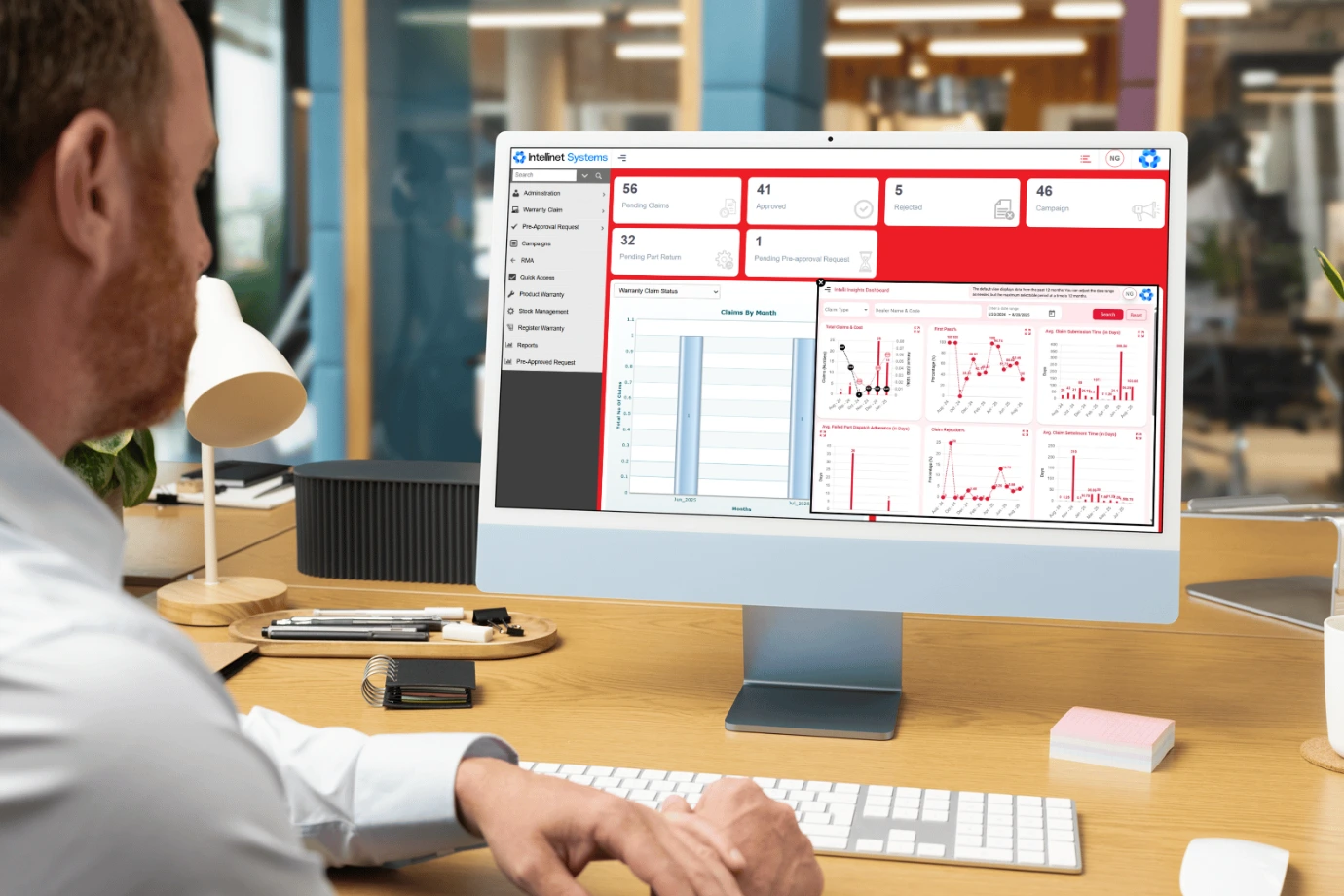
Here are the advanced capabilities that differentiate enterprise-grade warranty tracking software like Intelli Warranty from basic claim management tools for OEMs managing complex dealer networks.
- Real-Time Dashboards
Warranty tracking software like Intelli Warranty has configurable dashboards that give each team a live view of what matters to them, without needing to build reports manually: how many claims are coming in, how many are approved, which claims are still pending or stuck, how warranty costs are changing, and how each dealer is performing.
Warranty operations leaders, finance teams, and service leadership should all have views that are relevant to their role without needing to pull reports.
- Automated Entitlement Checks
Every claim should be validated against coverage terms, vehicle registration data, service history, and policy rules automatically. OEMs with large parts and accessories catalogs, goodwill programs, or dealer-specific coverage terms need entitlement logic that handles complexity without manual intervention.
- AI-Powered Fraud Detection
Intelli Warranty’s machine learning algorithms monitor warranty claims automatically and find patterns for anomalies. Dealers with unusual claim frequency, inflated labor charges, repeated identical repairs, or submission timing patterns that deviate from network norms should be flagged automatically, instead of waiting for a manual review. This helps OEMs catch possible fraud and reduce unnecessary payouts. Warranty Week estimates that warranty fraud accounts for 3% to 15% of warranty costs, placing recovery potential in the millions for most OEMs.
- Supplier Recovery Workflow Automation
When a claim is linked to a supplier-caused failure, the warranty tracking software should automatically initiate the supplier chargeback workflow, which includes documenting the claim, notifying the supplier, and tracking the recovery status. Without this automation, supplier recovery relies on manual follow-up that frequently fails to capture the full entitlement.
- ERP and DMS Integration
Warranty tracking software like Intelli Warranty connects with the OEM's ERP systems and dealer management systems to pull accurate vehicle, parts, and service data. Without this integration, entitlement checks are unreliable, and supplier recovery is incomplete.
- Multi-Region Warranty Governance
OEMs operating in multiple regions across the continent need a warranty tracking software where warranty policies can be configured by region, by dealer tier, by equipment line, or by coverage type. Intelli Warranty supports multi-region governance, allowing centralized policy management with localized application, ensuring consistency without sacrificing flexibility.
Conclusion: Warranty Is a Cost Center OEMs Can Control
For decades, warranty operations have been treated as an administrative function rather than a financial one. The good news is that a significant portion of that cost is now recoverable, which includes invalid claims that shouldn’t have been approved or supplier chargebacks that were never pursued. Moreover, fraud patterns that go undetected for months or the administrative overhead that consumes team capacity without generating value are also now recoverable.
Real-time warranty claim tracking, backed by the right warranty-tracking software, gives OEMs the visibility and control they need to address each problem systematically. It shifts warranty operations from a reactive process to a managed discipline, with measurable outcomes in cost, efficiency, and financial accuracy.
Warranty is not just a claims process but a controllable cost center, and OEMs that treat it that way will carry a structural cost advantage over those who don’t.
Take Control of Your Warranty Costs with Intelli Warranty
Intelli Warranty is a trusted warranty management software for OEMs with dealer networks across the globe. Designed for real-time warranty claim tracking, automated validation, fraud detection, and supplier recovery, Intelli Warranty gives OEMs warranty operations, finance, and service teams the visibility and control they need to reduce cost leakage and improve financial outcomes.
If your team is managing warranty through disconnected systems, manual approvals, or spreadsheet-based tracking, schedule a demo to see how Intelli Warranty works for OEM warranty operations.
FAQ
What are the benefits of Real-Time Warranty Claim Tracking?
Six benefits of real-time warranty claim tracking include:
- Full claim visibility across your dealer network
- Accurate financial reserve exposure before the month-end
- Fraud detection as claims arrive
- Early product failure intelligence before the cost compounds
- Vendor and supplier recovery tracking
- dealer performance scoring to identify training gaps
Which warranty tracking software offers real-time warranty claim tracking?
Not all warranty management platforms include real-time warranty claim tracking; however, Intelli Warranty offers this feature.
Can warranty tracking software integrate with OEM's existing ERP or CRM system?
Yes, most Warranty tracking software offers seamless integration with ERP, CRM, and other business systems. This ensures smooth data flow, better tracking, and improved decision-making across departments.


Explore More Insights






.webp)


About the Author


Chandra Shekhar
Chandra Shekhar is the Senior Manager, Strategy & Business Development at Intellinet Systems. With over a decade of experience in the automotive industry, Chandra Shekhar has led digital transformation and aftersales strategy initiatives for OEMs across multiple markets. His background combines deep industry knowledge with a practical understanding of how technology can solve real operational challenges. He focuses on making complex ideas clear and relevant for automotive and aftermarket professionals navigating ongoing change.


