

Overview: Warranty tracking software helps OEMs eliminate revenue leakage, automate entitlement verification, and manage spare parts warranty data across dealer networks in real time.
OEMs using manual warranty tracking lose 8-15% of warranty revenue annually to process failures, including out-of-window claims, missing entitlement records, and lapsed renewals. Warranty tracking software addresses this by validating claims at submission, sending automated renewal notifications, and creating an audit trail for supplier recovery. Cloud-based deployment ensures all authorized users, including field technicians on mobile devices, access the same real-time data regardless of location. Intelli Warranty from Intellinet Systems is purpose-built for OEM dealer networks and integrates with existing ERP and DMS platforms.

Most OEMs know they have a warranty problem. What they often do not know is how much it costs them.
A warranty manager running a network of 200 dealers, tracking thousands of spare parts with different warranty periods, across different markets and product lines, cannot do that manually without losing revenue somewhere. The losses are not dramatic; no single bad claim is catastrophic. But across thousands of transactions per year, the leakage compounds. Most OEMs only see the full picture when they run an annual audit and find claims that should never have been approved.
This is the operational gap that warranty tracking software is designed to close.
What Is Warranty Tracking Software For Oems?
Warranty tracking software is a centralized platform that allows OEMs and their dealer networks to manage the full lifecycle of spare parts warranties from entitlement verification at the point of service to claim submission, approval, and renewal.
It replaces spreadsheets, paper files, and disconnected ERP workflows with a single system of record accessible in real time from any device. The core purpose is to ensure that every warranty claim is validated before it is paid, every expiry is flagged before it lapses, and every supplier recovery is supported by a clean audit trail.
The Real Cost of Manual Warranty Tracking

OEMs running warranty operations on spreadsheets or basic ERP modules typically encounter three recurring problems: leakage from claims that should be rejected but are not, revenue lost from warranties that expire without renewal, and customer dissatisfaction from slow or inconsistent service responses.
A mid-size OEM managing 30,000 active spare parts warranties can lose 8 to 15 percent of warranty revenue annually to leakage alone and not primarily from fraud. Most leakage comes from process failures. Claims submitted after the warranty window when no one flags them. Service performed without a diagnostic record. Parts replaced under warranty when the cause was operator error. None of these are caught without a system designed to catch them.
The deeper issue is visibility. When warranty data lives in filing cabinets, local spreadsheets, or siloed systems across locations, the central team has no real-time view of what is happening across the dealer network. By the time a problem is visible, it has already cost money.
Where Warranty Revenue Leaks Without Proper Tracking
Understanding the sources of leakage is the first step toward preventing it. Based on what we see in OEM warranty operations, leakage typically comes from five areas.
- Claims filed after the warranty period
Without automated eligibility checks, dealers routinely submit out-of-window claims. If the approval workflow does not cross-check against purchase date and warranty terms in real time, those claims get paid. In multi-country operations where warranty periods differ by market, manual review cannot keep pace.
- Missing entitlement records
When warranty documentation is stored in filing cabinets or scattered across systems, OEMs sometimes cannot locate a record when they need it most. The default response is to honor the claim, even when entitlement is uncertain. This is not negligence, it is a predictable outcome of a process that makes verification difficult.
- Warranty renewals not triggered
Extended warranties have value only if the customer is reminded before expiry. Without automated alerts, many extended warranties lapse without renewal. The OEM loses the renewal fee, and the customer discovers the lapse at the worst possible moment when they need service.
- Supplier recovery not pursued
When a component fails due to a manufacturing defect, the OEM can often recover costs from the supplier. But that recovery depends on documentation. Without a clear audit trail linking the claim to the component, the batch, and the fault type, most supplier recoveries go unpursued.
- Patterns that look routine
In large dealer networks, inflated claims or duplicate submissions only become visible through data comparison. A dealer whose warranty claim frequency for a specific component is twice the network average is not visible to a manual reviewer processing a queue of hundreds. It is visible to a system that runs the numbers.

What Warranty Tracking Software Actually Does
The core function of warranty tracking software is not claims processing, it is visibility and control. OEMs need to know the warranty status of every part in their network, at any point in time, without searching through systems or waiting for reports.
A well-built warranty tracking system delivers several capabilities that manual processes cannot replicate:
- Centralized warranty data purchase dates, warranty periods, extension terms, dealer assignments all in one database, accessible in real time from any authorized location.
- Automated entitlement verification when a dealer submits a service request, the system cross-checks the serial number, purchase date, warranty terms, and service type before a human touches the claim.
- Proactive renewal notifications when a warranty approaches expiry, the system notifies the customer and dealer automatically. This prevents lapses, creates renewal opportunities, and reduces disputes.
- Complete audit trail every claim, approval, exception, and escalation is logged. This makes patterns visible and supplier recovery documentation straightforward to produce.
- Purchase history and parts condition tracking OEMs can review the service history of any part across its warranty lifecycle, which matters for both dispute resolution and quality analysis.
How Does Warranty Tracking Software Reduce Leakage for OEMs?
Warranty tracking software reduces leakage by automating entitlement checks at the point of claim submission, flagging out-of-window claims before approval, preventing duplicate submissions, and generating documentation for supplier cost recovery.
The system validates eligibility in real time rather than reviewing claims after payment. This front-end validation is the most effective mechanism for preventing the process failures that cause the majority of warranty leakage in OEM dealer networks.
Key Features to Look For in OEM Warranty Tracking Software
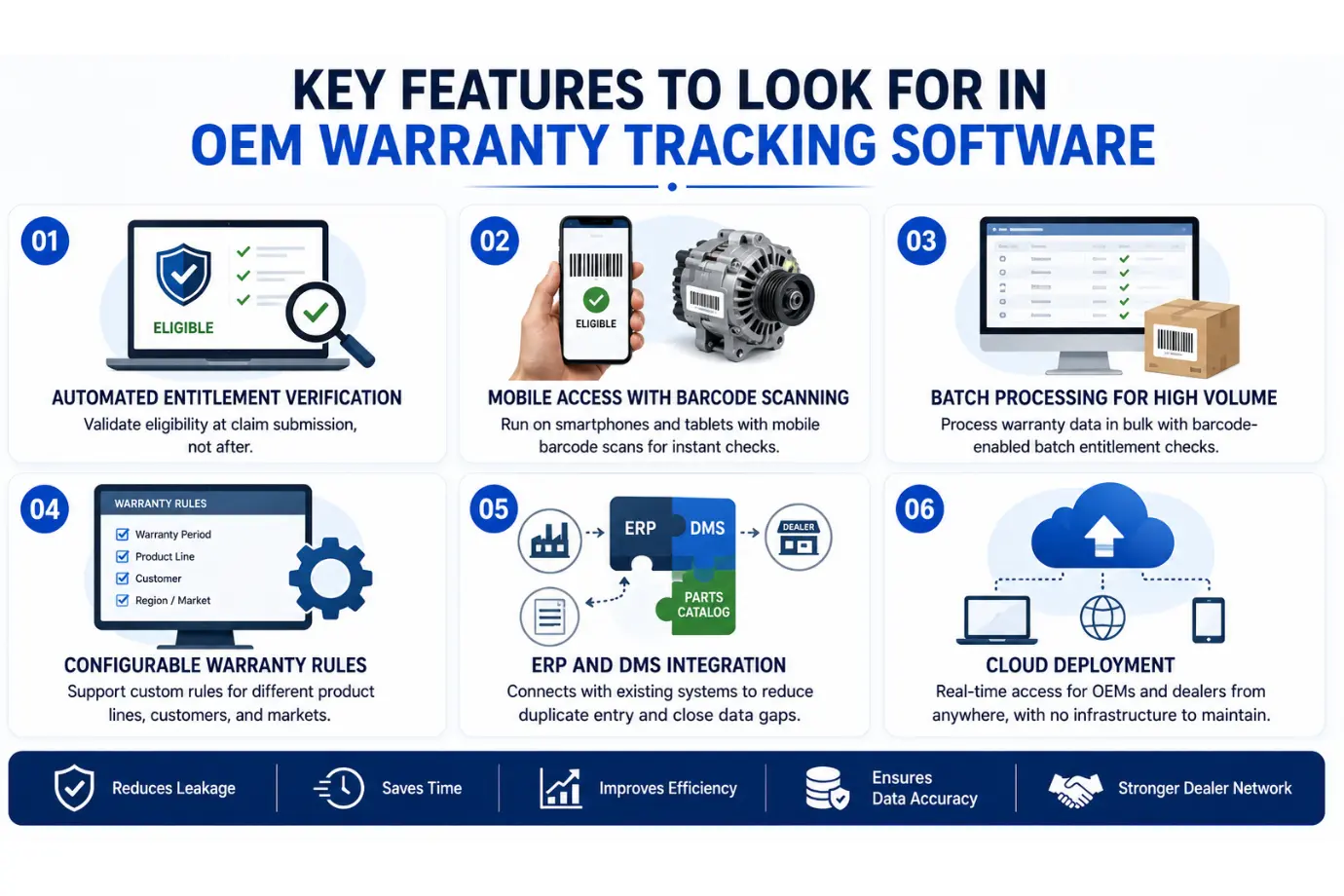
Not all warranty tracking systems are built for OEM complexity. A dealer network spanning multiple countries, product lines, and warranty tiers needs more than a basic claims portal. When evaluating options, these are the capabilities that matter:
Automated Entitlement Verification
The system should validate eligibility at claim submission, not after. Automated entitlement checking at the point of entry is the single most effective way to reduce leakage and eliminate the need for large manual review teams.
Mobile Access with Barcode Scanning
Dealer technicians work on the shop floor. The system needs to run on smartphones and tablets, and entitlement checks should be possible through a mobile barcode scan against the part serial number. This removes friction at the point of service and accelerates claim submission.
Batch Processing for High Volume
OEMs with large dealer networks and high claim volumes need the ability to process warranty data in bulk. Systems that handle large volumes through barcode-enabled batch entitlement checks reduce the time spent on routine processing significantly.
Configurable Warranty Rules
Warranty terms vary by product line, customer, and market. The software needs to support custom rules without requiring a developer to change configuration every time terms are updated.
ERP and DMS Integration
Warranty tracking does not operate in isolation. It needs to connect with existing ERP, parts catalog, and dealer management systems. Integration reduces duplicate data entry and avoids the gaps that form between disconnected systems.
Cloud Deployment
A cloud-hosted warranty tracking system means OEMs and authorized dealers work from the same real-time database, regardless of location, no local infrastructure to maintain, no version inconsistencies across regions.
How Automated Entitlement Checks Stop Warranty Fraud Before It Starts
Manual entitlement checks create gaps. When a service desk is processing high volumes and a dealer submits a claim with a plausible justification, claims tend to get approved. The issue is not intent; it is a process that puts humans in a position where verifying every claim carefully is not operationally realistic.
Automated entitlement verification removes that gap. The moment a claim arrives, the system checks the serial number, the purchase date, the warranty tier, the service type, and whether the specific part has been claimed before. If any check fails, the claim is flagged at the front end not approved and audited later.
In OEM networks where a single dealer submits hundreds of claims per month, this kind of immediate validation is the only scalable approach. Human review remains valuable for exception handling, but it should not be the primary line of defense against claims that a system can validate automatically.
Why Cloud-Based Warranty Tracking Changes OEM Operations
Legacy warranty systems were often deployed locally on-premises at OEM headquarters or at individual dealer locations. The result was fragmented data, version inconsistencies, and a central team that never had a real-time view of what was happening across the network.
Cloud-hosted warranty tracking solves this structurally. OEMs, regional service managers, and authorized dealers all work from the same database. When a claim is submitted at a dealership, the central team sees it immediately. When a warranty record is updated, that update is reflected across every authorized user at once.
For OEMs operating across multiple countries with different warranty terms per market, this single-source-of-truth architecture is not a convenience, it is an operational requirement. It also makes the system accessible from any device, which matters for service teams who need to run entitlement checks from the workshop floor.
Benefits of Warranty Tracking Software for OEMs
- Reduce warranty leakage and protect revenue margins
- Automate entitlement verification to eliminate manual review bottlenecks
- Trigger renewal notifications before warranties lapse
- Generate supplier recovery documentation automatically
- Improve dealer service efficiency with instant mobile entitlement checks
- Centralize warranty data for complete visibility across the dealer network
- Reduce fraud through systematic claim validation and pattern detection
- Improve customer confidence with accurate warranty records and timely renewals
Stop warranty leakage before it impacts your bottom line. Discover how automated entitlement verification and real-time warranty tracking help OEMs reduce costs, prevent fraud, and improve dealer operations. Schedule a demo today.
Frequently Asked Questions
What is warranty tracking software?
Warranty tracking software is a platform that helps OEMs and dealers manage spare parts warranty data including entitlement verification, claim processing, renewal alerts, and audit trails from a centralized, cloud-accessible system.
How does warranty tracking software reduce leakage?
It reduces leakage by automating entitlement checks at claim submission, flagging out-of-window claims before they are paid, preventing duplicate submissions, and creating a digital audit trail that supports supplier recovery.
What types of OEMs benefit from warranty tracking software?
Any OEM managing a dealer network with large volumes of spare parts warranties, including automotive, construction equipment, agricultural machinery, and industrial equipment manufacturers.
Can warranty tracking software integrate with existing ERP systems?
Yes. Leading warranty tracking systems integrate with existing ERP, dealer management, and parts catalog systems through standard APIs, minimizing disruption and eliminating duplicate data entry.
How do customers benefit from OEM warranty tracking software?
Customers receive automated renewal reminders before warranties expire, faster service responses due to instant entitlement verification, and greater confidence that their warranty coverage is accurately recorded.
What happens to extended warranties without tracking software?
Without automated tracking, extended warranties commonly lapse without renewal because neither the customer nor the dealer is notified in time resulting in revenue loss for the OEM and unexpected repair costs for the customer.
Is warranty tracking software difficult to implement?
Modern warranty tracking platforms are built to integrate with existing systems and can import data from spreadsheets during onboarding. The right software is configurable without heavy custom development.


Explore More Insights







.webp)


About the Author


Chandra Shekhar
Chandra Shekhar is the Senior Manager, Strategy & Business Development at Intellinet Systems. With over a decade of experience in the automotive industry, Chandra Shekhar has led digital transformation and aftersales strategy initiatives for OEMs across multiple markets. His background combines deep industry knowledge with a practical understanding of how technology can solve real operational challenges. He focuses on making complex ideas clear and relevant for automotive and aftermarket professionals navigating ongoing change.


