

Overview: A Parts Lookup Module is the search and identification components inside Electronic Parts Catalog Software that lets dealers and technicians find the correct replacement part using a VIN, model, serial number, or part number. It replaces manual searching through printed manuals and static PDFs with structured, filterable search results. For OEMs, this module is the single biggest factor in whether a dealer orders the right part on the first attempt.

This guide covers how the parts lookup module works, what business problems it solves, and what to look for when evaluating one for your dealer network.
Key Takeaways:
- A Parts Lookup Module is the search feature within an Electronic Parts Catalog that identifies the correct part using VIN, model, serial number, or part number.
- Manual searches through PDFs and printed catalogs remain a leading cause of wrong-part orders and repair delays.
- VIN and serial number lookup narrow results to the exact configuration of a unit, reducing fitment errors.
- Illustrated exploded views and hotspot navigation let users visually confirm a part before ordering.
- Part supersession and alternate parts logic prevent lost sales when an original part number is discontinued or out of stock.
- Dealers using a structured lookup module process repair orders faster and rely less on OEM support staff.
- Evaluating a parts lookup module should focus on search accuracy, integration depth, and mobile access, not just feature count.
Help Your Dealers Find the Right Part Faster. Request an Intelli Catalog Demo
What Is a Parts Lookup Module?
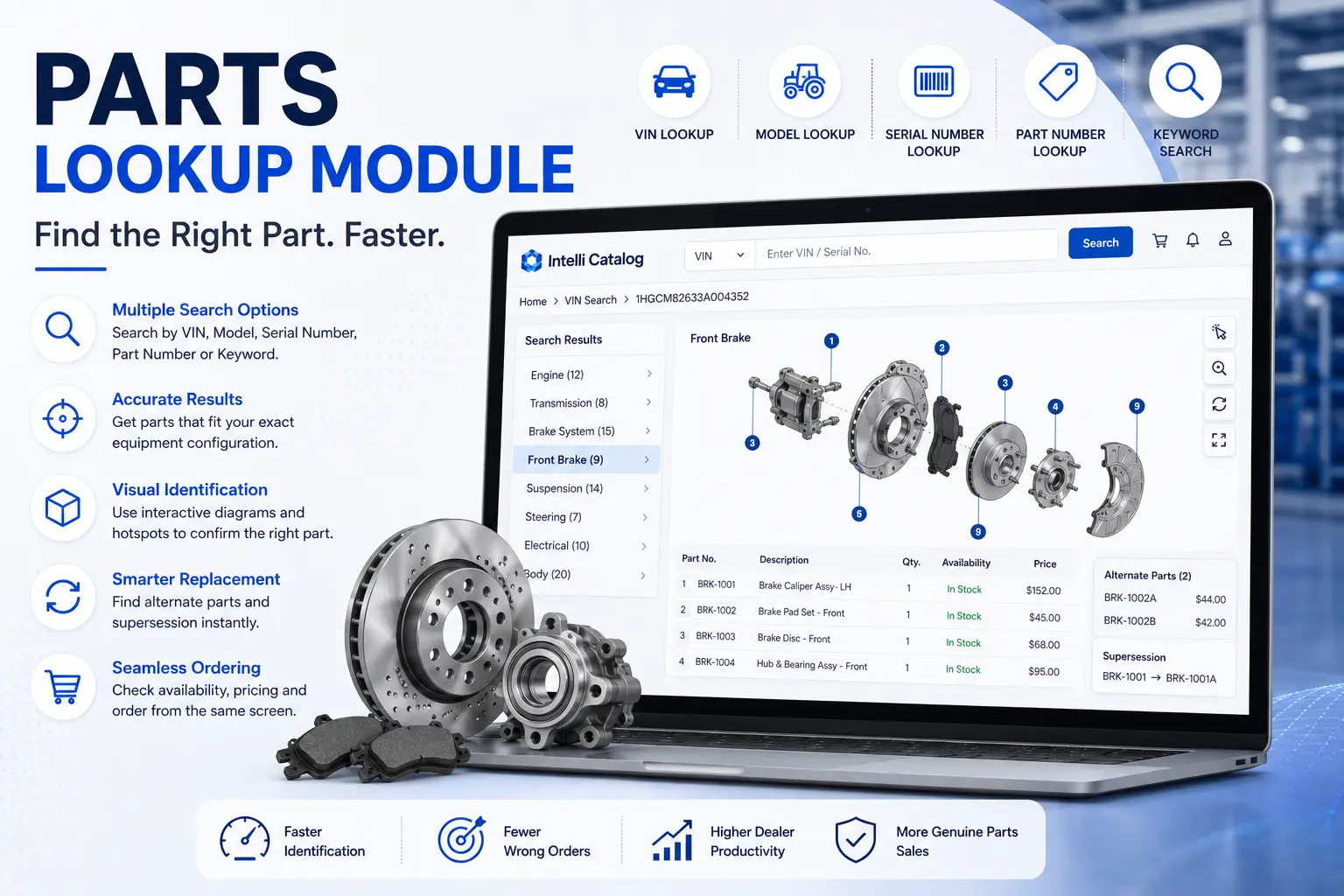
A Parts Lookup Module is a feature within Electronic Parts Catalog Software that functions as the search tool for matching a technician’s input, such as a VIN or part number, to the correct component in an OEM’s parts data. It is designed to return an exact match in seconds, rather than a list of possibilities that technicians have to sort through manually.
The module typically sits inside an electronic parts catalog, working alongside illustrated diagrams and ordering tools. It pulls from a structured parts database rather than a static document, so results reflect current part numbers, supersession, and availability.
OEMs use it because parts identification is the step where most ordering mistakes happen. A well-built lookup module removes guesswork by narrowing results based on the exact configuration of the unit in front of the technician.
Purpose and fit within the catalog:
- Acts as the entry point for most dealer interactions with the parts catalog
- Connects free-text and structured search to a validated parts database
- Feeds directly into ordering, inventory, and pricing systems
- Reduces reliance on OEM support staff for basic identification questions
Why Traditional Parts Identification Methods Create Problems?
Printed catalogs, PDF manuals, and manual phone or email support slow down parts identification and increase the rate of wrong orders. Each method depends on a person interpreting static information correctly, which introduces room for error at every step.
The scale of the identification problem is significant. A Ricardo survey found that around 10% of parts in incoming orders were not unequivocally identifiable, while 93% of respondents considered accurate parts identification extremely important to workshop customers.
These methods were adequate when product lines were smaller, and part counts were lower. As OEM catalogs have grown more complex, the limitations have become harder to absorb.
- Printed catalogs: Flipping through hundreds of pages to find a single part number wastes valuable technician time on every repair order.
- PDF manuals: Searchable text helps, but PDFs cannot filter by VIN or reflect a supersession without a full document update.
- Manual searches: Technicians without a clear part description often guess, based on what looks similar in a diagram.
- Phone and email support: Waiting on an OEM representative to confirm a part number adds hours or days to a repair.
- Wrong-part orders: Ambiguous descriptions and outdated references lead directly to parts that do not fit.
- Repair delays: Every wrong order restarts the identification process, extending vehicle or equipment downtime.
- Increased returns: Parts that do not fit generate return shipments, restocking costs, and dealer frustration.
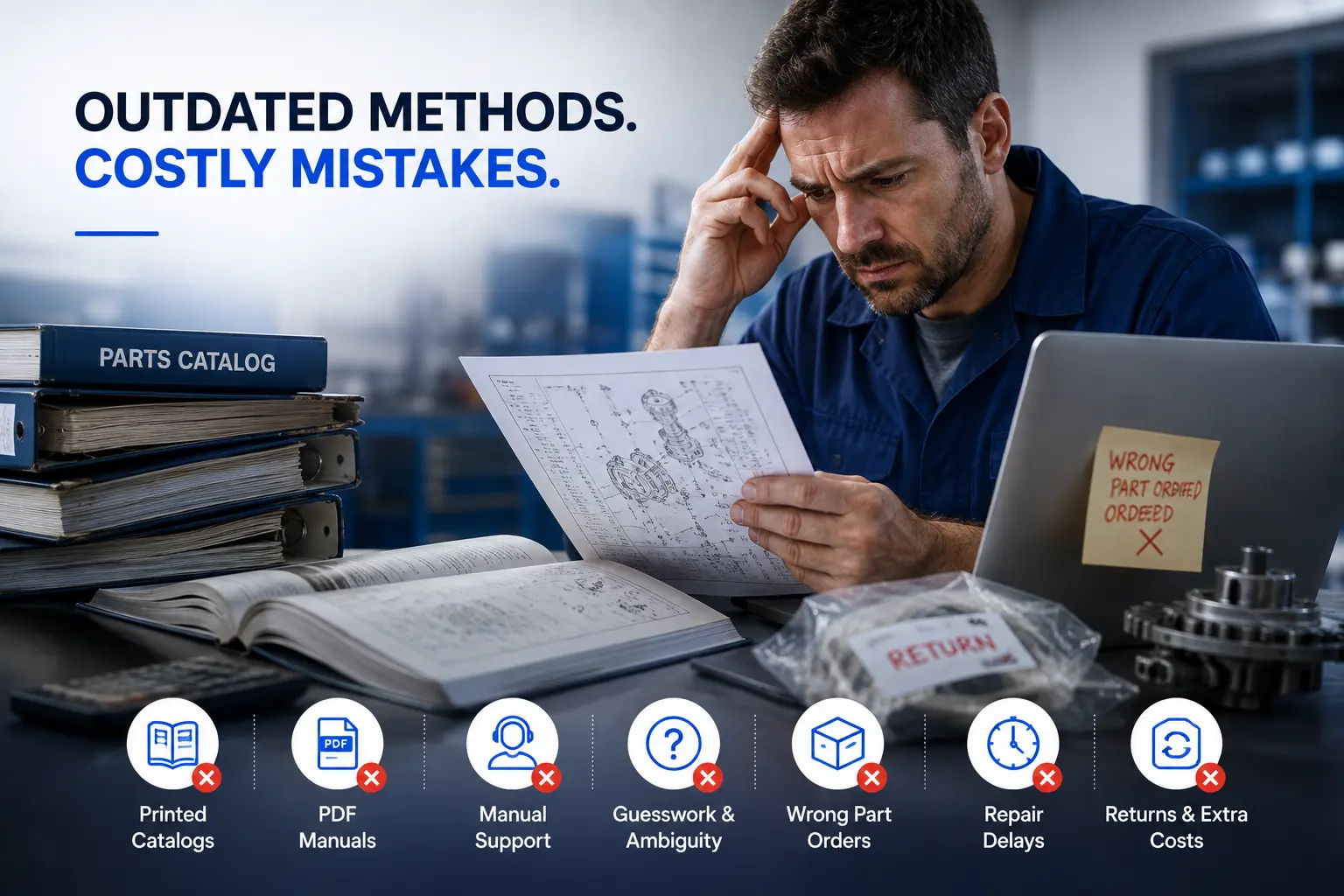
None of these issues are isolated. A wrong order caused by a static PDF leads to a return, a repair delay, and often a frustrated customer, all from a search that should have taken only seconds.
How Does a Parts Lookup Module Work?
A Parts Lookup Module works by matching structured input, such as a VIN, model, or part number, against a validated parts database and returning an exact or narrowed set of results. Each search method below serves a different identification scenario.
VIN Lookup
How it works: The system decodes the vehicle identification number and maps it to the exact bill of materials for that specific unit, not just the general model.
Business value: Dealers see only parts that fit the vehicle in front of them, including trim, engine, and production-date variations.
Operational impact: VIN-based parts lookup eliminates fitment errors by returning results specific to the individual vehicle rather than the general model.
Model Lookup
How it works: Users search by model name or number when a VIN or serial number is unavailable, returning parts common to that model line.
Business value: This provides a practical fallback for parts research before a unit is physically in the shop.
Operational impact: Useful for pre-ordering and quoting, though it carries more risk of configuration mismatches than VIN search.
Serial Number Lookup
How it works: Common in construction, agriculture, and industrial equipment, this method maps a serial number to the exact production configuration of that unit.
Business value: It accounts for mid-production design changes that a model number alone would miss.
Operational impact: Reduces misorders on equipment where configurations shift frequently within the same model year.
Part Number Lookup
How it works: When a technician already has a part number from a label or old part, direct search confirms whether it is current or superseded.
Business value: This is the fastest path to an order when the part number is known and accurate.
Operational impact: Prevents ordering a discontinued part by surfacing the current replacement automatically.
Keyword Search
How it works: Users search using plain-language descriptions, such as "front brake caliper," when they do not know an exact part number.
Business value: This lowers the skill barrier for less experienced technicians and new dealer staff.
Operational impact: Reduces failed searches that would otherwise require a call to OEM support.
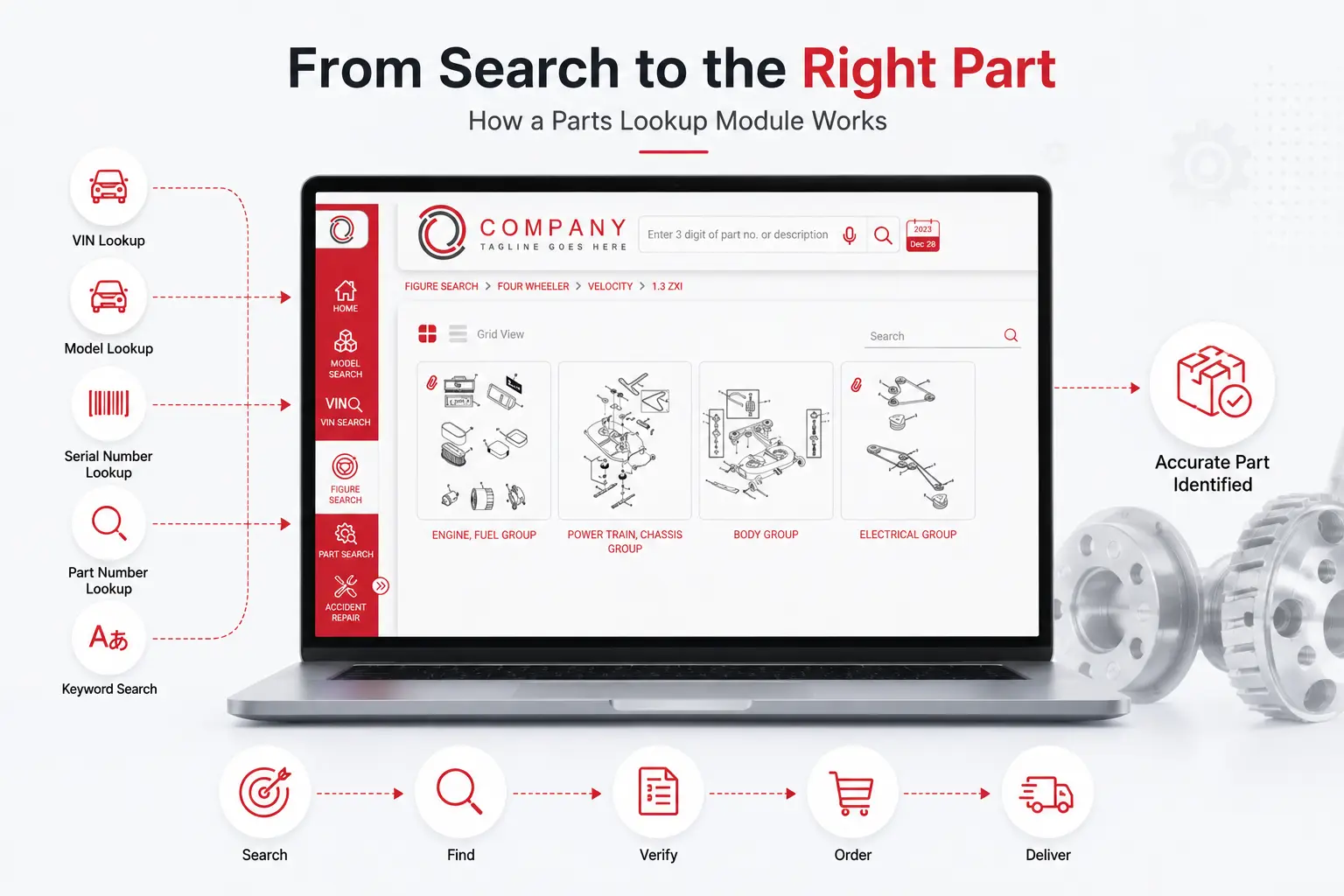
Illustrated Exploded Views
How it works: An Illustrated Parts Catalog uses exploded-view diagrams to break an assembly into its individual components, making parts easier to identify than in a text-only list.
Business value: Technicians can visually compare the diagram to the physical part before finalizing an order.
Operational impact: Visual confirmation reduces the return rate tied to misidentified components.
Hotspot Navigation
How it works: Clickable points on an exploded-view diagram link directly to part details, pricing, and availability.
Business value: Users move from visual identification to order placement without leaving the diagram.
Operational impact: Shortens the path from search to order, reducing time spent per repair order.
Alternate Parts
How it works: When a primary part is out of stock, the module surfaces approved substitutes that meet the same specification.
Business value: Dealers keep sales and repairs on schedule instead of waiting on backordered stock.
Operational impact: Protects genuine parts revenue during inventory gaps rather than losing the sale to a third party.
Part Supersession
How it works: The system automatically redirects an outdated part number search to its current replacement.
Business value: Technicians never have to manually track which part numbers have changed over a product's lifecycle.
Operational impact: Parts supersession prevents failed orders and eliminates a common source of dealer frustration with OEM catalogs.
What Are the Business Benefits of a Parts Lookup Module?
A Parts Lookup Module delivers measurable gains across identification speed, order accuracy, and dealer productivity. These benefits compound across a full dealer network, where even small time savings per order add up quickly.
- Faster parts identification, cutting search time from minutes to seconds
- Reduced wrong-part orders through VIN, serial number, and supersession accuracy
- Lower return rates from visual confirmation before ordering
- Higher dealer productivity, with less time spent on manual lookups
- Faster repairs and shorter vehicle or equipment downtime
- Better customer satisfaction from fewer repeat visits
- Higher genuine parts sales, since accurate identification keeps orders inside the OEM network
- Reduced OEM support requests, freeing internal teams for higher-value work
Which Industries Benefit Most From a Parts Lookup Module?
Every industry that sells and services complex equipment relies on accurate parts identification, but the search methods that matter most differ by sector. Understanding these differences helps OEMs prioritize the right lookup capabilities.
- Automotive: VIN lookup is central, since trim, engine, and production-date variations directly affect fitment.
- Agriculture: Serial number lookup matters most, given frequent mid-season configuration changes across equipment lines.
- Construction Equipment: Heavy reliance on serial number and hotspot navigation due to complex, multi-component assemblies.
- Commercial Vehicles: Fleet operators need fast part number and keyword search to minimize vehicle downtime.
- Industrial Equipment: Illustrated exploded views are critical for identifying components within dense mechanical assemblies.
- Marine: Distributed dealer networks depend on centralized VIN and model lookup to maintain consistency across locations.
What Should OEMs Look for in a Parts Lookup Module?
The right parts lookup module combines multiple search methods with integration into ordering and inventory systems. Evaluate vendors against this checklist rather than a single standout feature.
- VIN lookup for unit-specific accuracy
- Serial number lookup for equipment with configuration variance
- Part number search with supersession handling built in
- Illustrated diagrams with hotspot navigation
- Alternate parts logic for out-of-stock scenarios
- Direct ERP integration for real-time pricing and availability
- Dealer ordering built into the same interface as search
- Mobile support for field technicians and shop floor use
- Multi-language support for global dealer networks
How Intelli Catalog Supports Accurate Parts Identification
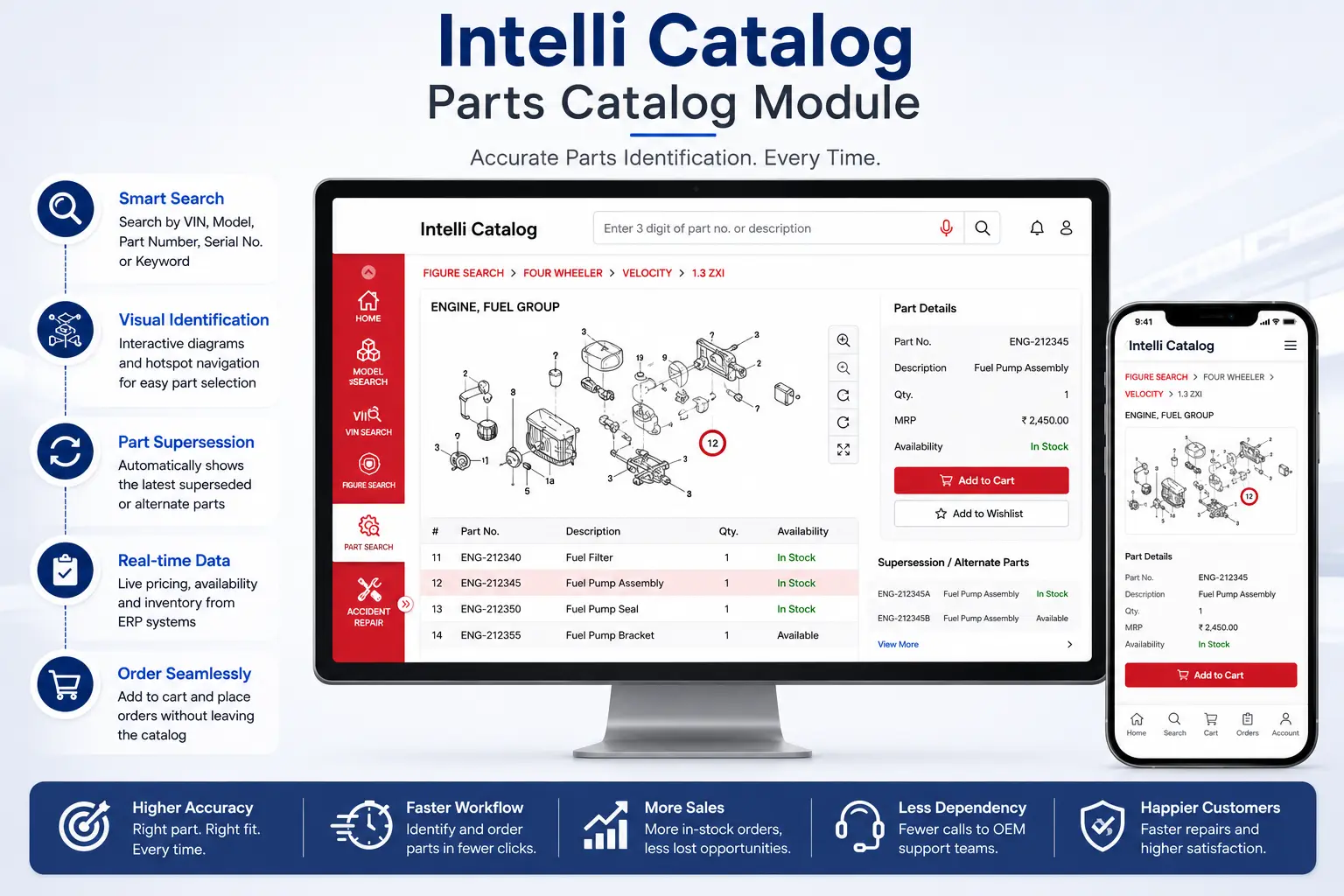
Intelli Catalog includes a parts lookup module built to handle VIN, model, and part number search within Electronic Parts Catalog Software, with illustrated diagrams that help dealers and technicians confirm the correct part before ordering.
VIN and model lookup narrow results to the exact configuration of a unit, while hotspotting on exploded-view diagrams lets technicians visually confirm a part before ordering. This visual step reduces misidentification on complex assemblies.
Part supersession is handled automatically within the search results, so an outdated part number search still returns the current, orderable replacement. Dealers are not left guessing when an OEM discontinues or redesigns a component.
The module connects directly to OEM ERP systems, keeping pricing and inventory current at the moment of search. Dealers can place an order from the same screen where they confirmed the part, without a separate manual step.
Conclusion
A Part Lookup Module is the point where parts identification either works or breaks down. VIN, serial number, and part number search, combined with illustrated diagrams and supersession logic, replace guesswork with accurate, fast results.
For OEMs managing large product lines and dealer networks, this module directly affects order accuracy, repair speed, and how much genuine parts revenue stays inside the authorized network. It is a core piece of any Electronic Parts Catalog Software strategy focused on aftermarket growth.
Want to see how a dedicated parts lookup module can cut wrong orders and speed up your dealer network? Book a demo of Intelli Catalog today.
FAQ
What is a parts lookup module?
A parts lookup module is the search functionality within Electronic Parts Catalog Software that enables dealers and technicians to quickly identify the correct part using a VIN, model, serial number, or part number, eliminating the need to search manually in printed catalogs.
How does VIN lookup improve parts accuracy?
VIN lookup decodes a vehicle’s build data and maps it to the exact bill of materials, allowing search results to reflect the specific vehicle rather than a generic model. This improves part fitment accuracy and significantly reduces the risk of incorrect part selection.
Why do dealers order the wrong parts?
Wrong orders usually stem from ambiguous descriptions in static catalogs, outdated part numbers, or a lack of visual confirmation, all of which a structured lookup module with illustrated diagrams is designed to prevent.
What is part supersession in a parts catalog?
Part supersession is the process of automatically directing a search for a discontinued part number to its current replacement, preventing failed orders when an OEM redesigns or replaces a component.
Can a parts lookup module work on mobile devices?
Yes. Most modern parts lookup modules support mobile and tablet access, allowing field technicians and shop floor staff to search and confirm parts without returning to a desktop terminal.


Explore More Insights







.webp)


About the Author


Chandra Shekhar
Chandra Shekhar is the Senior Manager, Strategy & Business Development at Intellinet Systems. With over a decade of experience in the automotive industry, Chandra Shekhar has led digital transformation and aftersales strategy initiatives for OEMs across multiple markets. His background combines deep industry knowledge with a practical understanding of how technology can solve real operational challenges. He focuses on making complex ideas clear and relevant for automotive and aftermarket professionals navigating ongoing change.


