

Overview: Automotive warranty claims management is the process OEMs and their dealer networks use to submit, validate, approve, and reimburse warranty repair claims. When warranty claims are managed through spreadsheets, email, and manual reviews, the process creates delays, payment errors, and fraud risks that quietly erode profit margins. Modern warranty claims management software replaces these disconnected workflows with automated validation, standardized approvals, fraud detection, supplier recovery, and real-time visibility across the entire claims lifecycle.

Key Takeaways:
- Automotive warranty claims management directly impacts OEM profitability by reducing claim costs, shortening cycle times, and minimizing fraud risks.
- Manual, paper-based, or spreadsheet-driven claims processes slow approvals and increase the risk of overpayment.
- Warranty claim automation shortens the claim-to-payment cycle and frees warranty teams from repetitive review work.
- Warranty claim validation rules catch duplicate, incomplete, or ineligible claims before payment goes out.
- OEM warranty management platforms improve supplier recovery, giving OEMs stronger data to recover costs from parts suppliers.
- Choosing the right automotive warranty management software requires clear evaluation criteria and a phased rollout plan.
Transform your automotive warranty operations with Intelli Warranty. Book a live demo to streamline claims processing
What Is Automotive Warranty Claims Management?
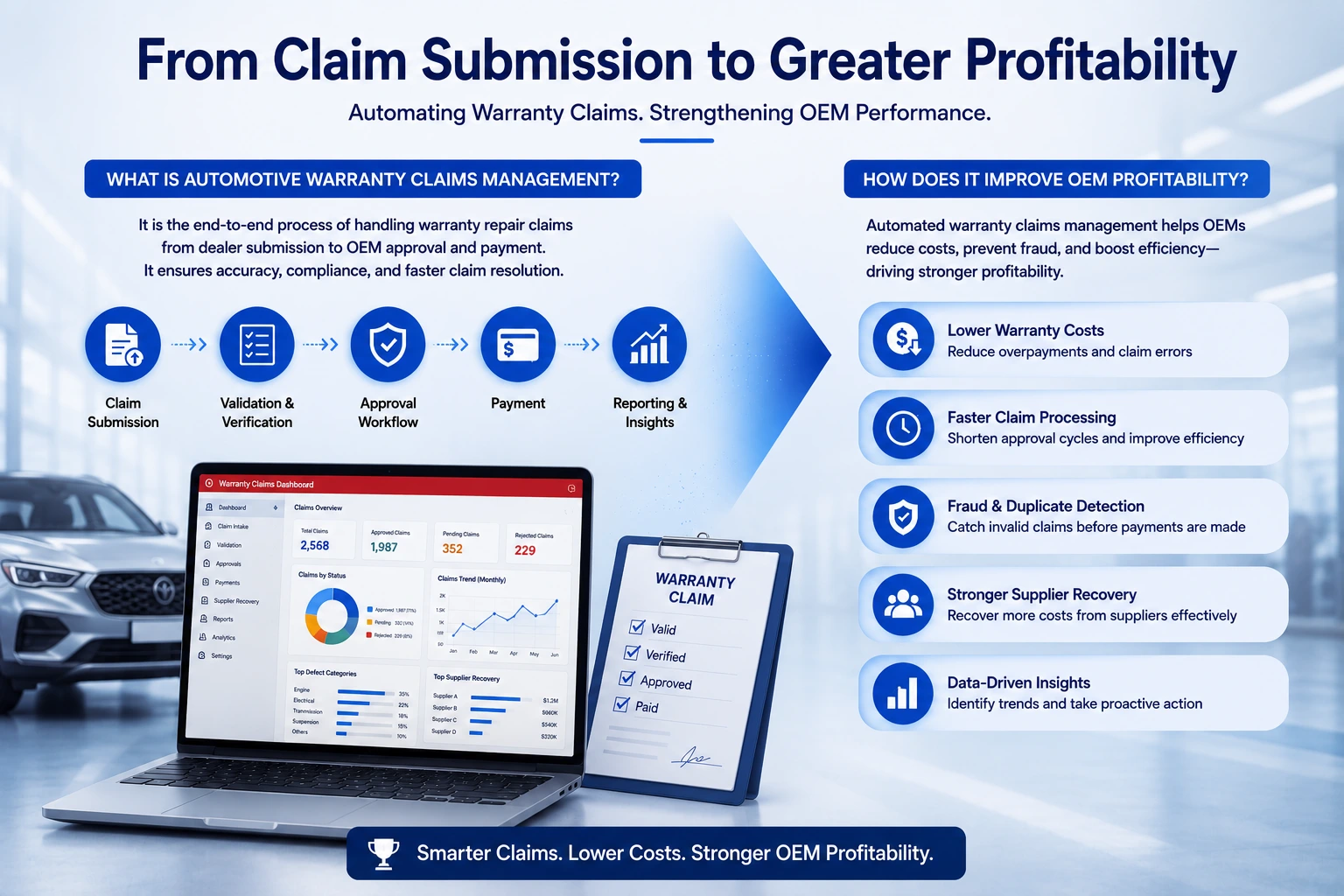
Automotive warranty claims management is the end-to-end process of handling a warranty repair claim, from the moment a dealer submits it to the moment the OEM approves, pays, or rejects it. It includes claim intake, document review, eligibility checks, payment processing, and reporting.
For OEMs, this process touches thousands of dealers and millions of dollars in claims each year. Every step, from checking a vehicle identification number against build data to confirming labor time against a standard repair guide, affects how much the OEM ultimately pays. When these checks are manual, errors and delays are common. When they are automated and rules-based, claims move faster, and payments are more accurate.
How Does Automotive Warranty Claims Management Improve OEM Profitability?
Automotive warranty claims management improves OEM profitability by reducing claim overpayment, shortening approval cycles, and lowering the administrative cost of processing each claim. Faster, more accurate claims handling means less money paid on invalid claims and lower labor cost per claim reviewed.
A McKinsey analysis of the auto industry found that warranty-related costs have nearly doubled since 2012 and reached roughly $58 billion globally in 2024, about 2.2 percent of industry sales. For some OEMs, warranty costs now exceed 4 percent of revenue, a figure that rivals annual research and development spending. This scale of spending means even small improvements in claims accuracy or processing speed translate into meaningful savings.
Profitability gains typically come from four areas:
- Fewer overpayments: automated validation flags claims that do not meet coverage terms before payment is issued.
- Lower processing cost: automation reduces the manual labor needed to review, approve, or reject each claim.
- Faster supplier recovery: structured claim data makes it easier to identify and recover costs from Tier 1 suppliers.
- Earlier defect detection: Warranty claims data reveals recurring defects sooner, helping OEMs reduce future warranty exposure and lower recall risk.
What Is the Real Cost of Manual Warranty Claims Processing?
Manual warranty claims processing increases costs through slow cycle times, inconsistent review standards, and a higher rate of paid claims that should have been rejected or sent back for correction. These costs build up across a dealer network of hundreds or thousands of locations.
Beyond the automotive sector specifically, warranty costs are also rising across manufacturing industries. In 2025, U.S.-based manufacturers paid a combined $30.37 billion in warranty claims, an increase of 4 percent from 2024, according to Warranty Week's annual industry analysis. At the scale, a small percentage of claims processed incorrectly, whether overpaid, duplicated, or approved without full documentation, adds up to a high and avoidable cost.
Common manual-process problems include:
- Claims reviewed against outdated labor time guides or parts pricing.
- Duplicate claims submitted for the same repair across different systems.
- Missing documentation approved because a reviewer is under time pressure.
- Delayed dealer payments that damage OEM-dealer relationships.
- Limited visibility into claim patterns until a problem has already grown large.
What Are the Key Features of Warranty Claims Management Software?
Warranty claims management software should combine automated intake, rule-based validation, approval workflows, and reporting in one system. The right feature set reduces manual review time while giving OEMs full visibility into claim status, cost, and trends across the entire dealer network.
Core modules to look for include:
- Claim intake and dealer portal: a single point of submission with required fields and document uploads.
- Automated warranty claim validation: rules engines that check VIN data, coverage terms, mileage, and repair codes.
- Approval workflows: routing rules that send claims to the right reviewer based on value, risk, or claim type.
- Fraud and duplicate detection: pattern recognition that flags unusual claim volume or repeat submissions.
- Supplier recovery tracking: tools to identify and pursue chargebacks from parts and component suppliers.
- Analytics and reporting: dashboards that surface claim trends, cost by model or plant, and defect patterns.
- Integration with dealer management and ERP systems: data flows without manual re-entry.
How Does Warranty Claim Validation Reduce Fraud and Errors?
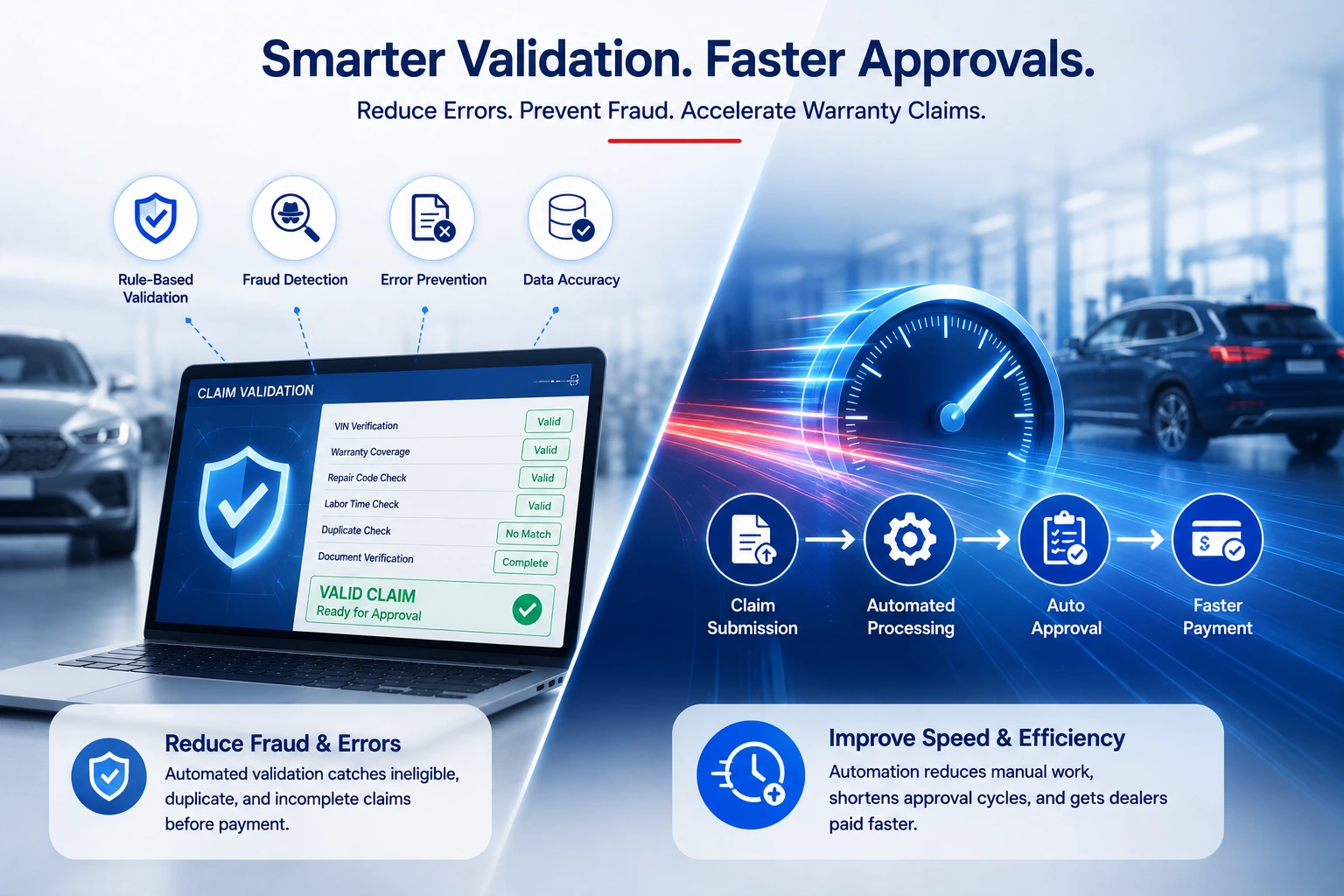
Warranty claim validation is the automated checking of each claim against coverage rules, vehicle data, and repair standards before payment is approved. It catches ineligible, duplicate, or incomplete claims early, which prevents overpayment and reduces the manual back-and-forth between OEM and dealer.
Validation rules typically check multiple data points at once, including whether the vehicle is still within its warranty period, whether the reported repair matches the diagnostic code, whether the claimed labor time falls within standard guidelines, and whether the same repair has already been submitted as a warranty claim. By automating these checks, dealers receive faster decisions, while OEMs reduce the number of claims that require manual review or escalation.
How Does Warranty Claim Automation Improve Speed and Efficiency?
Warranty claim automation uses rules-based processing to replace manual reviews, enabling straightforward claims to be approved or flagged within minutes rather than days. This shortens the claim-to-payment cycle, reduces the backlog of claims awaiting review, and lets warranty teams focus on complex or high-value cases.
Automation does not remove human judgment from the process. It removes repetitive, low-risk decisions from human queues so reviewers spend their time on claims that genuinely need attention, such as high-cost repairs, unusual patterns, or first-time defect reports. This shift improves both speed and the quality of review on the claims that matter most.
What Does an Effective OEM Warranty Management Checklist Look Like?
OEM warranty management works best when it follows a consistent set of practices across the entire dealer network, rather than varying by region or reviewer. A standardized approach reduces disputes, improves data quality, and makes supplier recovery easier to pursue.
- Standardize claim submission requirements across all dealers and regions.
- Set clear service level targets for claim review and payment turnaround.
- Review validation rules quarterly against updated labor and parts data.
- Track claim trends by model, plant, and supplier to catch defects early.
- Give dealers visibility into claim status to reduce support calls and disputes.
- Audit a sample of approved claims regularly to check for process drift.
- Document supplier recovery cases with the data needed to support each claim.
Why OEMs Choose Intelli Warranty
Intelli Warranty provides OEMs with a centralized platform for warranty claim intake, automated validation, approval workflows, supplier recovery tracking, and real-time reporting. Instead of relying on spreadsheets, email chains, or disconnected systems, warranty teams can manage the complete claim lifecycle from a single application.
The platform includes configurable validation rules that automatically verify VIN eligibility, warranty coverage, labor operations, parts usage, and supporting documentation before a claim reaches an approver. High-value or exception claims can be routed through configurable approval workflows, while routine claims are processed faster with automated rule-based validation.
Intelli Warranty also integrates with dealer management systems (DMS), ERP platforms, and parts catalogs, reducing duplicate data entry and ensuring warranty decisions are based on accurate vehicle and repair information. Built-in dashboards provide visibility into claim status, approval cycle times, defect trends, supplier recovery opportunities, and warranty costs across the dealer network.
For OEMs replacing manual or spreadsheet-based warranty processes, Intelli Warranty provides the tools to standardize claim handling, improve data quality, accelerate approvals, and generate actionable insights from warranty data.
Conclusion
Automotive warranty claims management is a direct lever on OEM profitability, not a back-office function to overlook. Manual processes create overpayment, slow cycle times, and missed supplier recovery opportunities, all of which erode margin at a scale that industry data shows is already substantial. Warranty claims management software addresses these gaps through automated validation, faster approval workflows, and clearer reporting on claim trends. OEMs that standardize their warranty management practices and invest in the right automotive warranty management system put themselves in a stronger position to control costs, protect dealer relationships, and turn warranty data into an early signal for quality improvement.
Ready to Streamline Warranty Claims?
Schedule a personalized demo to discover how Intelli Warranty automates validation, approvals, and supplier recovery.
Frequently Asked Questions
What is automotive warranty claims management?
Automotive warranty claims management is the process of submitting, reviewing, validating, and paying warranty repair claims between dealers and OEMs. It covers claim intake, eligibility checks, approval workflows, and reporting, and it directly affects how much an OEM spends on warranty repairs each year.
How does warranty claims management software reduce costs?
Warranty claims management software reduces costs by automating claim validation, catching duplicate or ineligible claims before payment, and shortening the review cycle. This lowers both the direct cost of overpaid claims and the administrative cost of manual review across a large dealer network.
What is the difference between warranty claim validation and warranty claim automation?
Warranty claim validation refers to the specific rules checking a claim's eligibility, such as coverage dates and repair codes. Warranty claim automation is the broader process of routing, reviewing, and approving claims with minimal manual intervention. Validation is one part of a fully automated workflow.
How long does it take to implement OEM warranty management software?
Timelines vary by dealer network size, but most OEMs run a pilot with a small group of dealers over 60 to 90 days before a phased rollout. Full network deployment typically takes several months, depending on integration complexity with existing dealer management systems.
Can warranty claims management software help with supplier recovery?
Yes. Structured claim data makes it easier to identify which defects trace back to a specific supplier or part batch. This supports stronger, better-documented supplier recovery cases, which can offset a meaningful share of an OEM's total warranty spend.


Explore More Insights








.webp)


About the Author


Chandra Shekhar
Chandra Shekhar is the Senior Manager, Strategy & Business Development at Intellinet Systems. With over a decade of experience in the automotive industry, Chandra Shekhar has led digital transformation and aftersales strategy initiatives for OEMs across multiple markets. His background combines deep industry knowledge with a practical understanding of how technology can solve real operational challenges. He focuses on making complex ideas clear and relevant for automotive and aftermarket professionals navigating ongoing change.


