Overview: Supplier recovery software helps OEMs with the identification, validation, and management of warranty claims which arise from supplier-related product failures. With automated workflows, OEMs can reduce manual effort, improve the documentation process, keep a check on contractual deadlines, and track claims through approval and final settlement.
Key Takeaways:
- Reduce warranty leakage: Enables identification of eligible supplier recovery opportunities that are otherwise overlooked.
- Automate repetitive tasks: Preparation of claims, collection of evidence, calculation of costs, and further follow-ups are significantly streamlined.
- Improve claim accuracy: Use of structured documentation and failed component verification for supporting supplier warranty claims.
- Recover costs more effectively: Tracking of claims from identification and submission through approval, issuance of credit, and reconciliation.
- Strengthen supplier accountability: Analysis of recurring parts failures, rejection of claims, and response time of suppliers.
- Improve financial visibility: Monitoring of recovery rates, outstanding claims, and vendor credits that are uncollected.
- Use warranty intelligence strategically: Recovery data is turned into actionable insights to support supplier quality improvement and cost control in the long run.
Connect warranty claims, supplier recovery, and analytics in one structured platform to improve financial control and support continuous supplier quality improvement. Schedule a Free Demo
Introduction
For any manufacturing business, warranty claims are unavoidable. These warranty claim costs don't need to be borne by the original equipment manufacturer (OEM) in full. When a product fails because of a defective component or a supplier-related quality issue, OEMs may be entitled to recover eligible warranty expenses from the supplier.
The major challenge is identifying these recovery opportunities, validating the responsibility of the supplier, calculating the recoverable amount, and ensuring these claims are submitted and settled within the required timeframe.
Supplier recovery software helps OEMs automate and streamline the recovery of eligible warranty costs from suppliers. When OEMs connect warranty claims with component traceability, inspection records, information of suppliers, calculation of costs, and the financial workflow, it can result in a business improving its recovery visibility. This can also result in a reduction of administrative efforts needed in managing supplier warranty claims.
For OEMs, supplier recovery is not just a financial exercise but is also an opportunity to strengthen supplier accountability, identify recurring product failures, and improve the overall quality across their supply chain.
In this blog, we will explore how supplier recovery software supports OEMs with a more structured approach to warranty cost recovery.
Why Manufacturers Struggle to Recover Warranty Costs from Suppliers
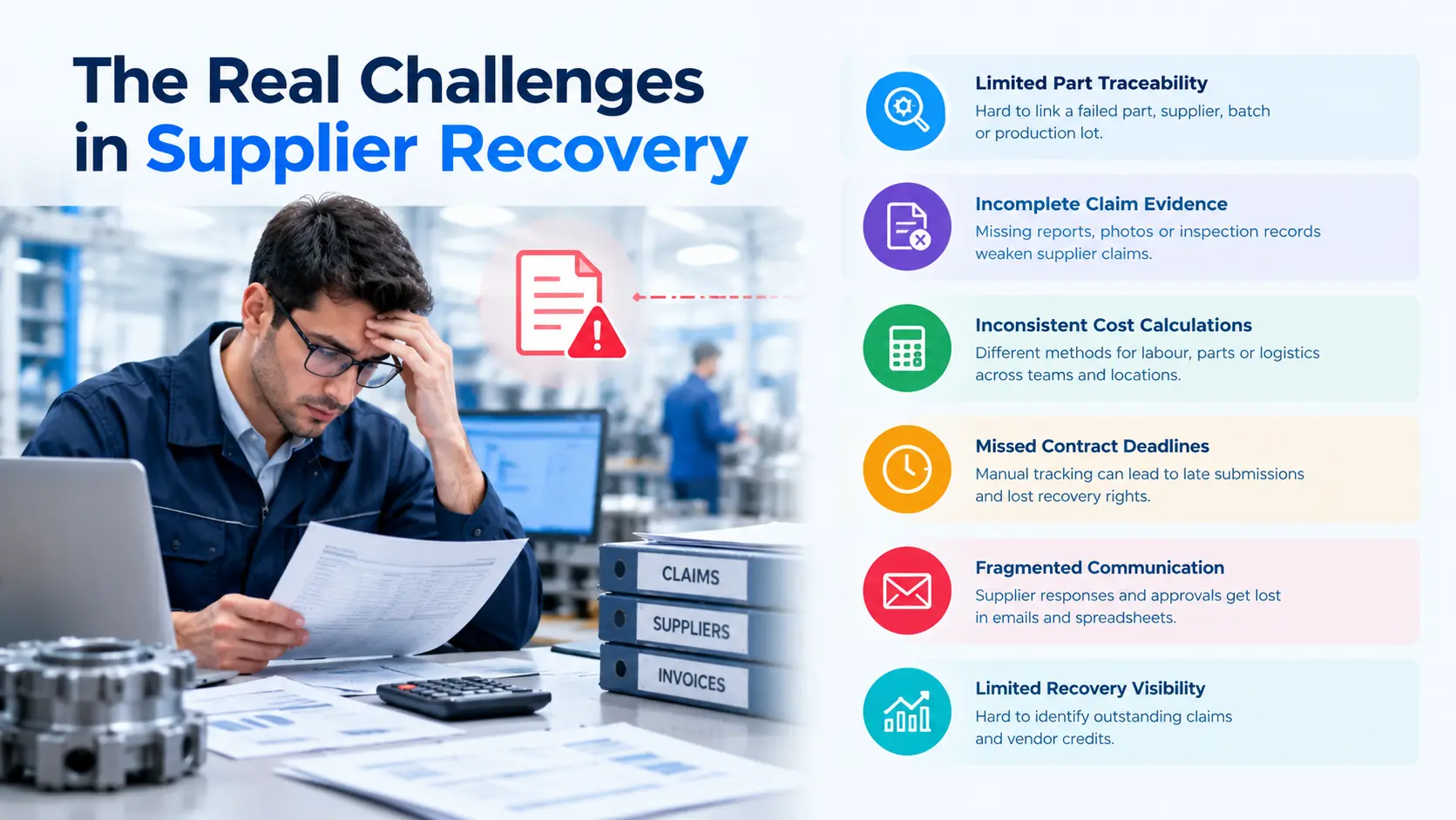
Identification of a defective part is just the first step in supplier recovery. OEMs also have to establish supplier responsibility, document the failure, calculate the costs, and submit claims within the deadline.
The most common challenges include the following:
- Limited part traceability: If the records are fragmented, connecting a failed part, supplier, batch, or the production lot can be difficult.
- Incomplete claim evidence: Supplier warranty claims are weakened because of missing inspection report, photographs, inspection reports, or failure records.
- Inconsistent cost calculations: The calculation of costs like labour, replacement parts, or logistics might be calculated differently across locations or teams.
- Missed contractual deadlines: When claims are tracked manually, it might lead to late submission, which is beyond the contractual deadline.
- Fragmented communication: Supplier communications like responses, disputes, approvals, or credit notes might be scattered across emails or spreadsheets.
- Limited recovery visibility: In the absence of consolidated reporting, warranty teams may struggle to identify outstanding claims or vendor credits.
What is the Business Impact of Inefficient Supplier Recovery
The direct business impact caused by inefficient supplier recovery is an increase in warranty costs, repeated administrative work, and limited visibility into supplier quality issues.
Missed, rejected, delayed, or unresolved eligible claims lead to OEMs absorbing the costs incurred in their entirety.
The American Society for Quality identifies warranty claims, field repairs, and part returns as common examples of external failure costs in it Cost of Quality Framework. When OEMs analyse these costs, identification of opportunities for process improvement is done and corrective action is taken for such improvement.
What is Supplier recovery Software?
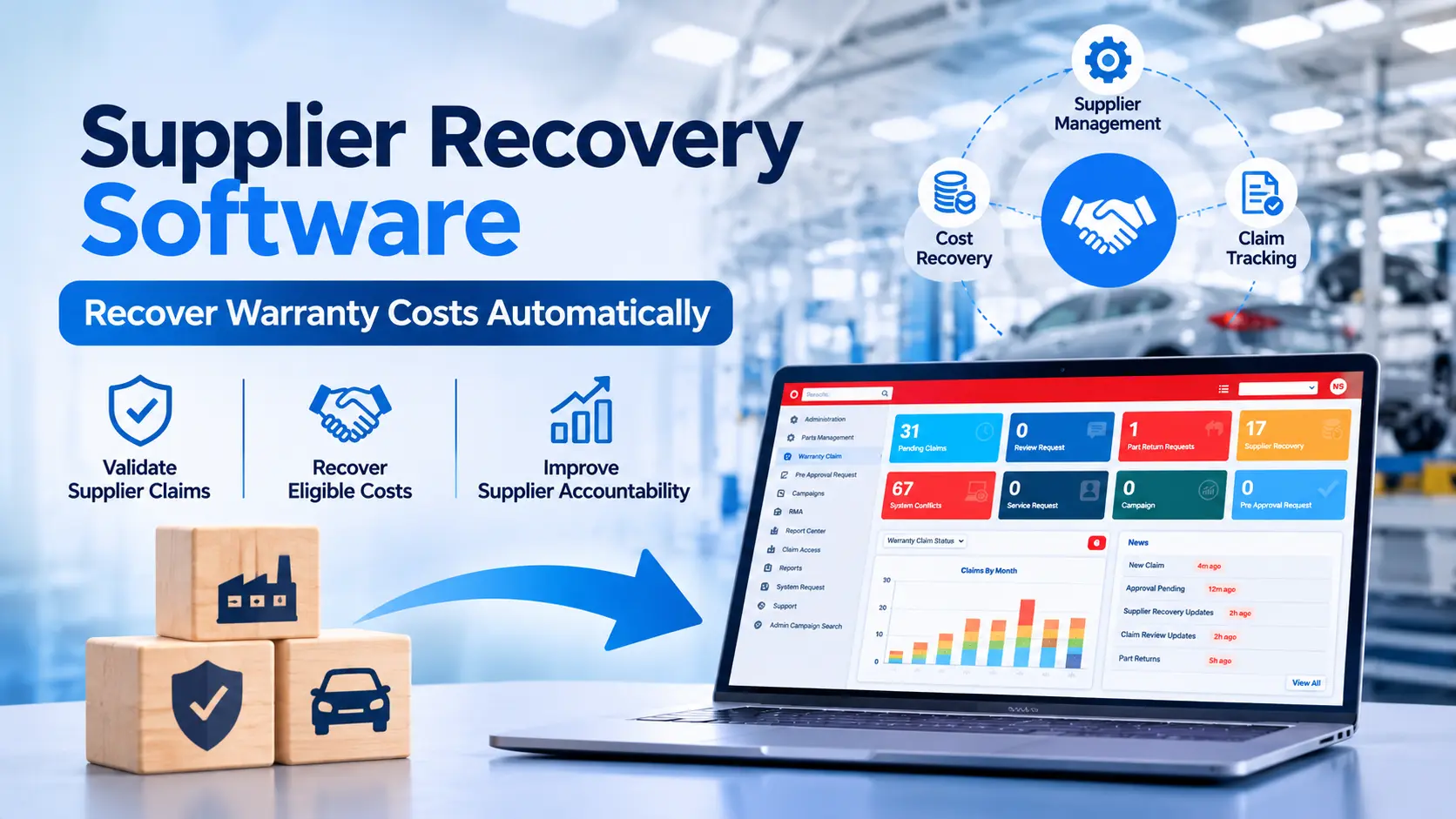
Supplier recovery software is a digital solution that enables OEMs to identify, validate, submit, track, and recover warranty-related expenses from suppliers. If the responsibility of the supplier is established through the supplier agreement, the OEM can recover those costs from the supplier.
Key Capabilities of Supplier Recovery Software
Supplier recovery software can support OEMs with the following capabilities:
- Helps with the identification of warranty claims that are recoverable.
- Enables supplier and component traceability.
- Establishes failed component verification and follows inspection workflows.
- Enables OEMs to collect and validate supporting documents.
- It also automates the cost analysis of supplier recovery costs.
- Manages the process of claim preparation, approval, and submission.
- It monitors the suppliers' responses and the dispute resolution timelines.
- It tracks the approved claims, credit notes, and the reimbursements.
- It also provides reporting on recovery performance and quality trends of the supplier.
Together, these capabilities enable OEMs to transform their supplier recovery process from reactive to a proactive cost recovery with a data-driven approach.
How Supplier Recovery Software Automates Warranty Cost Recovery
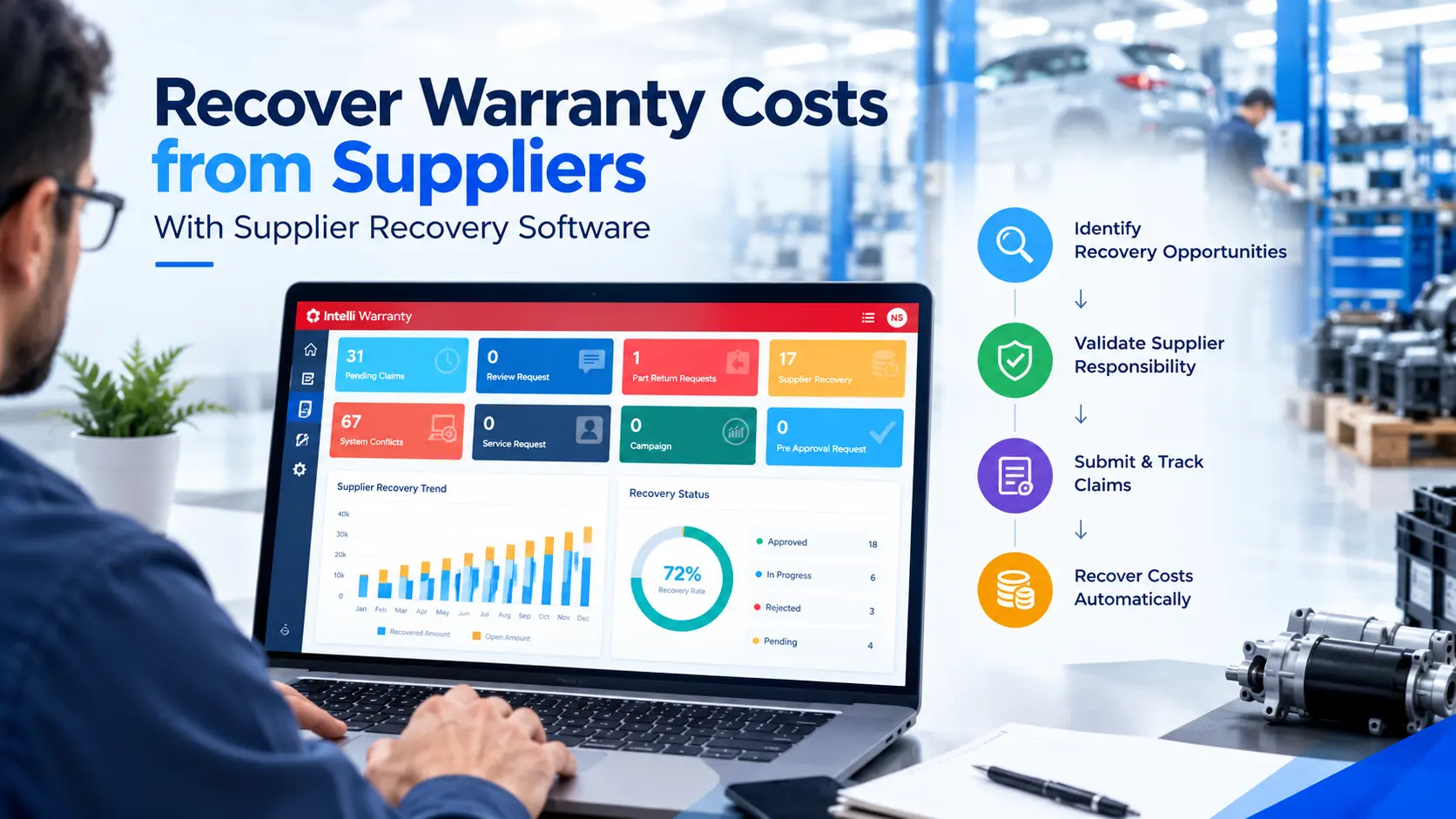
With the help of a structured workflow, supplier recovery software helps OEMs manage the supplier recovery process.
Here are the steps followed in an automated supplier recovery process:
- Identify recovery opportunities: Warranty claims and available part data are reviewed to flag failures that might be attributable to suppliers.
- Verify failed component: The claim is connected with the relevant part, supplier, batch, inspection, and service records for verification.
- Validate supporting evidence: Checks if the documentation required as per the supplier agreement is available. Identifies missing information too.
- Calculate recoverable costs: Contractual rules are applied to calculate the eligible expenses. These costs could be replaced parts, labour, or logistics.
- Prepare and submit claims: The claim information is standardised and supporting documentation improves consistency.
- Track deadlines disputes: Claim status, supplier response, outstanding actions, and dispute resolution timelines are monitored.
- Reconciliation: Approved amounts are tracked against the reimbursement or credit notes. Unresolved issues are also identified.
- Performance analysis: Recovery rates, rejection reasons, recurring failures, and supplier-level cost trends are reviewed to identify opportunities for improvement.
American Society for Quality’s Supplier Quality Score explains quality management as a proactive and collaborative process. It involves supplier performance monitoring, inspection, and continuous improvement.
What Are the Business Benefits of Automating Supplier Warranty Recovery
OEMs that implement automated supplier recovery software can improve financial control, reduce administrative efforts, and manage supplier quality more effectively.
Here is how supplier recovery software helps OEMs:
Reduce Warranty Leakage
Warranty leakages happen when the opportunities to recover eligible costs from suppliers are missed, underclaimed, delayed, or left unresolved.
When claims are not identified, evidence is incomplete, deadlines expire, or approved credit notes are not reconciled, supplier-related costs can further contribute to this problem.
Supplier recovery software implements structured identification rules, checks on submitted documentation, monitors deadlines, and tracks the recovery. With these capabilities of supplier recovery software, warranty leakages can be reduced significantly.
Improve Supplier Recovery rates
Better visibility into potential claims across products, parts, suppliers, and service locations can be achieved through a centralised recovery workflow. Rather than manually identifying recovery opportunities, OEMs can apply consistent rules to the warranty records.
Reduce Manual Administrative Work
Repeated data collection, updates across spreadsheets, calculation of costs, requests for documents, and constant supplier follow-ups are the steps involved in a manual recovery process.
Automating this can result in a significant reduction of these repetitive tasks and allow the warranty teams to focus on complex investigations, disputed claims, and initiatives for supplier improvement.
Improve Supplier Accountability
OEMs can evaluate supplier performance effectively through a centralised record of failures, claims, disputes and financial outcomes.
Recurring part failures, repeated claim rejections, or delayed responses can help procurement and quality teams identify suppliers associated with these attributes. Such actions can result in supplier recovery software contributing to long-term quality improvement rather than just being used as a tool for reimbursements.
Improve Financial Visibility
Supplier recovery software enables OEMs to differentiate between the gross warranty expenditure and the actual amount received. It can also help in managing open claims, amounts approved, outstanding payments, rate of the recovery, and the status of credit reconciliation.
Strengthened Audits
For almost every supplier recovery claim, additional evidence is required. It also needs to establish the supplier's responsibility and contractual eligibility. With a structured system, all these activities such as maintaining supporting documents, approvals, communication history, and recovery records associated with claims.
Such a process significantly improves traceability of claims and provides evidence on how a claim was raised, reviewed, and resolved.
Supplier Recovery Software vs Manual Recovery Process
As the claim volumes increase, the operational differences between manual and automated supplier recovery become apparent. Let us see how
The need for technical investigations, interpretation of contracts, or supplier negotiations is not eliminated through automation, but it provides a consistent framework for managing these activities and also tracks their outcomes.
KPIs to Measure Supplier Recovery Performance
OEMs need to establish a baseline before automation and make a performance comparison over a period of time. Each metric and its calculation should be defined consistently including its measurement and measurement period. This helps in a meaningful evaluation of changes.
How Does Intelli Warranty Support a More Structured Supplier Recovery Process
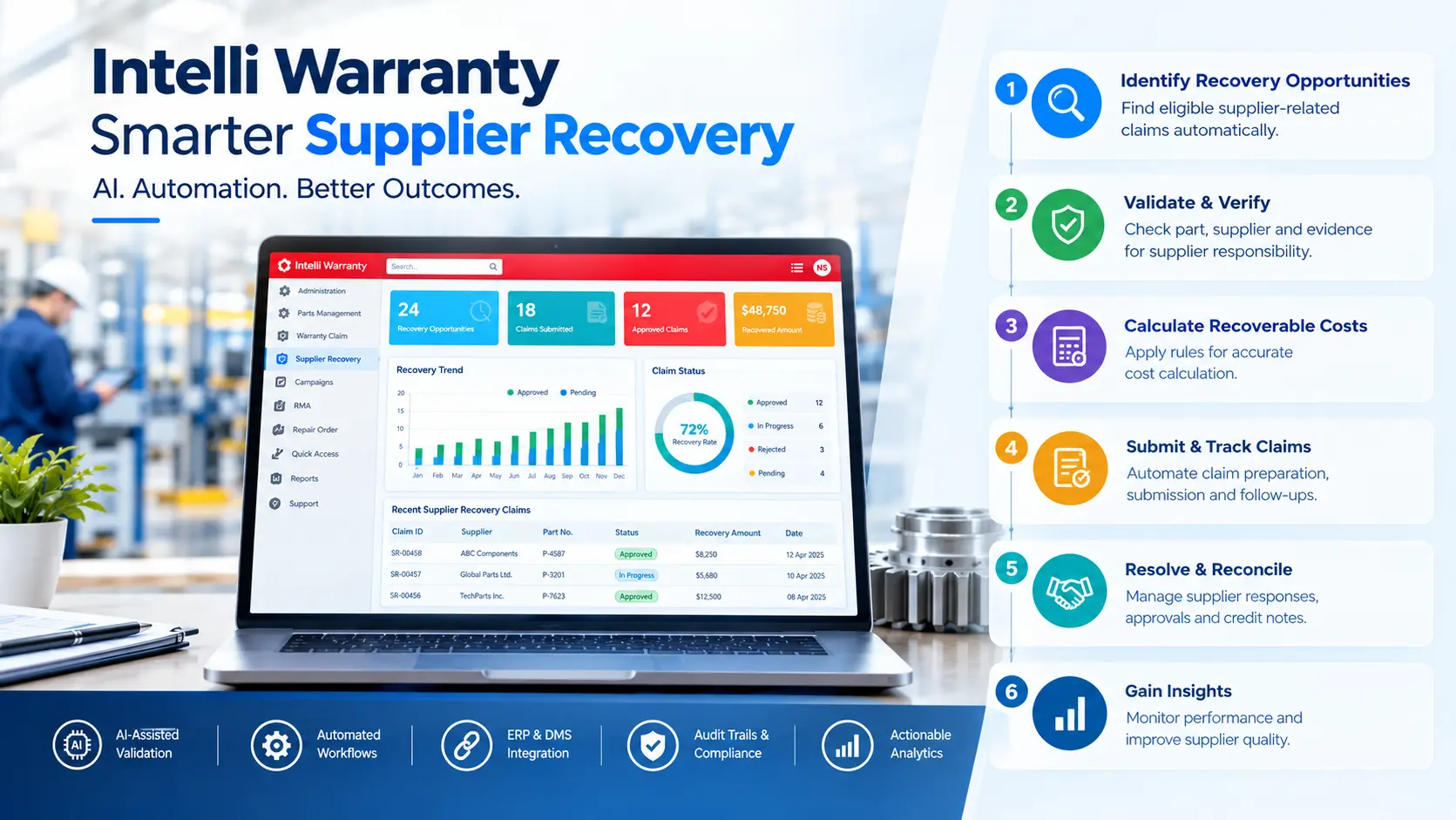
To increase the effectiveness of supplier recovery software, it must be connected with a broader warranty lifecycle management system rather than an isolated activity.
This approach is supported by Intelli Warranty by enabling OEMs to organise warranty workflows, improve the claim visibility, and use the warranty data available to streamline the supplier recovery activities in a systematic manner.
Here are the relevant capabilities of Intelli Warranty that make it a top choice for connected and automated supplier recovery software:
AI-Assisted Claim Validation and Risk Analysis
Identification of inconsistencies, missing or incomplete information, and unusual patterns in warranty claims can be done through AI-assisted claim validation.
Before the OEM proceeds with the supplier recovery process, these insights can help prioritise cases that need additional review.
Document and Image Verification
When validating supplier warranty claims, supporting evidence and part photographs play a crucial role. Intelli Warranty helps OEMs with document and image verification, which enables reviewers to assess claim evidence, identify discrepancies, and improve the efficiency of the review process.
Configurable Work Queues
The supplier recovery process is a coordinated effort between warranty, quality, procurement, engineering, and finance teams. With the help of configurable work queues, claims can be routed to the appropriate owners, visibility into pending actions can be maintained, and escalation of overdue tasks can be supported.
Supplier Recovery and Audit Trails
The retention of claim information, supporting evidence, approvals, supplier responses, and final outcomes should be done through a structured supplier recovery workflow. Intelli Warranty helps OEMs maintain these, which helps warranty teams track the status of these claims and maintain traceability throughout the supplier recovery process.
ERP and DMS Integration
To improve the flow of information between warranty claims, part records, service, and financial processes, integration with the relevant enterprise resource planning (ERP) and dealer management system (DMS) should be done.
Intelli Warranty supports this integration and creates a structured flow of information through a connected system.
Analytics for Continuous Improvement
Warranty analytics is an important feature that helps OEMs in identifying recurring failures, supplier-related cost patterns, reasons for claim rejection, and bottlenecks in the recovery process.
Intelli Warranty supports the long-term goal of creating a transparent and measurable supplier recovery process that supports financial control, supplier accountability, and continuous improvement.
Conclusion
Warranty-related expenses are increased significantly by part failures related to suppliers, but not all of these costs necessarily have to be borne by OEMs.
The challenge that OEMs mostly face is establishing supplier responsibility, identifying eligible costs, collecting sufficient evidence, meeting the contractual deadlines, and recovering approved claims.
Supplier recovery software enables OEMs to create structured workflows, consistent cost analysis, better claim visibility, and increased effectiveness of the follow-up process.
Using recovery data to identify recurring product failures, improve supplier quality, and prevent repeated defects of parts, results in OEMs addressing both financial causes and underlying reasons for warranty claims.
Intelli Warranty offers a more structured approach to warranty management, claim validation, recovery tracking, and warranty analytics.
Learn more about how Intelli Warranty creates a more connected warranty management approach and how it helps your business improve visibility, strengthen accountability, and manage warranty costs more effectively. Book a free live demo now: Warranty Management Software
Frequently Asked Questions
What is supplier recovery software?
Supplier recovery software enables OEMs to identify, validate, submit, track, and recover warranty-related expenses from suppliers. It supports part verification, evidence collection, cost calculations, and financial reconciliation.
How does supplier recovery software reduce warranty leakage?
Supplier recovery software helps identify opportunities for recovery, standardise claim documentation, monitor deadlines for contracts, and track outstanding claims and credits. With such controls, warranty leakage is significantly reduced.
What is the supplier recovery process?
The supplier recovery process is the activity where the OEM identifies a potential supplier-related part failure, verifies the part, collects evidence, establishes the contractual eligibility, calculates the recoverable expenses, submits the claim, manages any disputes, and reconciles the credit or reimbursement.
How does automated supplier recovery improve claim accuracy?
Automated workflows help OEMs standardise claim information, flag missing evidence, apply cost rules, and maintain records that are traceable. These capabilities reduce errors and result in improved consistency of supplier warranty claims.


Explore More Insights






About the Author


Nishant Sharma
Nishant Sharma is the Head of Demand Generation at Intellinet Systems, specializing in B2B marketing, sales, digital transformation, and automotive aftermarket solutions. He shares insights on emerging technologies, industry trends, and strategies that help OEMs and businesses improve operational efficiency, customer experience, and aftermarket growth.