

Overview: When digital job cards are linked with warranty claims, OEMs and dealers can improve documentation, traceability, and claim validation. Through a strategic combination of Intelli Warranty and Intelli DMS, OEMs can build a more structured warranty process, reduce errors, and get better visibility into claim outcomes.

Introduction
An essential part of post-sales operations, warranty claims help OEMs honour warranty commitments, maintain dealer relationships, and also protect the confidence of consumers. The warranty processes become costly for everyone when warranty claims are rejected because of missing or incomplete information, repair record inconsistencies, or when supporting evidence is incomplete.
From a dealer’s perspective, any claim rejection would mean repeated administrative work, continuous to-and-fro communication with OEMs, and, most importantly, delayed reimbursements. For OEMs, rejected claims would mean an increase in claim processing costs, reduced visibility into warranty expenditure, and increased difficulty in identifying recurring issues related to product quality.
Connecting service job cards directly to claims is one way to address and reduce these challenges. A job card contains the customer’s complaint, diagnostic findings, repair activities done, parts that were used, and labour details related to the repair. By linking this job card to claims, warranty teams have a better understanding and a clear picture of the work done and evidence supporting the reimbursement.
This is the exact crossroads where warranty lifecycle management software and dealer management systems can work together. Intelli DMS helps dealers with better management of service operations and digital job cards. Intelli Warranty enables OEMs to manage warranty claims and supplier recovery. When these two systems are integrated, they work together and help improve the documentation consistency, reduce the manual entry, and make every claim more traceable.
In this article, we explore why warranty claims are denied, how rejections can be reduced through job card integrations, and how OEMs can streamline warranty operations through connected dealer and warranty management workflows.
Key Takeaways:
- Connecting service records with warranty claims: This makes repair details and supporting evidence easier to trace.
- Improve documentation quality: Standardising digital job cards helps reduce missing information and inconsistencies.
- Use lifecycle warranty management software: Using a structured workflow enables OEMs to manage claims from submission to evaluation through approval and supplier recovery.
- Reduce rejections: Pre-submission checks help identify incomplete records and mismatches in parts details before a claim reaches the review stage.
- Combine Intelli DMS and Intelli Warranty: From dealer service operations to warranty claim management, these two solutions address the complementary parts of the after-sales process.
- Measuring results: The scope of improvement in processes related to rejection rates, first-submission approval rate, claim cycle time, and documentation-related errors can be identified.
Connect dealer service operations with warranty claim management to build a more traceable and efficient aftersales workflow. Book a Free Demo
Why Are Warranty Claims Denied?

When a warranty claim is denied, it doesn’t mean that the repair was unnecessary or that the dealer made a mistake. When the repair doesn’t meet the manufacturer’s warranty terms, or the supporting documentation is incomplete, the warranty claim could be rejected.
It is important to understand this distinction. On one hand, OEMs are required to protect their warranty budgets and apply their policies consistently. On the other hand, dealers need a clear process for submitting accurate claims and resolving issues.
There are many common problems that contribute to warranty claim rejections. Let us explore a few reasons:
- Incomplete job-card information
The primary service record for any repair is the job card. Generally, the job card captures the customer complaint, observations of the technician, diagnostic findings, work done, parts that were replaced, and the labour details.
When the job card contains vague information such as ‘engine problem’ or ‘part replaced’, the reviewer doesn’t get much detail from this incomplete information. There should be enough evidence to establish why the repair or replacement was required.
Addressing mechanism: Mandatory job-card fields should be defined for relevant repair categories. The service advisors should be trained, technicians should capture specific findings, corrective action should be noted, and supporting evidence should be provided. This process is crucial and should not rely on incomplete or generic descriptions.
- Missing diagnostic evidence
Many warranty claims would need further evidence, such as a photograph, details about the inspection, fault codes, test reports, or any further technical evidence. In case of such missing documentation, the reviewer could ask for additional information or just reject the claim as per the applicable process.
The problem of missing evidence arises when details are collected during the repair but aren’t attached to the job card or carried further into the submission of the claim.
Addressing mechanism: The evidence requirements of each applicable repair or failure category should be established. A workflow that supports the technicians in attaching the required documents before closing the job card should be adopted and implemented.
- Incorrect part or labour details
A warranty claim may be denied when a part number, quantity, labour operation, or reimbursement amount does not match the OEM repair record.
Here are some common examples:
a. A submitted claim with a part number different from the part recorded in the job card.
b. Labour hours exceeding the permitted allowance without approval.
c. Duplicate entry of parts or labour.
d. A replacement part inconsistent with the diagnosis recorded.
e. Missing supporting explanations or incorrect reimbursement values.
Addressing mechanism: There should be standardised part and labour references, claim values should be validated against the configured rules, and exceptions should be reviewed before submission.
- Warranty eligibility issues
A warranty claim is denied if a repair falls outside the applicable coverage period or if it is excluded under the OEM’s warranty terms. Eligibility criteria here would depend on the identification of the product, warranty registration, the date of repair, type of failure, maintenance requirements, and other conditions of the policy.
Addressing mechanism: Relevant warranty conditions must be checked before submitting the claim. All required authorisations, such as product identifiers, service dates, and repair details, must be recorded accurately.
- Delayed claim submission
There could be a deadline specified by the OEM for submitting warranty claims after repairs are completed. In case a dealer misses that deadline, either the dealer raises an exception or the claim becomes ineligible under the policy.
These delays can occur when the job card is not complete, supporting documents and evidence are gathered manually, or there is a delay in preparing the claim post-completion of the repair.
Addressing mechanism: It is best to track repair completion dates, deadlines for submission, and whether any outstanding documentation remains to be completed. A workflow reminder helps dealers identify claims that require completion before the deadline approaches.
- Inconsistent information across systems
A warranty claim may be denied when a job card shows a different part number than the submitted claim. There can be differences in information, such as repair date, serial number, labour details, etc.
With such disconnected records, the staff may have to manually compare all this information, which increases the possibility of errors or causes delays.
Addressing mechanism: There should be a traceable connection between the service record and the claim. Integrating systems which complement one another can help validate the mapping and exchange of relevant fields to reduce duplicate entries and inconsistencies.
What is Warranty Lifecycle Management Software?
Warranty lifecycle management software is a system which helps OEMs streamline warranty-related activities through a structured workflow. Many OEMs rely on disconnected systems and processes, such as spreadsheets, emails, and manual reviews.
The warranty management process can include warranty policy administration, claim submission, claim evaluation, approvals, workflows for parts return, supplier recovery, reporting, and warranty analytics.
For OEMs with large dealer networks, it is essential to implement a centralised workflow to standardise how claims are submitted, reviewed, tracked, and resolved.
Key functions of warranty lifecycle management software
OEMs should evaluate the available functions in warranty lifecycle management software, as not every warranty management platform offers the same capabilities.
Why Are Job Cards Critical to Warranty Claim Management?
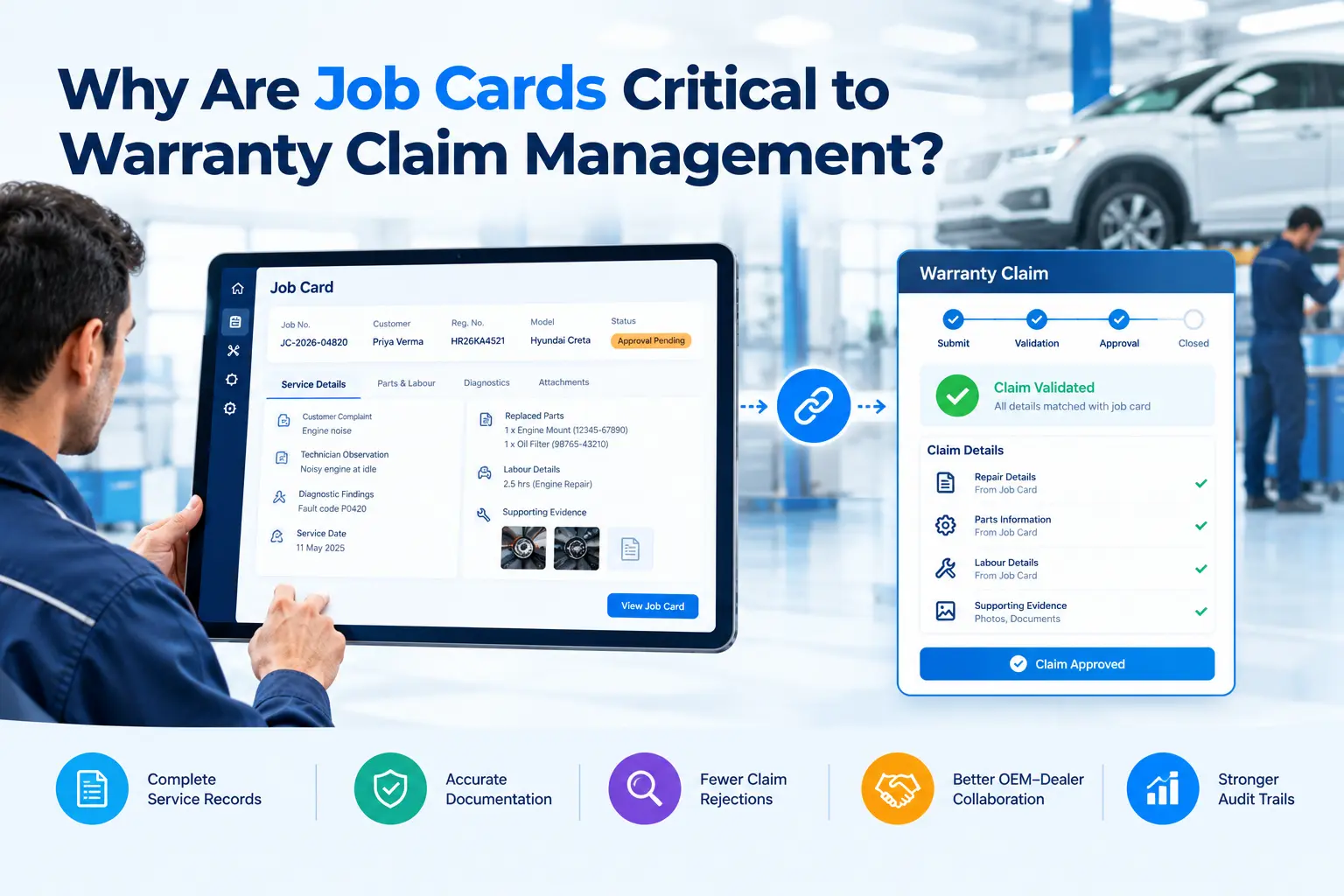
A job card is the operational evidence behind the warranty claim. This job card is the connecting link between the customer’s complaint and the diagnosis, decision of repair, consumed parts, labour details, and completion of service.
Without these details, the warranty team may not be able to verify the reimbursement request.
A job card may contain the following information:
- Customer and product identification.
- Product model, serial number or details about the vehicle identification.
- Issues reported by the customer.
- Service and repair dates.
- Observations of the technician and diagnostic findings.
- Fault codes and inspection results.
- Replaced parts and quantities.
- Time spent on repair and labour details.
- Supporting evidence, like photographs or reports.
- Details about repair completion and authorisations required.
The problem with disconnected job cards and claims
Managing job cards and warranty claims separately results in the person preparing the claim re-entering the information from the service record into the warranty system.
Such repeated entries can lead to errors in transcription, missing attachments, inconsistent identifiers, and repeated efforts.
When these two records are linked, a clearer relationship between the service event and reimbursement request is created. Relevant information can be transferred or referenced through a defined workflow when the systems support a configured data exchange.
How Does Linking Job Cards to Claims Reduce Rejections?
Linking job cards with warranty claims helps improve the process at various stages.
Creates a consistent record of the repair
When job cards are linked with the warranty claim, it allows the warranty teams to trace the claim back to the service record. This creates a connected workflow where the reviewers can refer to the customer’s complaint, the technician's diagnosis, replaced parts details, labour operations, and repair details without entirely relying on separately entered information during claim preparation.
Reduces duplicate data entry
When a user has to enter the same details repeatedly, it creates room for avoidable errors. An integrated and connected system that supports the transfer of relevant fields reduces the chances of errors.
Improves completeness of evidence
Before submitting the claim, a structured system can check whether mandatory fields are filled and supporting documents or evidence are present. In case a mandatory field or item is missing, the user can be directed to resolve this gap before the claim is submitted for approval or reimbursement.
Identifies discrepancies earlier
Imagine a system that helps flag discrepancies before the claim is submitted! A pre-submission check can help identify mismatches while the service information is freshly available. This same principle can be applied to repair dates, labour operations, quantities, and other relevant fields that require such consistency across the service record and claim.
Improves communication between OEM and dealers
In cases where a claim is denied, the dealers and OEM have to communicate constantly to identify the exact reason for claim rejection and the steps needed to correct it.
A structured workflow enables both OEMs and dealers to check why a claim is denied, supporting evidence, follow-up requirements, and the status of resubmission.
Such a system reduces the reliance on scattered email communication and gives both OEMs and dealers a clear view of the progress of the claim.
Strengthens audit trails
A linked job card with a warranty claim helps trace and establish what was recorded, submitted, reviewed, and changed. This is particularly valuable when there are claim disputes between dealers and OEMs and helps distinguish a genuine eligibility issue from a documentation gap.
How Does Intelli DMS Support Job Card Management?
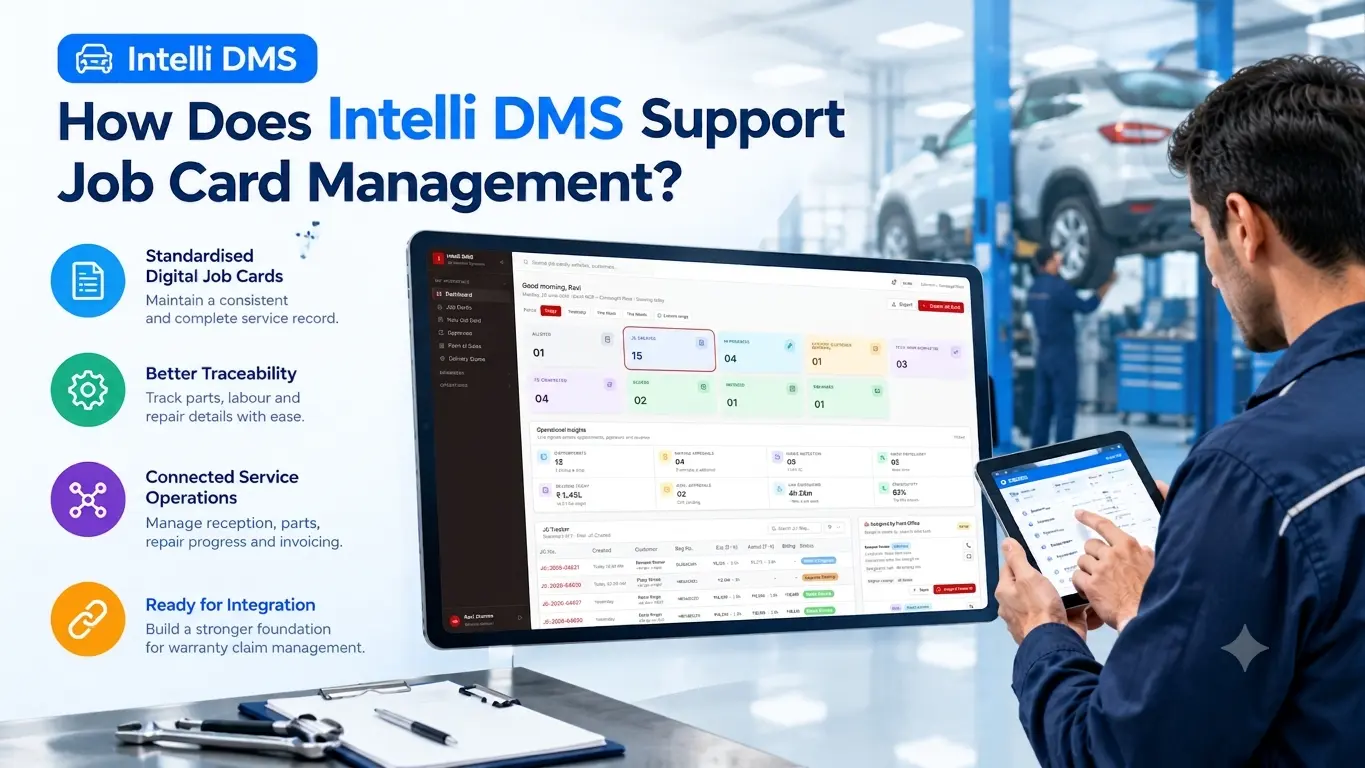
Intelli DMS is a dealer management system that enables OEMs and dealers in managing service operations, job cards, parts, billing, and other dealership workflows.
The digital job card capabilities that Intelli DMS provides help OEMs and dealers organise repair history, inspection details, technician details, and the progress of repair work. A service record that is structured, helps establish a stronger foundation for warranty claim management.
Here is how Intelli DMS supports job card management:
- Standardised digital job cards: A digital job card helps the service teams in maintaining a consistent record of the repair work done. It primarily enables OEMs and dealers to not rely on scattered information which is either on paper forms or unstructured notes.
Such consistency in record maintenance makes it easier to review the repair and identify any missing information to be added before the claim is submitted for approval. - Better traceability of parts and labour: Most warranty claims depend on the knowledge of which part was used and what repair work was done. To ensure the correct referencing during claim preparation, relevant parts and labour details must be recorded as part of the service workflow.
- Connected service operations: Job cards are just a part of the broader service process that includes reception, management of parts, progress of repair, and invoicing work. When all of these operations are managed through a connected dealer workflow, it helps in keeping all this information organised, and each record is automatically connected to the service event.
- A foundation for warranty integration: A dealer management system and a warranty management platform complement one another in a way that a DMS supports dealer service operations, whereas a warranty management system supports claim management and supplier recovery.
How Does Intelli Warranty Support Warranty Lifecycle Management?
Intelli Warranty is a comprehensive, AI-powered system to manage warranty claims and supplier recovery management for OEMs. It helps OEMs in streamlining warranty workflows and enables businesses to improve visibility into claim handling and warranty-related costs.
Know more about Intelli Warranty: Warranty Management Software
Here is how Intelli Warranty helps:
- Structured claim evaluation: All submitted warranty claims must be assessed based on the applicable policies, evidence, and reimbursement requirements. This AI-powered system helps implement a structured workflow that can apply eligibility checks, documentation requirements, approval limits, and multiple other business rules.
- AI-powered validation and anomaly detection: The inbuilt AI-powered capabilities help OEMs identify unusual claim patterns, inconsistencies, duplicate entries, or information that warrants further investigation.
- Claim status and workflow visibility: This system implements a structured workflow that enables users to track claims through submission, review, clarification, approval or rejection, depending on the process that has been established by the OEM. This makes identification of pending actions easy and understanding the reason for delays.
- Warranty analytics: Every claim provides insight into the issues and responses. This claim data can reveal any recurring issues across the dealer network, components, categories of repairs, and different product lines. OEMs are empowered to update their instructions or training if documentation-related rejections are concentrated among certain repair types. If a failure is occurring frequently with particular components, this data can also support technical investigation and product-quality improvement.
- Supplier recovery: If the warranty costs incurred establish supplier responsibility, they are recoverable from suppliers with, of course, proper evidence and within the contractual terms. With structured claim information, OEMs can investigate eligible cases and manage the workflows of the recovery process.
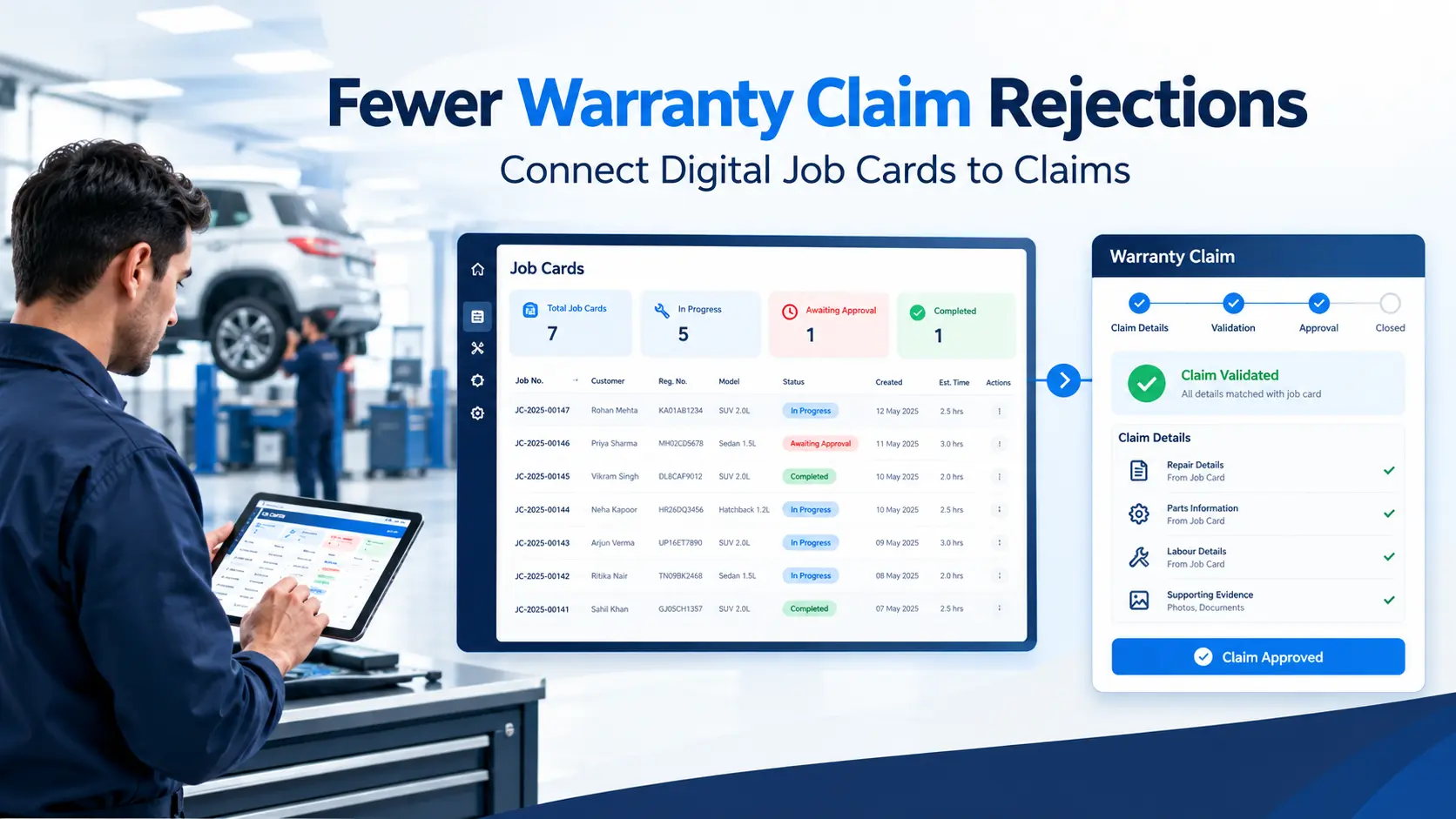
How Do Intelli DMS and Intelli Warranty Work Together?
The integration of Intelli DMS and Intelli Warranty connects the two important aspects of warranty lifecycle management, which is an essential part of the after-sales process: the repair work performed by the dealer and the warranty claim assessed by the OEM.
As we can see, integrating Intelli DMS and Intelli Warranty can enable OEMs to automate a crucial function of aftermarket operations. Such implementation creates a structured workflow that improves coordination between service teams and warranty teams. It also helps in a structured flow of information while submitting claims and creates a traceable record of all information about a claim while reviewing.
The objective is to establish a reliable flow of information available to both service and warranty management teams.
Conclusion
Reducing warranty claim rejections requires more than just correcting individual errors after they occur. OEMs need a process that links the service repair record to the warranty decision, implements an easier way to verify supporting documentation, and identifies recurring problems across the dealer network.
A warranty lifecycle management software helps in streamlining the claim process, and a dealer management system supports operations in the service team that generates the information behind each claim. If these two systems are linked together, it creates a connected workflow that reduces duplicate entry, improves traceability of service records for each claim, and helps identify gaps in documentation prior to submission.
Intelli DMS is a dealer management software that supports dealer service operations and manages digital job cards, while Intelli Warranty streamlines warranty claim management and supplier recovery processes. When these systems are integrated, they create a connected system that provides the foundation for more structured aftermarket operations. Together, they create a warranty lifecycle management system that takes both the service operations and warranty claim management into consideration to improve the underlying processes and functions and enable OEMs and dealers to coordinate better.
The practical starting point is to review why warranty claims are denied today, identify which job-card details are required to substantiate each claim type, and establish a workflow that captures and validates that information early.
Explore more details about Intelli DMS and Intelli Warranty and get a free live demo today!
Frequently Asked Questions
What is warranty lifecycle management software?
Warranty lifecycle management software enables OEMs to manage warranty policies, claim submission, evaluation of claims, approvals, supplier recovery, and reporting. This system creates a structured workflow that streamlines the entire warranty management function.
Why are warranty claims denied?
If a repair falls outside the applicable coverage period, has missing evidence, has inconsistent information about parts and labour, has missed the deadline for submission, or the repair doesn’t meet the OEMs guidelines, the warranty claim is denied.
How does linking job cards to claims reduce warranty rejections?
When the job card is linked with warranty claim, it becomes easier to trace the claim to the repair that supports it. This configured exchange of data reduces duplicate entry, helps identify inconsistencies, and improves the overall completeness of claim documentation.
How does Intelli DMS help with warranty claim preparation?
Intelli DMS is a dealer management system that supports the dealer operations and service workflows, including digital job-card management and related operational information. Whe it is connected with Intelli Warranty, the warranty management system, this information can help provide a clearer record of the repair for each claim.
Can warranty lifecycle management software prevent every claim rejection?
The straight answer is No. The warranty lifecycle management software helps identify missing information, apply configured rules, and improve the traceability of the claim. This cannot make an ineligible repair become eligible or guarantee an approval on a claim. The final decision about a warranty claim denial depends on the applicable policy and supporting evidence.


Explore More Insights








About the Author


Nishant Sharma
Nishant Sharma is the Head of Demand Generation at Intellinet Systems, specializing in B2B marketing, sales, digital transformation, and automotive aftermarket solutions. He shares insights on emerging technologies, industry trends, and strategies that help OEMs and businesses improve operational efficiency, customer experience, and aftermarket growth.


