

Overview: Warranty lifecycle management is the end-to-end process of managing warranties from registration and claim submission to validation, settlement, fraud detection, and analytics. For OEMs, a unified warranty management system reduces claim leakage, accelerates dealer reimbursements, improves supplier recovery, and provides the visibility needed to control costs, strengthen compliance, and enhance product quality.

Key Takeaways
- Warranty lifecycle management covers every stage from registration through settlement and analytics, and requires a unified system to operate effectively at scale.
- Manual and fragmented warranty processes create claim leakage, inconsistent validation, fraud exposure, and limited analytics visibility. According to Warranty Week’s 2023 Annual Warranty, U.S. automotive OEMs spent over $20 billion on warranty claims in the prior fiscal year.
- The six core modules of an effective system are: warranty registration, claims validation engine, dealer portal, analytics dashboard, extended warranty management, and fraud detection.
- The most common implementation mistakes are migrating dirty data, under-investing in dealer onboarding, and deferring analytics configuration to a later phase.
- OEMs should evaluate warranty platforms on rules engine flexibility, ERP and DMS integration depth, fraud detection sophistication, and the vendor’s deployment track record at comparable scale.
- A unified warranty lifecycle management platform shifts warranty operation from a reactive cost center to a proactive function that supports quality improvement, supplier recovery, and dealer network management.
What is Warranty Lifecycle Management?
Warranty lifecycle management is the end-to-end process of overseeing a product warranty from registration at the point of sale through claim validation, approval, financial settlement, and post-settlement analytics, covering every operational stage an OEM must control to prevent financial leakage and maintain dealer network compliance.
Without a structured system, this process falls apart at scale. An OEM managing 200,000 warranty claims annually across 1,000 dealer locations cannot rely on spreadsheets, email chains, or disconnected dealer portals. Every gap in the process creates financial leakage, compliance risk, and operational delays that compound over time.
Warranty lifecycle management software centralizes and automates these stages, providing OEMs with a single source of truth across their entire dealer and claims ecosystem.
Why Is Warranty Lifecycle Management a Critical Challenge for OEMs?
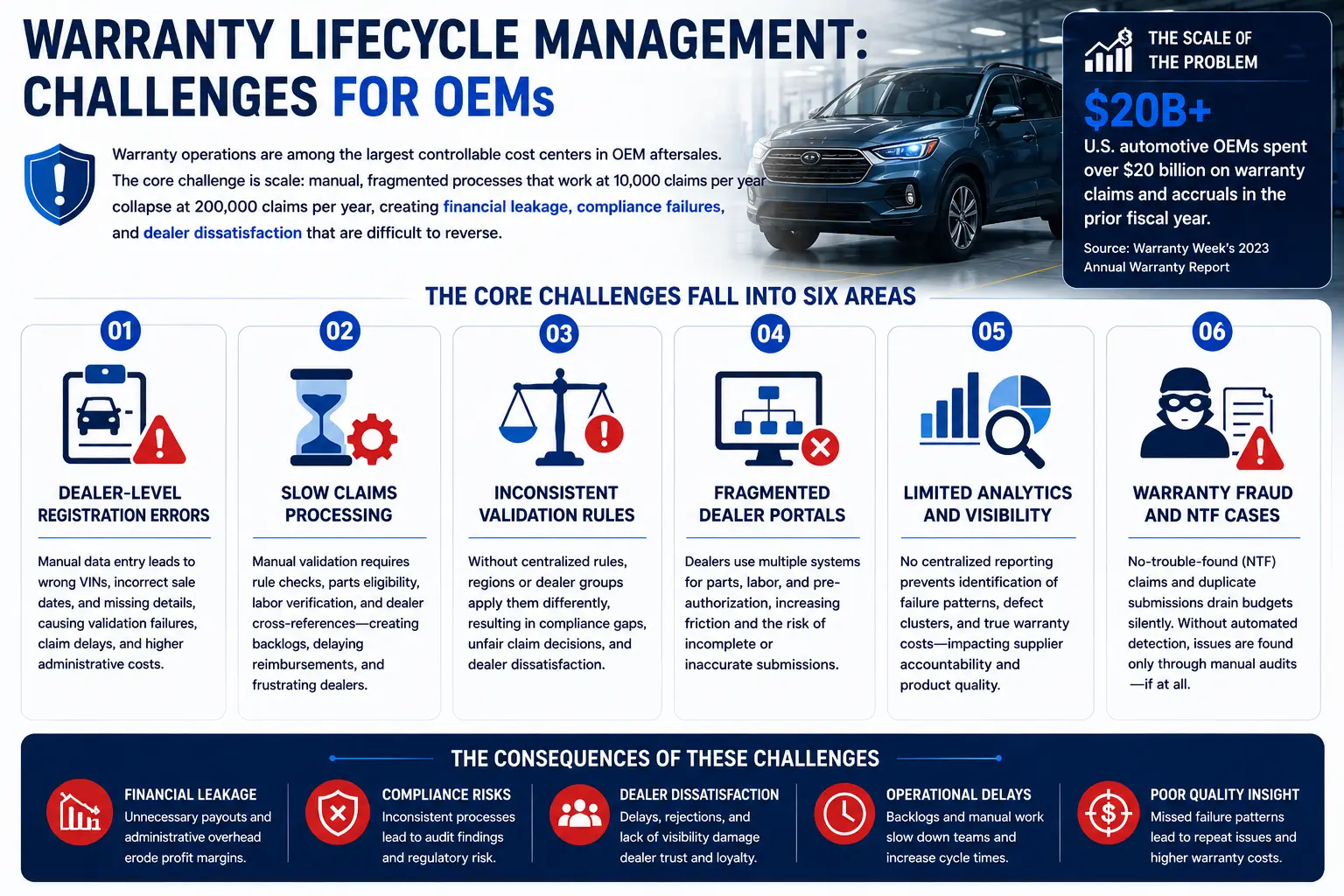
Warranty operations are among the largest controllable cost centers in OEM aftersales. The core challenge is scale: manual, fragmented processes that work at 10,000 claims per year collapse at 200,000 claims per year, creating financial leakage, compliance failures, and dealer dissatisfaction that are difficult to reverse.
According to Warranty Week’s 2023 Annual Warranty Report, U.S. automotive OEMs spent over $20 billion on warranty claims and accruals in the prior fiscal year. Yet most of that spend is managed through fragmented systems that were not designed for the complexity of modern dealer networks.
The core challenges fall into six areas:
- Dealer-level registration errors: When warranty registration depends on manual data entry at the dealer level, errors are inevitable. Wrong VINs, incorrect sale dates, and missing customer details create downstream validation failures that delay claims and inflate administrative costs.
- Slow claims processing: Manual claims validation requires a warranty administrator to review each claim against a ruleset, check parts eligibility, verify labor times, and cross-reference dealer authorizations. For high-volume OEMs, this creates backlogs that frustrate dealers and delay reimbursements.
- Inconsistent validation rules: When validation rules are not centralized, different regions or dealer groups apply them differently. One dealer gets reimbursed for a repair that another dealer gets rejected for, creating compliance gaps and dealer dissatisfaction.
- Fragmented dealer portals: Many OEMs have dealers submitting claims through multiple systems: one for parts, another for labor, a third for pre-authorization. Each system adds friction and increases the likelihood of incomplete submissions.
- Limited analytics and visibility: Without centralized reporting, OEMs cannot identify failure patterns, track recurring defect clusters, or calculate true warranty cost per model or component. This makes it difficult to hold suppliers accountable or improve product quality.
- Warranty fraud and NTF cases: No-trouble-found (NTF) claims and duplicate submissions represent a significant but often invisible drain on warranty budgets. Without automated fraud detection, these cases are caught only through manual audits, if at all.
Traditional vs. Modern Warranty Lifecycle Management
The operational and financial gap between manual warranty management and a unified automated platform is measurable at every stage of the lifecycle.
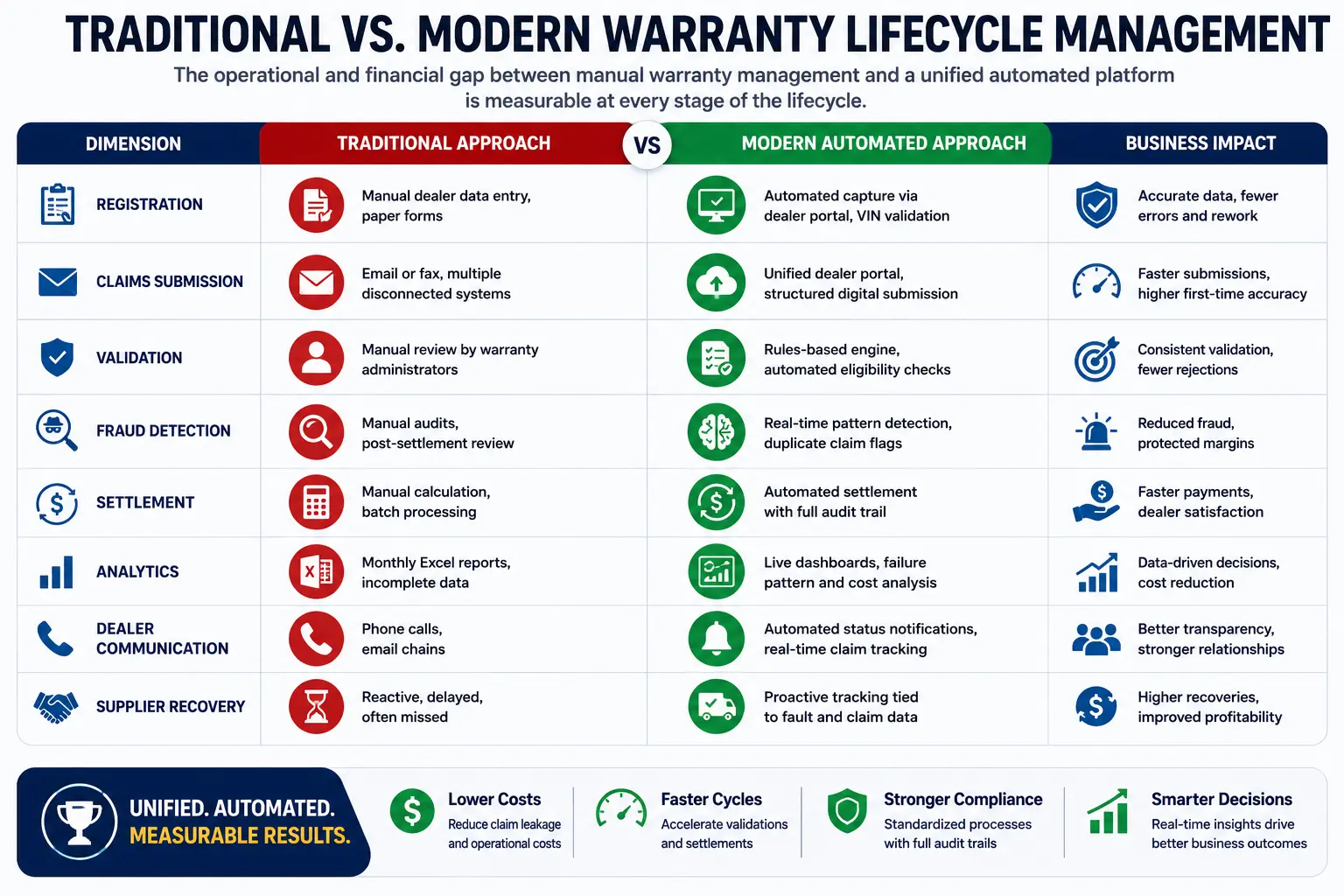
The gap between these two approaches is not just operational. It is financial. OEMs running on traditional models carry higher warranty reserves, longer claim cycles, and weaker supplier recovery rates than those running on unified lifecycle platforms.
How Does the Warranty Lifecycle Work From Registration to Settlement?
The warranty lifecycle has six distinct stages, each with its own data requirements and process risks. Understanding the full sequence is the foundation for identifying where automation and system integration create the most value.
- Stage 1: Warranty Registration: The warranty is activated when a vehicle or product is sold. The dealer captures customer details, product serial number or VIN, sale date, and applicable warranty terms. Errors at this stage cascade through every subsequent stage. A single transposed VIN digit creates a validation failure that requires manual intervention three or four steps later.
- Stage 2: Claim Initiation: When a product fails within the warranty period, the dealer or authorized service center initiates a claim. This includes documenting the fault code, repair details, parts used, and labor time. Incomplete documentation at initiation is the most common cause of downstream rejection.
- Stage 3: Validation Rules Engine: The claim passes through a validation engine that checks it against the OEM's defined ruleset: Is the product within the warranty period? Are the claimed parts eligible? Does the labor time fall within standard repair time guidelines? Is the dealer authorized for this repair type?
- Stage 4: Approval or Rejection Workflow: Claims that pass validation are routed for approval. Those that fail are flagged with a specific reason code. Dealers receive automated notifications so they can resubmit or escalate. Generic rejection messages without reason codes are a leading cause of resubmission loops that consume administrative capacity.
- Stage 5: Settlement: Approved claims are settled against the dealer's account. Settlement may include parts reimbursement, labor reimbursement, and freight credits, depending on the OEM's dealer agreement structure. Automated settlement with a full audit trail is essential for financial reconciliation and dealer trust.
- Stage 6: Analytics Feedback Loop: Settled claims feed into an analytics layer that tracks cost per model, failure frequency, dealer compliance rates, and supplier recovery opportunities. This data drives engineering, procurement, and aftersales strategy. OEMs that treat analytics as a Phase 2 feature often spend the first year of a new system running the same manual reports they ran before.
What Are the Core Modules of an Effective Warranty Lifecycle Management System?
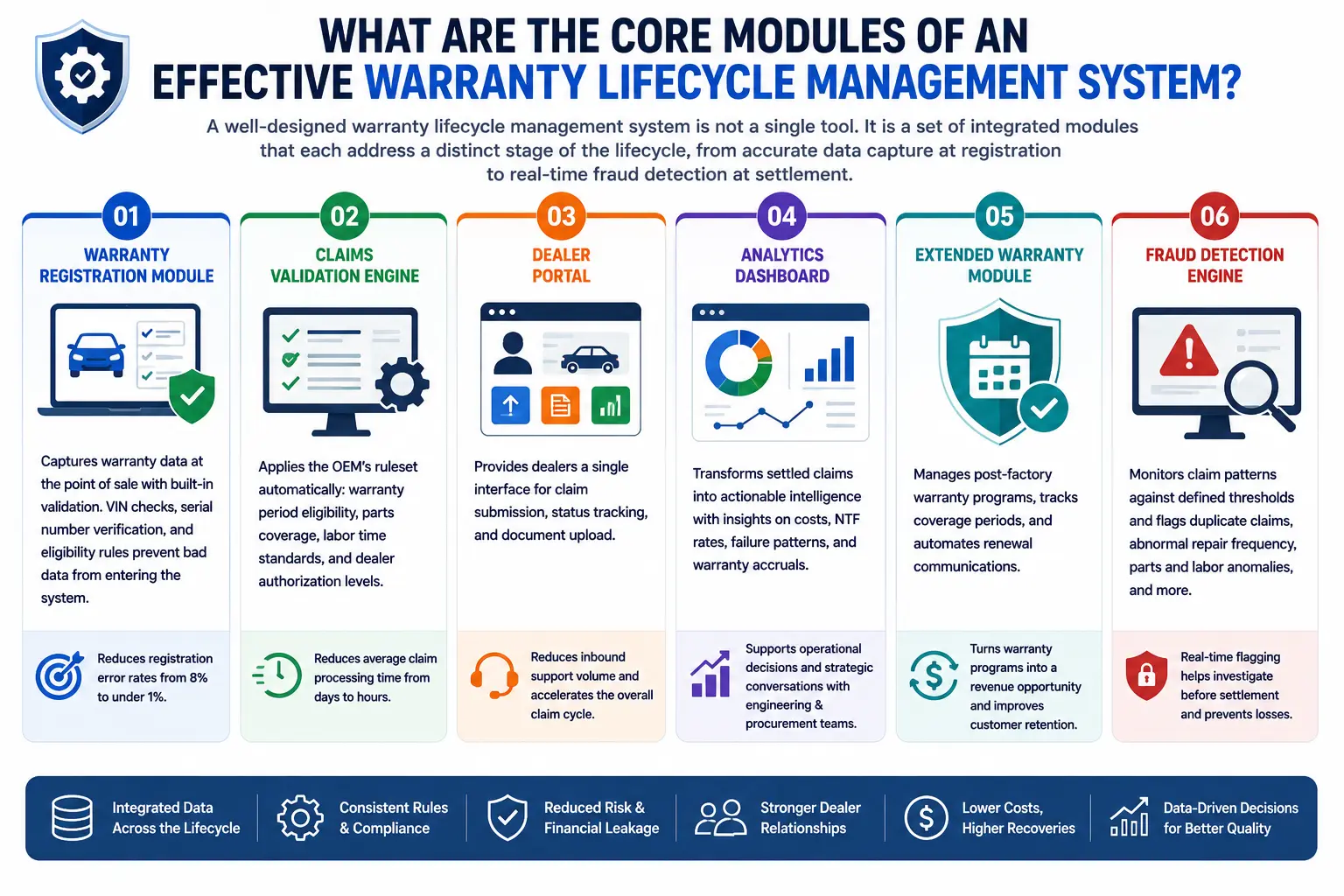
A well-designed warranty lifecycle management system is not a single tool. It is a set of integrated modules that each address a distinct stage of the lifecycle, from accurate data capture at registration to real-time fraud detection at settlement.
- Warranty Registration Module
The registration module captures warranty data at the point of sale with built-in validation. VIN checks, serial number verification, and eligibility rules prevent bad data from entering the system. For an OEM with 500 active dealers, reducing registration error rates from 8% to under 1% eliminates thousands of downstream claim failures annually.
- Claims Validation Engine
The validation engine is the operational core of the system. It applies the OEM's ruleset automatically: warranty period eligibility, parts coverage, labor time standards, and dealer authorization levels. Automated warranty claim validation reduces average claim processing time from days to hours and creates a consistent, auditable decision trail.
- Dealer Portal
A unified dealer portal gives every authorized service center a single interface for claim submission, status tracking, and document upload. Dealers no longer need to navigate multiple systems or call warranty administrators for updates. This reduces inbound support volume and accelerates the overall claim cycle.
- Analytics Dashboard
The warranty analytics layer transforms settled claims into actionable intelligence. OEMs can identify which components generate the highest warranty costs, which dealers have the highest NTF rates, and which models are approaching their warranty accrual thresholds. This supports operational decisions and strategic conversations with engineering and procurement teams.
- Extended Warranty Module
As OEMs look to warranty programs as a revenue stream rather than a cost center, extended warranty management becomes critical. The extended warranty module manages post-factory warranty programs, tracks coverage periods, and automates renewal communications.
- Fraud Detection Engine
The fraud detection module in warranty monitors claim patterns against defined thresholds. It flags duplicate claims, abnormal repair frequency from specific dealers, parts claimed for vehicles outside service areas, and labor time anomalies. Real-time flagging allows warranty teams to investigate before settlement rather than recovering funds after the fact.
How Does Warranty Lifecycle Management Software Reduce OEM Costs?
The financial case for warranty management software operates across four cost categories: reduced claim leakage, lower administrative overhead, faster dealer reimbursement cycles, and accelerated supplier recovery.
- Reduced claim leakage: Automated validation catches ineligible claims before settlement. An OEM processing 100,000 claims per year at an average claim value of $400 that reduces ineligible approvals by 3% saves $1.2 million annually without any change to product quality or dealer behavior
- Lower administrative overhead: Manual validation requires dedicated headcount. Automated validation reduces the time warranty administrators spend on routine claims, freeing capacity for exception handling and analytics review.
- Faster dealer reimbursement: When dealers receive faster reimbursements, they submit claims more promptly and accurately. The feedback loop between claim speed and submission quality is a measurable operational benefit that most OEMs underestimate at the evaluation stage.
- Supplier recovery acceleration: Clear fault data linked to settled claims makes it easier to pursue supplier recovery for defective components. OEMs with strong analytics layers recover more warranty costs from suppliers than those relying on manual tracking and delayed reporting.
What Are the Most Common Implementation Mistakes in Warranty Lifecycle Management Systems?
Implementation failures in warranty lifecycle management software share common patterns. Most are avoidable with the right sequencing and change management investment, but they are also consistently overlooked by OEM teams focused on feature selection rather than deployment planning.
- Migrating dirty data: Many OEMs attempt to migrate years of historical claim data without first cleaning registration records. Legacy VIN errors, duplicate dealer codes, and inconsistent part numbering create validation failures from day one. A data audit before migration is not optional at scale.
- Insufficient dealer onboarding: The dealer portal is only as effective as the dealers using it. OEMs that invest in structured training and change management see adoption rates above 90% within 90 days. Those that issue login credentials and a PDF guide see adoption stall below 50%.
- Validation rules that are too aggressive at launch: Starting with an overly strict validation ruleset causes high rejection rates, dealer frustration, and management escalations. A phased approach, starting with core eligibility rules and adding complexity over six to twelve months, produces better outcomes.
- No feedback mechanism for dealers: When a claim is rejected, the dealer needs a specific reason code, not a generic ‘failed validation’ message. Without clear rejection reasons, dealers resubmit the same claim with the same errors, creating processing loops that consume administrative capacity.
- Treating analytics as a Phase 2 feature: OEMs that defer analytics configuration often spend the first year of a new system running the same manual reports they ran before. Analytics setups should be part of the initial deployment scope, not a follow-on project.
Why Do Fragmented Systems Fail OEMs at Scale?
Many OEMs have reached a point where their warranty operations run on a combination of ERP modules, custom-built dealer portals, regional claim tools, and spreadsheet-based reporting. Each system solves one part of the problem while creating gaps in others. The fundamental issue is data fragmentation.
When registration data lives in one system, claim data in another, and analytics in a third, there is no single version of the truth. Warranty managers spend more time reconciling data than acting on it.
At scale, fragmentation creates three compounding problems:
- Inconsistent rule enforcement across regions leads to dealer compliance gaps and legal exposure in markets with regulated warranty requirements.
- Delayed settlement cycles damage dealer trust and, in some markets, dealer network participation.
- Lack of aggregate failure data means engineering teams cannot identify systemic defects early, increasing the total cost of late-stage quality interventions.
A unified platform eliminates these gaps by providing a single data model across all lifecycle stages.
How does Intelli Warranty Support the Full Lifecycle?
For OEMs evaluating what a unified warranty lifecycle management system looks like in practice, Intelli Warranty illustrates how the modules described above work as an integrated platform rather than a collection of separate tools.
Intelli Warranty is an AI-powered warranty management system built for OEMs and manufacturers across automotive, agriculture, aerospace, industrial equipment, and electric vehicle sectors, with deployments spanning global dealer networks and multi-region operations.
The platform covers the full warranty lifecycle through integrated modules: warranty registration, claims validation, dealer portal, analytics and reporting, supplier recovery management, and AI-based fraud detection.
The claims validation engine applies configurable policy rules, covering product coverage terms, parts eligibility, labor time standards, and reimbursement parameters, that warranty administrators can update independently without raising a development ticket, reducing rule change cycles from weeks to hours.
The fraud detection layer goes beyond flag-and-review. It analyzes claim-level risk indicators including inflated repair costs, unusual repair durations, claims submitted close to warranty expiry, duplicate images, altered documents, and abnormal dealer billing patterns, catching irregularities before settlement rather than recovering funds after the fact.
The supplier recovery module is fully integrated into the claims workflow. When a warranty payout is linked to a part failure, Intelli Warranty connects the defect data to the responsible supplier, enabling OEMs to initiate recovery automatically rather than through a separate manual process.
For OEMs managing multiple regions with different warranty policies, Intelli Warranty's policy administration module supports independent configuration of coverage terms, model variants, payment structures, and claim types, including OEM PDI, Dealer PDI, Post-Sale, Campaign, Goodwill, and Spare Parts claims, without requiring IT involvement for each policy change.
Conclusion
Warranty lifecycle management is not an administrative function. For OEMs, it is a financial and operational discipline that directly affects profitability, dealer relationships, supplier accountability, and product quality feedback loops.
The shift from manual, fragmented warranty processes to a unified lifecycle management platform reduces claim leakage, accelerates settlement cycles, and gives OEMs the analytical foundation to make decisions based on real data rather than incomplete reports.
As dealer networks grow and product complexity increases, the gap between OEMs running unified warranty systems and those relying on legacy tools will widen. The question is not whether to invest in warranty lifecycle management software, but how quickly the investment can be structured to deliver measurable returns.
OEMs that treat warranty management as a strategic capability, rather than a back-office cost, are better positioned to protect margins, retain dealers, and use quality data to improve products before warranty costs escalate.
Schedule a free Intelli Warranty demo and see how OEMs are cutting claim processing time, accelerating supplier recovery, and catching fraud before settlement.
Frequently Asked Questions
What is warranty lifecycle management?
Warranty lifecycle management is the structured process of overseeing a product warranty from registration at the point of sale through claim validation, settlement, and post-settlement analytics. It includes all operational stages and the systems that support them. For OEMs, it is the operational framework that controls warranty costs, dealer compliance, and product quality feedback.
Why do OEMs need dedicated warranty lifecycle management software?
OEMs manage warranty operations at a scale and complexity that generic ERP modules and manual processes cannot support. Dedicated software provides automated claim validation, real-time fraud detection, unified dealer portals, and analytics that reduce costs and improve operational control. At 100,000+ claims per year, manual processes create leakage and delays that compound faster than headcount can address.
What is a warranty claims validation engine?
A claims validation engine is a rule-based system that automatically checks warranty claims against the OEM's defined criteria: warranty period eligibility, parts coverage, labor time standards, and dealer authorization. It replaces manual review for routine claims, reducing processing time and ensuring consistent rule application across all dealer locations.
How does warranty fraud occur and how is it detected?
Warranty fraud includes duplicate claim submissions, claims for vehicles outside the service area, inflated labor times, and parts claimed that were not used. Automated fraud detection systems identify these patterns in real time by comparing claim data against statistical thresholds and known fraud signatures, enabling investigation before settlement rather than after.
What is a no-trouble-found (NTF) claim?
An NTF claim is a warranty claim where the service technician could not reproduce the reported fault and found no defect. NTF claims represent unproductive warranty spend and signal either a diagnostic process problem or a misuse of the warranty system. High NTF rates from specific dealers are a key fraud detection and dealer performance indicator.
What is extended warranty management in the context of OEM software?
Extended warranty management covers the administration of post-factory warranty programs: coverage period tracking, claim processing under extended terms, renewal communications, and pricing management. For OEMs offering extended warranties as a revenue product, this module manages both the commercial and operational dimensions of that program.
How long does it take to implement a warranty lifecycle management system?
Implementation timelines vary based on dealer network size, ERP integration complexity, and the volume of historical data being migrated. A mid-size OEM with 200 to 500 dealers and a single ERP integration can typically complete a phased deployment in six to nine months. Larger, multi-region deployments with multiple ERP and DMS integrations typically require twelve to eighteen months.


Explore More Insights







.webp)


About the Author


Chandra Shekhar
Chandra Shekhar is the Senior Manager, Strategy & Business Development at Intellinet Systems. With over a decade of experience in the automotive industry, Chandra Shekhar has led digital transformation and aftersales strategy initiatives for OEMs across multiple markets. His background combines deep industry knowledge with a practical understanding of how technology can solve real operational challenges. He focuses on making complex ideas clear and relevant for automotive and aftermarket professionals navigating ongoing change.


