

Overview: A Dealer Management System (DMS) is software that connects sales, service, parts, finance, and customer data across a dealer network into a single operating system. OEMs use a DMS to gain visibility into dealership performance, standardize processes across hundreds or thousands of dealers, and reduce the reporting gaps caused by disconnected, dealer-managed tools.
.webp)
Key Takeaways:
- A Dealer Management System ( DMS) centralizes sales, service, parts, and finance data for a dealership or dealer network.
- OEMs use a DMS to standardize processes, monitor dealer performance, and close visibility gaps across the network.
- A DMS supports the full dealership lifecycle, from lead capture through vehicle delivery to service and warranty.
- Cloud-based DMS platforms are gaining share over on-premise systems due to lower maintenance and easier multi-location access.
- A DMS integrates with, rather than replaces, ERP, accounting, and CRM systems already in use.
- Platforms such as Intelli DMS are built for OEM-level dealer network management, including multi-location reporting and standardized workflows.
A Dealer Management System is the software platform that runs a dealership’s day-to-day operations, including sales, customer relationship management, service scheduling, parts inventory, warranty claims, and billing. For an OEM overseeing dozens or hundreds of dealerships, a DMS is the foundation that determines whether dealer data is consistent, current, and reliable enough to support informed decision-making.
Dealership digitization matters to OEMs for a practical reason: most of what an OEM knows about its retail network comes from the data dealerships enter into a DMS. When that data is fragmented across spreadsheets, regional tools, or outdated software, the OEM loses visibility into sales pipelines, warranty exposure, service quality, and customer experience.
This guide is written for OEM decision-makers evaluating a Dealer Management System for the first time, as well as those reassessing an existing platform that no longer scales with the network. It covers what a DMS does, how it fits alongside ERP and CRM systems already in use, what to expect during evaluation and implementation, and how a network-focused platform changes the way an OEM manages dealer performance.
Modern Dealer Management Systems, such as Intelli DMS, are built to give OEMs a standardized, cloud-based view across their dealer network while still allowing individual dealerships to manage their daily operations as they always have.
What Is a Dealer Management System?
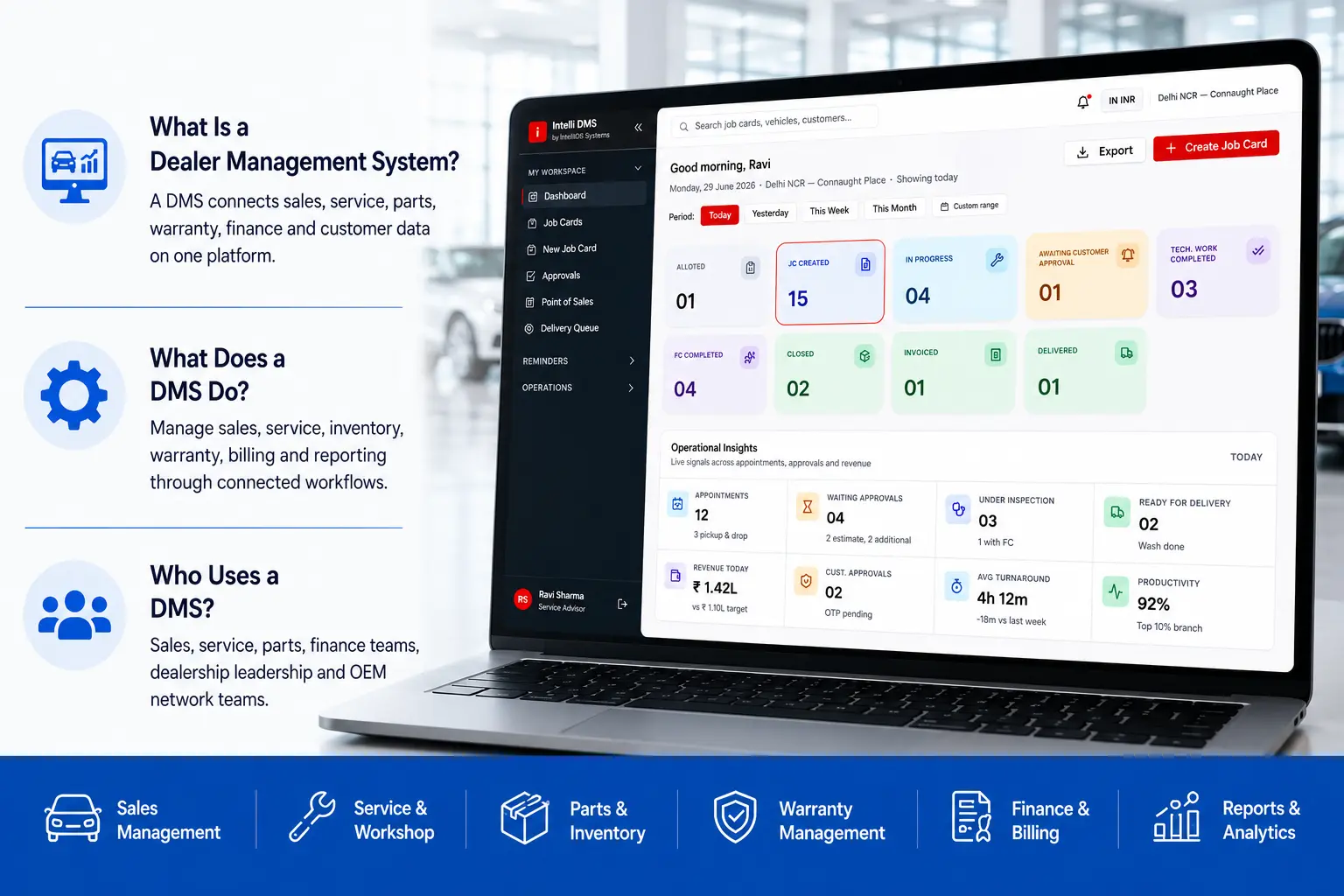
A Dealer Management System is software that manages the core operational functions of a dealership, including vehicle sales, customer relationship management, service and workshop operations, parts inventory, warranty processing, and finance and billing, all from one connected platform.
Before DMS platforms existed, dealerships ran sales, service, and accounting on separate, disconnected systems. A customer’s sales history was not visible to the service department, and parts inventory was tracked independently of repair orders. A DMS removes these silos by storing dealership data in one place and making it accessible across departments.
For an OEM, this matters because the DMS is usually the system of record at the dealership level. The OEM’s own reporting, whether for sales performance, warranty cost, or customer satisfaction, depends on data quality at the dealer level. A consistent DMS across the network makes that data far more reliable.
What Does a Dealer Management System Do?
A Dealer Management System performs several connected functions within a single dealership:
- Manages vehicle sales, from lead capture through quotation, financing, and delivery
- Tracks customer interactions and service history through a built-in CRM
- Schedules service appointments and manages workshop job cards
- Tracks parts inventory, ordering, and stock levels
- Processes warranty claims and submits them to the OEM
- Handles invoicing, billing, and financial reconciliation
- Generates reports on sales, service, and inventory performance
Who Uses a Dealer Management System?
Several roles within a dealership and at the OEM level rely on the DMS daily:
- Sales staff, who use it to manage leads, quotations, and vehicle allocation
- Service advisors and technicians, who use it to manage job cards and repair history
- Parts managers, who use it to track inventory and place orders
- Finance and accounting staff, who use it for billing and reconciliation
- Dealer principals and general managers, who use it for performance reporting
- OEM regional and network teams, who use aggregated DMS data to monitor dealer performance across the territory
Optimize Your Dealer Network Operations. Book a Free Intelli DMS Demo Today
Why OEMs Need a Dealer Management System

OEMs need a Dealer Management System to standardize dealer operations, gain real-time visibility across their dealer network, and eliminate the reporting delays and data inconsistencies caused by disconnected, dealer-managed software. Without this, the OEM has limited insight into how the retail network actually performs.
Many OEMs grow their dealer networks faster than their data infrastructure can keep up with. A dealer added through an acquisition or new market entry may run completely different software than the rest of the network. Over time, this creates several specific challenges.
- Dealer Visibility
When each dealer uses different software, or no formal DMS at all, the OEM cannot see sales pipeline status, service throughput, or inventory levels in real time. This slows decision-making around inventory allocation, marketing investments, and interventions for underperforming dealerships.
Intelli DMS helps OEMs overcome this challenge by providing a centralized dashboard that gives network teams real-time visibility across every connected dealership, eliminating the need to rely on monthly or quarterly manual reports.
- Standardization
Inconsistent processes across dealers make it difficult to compare performance, train new staff, or enforce brand and compliance standards. A dealer in one region may follow a completely different service workflow than one in another region.
A shared DMS enforces a consistent workflow structure across locations while still allowing for regional configuration where needed.
- Disconnected Systems
Many dealerships run separate tools for sales, service, and accounting, with manual data entry connecting them. This increases errors, slows down reporting, and makes it hard to get a single view of a customer or a vehicle.
Intelli DMS connects these functions on one platform, reducing duplicate data entry and the reconciliation work that comes with it.
- Warranty
Warranty claims submitted late, incorrectly, or without supporting documentation cost OEMs money and slow down dealer reimbursement. Disconnected systems make it harder to catch errors before submission.
- Workshop
Workshop scheduling and job card management directly affect service revenue and customer satisfaction. Inefficient scheduling leads to longer wait times and lower technician utilization.
- Reporting
OEMs need consistent, timely reporting to manage the network. When every dealer reports differently, or on a different schedule, building an accurate network-wide picture takes significant manual effort.
- Customer Experience
Customers expect a consistent experience whether they are buying a vehicle or bringing it in for service, regardless of which dealership they visit. Disconnected systems make it difficult to maintain a single customer record across departments and locations.
Modern Dealer Management Systems, such as Intelli DMS, address these challenges together, since they are built around a shared data model rather than separate modules bolted onto each other after the fact.
How Does a Dealer Management System Work?
The best Dealer Management System works by following a vehicle and customer through every stage of the dealership lifecycle, from the first sales inquiry to long-term service and follow-up, while keeping all related data connected in one place rather than recreating it at each stage.
Each stage in the lifecycle generates data that the next stage depends on. When this chain breaks, whether through manual re-entry, missing handoffs, or disconnected tools, errors and delays accumulate. The stages below outline how a connected DMS supports the full lifecycle.
- Customer Inquiry: A lead enters the system from a website form, walk-in, call, or referral, and is logged with source tracking.
- Lead Management: Sales staff follow up on leads, qualify them, and track engagement through the CRM module.
- Quotation: A formal quote is generated that covers vehicle pricing, accessories, financing, and trade-in value, where applicable.
- Test Drive: The system schedules and logs test drives, linking them to the customer record.
- Booking: The customer commits to a purchase, and a booking record is created with a deposit and order details.
- Vehicle Allocation: The dealership requests a specific vehicle from available OEM inventory or production allocation.
- Registration: Required documentation and regulatory registration steps are completed and tracked.
- Vehicle Delivery: The sale is finalized, and vehicle delivery is scheduled and recorded, often alongside a pre-delivery inspection.
- Service Appointment: The customer later books a service visit, which the system schedules against technician and bay availability.
- Workshop: The vehicle moves through the workshop according to the scheduled work.
- Job Card: A detailed job card captures the work performed, parts used, and labor hours.
- Parts Management: Parts consumed during service are deducted from inventory and reordered automatically when stock runs low.
- Warranty: Eligible repairs are submitted as warranty claims, with supporting documentation attached from the job card.
- Billing: The customer or warranty payer is invoiced, and payment is reconciled against the job card and parts used.
- Customer Follow-up: The system can trigger a follow-up communication or satisfaction survey tied to the completed visit.
Intelli DMS supports this entire lifecycle on a single platform, allowing the service department to access a vehicle’s sales history and future sales teams to view its complete service history.
Core Modules of Intelli DMS
Intelli DMS is organized into modules that map directly to dealership functions, including sales, CRM, vehicle allocation, workshop and job card management, parts and inventory, warranty, finance, and reporting, so each department works from the same underlying data.
The sections below outline the purpose, business value, and OEM benefit of each core module.
Sales Management
- Purpose: Manages quotations, bookings, vehicle orders, and delivery scheduling
- Business Value: Reduces manual paperwork and shortens the time between booking and delivery.
- OEM Benefit: Provides real-time visibility into sales pipeline and order status across the network.
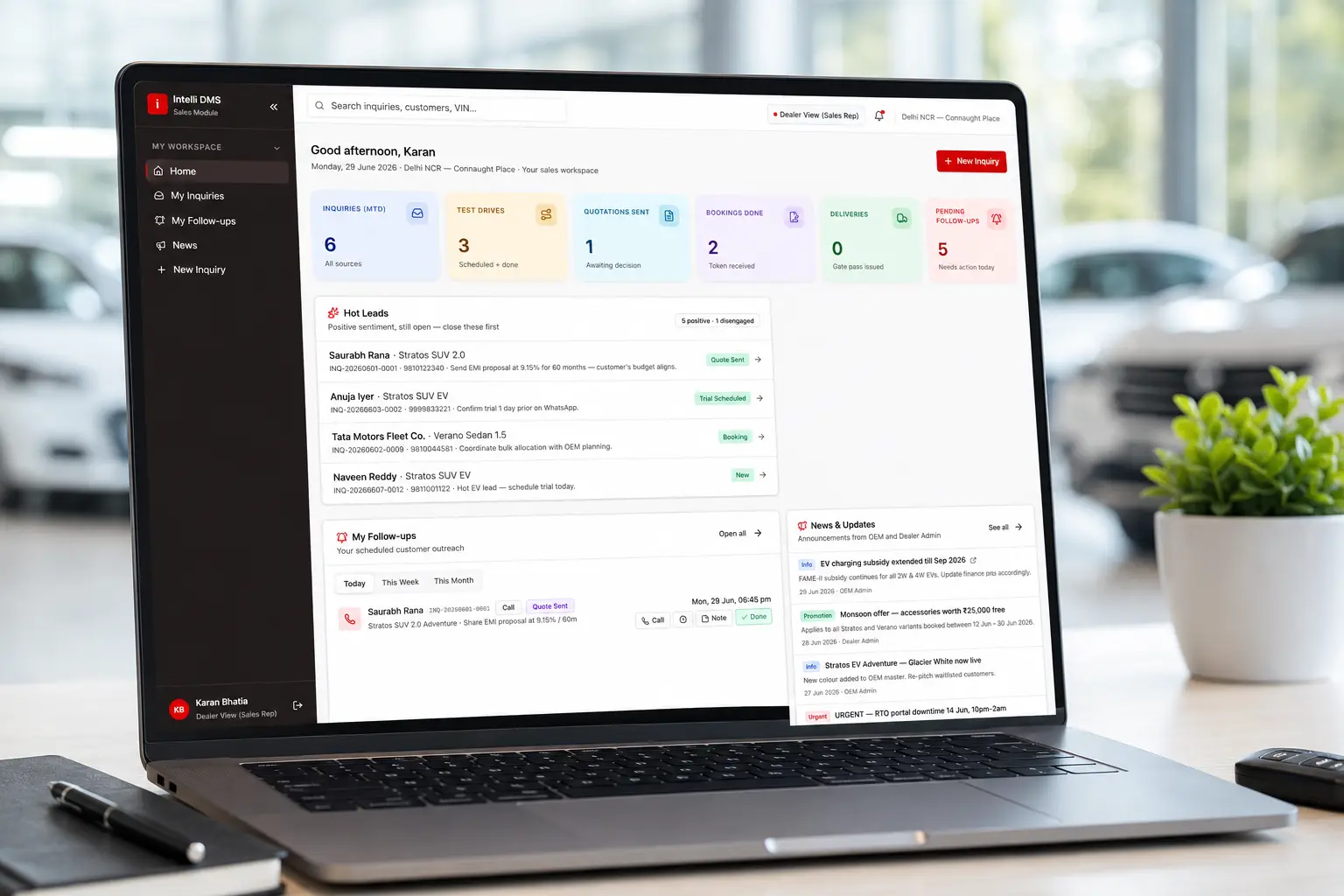
CRM
- Purpose: Track leads, customer interactions, and communication history
- Business Value: Improves follow-up consistency and conversion rates
- OEM Benefit: Gives the OEM a unified view of customer engagement across the dealer network
Vehicle Allocation
- Purpose: Matches dealer orders against available production or stock allocation
- Business Value: Reduces delivery delays and mismatched inventory
- OEM Benefit: Allows the OEM to allocate stock based on actual demand signals from dealers
Workshop Management
- Purpose: Schedules service appointments and manages bay and technician capacity
- Business Value: Improves workshop throughput and reduces customer wait times
- OEM Benefit: Surfaces service efficiency metrics across dealerships for benchmarking
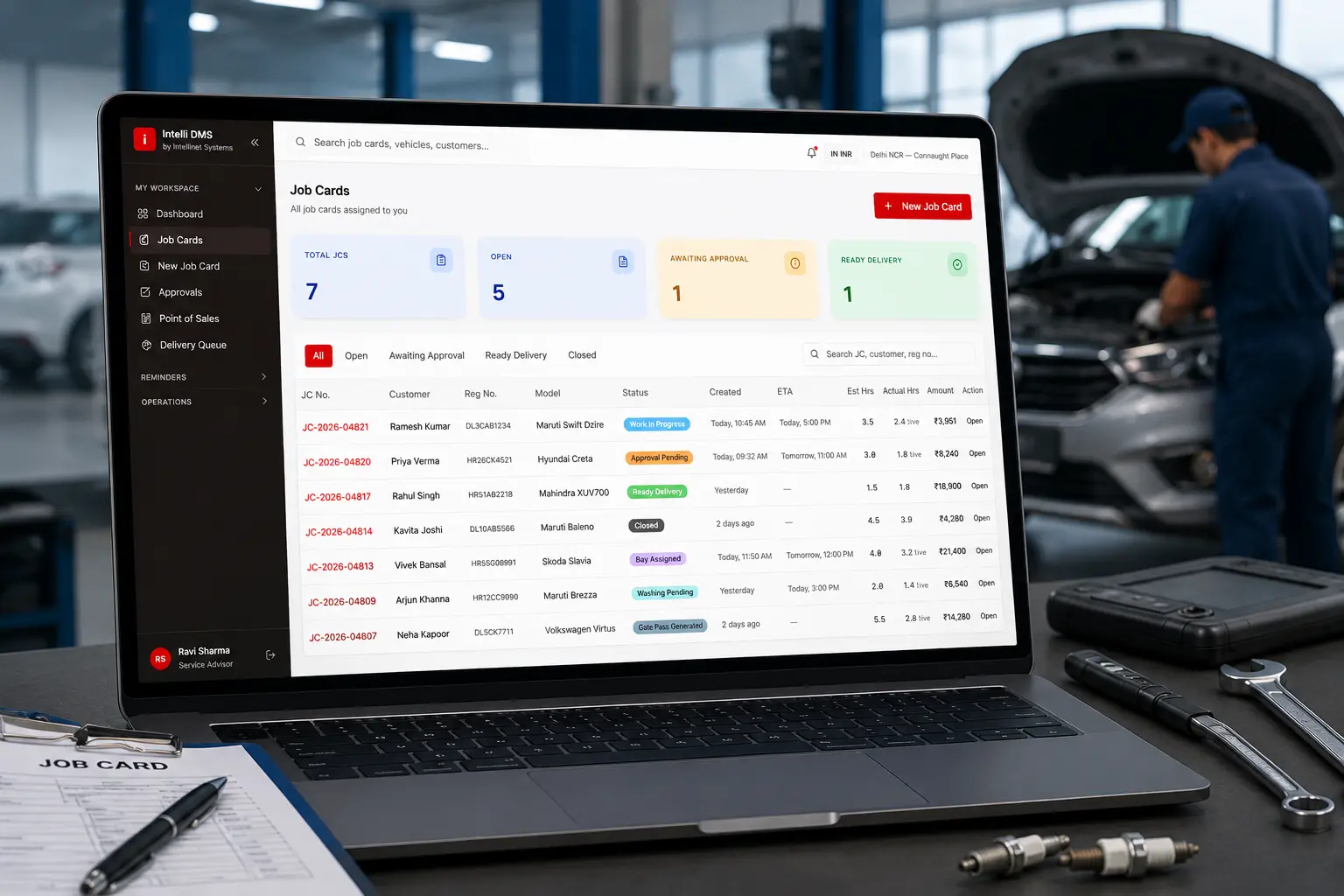
Job Card Management
- Purpose: Captures the details of work performed, parts used, and labor time per repair order
- Business Value: Creates a clean record for billing, warranty, and service history
- OEM Benefit: Supports accurate warranty validation and service quality monitoring
Parts & Inventory
- Purpose: Tracks parts stock, usage, and reordering across the dealership
- Business Value: Reduces stockouts and excess inventory holding costs
- OEM Benefit: Provides network-wide parts demand data to inform supply planning
Warranty Management
- Purpose: Manages claim submission, documentation, and approval workflow
- Business Value: Reduces claim rejection rates and processing time for dealers
- OEM Benefit: Improves warranty cost visibility and reduces fraudulent or duplicate claims
Finance & Billing
- Purpose: Handles invoicing, payment reconciliation, and financial reporting
- Business Value: Speeds up reconciliation and reduces billing errors
- OEM Benefit: Standardizes financial reporting formats across dealers for easier consolidation
Dashboards & Analytics
- Purpose: Aggregates sales, service, and inventory data into reportable metrics
- Business Value: Gives dealer principals a real-time operational view
- OEM Benefit: Enables network-wide benchmarking and performance monitoring
Customer Experience
- Purpose: Manages follow-up communication, satisfaction surveys, and service reminders
- Business Value: Improves repeat business and customer retention
- OEM Benefit: Supports consistent brand experience across every dealer touchpoint
Transform Your Dealer Network with Intelli DMS. Schedule a Personalized Demo
Benefits of a Dealer Management System
A Dealer Management System delivers measurable benefits across four areas: operational efficiency, financial performance, customer experience, and OEM-level visibility. The specific impact varies by dealership, but the categories below cover the benefits most commonly reported by OEMs and dealers.
Operational Benefits
- Fewer manual handoffs between sales, service, and parts
- Faster job card creation and closure
- Reduced duplicate data entry across departments
- Better technician and bay scheduling
Financial Benefits
- Faster billing and reconciliation cycles
- Reduced warranty claim rejections and rework
- Lower inventory holding costs through better parts forecasting
- Reduced the cost of manual reporting and data consolidation
Customer Benefits
- Shorter wait times for service appointments
- Consistent service history available across visits
- More accurate and timely communication on vehicle status
- A more consistent experience across different dealer locations
OEM Benefits
- Real-time visibility into sales and service performance across the network
- Standardized data for benchmarking dealers against each other
- Faster identification of underperforming locations
- Improved warranty cost control through consistent claim data
The relative weight of these benefits differs depending on whether the OEM is evaluating a DMS for a single growing market or for a mature, established network. A newer network often prioritizes operational and customer benefits first, since the dealer base is still building consistent processes. By contrast, a mature dealer network tends to focus on financial and OEM-level benefits, as the greater opportunity lies in improving reporting and reducing cost leakage across dealerships that are already operationally mature.
How Intelli DMS Helps OEMs Manage Dealer Networks
Intelli DMS helps OEMs manage dealer networks by centralizing performance data, enforcing standardized workflows, and giving network teams the tools to monitor, benchmark, and approve dealer activity from a single platform, rather than relying on inconsistent dealer -submitted reports.
For an OEM with a large or growing dealer network, this shifts network management from a reactive, report-driven process to a proactive one based on live data.
- Centralized visibility: Network teams can monitor sales, service, and inventory across every connected dealership from a single dashboard.
- Standardized workflows: Core processes, such as warranty claim submission or job card creation, follow the same structure at every dealership.
- Performance monitoring: OEM teams can track key metrics, such as service throughput or lead conversion, by dealer or region.
- Dealer benchmarking: Performance data can be compared across dealers to identify best practices and underperformance.
- Workflow approvals: Certain actions, such as warranty claims above a threshold, can route through OEM-level approval before processing.
- Compliance: Standardized data capture supports consistent compliance reporting across the network.
- Analytics: Aggregated data supports forecasting for parts demand, service capacity, and sales trends.
Dealer Management System vs ERP vs CRM
A Dealer Management System, an ERP, and a CRM serve different purposes and are not interchangeable. A DMS manages dealership-specific operations such as service and parts, an ERP manages enterprise-wide finance and resource planning, and a CRM manages customer relationships and sales pipeline, often at a broader scope than a single dealership.
OEMs sometimes ask whether a DMS can replace their ERP, or whether their existing CRM is enough on its own. In practice, these systems are designed to work together rather than substitute for one another.
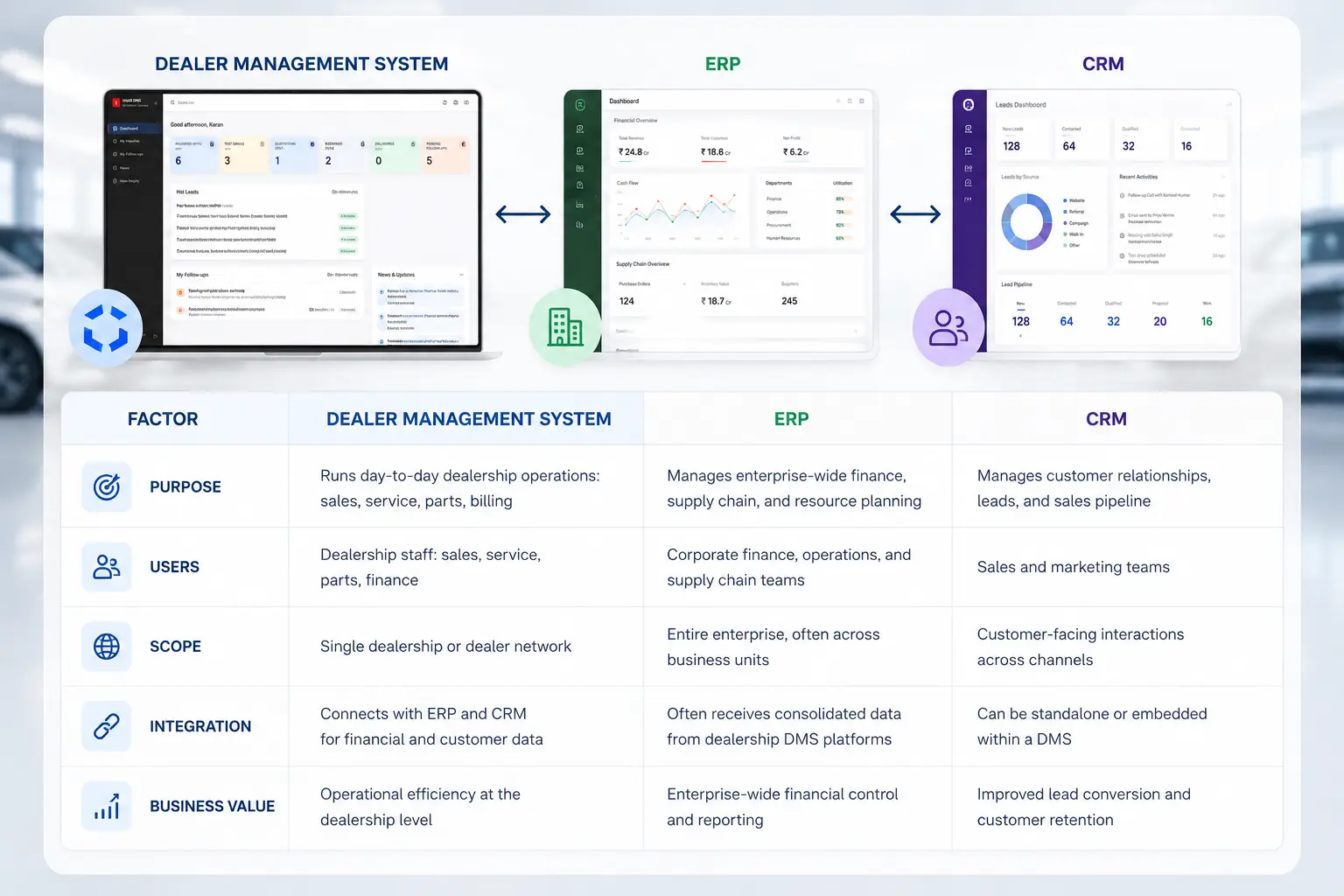
Intelli DMS integrates with ERP systems rather than replacing them. Dealership-level transactions, such as service billing or parts usage, flow into the OEM's ERP for consolidated financial reporting, while the dealership continues to operate day-to-day functions within the DMS.
Cloud vs On-Premise Dealer Management System
A cloud Dealer Management System is hosted and maintained by the vendor and accessed over the internet, while an on-premise DMS runs on servers owned and maintained by the dealership or OEM. The right choice depends on the OEM’s IT resources, security requirements, and the size and distribution of its dealer network.
Both deployment models remain common in the market, and the right fit depends on the OEM’s specific operating context rather than one model being universally better.
Cloud Deployment
- Lower upfront infrastructure cost, since the vendor manages servers and hosting
- Easier to scale across new dealerships without local hardware setup
- Updates and patches are applied centrally by the vendor
- Accessible remotely, which supports multi-location oversight and mobile use
On-Premise Deployment
- Data and infrastructure remain fully within the dealership’s or OEM’s control.
- May suit organizations with strict internal data residency requirements
- Requires dedicated IT staff for maintenance, updates, and security patching
- Scaling to new locations typically requires additional local hardware
Security, Scalability, Maintenance, and Remote Access
Security in a cloud DMS depends on the vendor’s infrastructure and compliance posture, while on-premise security depends on the dealership’s or OEM’s own IT practices. Regardless of the deployment model, dealerships handling customer financial data in the United States must comply with the FTC’s Safeguards Rule under the Gramm-Leach-Bliley Act, which sets specific requirements for access controls, encryption, and incident response.
The FTC outlines these requirements, including encryption of customer information and multi-factor authentication for system access.
Scalability generally favors cloud deployment for OEMs that frequently add new dealerships, as new locations can be onboarded without requiring local server installation. Maintenance burden is also in the cloud, since the vendor handles patching and uptime. Remote access is a built-in advantage of cloud platforms, since OEM network teams and multi-location dealer groups can view performance data without VPN access to individual dealership servers.
Which Deployment Suits Different OEMs
- OEMs with a large, geographically distributed dealer network often benefit from the lower IT overhead of cloud deployment.
- OEMs with strict internal data residency or regulatory requirements may prefer on-premise or hybrid models.
- OEMs growing their network quickly tend to favor cloud deployment for faster onboarding.
- OEMs with existing heavy IT investment in on-premise infrastructure may take a phased migration approach.
Intelli DMS is built as a cloud-based platform, which is one reason OEMs evaluating multi-location dealer networks often consider it alongside legacy on-premise alternatives.
Can Intelli DMS Integrate with Existing Enterprise Systems?
Yes. Intelli DMS is built to integrate with ERP, accounting, finance, warranty, inventory, and CRM systems already in use at the OEM or dealership level, using open APIs rather than requiring a full replacement of existing enterprise software.
OEMs typically already have a significant investment in enterprise systems before evaluating a DMS, and few are willing to rip out an ERP or finance platform just to adopt a new dealer-level system. Integration capability is therefore one of the most important evaluation criteria.
- ERP: Financial transactions, billing, and inventory movements sync with the OEM’s enterprise resource planning system
- Accounting and Finance: Reconciliation data flows into existing accounting platforms to avoid duplicate entry
- Warranty: Claim data can connect with OEM-side warranty processing systems
- Inventory: Parts and vehicle inventory data syncs with broader supply chain systems
- CRM: Customer and lead data can sync with enterprise CRM platforms used at the OEM level
- Open APIs: Custom integrations can be built where a specific enterprise tool is not natively supported
Open APIs and modular integration reduce the risk and disruption of adopting a new DMS, since dealers and OEM teams can keep using existing finance and CRM tools where needed.
Is Intelli DMS Suitable for Multi-Location Dealer Networks?
Yes. Intelli DMS is designed for multi-location dealer networks, with centralized dashboards, role-based access controls, standardized workflows, network-wide reporting, and shared customer history across locations, which are the specific capabilities OEMs need to manage dealer groups rather than single, independent dealerships.
Managing one dealership and managing a network of fifty or five hundred dealerships are different problems. A platform built around the needs of a single location often breaks down when applied at a network scale, particularly around reporting consistency and access control.
- Central dashboard: Network and regional teams can view aggregated performance across all connected dealerships
- Role-based access: Permissions can be scoped by dealership, region, or function, so users see only what is relevant to their role
- Standard workflow: Core processes remain consistent across locations, simplifying training and compliance
- Network reporting: Performance data rolls up automatically, removing the need for manual report consolidation
- Shared customer history: A customer who interacts with multiple dealerships in the same group can have a unified record
Industries That Use Dealer Management Systems
Dealer Management Systems are used across automotive, agriculture and farm equipment, construction and mining, aerospace, industrial equipment, and electric vehicles, since each of these industries relies on a dealer or distributor network for sales and after-sales service, even though the specific operational details differ by equipment type.
While the underlying lifecycle is similar across industries, the configuration of a DMS often needs to account for differences in equipment complexity, service intervals, parts cataloging, and field service requirements.
- Automotive: High sales volume with standardized service intervals, frequent model and parts revisions, and a strong emphasis on warranty claims and parts catalog accuracy
- Agriculture and Farm Equipment: Seasonal demand tied to planting and harvest cycles, with dealer networks that depend on fast parts identification and end-to-end warranty resolution to minimize equipment downtime
- Construction and Mining: High-value, long-lifecycle equipment where unplanned downtime is costly, making warranty turnaround, field issue tracking, and dealer audit consistency especially important
- Aerospace: Strict documentation, traceability, and compliance requirements across parts and service records, with less tolerance for manual or paper-based processes
- Industrial Equipment: Diverse equipment categories and distributor networks that need standardized parts cataloging and service documentation across multiple product lines
- Electric Vehicles: Specialized service requirements, including battery diagnostics and software-driven maintenance, alongside the same dealer-level sales and service workflow used for conventional vehicles
Cloud deployment has become the more common choice across these industries as dealer and distributor networks grow and OEMs look for systems that can scale across regions without significant local infrastructure investment. Industry research projects that cloud-based deployment will continue to account for a majority of new Dealer Management System installations going forward, reflecting the same scalability and remote access advantages described earlier in this guide. Cloud-based platforms are anticipated to hold the largest market share among automotive DMS deployments going forward, supported by their lower infrastructure overhead and real-time data synchronization.
How Much Does a Dealer Management System Cost?
The cost of a Dealer Management System depends on the number of dealerships, the number of users, the modules selected, the level of integration with existing systems, deployment model, customization needs, and the support tier chosen, which means there is no single price that applies across OEMs or dealer networks.
Vendors generally avoid publishing fixed pricing because the cost structure changes significantly based on scope. The factors below are the ones that most influence the final price an OEM or dealer group will see in a proposal.
- Number of dealerships: Network-wide deployments typically use volume-based pricing tiers
- Users: Per-seat or per-role licensing affects total costs as dealership staff counts grow
- Modules: A full lifecycle deployment costs more than a single-module rollout, such as service-only
- Integrations: Connecting to existing ERP, CRM, or warranty systems adds implementation cost
- Deployment model: Cloud subscriptions and on-premise licensing follow different cost structures
- Customization: Workflow changes specific to an OEM’s processes add development time
- Support: Service-level agreements and dedicated support tiers affect ongoing cost
OEMs evaluating a DMS should request a scoped proposal based on their specific dealer count, module needs, and integration requirements rather than relying on general market pricing benchmarks.
How Long Does DMS Implementation Take?
DMS implementation timelines vary widely depending on network size and complexity, but generally include discovery, configuration, data migration, integration with existing systems, user training, testing, and go-live, with single-dealership rollouts taking weeks and network-wide rollouts taking several months to over a year.
OEMs rolling out a DMS across an entire dealer network typically phase the rollout rather than going live everywhere at once, both to manage risk and to apply lessons learned from early dealerships to later ones.
- Discovery: Mapping current workflows, systems, and data sources across the dealer network
- Configuration: Setting up modules, workflows, and access roles to match OEM and dealer requirements
- Data Migration: Transferring existing customer, vehicle, and transaction data into the new system
- Integration: Connecting the DMS to ERP, CRM, warranty, and other enterprise systems
- User Training: Preparing dealership staff across sales, service, parts, and finance to use the new system
- Testing: Validating workflows, data accuracy, and integrations before go-live
- Go-Live: Rolling out the system at one or more dealerships, often in phases across the network
Factors Affecting Implementation Timelines
- Number of dealerships included in the initial rollout phase
- Complexity and volume of historical data being migrated
- Number and complexity of integrations with existing enterprise systems
- Availability of dealership staff for training during the rollout
- Degree of workflow customization required by the OEM
Why Choose Intelli DMS?
Intelli DMS supports the full dealership lifecycle on one platform, integrates with existing ERP and finance systems, and gives OEMs the network-wide visibility, standardized workflows, and reporting needed to manage dealer performance at scale, without forcing a disruptive replacement of systems already in place.
- End-to-end dealership lifecycle management, from lead capture through service and warranty
- Sales and service integration on a shared data model, removing departmental silos
- OEM-level visibility into network performance through centralized dashboards
- Workflow automation that reduces manual handoffs and data entry
- Reporting built for both dealership and OEM network use
- Structured warranty claim management to reduce processing time and errors
- Parts and inventory tracking connected to service and sales activity
- Scalability for OEMs managing a growing or geographically distributed network
- Multi-location support, including shared customer history and role-based access
None of these capabilities require an OEM to discard its existing technology investments. Intelli DMS is positioned to sit alongside ERP, finance, and CRM systems already in place, which keeps the adoption path practical for OEMs that have spent years building out enterprise infrastructure and are not looking to start over.
OEMs evaluating Dealer Management System options for their network can request a personalized demonstration of Intelli DMS to see how the platform fits their specific dealer structure and existing systems.
Conclusion
A Dealer Management System is the operational backbone of a dealership and, at network scale, the foundation for how an OEM understands and manages its retail business. It connects sales, service, parts, warranty, and finance into a single data model, replacing the fragmented reporting that comes from disconnected, dealer-managed tools.
For OEMs, the value of a DMS goes beyond individual dealership efficiency. Centralized visibility, standardized workflows, and consistent reporting make it possible to manage a dealer network proactively, benchmark performance fairly, and control warranty and service costs with more confidence.
Cloud platforms such as Intelli DMS are built to support this kind of network-wide management while integrating with the ERP, CRM, and finance systems OEMs already use, which makes adoption less disruptive than a full systems replacement.
OEMs evaluating a Dealer Management System for their network can request a personalized demo of Intelli DMS to see how it fits their specific dealer structure, existing systems, and reporting needs.
FAQ
What does a Dealer Management System do?
A Dealer Management System manages the core functions of a dealership, including vehicle sales, customer relationship management, service scheduling, parts inventory, warranty claims, and billing. It connects these functions in one platform so that data entered at one stage, such as a sale, is automatically available at the next stage, such as service.
Is a Dealer Management System different from ERP?
Yes. A DMS manages dealership-specific operations such as sales, service, and parts, while an ERP manages enterprise-wide finance, supply chain, and resource planning. Most OEMs use both, with the DMS handling dealership transactions and the ERP consolidating financial and operational data across the broader organization.
Can OEMs monitor dealerships using a DMS?
Yes. A network-level DMS gives OEMs visibility into sales, service, and inventory performance across connected dealerships through centralized dashboards. This allows OEM teams to benchmark dealer performance, identify underperforming locations, and respond to issues without waiting for manual reports.
Is a DMS suitable for multi-location dealer networks?
Yes, provided the platform is built for network-scale use. Features such as role-based access, standardized workflows, network-wide reporting, and shared customer history are specifically designed to support multi-location dealer groups rather than a single, independent dealership.
How does a Dealer Management System improve customer experience?
A DMS improves customer experience by maintaining a single customer record across sales and service interactions, reducing wait times through better scheduling, and enabling timely communication about vehicle status, service reminders, and follow-up. Customers benefit from a more consistent experience across visits and locations.


Explore More Insights





.webp)


About the Author


Chandra Shekhar
Chandra Shekhar is the Senior Manager, Strategy & Business Development at Intellinet Systems. With over a decade of experience in the automotive industry, Chandra Shekhar has led digital transformation and aftersales strategy initiatives for OEMs across multiple markets. His background combines deep industry knowledge with a practical understanding of how technology can solve real operational challenges. He focuses on making complex ideas clear and relevant for automotive and aftermarket professionals navigating ongoing change.


