

Overview: The best dealer management system for aftermarket operations is a cloud-based platform that connects sales, service, parts, warranty, and customer records into one system, while giving the OEM real-time visibility across every dealer in the network. Picking the right DMS for aftermarket OEMs comes down to four things: full coverage of the sales-to-service lifecycle, workflows that can be configured to match OEM policy, dealer-level and network-level reporting, and a vendor with a proven deployment record in your vehicle category. This guide breaks down the evaluation criteria, the common selection mistakes, and the rollout steps that matter most when making this decision.

This guide covers:
- What a dealer management system for aftermarket operations actually does, and how it differs from generic dealership software
- The sales and service modules an aftermarket DMS needs to include
- A practical scorecard for comparing vendors objectively
- The most common mistakes OEMs make when selecting a DMS, and how to avoid them
- A step-by-step plan for rolling out a DMS across a dealer network
- The business outcomes to expect, with verified industry benchmarks
- Where a platform like Intelli DMS fits into this decision
What Is a Dealer Management System for Aftermarket Operations?
A dealer management system for aftermarket operations is software that runs a dealership's full sales and service business on one platform: inquiries, bookings, job cards, parts, billing, and warranty. Intelli DMS is built specifically around this definition, covering both halves of the dealership rather than just new vehicle sales.
For OEMs, “aftermarket” covers everything that happens after the initial sale: service appointments, repairs, warranty claims, parts orders, and the long-term relationship with the customer. A generic dealership tool that only tracks new vehicle sales misses most of this.
Intelli DMS treats sales and service as one connected lifecycle rather than two systems bolted together. A customer inquiry, a test drive, a booking, a delivery, and every service visit that follows are stored under one customer record, visible to the dealer and to the OEM at the same time.
Why Aftermarket OEMs Need a DMS Built for Their Network
Generic retail software is not designed for the realities of an OEM dealer network: dozens or hundreds of dealers, inconsistent processes, regional warranty rules, and parts logistics across multiple locations. A DMS for aftermarket OEMs has to standardize how every dealer works while still giving the OEM real-time view of the entire network.
Most OEMs run into the same set of problems before they adopt a proper system:
- No real-time visibility into what is happening at the dealer level
- Different dealers following different sales and service processes
- Limited visibility into inquiry conversion, workshop productivity, and customer satisfaction
- Difficulty enforcing standard operating procedures across the network
- Disconnected applications for sales, service, warranty, inventory, and parts
- No actionable dashboards for OEM management to act on
These are not small inefficiencies. Response time alone has a measurable cost. McKinsey’s research on U.S auto retail productivity in 2025 found that more than half of new sales leads, 56%, arrive after business hours, and only 37% of dealerships respond to those leads within an hour. Without a system that captures and routes leads automatically, a large share of demand is lost before a salesperson ever sees it.
What Modules Should Every Aftermarket DMS Include
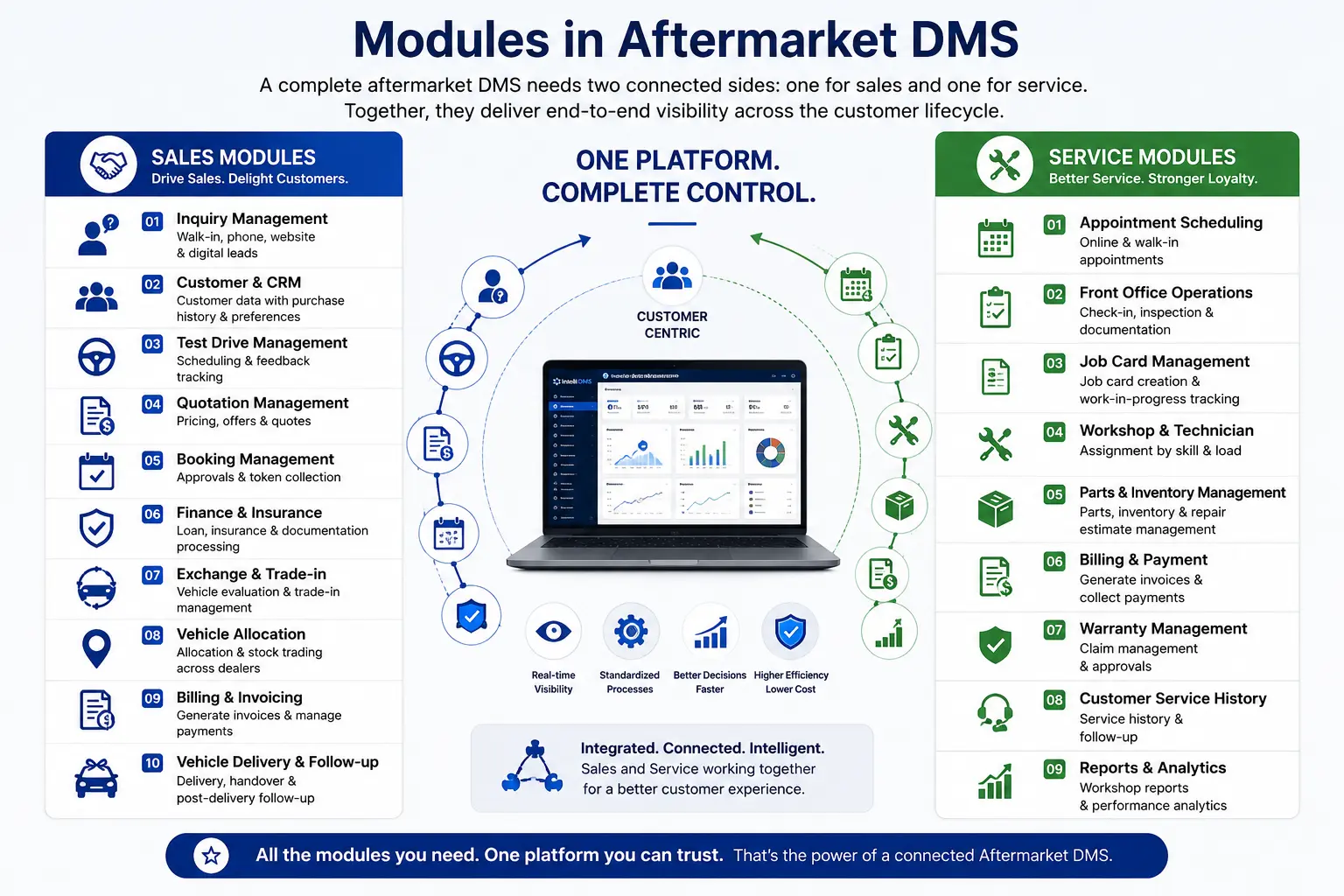
A complete aftermarket DMS needs two connected sides: one for sales and one for service. Any DMS missing several items from either list is asking the OEM to plug the gap with a second system, which recreates the same disconnected setup the DMS was bought to fix.
Sales modules to look for:
- Inquiry management for walk-in, phone, website, and digital leads
- Customer and CRM data with purchase history and preferences
- Test drive scheduling and feedback tracking
- Quotation management with pricing and offers
- Booking management with approvals and token collection
- Finance and insurance processing
- Exchange and trade-in evaluation
- Vehicle allocation and stock trading
- Billing and invoicing
- Vehicle delivery and post-delivery follow-up
Service modules to look for:
- Appointment scheduling for online and walk-in customers
- Front office check-in, inspection, and documentation
- Job card creation and work-in-progress tracking
- Workshop and technician assignment based on skill and load
- Parts, inventory, and repair estimate management
- Billing and payment collection
- Warranty claim management and approvals
- Customer service history and follow-up
- Reports and workshop analytics
Intelli DMS structures its platform exactly this way, and its module breakdown is a useful benchmark for what any serious aftermarket DMS should cover, module for module.
Evaluation Criteria: How to Identify the Best DMS for Aftermarket Networks
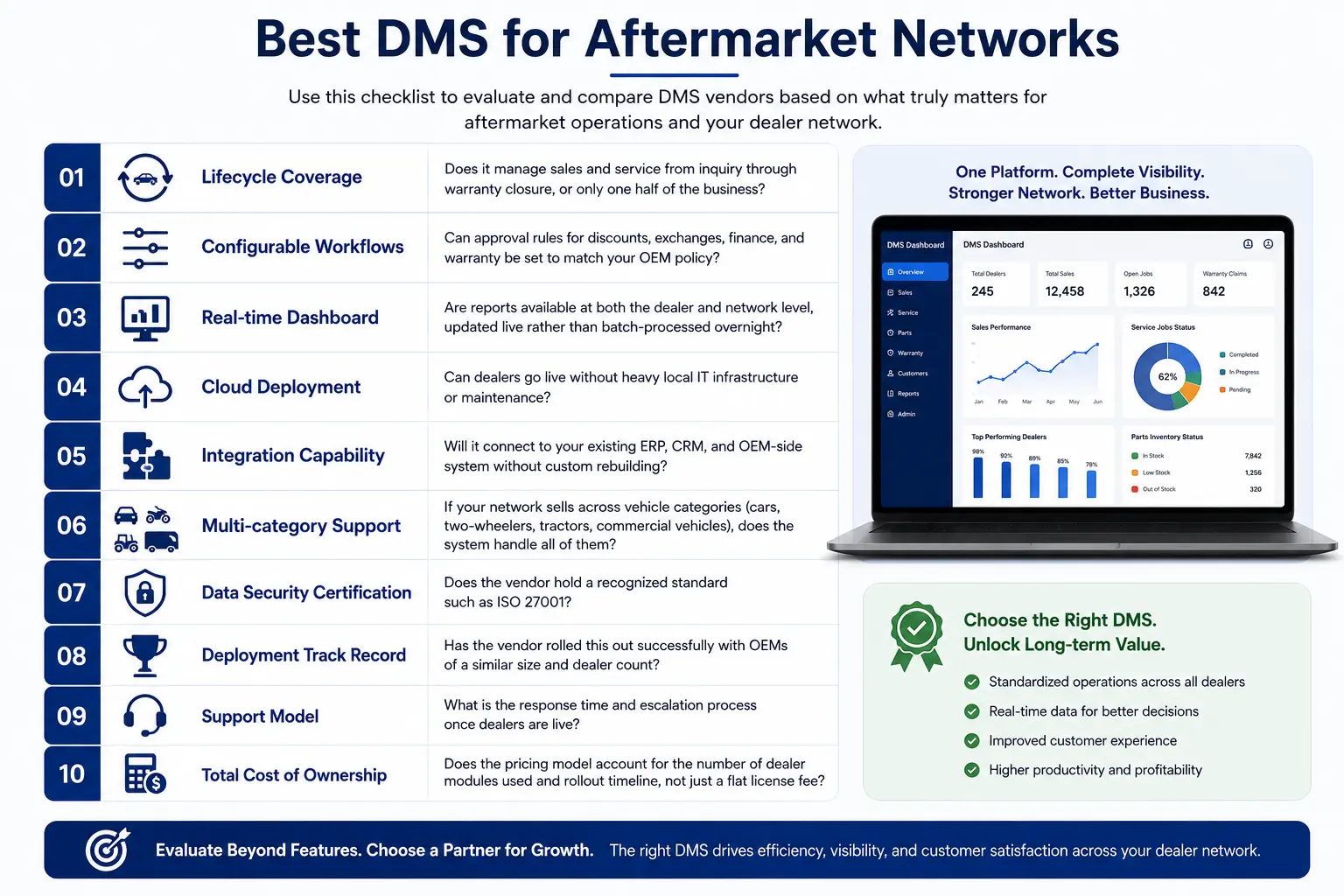
Comparing vendors on features alone is not enough. The best DMS for aftermarket operations should be scored against a fixed set of criteria that reflect how a US OEM actually runs a dealer network, not just what a sales demo shows.
Use this checklist when evaluating any DMS vendor:
- Lifecycle coverage: Does it manage sales and service from inquiry through warranty closure, or only one half of the business?
- Configurable workflows: Can approval rules for discounts, exchanges, finance, and warranty be set to match your OEM policy, rather than a fixed template?
- Real-time dashboard: Are reports available at both the dealer level and the network level, updated live rather than batch-processed overnight?
- Cloud deployment: Can dealers go live without heavy local IT infrastructure or maintenance?
- Integration capability: Will it connect to your existing ERP, CRM, and OEM-side system without custom rebuilding?
- Multi-category support: If your network sells across vehicle categories (cars, two-wheelers, tractors, commercial vehicles), does the system handle all of them?
- Data security certification: Does the vendor hold a recognized standard such as ISO 27001?
- Deployment track record: Has the vendor rolled this out successfully with OEMs of a similar size and dealer count?
- Support model: What is the response time and escalation process once dealers are live?
- Total cost of ownership: Does the pricing model account for the number of dealer modules used and rollout timeline, not just a flat license fee?
Common Mistakes OEMs Make When Selecting a DMS
Most failed DMS rollouts trace back to how the system was selected, not to the technology itself. The same handful of mistakes show up across OEM after OEM, regardless of network size, vehicle category, or region, and most of them are avoidable with a more structured evaluation process.
- Buying on price alone: A lower license cost rarely accounts for the cost of poor dealer adoption later.
- Splitting sales and service decisions: Choosing separate systems for each recreates the same data silos the DMS was supposed to fix.
- Underestimating training and change management: Dealer staff needs structured onboarding, not just system access.
- Skipping data security review: Customer and financial data moving through dealer systems needs the same scrutiny as any OEM-grade software
- No phased rollout plan: Switching every dealer on the same day, with no pilot group, multiplies the risk of disruption.
Implementation Roadmap: Rolling Out a DMS Across a Dealer Network
A dealer management system rollout works best as a phased project, not a single launch event where every dealer switches systems on the same day. The sequence below reflects how most successful OEM deployments are structured, from initial audit through full network coverage.
- Audit the existing process. Document how each dealer currently handles inquiries, bookings, job cards, and billing, and where the gaps are.
- Define standard operating procedures. Agree on one sales process and one service process that every dealer will follow on the new system.
- Run a pilot. Select a small group of dealers, ideally across different sizes and regions, and run the system alongside existing processes for a short period. This is the same phased approach OEMs typically follow when rolling out a platform like Intelli DMS, starting with a representative dealer group before expanding network-wide.
- Train dealer staff and technicians. Cover both the software and the new process, since the two are not the same training.
- Migrate historical data. Bring over existing customer records, service history, and open job cards before go-live, not after.
- Roll out in phases. Expand region by region or dealer group by dealer group, using lessons from the pilot to adjust the plan.
- Monitor adoption through dashboards. Track usage and data quality at each dealer, and follow up directly where adoption lags.
Business Impact: What Changes After Switching to the Right DMS
The case for investing in a proper DMS is not just about operational convenience or a cleaner dashboard. It shows up directly in conversion rates, turnaround times, staff retention, and the cost structure of running a dealer network at scale.
OEMs that move from fragmented manual processes to a connected DMS typically see:
- Higher inquiry-to-booking conversion
- Standardized sales and service processes across every dealer
- Improved customer experience and satisfaction scores
- Reduced turnaround time in both sales and service
- Better workshop productivity and technician utilization
- Stronger OEM-level visibility into dealer performance
- Lower operational cost and less manual rework
- Higher dealer profitability and revenue over time
The cost side of this matters as much as the upside. McKinsey’s analysis of dealership financials found that average SG&A costs have risen 8 percent in recent years, while staff turnover across the industry has averaged 34%. Manual, paper-based processes make both problems worse: every new hire has to relearn a process that exists only in someone’s head or in a stack of paper forms. A platform like Intelli DMS is built to produce the opposite effect: standardized workflows that reduce how much process knowledge depends on any one person, and dashboards that give the OEM a constant, current view of what is happening across the network.
Why OEMs Choose Intelli DMS
Intelli DMS is the platform built against the criteria above rather than as a single-function tool. It runs both the sales and service lifecycle on one platform, with configurable approval workflows and real-time dashboards for dealers and OEMs alike.
On the sales side, Intelli DMS covers inquiry management, customer and CRM data, test drive scheduling, quotation management, booking management, finance and insurance processing, exchange evaluation, vehicle allocation, billing, and delivery with post-sales follow-up.
On the service side, it covers appointment management, front office check-in, job card management, workshop and technician assignment, parts and inventory management, billing and payment, warranty and service operations, customer experience management, and reporting and analytics.
A few points worth noting for OEMs running due diligence on Intellinet Systems:
- ISO 27001:2022 certified for information security
- Recognized by Forbes in 2023 as one of 200 companies with global potential
- Dealer network clients include Ford, Mahindra, Maruti Suzuki, Honda, Tata, Kawasaki, and Ather Energy
- Deployments span India, the United States, Saudi Arabia, Malaysia, Israel, Mexico, and Canada
- Coverage across vehicle categories including passenger cars, two-wheelers, tractors, and commercial vehicles
None of this replaces a proper evaluation against your own network's requirements. But for OEMs working through the checklist in this guide, Intelli DMS is one of the few DMS platforms built to answer every item on it from a single, connected system.
Conclusion
Choosing the best dealer management system for aftermarket operations is not about finding the longest feature list. It comes down to whether the system covers the full sales-to-service lifecycle, can be configured to match OEM policy, gives both dealers and the OEM real-time visibility, and comes from a vendor with a track record of deploying it successfully across networks like yours.
Get the evaluation criteria right, and a DMS for aftermarket OEMs pays for itself in higher conversion, faster turnaround, and lower manual effort within the first year of full rollout. Get it wrong, and you end up with another disconnected system added to the pile. Intelli DMS was built against this exact checklist: sales and service on one platform, configurable workflows, real-time dashboards, ISO 27001:2022 certification, and a client base spanning Ford, Mahindra, Maruti Suzuki, Honda, and Kawasaki. For OEMs working through this decision, it is worth putting on the shortlist and evaluating directly against the criteria in this guide.
Looking for the Best Dealer Management System for Your Aftermarket Network?
See how Intelli DMS helps OEMs unify sales, service, warranty, and dealer operations on one platform. Book a personalized demo today.
Frequently Asked Questions
What is the difference between a generic DMS and a DMS built for aftermarket operations?
A generic DMS often focuses on new vehicle sales and basic inventory tracking. A dealer management system for aftermarket operations also runs the service side: job cards, technician scheduling, parts, warranty claims, and customer follow-up. For OEMs, most of the long-term relationship with a customer happens after the sale, so a DMS that stops at delivery misses the majority of the dealer's daily work.
How long does it take to implement a DMS across a dealer network?
Timelines vary by network size, but most OEM rollouts run in phases over several months rather than weeks. A pilot with a small group of dealers typically takes four to eight weeks, followed by a phased expansion across regions. Networks with hundreds of dealers often plan for six to twelve months to reach full coverage, with adoption monitored at each stage rather than assumed.
Is a cloud-based DMS better than an on-premise system for OEM dealer networks?
For most OEM dealer networks, cloud deployment is the more practical choice. It avoids the cost and delay of setting up local servers at every dealer, keeps updates and security patches consistent across the network, and gives the OEM centralized visibility without needing direct access to each dealer's hardware. On-premise systems can still make sense for dealers with strict local data residency requirements.
What should an OEM look for in a DMS vendor beyond the software itself?
Look closely at the vendor's deployment track record with OEMs of a similar size, their data security certifications, and their support model once dealers go live. A DMS is only as good as the rollout behind it. A vendor with strong software but no experience managing multi-dealer deployments can still produce a difficult rollout.


Explore More Insights






.webp)


About the Author


Chandra Shekhar
Chandra Shekhar is the Senior Manager, Strategy & Business Development at Intellinet Systems. With over a decade of experience in the automotive industry, Chandra Shekhar has led digital transformation and aftersales strategy initiatives for OEMs across multiple markets. His background combines deep industry knowledge with a practical understanding of how technology can solve real operational challenges. He focuses on making complex ideas clear and relevant for automotive and aftermarket professionals navigating ongoing change.


