

Overview: Warranty management for spare parts is the process OEMs use to receive, validate, approve, and reimburse warranty claims involving a single replacement part rather than a complete vehicle or product repair. Because OEMs ship millions of spare parts every year through dealer and distributor networks, this creates a steady stream of individual claims that need fast validation, fraud checks, and supplier cost recovery. This article covers what spare parts warranty management includes, how parts-only claims differ from standard warranty claims, the main challenges OEMs face at scale, the step-by-step claim process, the software modules that support it, and best practices for managing spare parts warranties without slowing down reimbursement.

Key Takeaways:
- Warranty management for spare parts covers claims involving only a replacement part, rather than a complete vehicle repair or a labour claim.
- Parts-only claims are harder to track because they move through dealers, distributors, warehouses, and multiple supplier tiers.
- Manual claim processing slows reimbursement and lets duplicate or fraudulent claims go unnoticed.
- At scale, OEMs need automated validation, part traceability, and structured supplier recovery to control warranty costs.
- Purpose-built software, such as Intelli Warranty, centralizes parts warranty management from claim submission to supplier recovery.
Automate Spare Parts Warranty Claims with Intelli Warranty. Book a Free Demo Today
What Is Warranty Management for Spare Parts?
Warranty management for spare parts is the process of tracking, validating, approving, and reimbursing warranty claims for defective or failed replacement parts, separate from labor or full vehicle repair claims. It covers the part’s warranty period, defect verification, dealer submission, and cost recovery from the original supplier.
Unlike a full warranty claim, a parts-only claim usually applies to an aftermarket sale, a service replacement, or a component swapped outside the original vehicle purchase. This makes spare parts warranties their own category, with rules that differ by part type, region, and supplier agreement. A functioning system for spare parts warranties typically includes:
- Part serial or batch number tracking from production to installation
- Claim submission by the dealer, distributor, or service center
- Defect verification through inspection or the returned part
- Reimbursement to the dealer or distributor once approved
- Recovery of the cost from the supplier when the supplier is at fault.
.webp)
Why Parts-Only Warranty Claims Are Different From Full Vehicle Claims
Parts-only claims differ from full repair claims because they involve failure of a single component rather than an entire repair job. They also pass through several layers: dealer, distributor, regional warehouse, and supplier before they are resolved. This makes tracking the part’s origin, batch number, and installation history essential for accurate validation.
A few practical differences stand out when comparing spare parts warranties to standard vehicle or full-repair warranties:
- Volume and value: parts claims are far higher in volume but lower in value per claim, which makes manual review inefficient.
- Traceability: a part can be sold, shelved, and installed months or years after manufacture, so batch tracking matters more than claim data alone.
- Multiple responsible parties: a defect may trace back to the OEM, a tier-1 supplier, or a dealer installation error, and each has a different recovery path.
- Coverage terms: parts often carry a separate warranty period from the vehicle they are installed in, so claim eligibility has to be checked against the part, not just the vehicle.
What Are the Core Challenges OEMs Face at Scale?
At scale, OEMs struggle with claim volume, inconsistent dealer documentation, slow supplier recovery, and limited visibility into fraud patterns. Without automation, claims teams process thousands of parts claims by hand, which delays reimbursement and lets errors and duplicate submissions slip through unnoticed.
Across OEM implementations, one of the most common bottlenecks is validating claim eligibility against warranty terms, part history, and supplier agreements. Automating these checks allows claims teams to focus on exceptions instead of reviewing every submission manually.
According to Warranty Week, U.S.-based manufacturers paid a total of $30.37 billion in warranty claims in 2025, a 4% increase from 2024, and held $71.89 billion in warranty reserves by year-end, the highest total on record.
This scale of spending means even small inefficiencies in parts warranty management add up quickly. Common challenges include:
- High claim volume across a global dealer and distributor network
- Inconsistent or incomplete documentation submitted by dealers
- Manual matching of part serial numbers to purchase and installation records
- Slow supplier recovery cycles that rely on email and spreadsheets
- Limited fraud detection across regions and dealer groups
- Disconnected systems between the parts catalog, DMS, and ERP
How Do OEMs Process Parts-Only Warranty Claims?
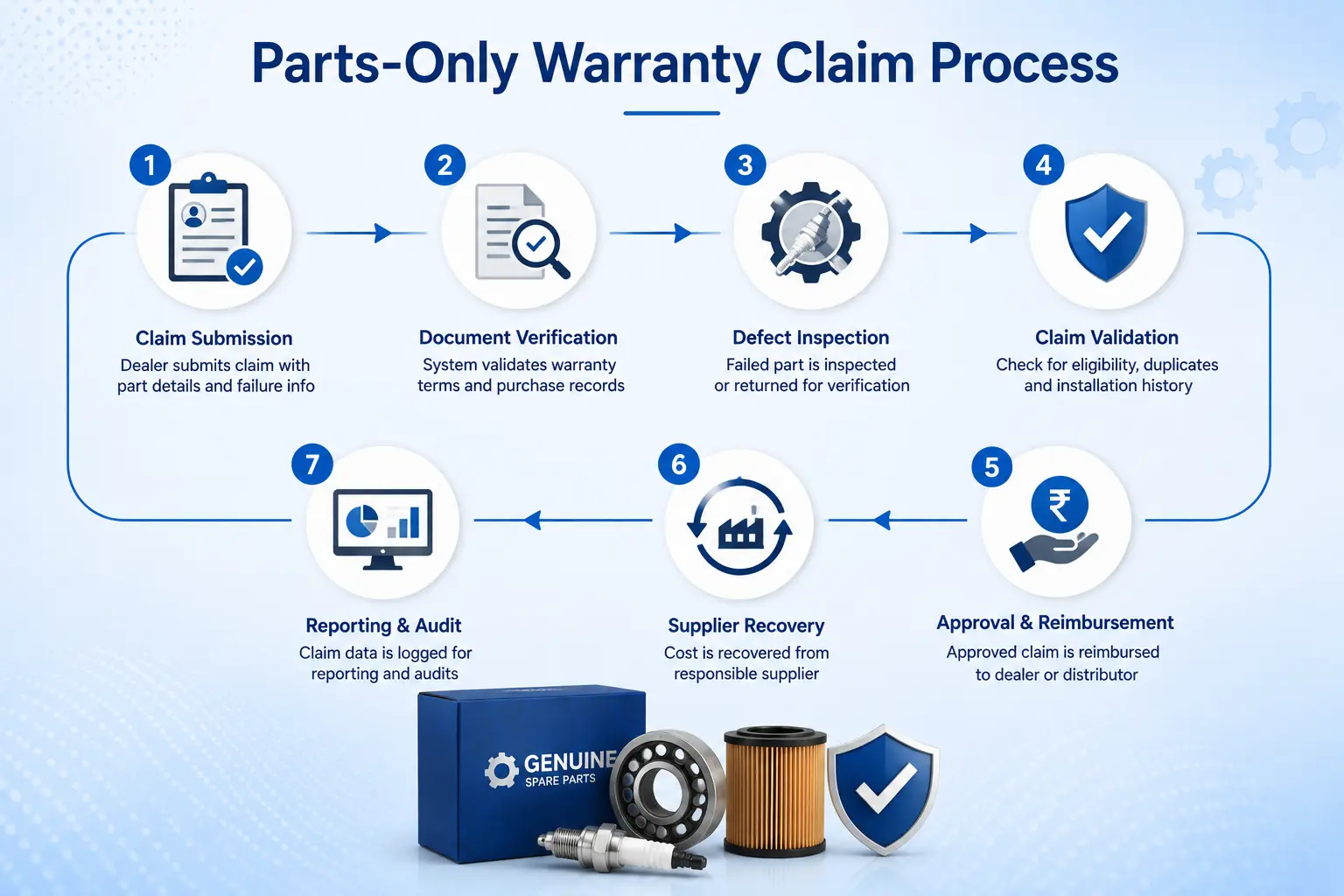
OEMs typically process a parts-only warranty claim through seven structured steps, from claim submission to final reporting. The seven steps are claim submission, document verification, defect inspection, claim validation, approval and reimbursement, supplier recovery, and reporting and audit. Each step verifies a different aspect of the claim before reimbursement and supplier cost recovery take place.
Step 1. Claim submission: The dealer or distributor files the claim with part number, purchase date, and failure description.
Step 2. Document verification: The system checks the claim against warranty terms, purchase records, and part registration.
Step 3. Defect inspection: The failed part is returned or photographed for inspection, depending on OEM policy.
Step 4. Claim validation: The claim is checked for duplicate submissions, coverage eligibility, and installation history.
Step 5. Approval and reimbursement: Once validated, the OEM reimburses the dealer for the part and any applicable labor.
Step 6. Supplier recovery: If the defect is traced to a supplier, the OEM opens a recovery claim to recover the associated costs.
Step 7. Reporting and audit: Claim data is logged for dealer-level, part-level, and supplier-level reporting.
What Are the Key Modules of an Effective Parts Warranty Management System?
An effective spare parts warranty management system brings claim intake, validation, traceability, and supplier recovery into a single workflow instead of scattered spreadsheets. For OEMs managing high claim volumes, integrating these capabilities into a dedicated spare parts warranty management platform improves consistency, reduces manual effort, and accelerates reimbursement.
- Claim submission portal for dealers and distributors to file claims with required documentation
- Automated validation rules that check part eligibility, warranty period, and prior claim history
- Part traceability by batch or serial number, from production through installation
- Dealer-level and part-level reporting to spot patterns across the network
- Supplier recovery workflow to track and collect reimbursement from suppliers
- Fraud detection logic that flags unusual claim rates or repeat failures
- Audit trail covering submission, approval, parts return, and payment
What Are the Best Practices for Managing Spare Part Warranties?
Managing spare parts warranties well comes down to consistency: the same format, the same validation rules, and the same recovery process, applied across every dealer and region. The following checklist covers the practices that reduce processing time and control costs:
- Standardize claim submission templates across all dealers and distributors
- Track parts by batch and serial number from production to installation
- Automate validation instead of relying on manual document checks
- Set clear service-level agreements for claim approval and reimbursement timelines
- Review dealer-level claim patterns monthly to catch anomalies early
- Recover supplier costs systematically, not on a case-by-case basis
- Keep a complete audit trail for every claim, from submission to payment
How Does Intelli Warranty Support Spare Parts Warranty Management at Scale?

As warranty costs continue to rise and manual processes become harder to scale, many OEMs are adopting dedicated warranty management platforms. Intelli Warranty is designed specifically to help OEMs automate parts-only warranty claims, improve traceability, and streamline supplier recovery from a single platform. This shortens manual review time, flags irregular claims earlier, and gives OEMs clear visibility into which parts, suppliers, or dealers are driving warranty costs.
According to Warranty Week, Ford's warranty claims payments increased 22% year over year to $5.83 billion in 2024, setting a new record for the automaker and highlighting the rising cost of warranty obligations across the automotive industry. Rising costs like this are pushing more OEMs to replace manual, spreadsheet-based claim tracking with dedicated warranty management software.
For example, Intelli Warranty automatically validates each parts-only claim against warranty coverage, part history, and previous claim records before it reaches an approver. Claims that meet predefined business rules move forward automatically, while exceptions such as duplicate submissions, expired coverage, or missing documentation are routed for review. The platform also maintains a complete audit trail that supports supplier recovery and simplifies compliance reporting. This workflow reduces manual verification and helps OEMs process parts warranty claims more consistently across dealer networks.
Conclusion
Warranty management for spare parts is no longer a side task handled through spreadsheets and email. As claim volumes grow and warranty costs climb industry-wide, OEMs need a structured process for validating claims, tracing parts, and recovering costs from suppliers. The OEMs that manage spare parts warranties well standardize claim submission, automate validation, and track every part from production to installation. This reduces processing delays, limits fraud, and puts money back into the business through consistent supplier recovery. Software built specifically for parts warranty management, rather than general-purpose ERP modules, is what makes this level of control possible at scale.
Request a Demo to see how Intelli Warranty helps OEMs automate claim validation, improve part traceability, and simplify supplier recovery from a single platform.
FAQ
What is the difference between a spare parts warranty and a full vehicle warranty?
A spare parts warranty covers only the replacement part itself, not labor or the full vehicle repair. It usually has its own coverage period that starts from the part's installation or purchase date, separate from the vehicle's original warranty terms.
How long does a typical spare parts warranty claim take to process?
Processing time varies by OEM, but manual claims often take one to three weeks due to document checks and inspection delays. Automated warranty management systems can cut this significantly by validating claims and part eligibility as soon as they are submitted.
Who pays for a spare parts warranty claim, the OEM or the supplier?
The OEM typically reimburses the dealer first to keep the customer relationship intact. If the defect traces back to a supplier's manufacturing fault, the OEM then files a separate recovery claim against that supplier to recoup the cost.
Can OEMs recover the cost of a defective part from the supplier?
Yes, when the failure is traced to a supplier defect through inspection or failure analysis. Recovery depends on having clear documentation, batch tracking, and a structured supplier recovery process rather than case-by-case negotiation.
What causes most spare parts warranty claims to get rejected?
Common rejection reasons include missing documentation, claims filed after the warranty period, mismatched part serial numbers, and installation errors not covered under the part's warranty terms. Clear claim templates reduce these rejections.


Explore More Insights








.webp)


About the Author


Chandra Shekhar
Chandra Shekhar is the Senior Manager, Strategy & Business Development at Intellinet Systems. With over a decade of experience in the automotive industry, Chandra Shekhar has led digital transformation and aftersales strategy initiatives for OEMs across multiple markets. His background combines deep industry knowledge with a practical understanding of how technology can solve real operational challenges. He focuses on making complex ideas clear and relevant for automotive and aftermarket professionals navigating ongoing change.


