

Overview: Scaling a manufacturing business through a dealer network is not just about adding more dealers. It requires consistent processes, real-time visibility, and standardized operations across every location. Without a unified system, fragmented data, disconnected workflows, and inconsistent service make it difficult for OEMs to manage growth efficiently. A dealer management system (DMS) connects sales, inventory, service, and dealer operations on a single platform, enabling manufacturers to expand into new markets while maintaining control, improving decision-making, and delivering a consistent customer experience across the network.

Key Takeaways:
- OEMs scale their manufacturing business by standardizing how every dealer in the network captures leads, manages inventory, and delivers service, not just by adding more dealers.
- Fragmented systems across a dealer network are a measurable cost, not just an inconvenience, with estimates of $800,000 to $2 million a year in lost margin and delayed decisions for mid-sized manufacturers.
- Slow lead follow-up is one of the most avoidable costs of scale: contacting a lead within an hour makes a dealer roughly 7 times more likely to have a meaningful conversation with a decision maker.
- Cloud-based dealer management systems now account for more than 65% of DMS installations, largely due to their ability to reduce IT maintenance costs and provide OEMs with real-time visibility across every location.
- A DMS built for multi-brand, multi-location networks, such as Intelli DMS, connects CRM, lead management, inventory, and service into a single system instead of leaving each dealer to run its own patchwork of disconnected tools.
A dealer management system helps OEMs scale their business by standardizing lead management, inventory tracking, and service operations across every dealership, replacing spreadsheets and disconnected software with a single, unified platform. When customer, inventory, and service data are centralized in a single system rather than scattered across a multi-brand network, OEMs can expand into new markets and onboard new dealers without losing visibility into how the business is performing on the ground.
Why Scaling a Multi-Brand Dealer Network Gets Harder, Not Easier for OEMs

Growth multiplies complexity before it multiplies revenue. Each new dealer, brand, or region adds another set of processes, another set of spreadsheets, and another gap in visibility for the OEM trying to manage the network as a whole.
This is not a minor inefficiency. Millennium Business Solutions analysis of mid-sized manufacturers and distributors estimated that fragmented, disconnected systems cost businesses between $800,000 and $2 million a year, driven by delayed quotes, inconsistent pricing, and decisions made on incomplete information.
For an OEM managing a multi-brand or multi-location dealer network, that cost compounds with every new dealer added, because each one becomes another source of inconsistent data rather than another contributor to a shared, standardized system.
1 How Does Fragmented Data Slow Down a Growing Dealer Network?
Fragmented data slows growth because teams spend time reconciling numbers rather than acting on them. Disconnected systems force teams to spend significant time reconciling information from multiple sources before they can make informed business decisions. As dealer networks grow, this manual effort delays reporting, reduces visibility, and slows operational decision-making.
In a dealer network, this shows up in familiar ways: a dealer’s inventory count in one system does not match what is on the lot, a customer’s service history lives in a different tool than their purchase record, and an OEM asking for network-wide performance data has to wait days for someone to compile it manually. None of this is a single dramatic failure. It is a slow, ongoing drag on how fast an OEM can make decisions and how confidently it can expand.
2. Lead and Campaign Management: Where Scale Is Won or Lost Early
Every new market an OEM enters starts with leads, and how fast those leads get a response determines how much of that early growth actually converts. When each dealer in a network handles leads differently, some fast and some slow, the OEM has no way to know which markets are underperforming because of the product and which are underperforming because leads are sitting unanswered. A shared campaign and lead management process closes that gap:
- Leads generated by OEM marketing campaigns are automatically assigned to dealers rather than sitting in an inbox.
- Every dealer follows the same follow-up cadence, so response time is not left to individual habits.
- The OEM can see lead-to-conversion rates by dealer, by region, and by campaign, not just in aggregate.
3. Inventory and Parts Visibility Across a Multi-Brand Network
Inventory is one of the clearest places where fragmented systems cost real money. Without shared visibility, one dealer overstocks a slow-moving model while another turns away a customer for a part or unit that is sitting unsold two locations away.
Modern dealer management systems provide real-time inventory visibility and demand forecasting that help OEMs reduce excess inventory, improve stock allocation, and make replenishment decisions based on actual dealer demand rather than manual estimates.
For an OEM scaling across brands or regions, this visibility enables production and inventory allocation around actual demand rather than dealer-by-dealer guesswork.
4. How Does a DMS Standardize Service Management Across Dealerships?
Service is where inconsistency across a dealer network becomes most visible to customers, and it is usually the hardest area for an OEM to standardize because aftermarket operations depend on people, parts, and processes working together.
- Service contracts, maintenance schedules, and warranty terms should look the same to a customer regardless of which dealer they visit.
- Technician scheduling and job tracking should follow a standardized workflow rather than relying on different spreadsheets at every location.
- Service KPIs, turnaround time, first-time fix rate, and customer satisfaction need to be visible to the OEM at the network level, not just within each dealer’s own records.
Without a shared system behind these processes, an OEM’s brand promise on service quality is only as strong as its least organized dealer, and customers rarely separate that experience from their opinion of the brand itself.
5. Real-Time Data and Analytics: The Foundation for Faster Decisions
Real-time data access is what turns a dealer network from a collection of separate businesses into one system an OEM can actually manage. Cloud-based dealer management systems are becoming the preferred deployment model because they reduce infrastructure requirements, simplify software updates, and provide OEMs with real-time visibility across geographically distributed dealer networks.
Implementing a shared dealer management platform across multiple locations requires careful planning to ensure consistent data across the network. Choosing a platform with experience in multi-brand, multi-location deployments helps reduce implementation risks and supports reliable reporting from day one.
How Intelli DMS Supports OEMs Scaling a Multi-Brand Network
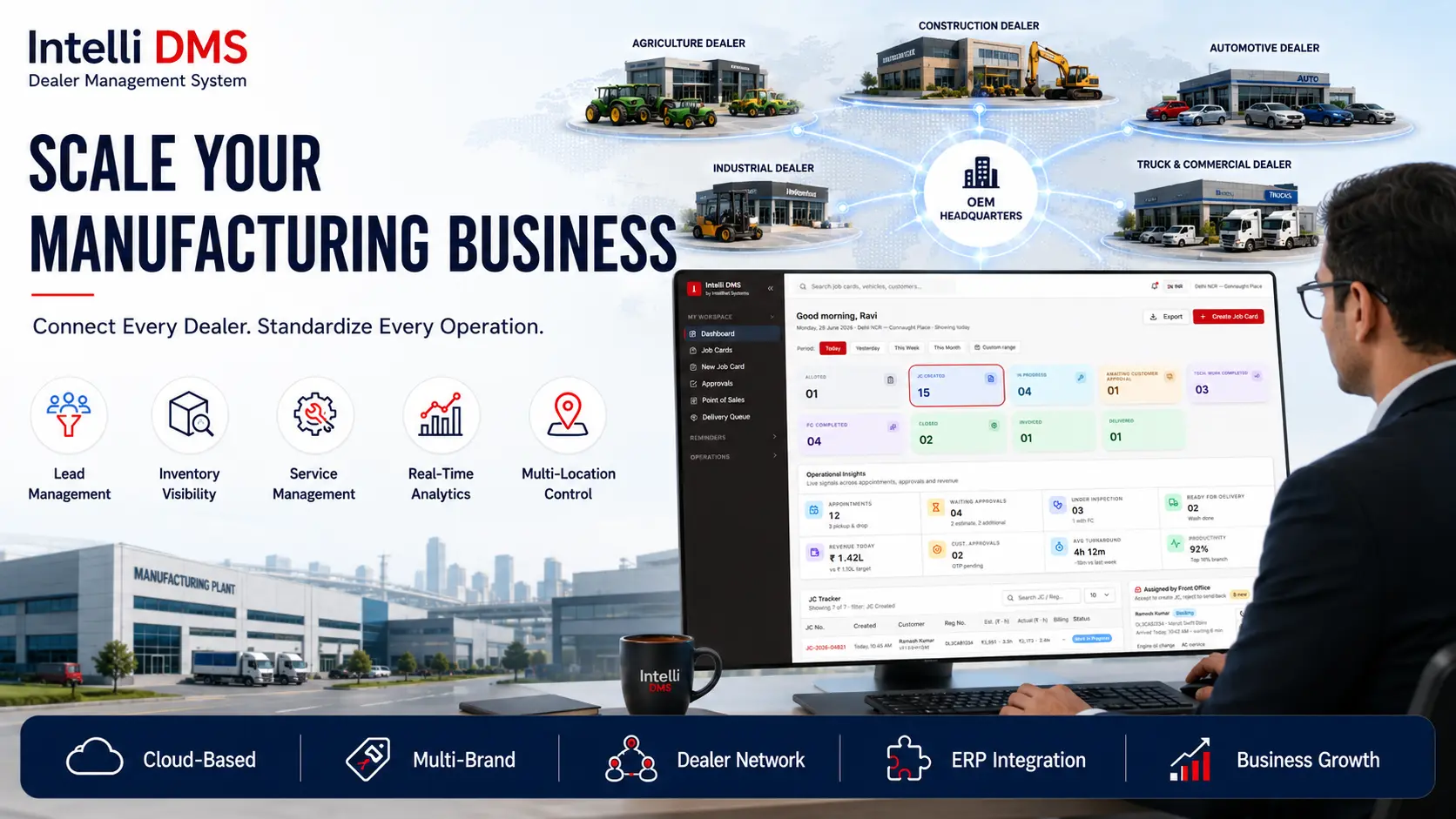
Intelli DMS is a cloud-based dealer management system designed for OEMs managing multi-brand, multi-location dealer networks across automotive, agriculture, construction, and industrial equipment. Instead of leaving each dealer to run its own CRM, inventory spreadsheet, and service log, it puts sales, service, and customer data on one platform that every dealer and the OEM share.
The platform brings together the areas covered in this article:
- Customer relationship management that keeps purchase history, service records, and communication in one profile, visible across departments and, where needed, across dealer locations.
- Lead and campaign management that captures inquiries from OEM marketing campaigns, assigns them to dealers automatically, and tracks conversion by dealer and by campaign.
- Service management with scheduling, job cards, and service contract tracking, so service quality looks the same across the network rather than varying by location.
- Real-time dashboards that give OEMs visibility into inventory, sales performance, and service KPIs across every dealer, without waiting on manually compiled reports.
Conclusion
Scaling a manufacturing business through a dealer network is not primarily a sales problem. It is a data problem: fragmented systems cost real money, slow lead response loses deals before they are even logged, and inconsistent inventory and service processes make it hard for an OEM to trust its own numbers as the network grows. A connected dealer management system does not replace the work of building good dealers and good products, but it removes the structural friction, disconnected tools, delayed reporting, and inconsistent service that makes growth harder to manage than it needs to be.
Ready to Standardize Your Dealer Operations?
Book a demo to see how Intelli DMS helps OEMs streamline lead management, inventory control, service operations, and analytics across their entire dealer network.
Frequently Asked Questions
What Is a Dealer Management System?
A Dealer Management System (DMS) is software that helps OEMs and dealerships manage sales, customer relationships, inventory, parts, service, warranty, and reporting through a single platform. It standardizes operations across dealer locations, giving manufacturers real-time visibility into network performance and enabling consistent processes as the business grows.
What Is a Multi-Brand Dealer Network?
A multi-brand dealer network is a distribution model where an OEM manages dealerships that sell or service multiple brands, product lines, or business units across different locations. As these networks expand, standardized processes and centralized data become essential for maintaining operational consistency and visibility.
What does it mean for an OEM to scale a manufacturing business through a DMS?
It means giving every dealer in the network the same system for managing leads, inventory, and service, instead of each dealer running its own separate tools. This lets an OEM add dealers, brands, or regions without losing visibility into how the network performs as a whole.
How does a DMS improve lead and campaign management for OEMs?
A DMS captures leads generated by OEM marketing campaigns and routes them to the right dealer automatically, then tracks how quickly each dealer follows up and how many leads convert. This gives OEMs visibility into which dealers or regions are converting well and which need support.
Is a cloud-based DMS harder to roll out across many dealers than an on-premise system?
Not inherently, but multi-location rollouts do carry a real risk of data synchronization issues if the vendor lacks experience with networks of that size. Choosing a platform with a track record in multi-brand deployments, and a clear rollout plan, reduces that risk significantly.
Does scaling through a DMS require standardizing every dealer’s process at once?
No. Most OEMs roll out module by module, starting with the area causing the most inconsistency across the network, often lead management or inventory visibility, and expanding into service and reporting once dealers are comfortable with the system.


Explore More Insights






.webp)


About the Author


Chandra Shekhar
Chandra Shekhar is the Senior Manager, Strategy & Business Development at Intellinet Systems. With over a decade of experience in the automotive industry, Chandra Shekhar has led digital transformation and aftersales strategy initiatives for OEMs across multiple markets. His background combines deep industry knowledge with a practical understanding of how technology can solve real operational challenges. He focuses on making complex ideas clear and relevant for automotive and aftermarket professionals navigating ongoing change.


