Overview: Warranty management system cost is the total cost an organization incurs to implement and operate software for managing warranty claims, approvals, policies, dealer submissions, supplier recovery, reporting, and related workflows. Pricing commonly depends on the software's pricing model, such as transaction-based pricing tied to claim volume, seat-based pricing tied to users, or tiered pricing based on usage and functionality. For an OEM, the final cost can also vary based on claim types, integration requirements, implementation scope, data migration, and ongoing support.

Key Takeaways:
- Intelli Warranty's cost is driven by claim volume, user count, and integration scope, not a single license fee.
- The number of claim types an OEM runs through the platform (OEM PDI, dealer PDI, post-sale, campaign, goodwill, spare parts) directly affects configuration and pricing.
- Implementation, data migration, and DMS or ERP integration are scoped separately from the base subscription and often get underestimated.
- The right way to evaluate the warranty software’s cost is against what manual claims processing is already costing the organization in staff time and rework, not against a sticker price alone.
Get warranty management software pricing estimate based on your actual claim volume, users, claim types, integrations, implementation requirements, and support needs. Speak to a consultant
What Does Warranty Management Software Cost?
There is no single market-wide price for warranty management software because products range from lightweight warranty tracking tools to enterprise platforms built around claims, dealer networks, integrations, and complex workflows. Publicly listed prices illustrate that spread: Capterra's published pricing data places entry-level warranty management products in bands from $14–$16, $16–$159, and $159+ per month, while current vendor listings include products starting at $99/month and others that use custom, quote-based enterprise pricing.
Those figures should not be treated as a benchmark for an OEM warranty operation. A platform handling dealer-submitted claims, multiple claim types, ERP or DMS integrations, approval workflows, supplier recovery, and large transaction volumes has a substantially different scope from a basic warranty tracking application. Current market listings with G2 also show enterprise warranty platforms using custom pricing rather than publishing a standard license fee.
For that reason, Intelli Warranty does not publish a generic “per claim” or “per user” price. The meaningful cost estimate comes from the organization's actual claim volume, users, claim types, integrations, implementation requirements, and support needs.
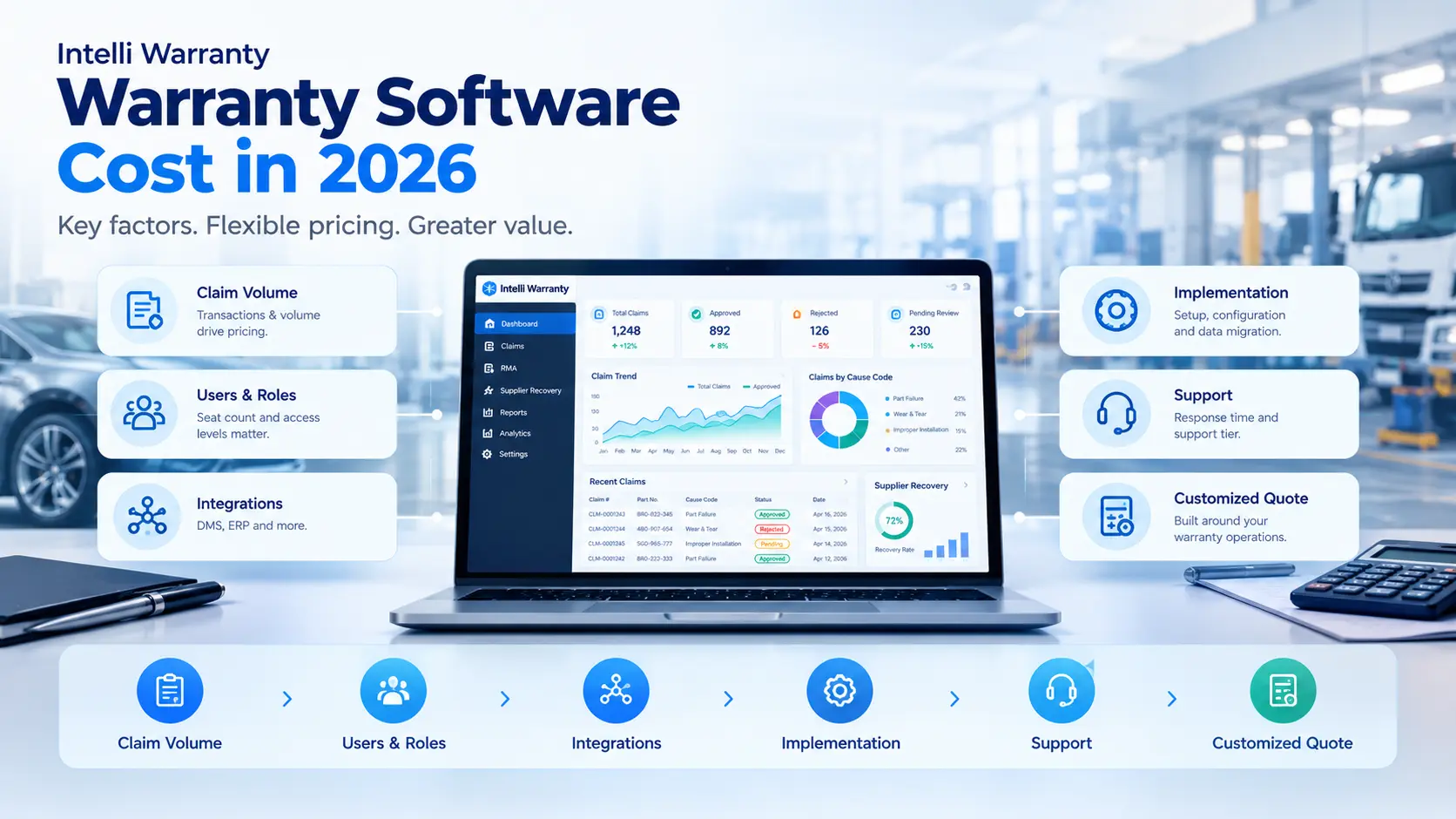
What Determines Warranty Management System Cost?
Warranty management software pricing is shaped by several operational variables: how many claims an OEM processes annually, how many people need access, how many claim types the platform must support, and how much integration work is required to connect it to the organization's DMS, ERP, or parts catalog. Vehicle count alone doesn't set the price.
This is where a lot of OEMs get their initial budgeting wrong when they first inquire about warranty management software. It’s tempting to assume pricing scales cleanly with the number of vehicles sold, the same way parts inventory gets budgeted. It doesn’t work that way, because the platform isn’t pricing the vehicle parc; it’s pricing the transaction volume and complexity that comes through the claims process.
A regional distributor processing a few thousand claims a year through two claim types has a fundamentally different cost profile than a national OEM processing high claim volume across six or seven claim types, with claims coming from hundreds of dealers across multiple states or regions. Same platform, very different scoping conversation.
Why Doesn’t Intelli Warranty Publish a Fixed Price List?
There's no standard sticker price for the platform because it isn’t a shrink-wrapped product. It’s configured around each OEM’s claim types, approval workflows, cause code taxonomy, and the systems it needs to talk to. Two organizations requesting ‘the same platform’ are often asking for very different scopes of work.
The pricing process is based on a discovery process, not a published price list, because the honest answer to ‘what does it cost’ is ‘it depends on what the organization needs it to do.’ That’s not evasive pricing. It reflects how differently OEMs actually run warranty operations:
- Some OEMs manage everything in-house with a small warranty administration team
- Others route a portion of claims through third-party administrators or regional distributors
- Some need multi-currency and multi-region support; others operate in a single market
- Some need tight integration with an existing DMS or ERP; others are building the workflow from a cleaner starting point
- Some need heavy reporting and audit trail requirements for internal finance or compliance review; others need a leaner setup.
Any one of these differences changes the implementation scope for Intelli Warranty, which changes the cost, independent of the base subscription.
What Factors Shape an Intelli Warranty Quote?
Six factors do most of the work in determining warranty software pricing: claim volume, user and role count, number of claim types supported, integration requirements, implementation and data migration scope, and the level of ongoing support required. Everything else in a quote is largely a variation on these.
This is what separates a real warranty claims software pricing conversation from a guess based on vehicle count alone.
These factors are reviewed during a scoping call before providing a number, because guessing at a price before understanding claim volume and integration scope produces a quote that won’t hold up once implementation starts.
How Do Claim Volume and Claim Types Affect Intelli Warranty Pricing?
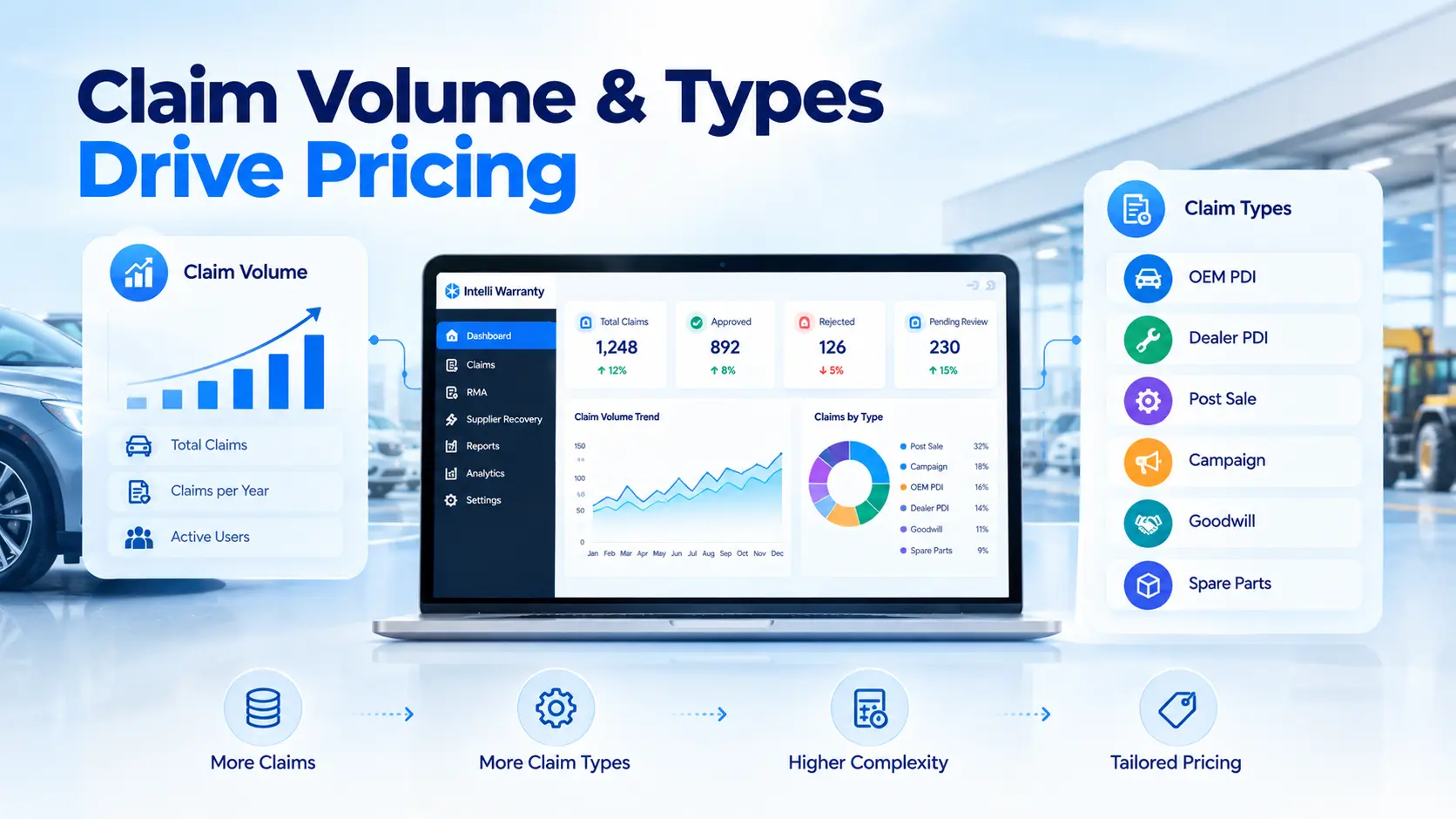
Claim volume and claim type complexity are usually the biggest single drivers of warranty management software pricing. An OEM running claims through two or three claim types has a simpler deployment than one running six or seven, and a higher tier in a transaction-based or tiered pricing structure.
Intelli Warranty is built to handle OEM PDI, dealer PDI, post-sale, campaign, goodwill, and spare parts claims within one system. That range of claim types is a strength operationally, since it means one platform instead of several disconnected tools, but each claim type an OEM activates adds its own cause code taxonomy, approval workflow, and reporting requirements to configure. An OEM that only needs post-sale and campaign claims handled has a lighter deployment than one that needs all six claim types live at launch.
This is also why claim volume matters more than vehicle count. A high-volume OEM with a simple claim structure can cost less to onboard than a lower vehicle OEM running a complex multi-claim-type, multi-region setup.
How Do User Count and Access Roles Affect Cost?
The people who need access to warranty management software include dealer service writers, regional warranty administrators, internal reviewers, and finance or compliance users. This is a separate pricing input from claim volume. More roles and more granular permission levels generally mean a larger seat count in the quote.
Dealer networks vary widely in how many people actually touch warranty claims day to day. A dealer group with a centralized warranty desk might only need a handful of platform logins per store, while a network where individual service advisors submit claims directly needs many more. Internal roles matter too: a warranty administrator reviewing claims needs different access than a supplier quality analyst pulling claim rate reports, and the permission structure is built to separate those roles rather than give everyone the same view.
Before a scoping call, it's worth an organization counting actual users by role (not just headcount) so the seat estimate reflects how the platform will really be used.
What Adds Cost Beyond the Base Platform?
Connecting Intelli Warranty to an organization's DMS, ERP, or parts catalog, along with migrating historical claims data, is typically scoped and priced separately from the base subscription. This is the part of a warranty software quote that most often gets underestimated if it isn't discussed early.
The integration and implementation items that most affect the quote include:
- Integration with an existing DMS or ERP, which varies depending on how modern or fragmented those systems already are
- Historical claims data migration, especially if past claims need to remain searchable for audit or warranty reserve purposes
- Configuration of cause code taxonomies, approval workflows, and policy parameters by claim type
- Linking claim data to VIN-level stock and sales records, which is part of what makes the system useful for tracing failures back to a supplier lot or build date
- Training for dealer users and internal reviewers, particularly where the current process is largely manual or spreadsheet-based
A quote that only covers the subscription and skips these items isn't necessarily cheaper. It's usually incomplete, and the gap shows up during implementation instead of during budgeting.
Support Tier and Ongoing Cost Considerations
Ongoing warranty software cost isn't just the subscription renewal. Support response times, account coverage, and regional support availability sit in different tiers, and the right tier depends on how much a warranty team relies on vendor support versus handling issues internally.
An OEM with an experienced internal warranty administration team may need a lighter support tier, since most day-to-day questions get handled in-house. An OEM that's newer to structured claims management, or one running multiple regions with different working hours, usually needs faster response times and more direct account support. This is worth discussing honestly during scoping, since underpaying for support and needing it later is a common source of frustration, and overpaying for a support tier that goes unused is an avoidable cost.
Evaluating Intelli Warranty's Cost Against Current Process
Comparing the software's price to a quoted number alone misses the point. The real comparison is between warranty management software cost and what manual claims processing is already costing the organization in staff time, claim rejection rework, and delayed defect detection. A system that reduces that rework can be worth more than its sticker price suggests.
Before finalizing a budget conversation, it's worth an organization putting a number, even a rough one, on what the current process actually costs:
- How many hours the warranty team spends manually reconciling claim exports or chasing missing cause codes each month
- How often claims get rejected or reworked because of incomplete documentation, and what that costs in dealer relationship friction
- How long it currently takes to spot a part-level failure pattern, and what that delay has cost in past campaigns or escalations
- How much manual effort goes into RMA tracking and parts return inspection today.
These aren't numbers the Intelli Warranty team can hand to an OEM. They come from the organization's own claims and service operations data, and they're the real baseline for deciding whether a given quote is worth paying.
Questions to Bring to an Intelli Warranty Scoping Conversation
Before requesting pricing, warranty teams should gather annual claim volume by claim type, current user count and roles, integration requirements (DMS, ERP, parts catalog), and a rough estimate of historical data that needs migrating. The vendor can quote faster and more accurately when this information is ready up front.
- What is the organization's annual claim volume, broken out by claim type
- How many internal and dealer users will need system access, and at what permission levels
- What systems does the platform need to integrate with, and how current is the data in those systems?
- How much historical claims data needs to migrate, and does it need to remain queryable
- What response time and support coverage does the warranty team actually need, versus what sounds nice to have
- Are there multi-region, multi-currency, or multi-brand requirements that affect configuration
Warranty teams that walk into an Intelli Warranty scoping conversation with these answers ready usually receive a tighter, more accurate quote than starting from “what does the platform cost.”
Conclusion
Intelli Warranty's cost comes down to a handful of factors: claim volume, user count, claim type complexity, integration scope, and implementation effort. There's no standard price list, because no two OEMs run warranty operations the same way. The more clearly a warranty team understands its own claim volume, user needs, and integration requirements before a scoping conversation, the more accurate and useful the resulting quote will be.
The right comparison isn't simply the lowest quoted number. It is the total cost of the warranty management solution against what manual claims processing is already costing the organization in staff time, rework, delayed recovery, and operational inefficiency.
OEMs trying to determine what Intelli Warranty would actually cost for their claim volume and dealer network won't get there from a generic estimate. Warranty teams are encouraged to bring their claim types, user count, and integration needs to a scoping conversation with the Intelli Warranty team and get a quote built around their actual operation. Book a conversation here.
FAQs
How much does Intelli Warranty cost?
There's no fixed number. Intelli Warranty's cost depends on an OEM's claim volume, number of users, how many claim types run through the platform, and how much integration and implementation work is required. The product team quotes after a scoping conversation, not from a published price list.
What factors affect Intelli Warranty's pricing?
The main factors are claim volume, user and role count, number of claim types supported (OEM PDI, dealer PDI, post-sale, campaign, goodwill, spare parts), integration requirements with the organization's DMS or ERP, implementation and data migration scope, and the support tier required.
Is Intelli Warranty priced per claim or per user?
It depends on the OEM's operation. Pricing typically maps to a transaction-based, seat-based, or tiered structure depending on whether claim volume or user count is the bigger driver of usage.
Does Intelli Warranty's pricing include DMS or ERP integration?
Usually not by default. Integration work is scoped and priced separately from the base subscription, because the effort varies depending on how modern or fragmented the organization's existing DMS or ERP systems are.
How does an OEM get an accurate Intelli Warranty quote?
Warranty teams should come to the scoping conversation with annual claim volume by claim type, current user count and roles, integration requirements, and an estimate of historical data that needs migrating. That information turns a general pricing range into an actual number for the organization.


Explore More Insights





.webp)


About the Author


Nishant Sharma
Nishant Sharma is the Head of Demand Generation at Intellinet Systems, specializing in B2B marketing, sales, digital transformation, and automotive aftermarket solutions. He shares insights on emerging technologies, industry trends, and strategies that help OEMs and businesses improve operational efficiency, customer experience, and aftermarket growth.