

Overview: EV manufacturers require a structured process to manage claims, approvals, warranty trend analysis, and supplier recovery. Managing all these in disconnected processes increases the difficulties of tracking claims at cell and pack level. Intelli Warranty enables EV manufacturers to streamline warranty claims and supplier recovery management by organising warranty workflows and improving claim visibility.
Introduction
For an electric vehicle (EV), the battery is one of the most valuable and technically complex components. It has a direct influence on the vehicle range, safety, operational costs, and customer satisfaction.
EV manufacturers, it is essential to manage battery performance, as it caters to just one part of the challenge. They also need to manage the warranty coverage, investigate battery or parts failures, validate these warranty claims, and manage accountability of the supplier throughout the battery lifecycle.
As an EV battery is not a single component but is made of individual cells, modules, and a battery pack, a problem originating from one cell also affects the performance of the other modules or the entire pack. In such cases, identification of the source of failure and determining warranty responsibility becomes a time-consuming process.
This is where a structured battery lifecycle management process becomes highly relevant. As the demand for EVs rises, EV manufacturers need such reliable processes to connect battery identification, service history, failure reports, documentation of claims, and supplier recovery.
Key Takeaways:
- An efficient EV battery warranty management system requires cell, module, and pack-level traceability.
- Information about cell-level failure helps EV OEMs with the root-cause analysis of pack-level issues.
- Battery management systems help monitor battery operating conditions, whereas battery lifecycle management software helps organise claims, approvals, and supplier recovery workflows.
- Warranty costs are increased, and resolutions are delayed due to incomplete service records and inconsistent claim documentation.
- For EV OEMs to identify recurring issues, monitor supplier performance, and improve aftersales performance, structured warranty data is essential.
- Intelli Warranty enables structured warranty workflows to support warranty claim handling and supplier recovery management for EV OEMs.
Take Control of EV Battery Warranty Claims and Supplier Recovery. Schedule a Free Demo
Why Do EV Manufacturers Struggle with Battery Warranty Management?
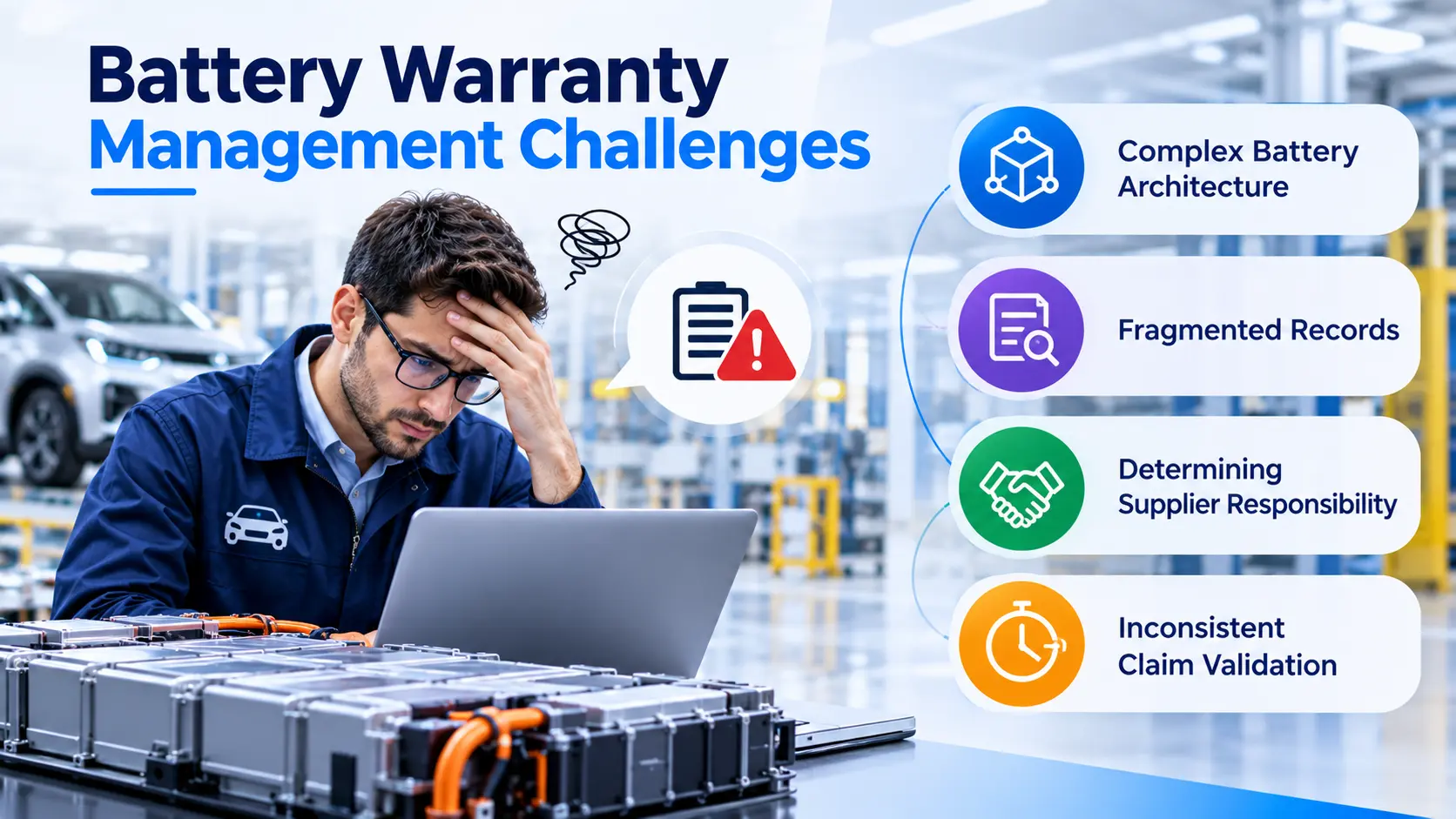
EV batteries are more complex and involve multiple interconnected parts with complex operating conditions, compared to conventional vehicle parts. When managing the warranty of EV batteries, manufacturers require more than just recording a failure followed by repair or part replacement. EV manufacturers need to understand the battery configuration, operating history, location of failure and applicable warranty terms.
Let's talk about the challenges:
Complex Battery Architecture
A battery used in an electric vehicle consists of multiple interconnected cells. These cells are then arranged into modules, which are further assembled into a larger pack. Depending on the type of failure, EV manufacturers need to investigate these issues at multiple levels.
With such complexity, EV OEMs need to implement consistent identification and documentation practices which connect failures to the relevant battery, module, or pack.
Fragmented Warranty and Service Records
The information related to batteries could be spread across multiple manufacturing systems, dealer service records, diagnostic reports, supplier documents, and warranty databases.
In the absence of a consistent and structured claim process, these records wouldn’t be connected, resulting in increased difficulty in identifying them for warranty teams.
The following identifications become a challenge in this case:
- Battery and vehicle identification details.
- Installation and replacement history.
- Warranty start and end dates.
- Reported symptoms and diagnostic findings.
- Previous repairs or claims related to them.
- Supplier responsibility for components and parts
Such fragmented information can lead to delays in claim assessment and difficulty in identifying recurring failures.
Difficulty Establishing Warranty Responsibility
A battery involves multiple parts from multiple suppliers. In case of a defective cell or module affecting the entire pack, the OEM must investigate and determine which part and supplier is responsible.
Without a structured system, the OEM would have challenges in the investigation process, as it requires diagnostic reports, inspection results, part traceability, and supporting evidence.
In the absence of a consistent battery lifecycle management system, the OEM’s warranty costs may increase as the supplier recovery process could be affected.
Inconsistent Claim Validation
In many instances, dealers and suppliers might submit claims with incomplete information or missing documentation. When the warranty teams validate these claims, administrative work significantly increases, causing delays in approvals and reimbursement.
EV OEMs need a standardised warranty process which enables claim validation against the defined policies and documentation guidelines.
What Is the Business Impact of Inefficient EV Battery Warranty Management?
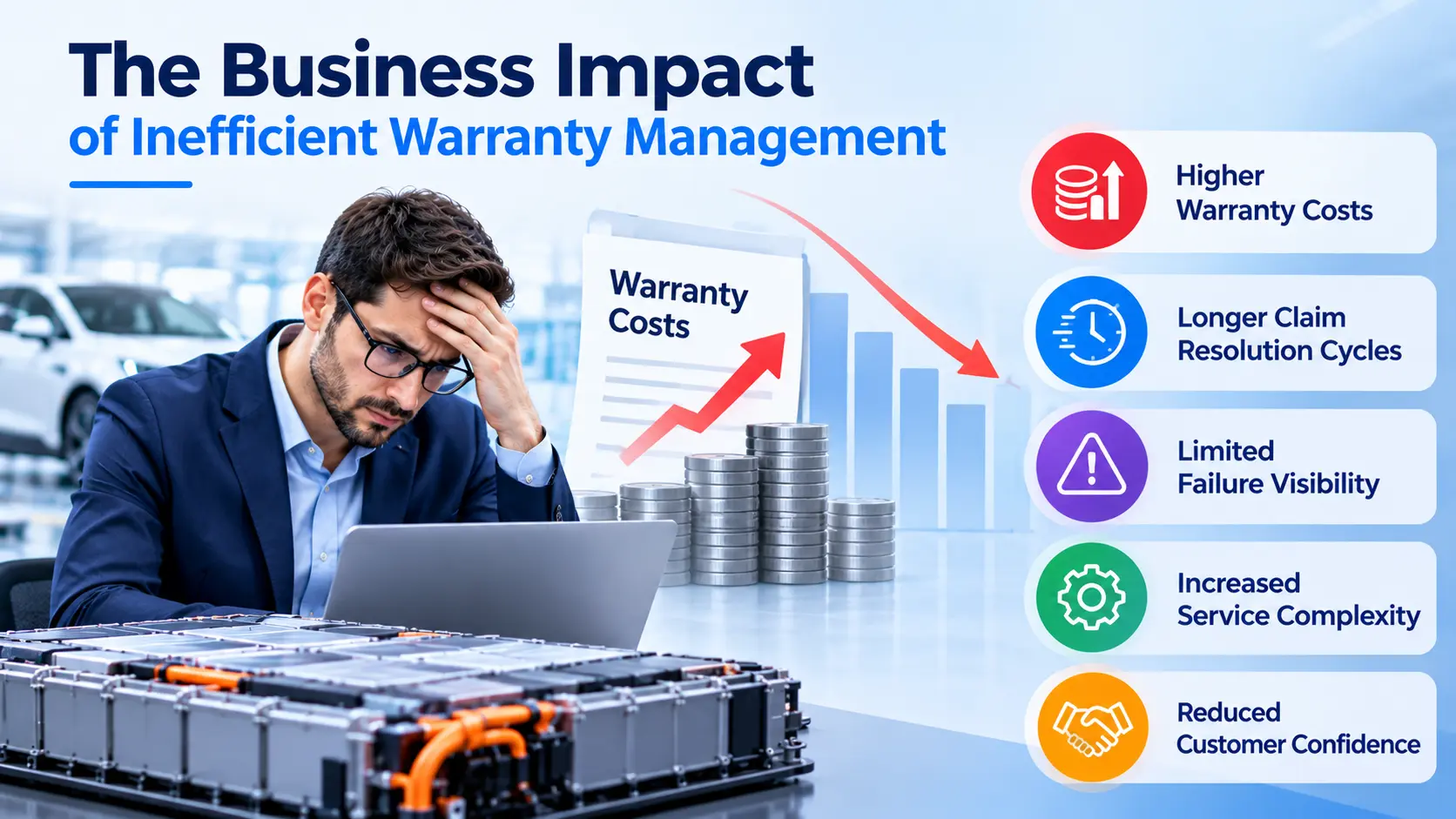
When the battery lifecycle management process is poorly managed, it affects both operational efficiency and financial performance.
Let us see the impact:
- Higher warranty costs: Failure to establish supplier responsibility or identify recoverable costs leads to EV OEMs absorbing warranty costs incurred.
- Longer claim resolution cycles: When there is incomplete or missing information in claim records or approvals are done manually, both customer support and claim decisions are delayed.
- Limited failure visibility: A disconnected claim records system results in increased difficulty in identifying failures across battery models, suppliers, or vehicle populations.
- Increased service complexity: Inefficient battery lifecycle management leads to teams spending more time in coordination instead of resolving customer issues.
- Reduced customer confidence: When the battery is central to vehicle use, delays in warranty-related decisions can affect the customer experience negatively.
These challenges make warranty data an uncompromisable part of battery lifecycle management. It gives EV OEMs the cost of individual claims and also helps them understand the broader patterns behind product quality and service performance.
How Does Cell- and Pack-Level Tracking Improve EV Battery Warranty Management?
Cell- and pack-level tracking makes the relationship between battery physical configuration and its warranty history clearer. EV OEMs can investigate claims with better context rather than treating every battery failure as an isolated event.
Here is how it improves EV battery lifecycle management:
Cell-Level Identification and Failure Records
Individual cells in a battery have unique identifiers, and recording them in case of a failure can help EV OEMs trace them back to their supplier and make the recovery process easier.
Here is what a structured claim can capture:
- Cell or part identification.
- Supplier and batch details.
- Reported failure symptoms.
- Inspection findings and diagnostic evidence.
- Replacement or repair history.
- Related warranty claim references.
These records help teams investigate recurring issues and maintain a strong evidence record.
Module-Level Traceability
EV OEMs can get more information with a module-level record. They can understand whether a reported problem is due to one module or it is a wider battery issue.
In cases where a module is repaired, replaced or inspected, there should be a service record that points to that particular activity documented against the relevant battery pack or vehicle record.
Such structured activity supports better claim investigation and prevents repeated issues from being treated as isolated incidents.
Pack-Level Warranty Tracking
A battery pack is the complete assembly installed in an EV. Pack-level warranty records need to connect the serial number of the battery with vehicle details, installation details, warranty coverage information, and history of service.
To build a complete picture of battery reliability, connecting pack-level claims with module and cell information should be done.
Please note: Battery lifecycle management software should not be confused with a battery management system. Warranty management software helps organise claim records and workflows, whereas a battery management system monitors battery performance.
How Can OEMs Structure the EV Battery Warranty Claim Process?
With the help of a consistent warranty workflow, EV OEMs can manage claims from submission to resolution.
Let us see the steps:
Capture Vehicle and Battery Information
The first step begins with the identification of the vehicle and the battery involved. This could include the VIN, battery pack serial number, installation details, and warranty coverage information.
Wherever cell- or module-level information is present, the linking to the relevant battery record should be done.
Record the Failure and Supporting Evidence
There should be a clear description of the failure with relevant diagnostic reports, findings, photographs, and supporting evidence (if any) by the dealer or the service centre.
When there is a standardised information workflow, incomplete claim submissions and repeated clarification requests will be reduced.
Validate Warranty Eligibility
Once all these details are filled in, the claim should be assessed against the applicable warranty policies, coverage period, and exclusions.
Consistency can be created by defining validation rules and approval responsibilities.
Investigate the Failure and Determine Responsibility
The technical team should review the evidence submitted with the claim, history of service, and part-level records to investigate the issue reported.
If this issue turns out to be a supplier-level defect, the supporting documentation can be used to initiate the supplier recovery process.
Process the Claim and Maintain Closure Records
Post review and approval of the claim, the OEM can record its decision, details of the reimbursement, parts replaced, and final resolution provided.
To analyse recurring failures and review warranty expenditure over a period of time, it is essential to maintain a complete claim history and audit trail.
What Are the Business Benefits of Structured EV Battery Warranty Management?
A well-structured battery lifecycle management process delivers its benefits across multiple functions such as finance, service operations, quality management, and supplier relationships.
Here are some business benefits of a structured battery lifecycle management process:
Improved Warranty Cost Control
EV OEMs can review warranty expenditure more effectively with the help of consistent claim documentation and policy-based validation. Cost recovery can also be supported by gaining better visibility into supplier-related failures.
Better Failure Analysis
With organised claim history, recurring issues can be identified by battery model, part, supplier, or the production batch. These insights also help EV OEMs support quality investigations and enable them to take corrective action.
Faster and More Consistent Claim Processing
EV OEMs can experience a reduction in administrative delays through the implementation of standardised workflows, clear approval responsibilities, and complete claim documentation.
Stronger Supplier Accountability
Traceable claim records and inspection evidence can help identify supplier-related failures. With the help of this information, EV OEMs can investigate the claims and pursue supplier recovery.
Improved Dealer and Customer Experience
Dealers can better understand the documentation requirements and track claim progress with a more predictable claim process. This results in an improved after-sales service and better customer communication.
How Does Intelli Warranty Support EV Battery Warranty Management?
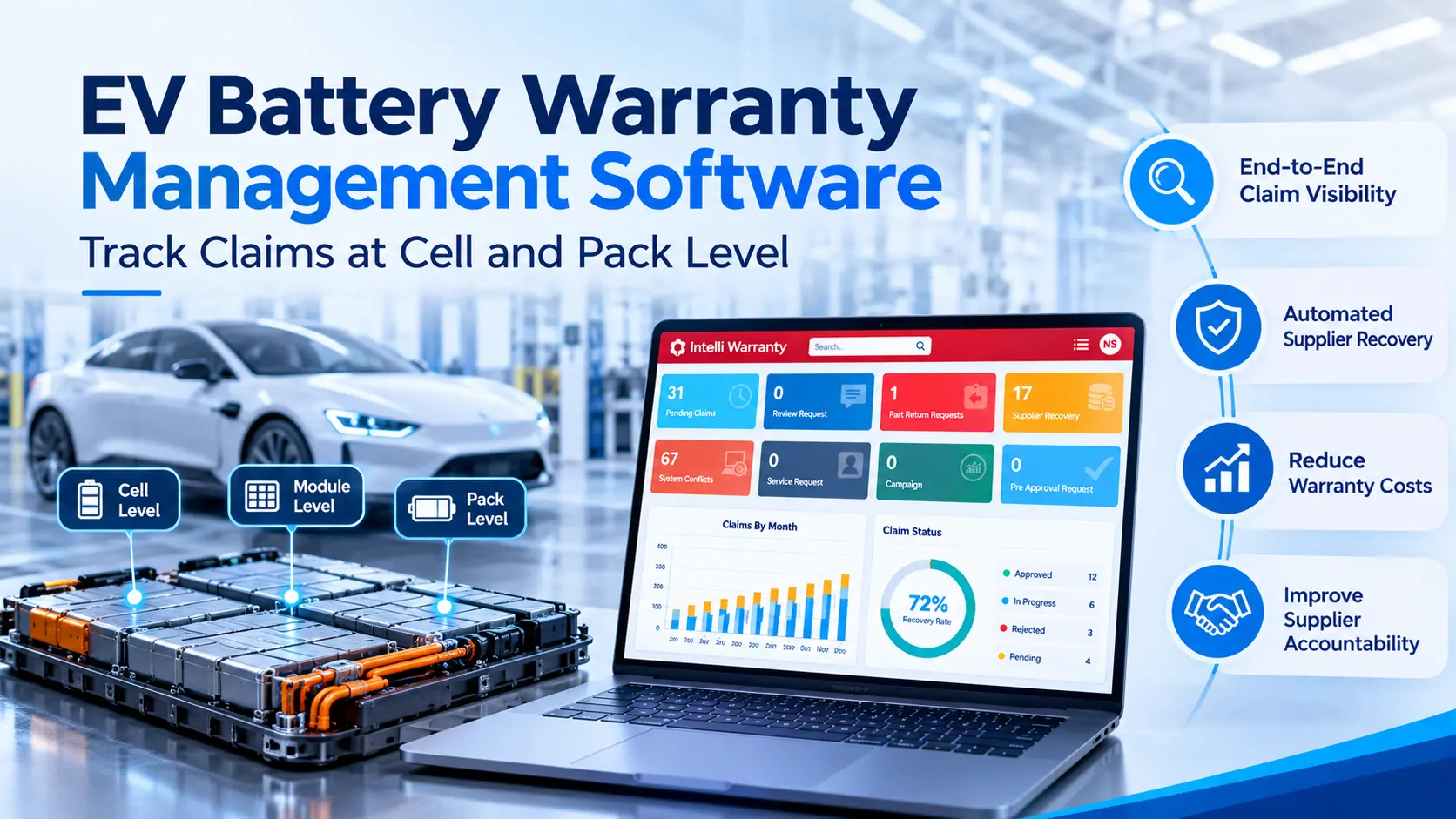
Intelli Warranty is a warranty lifecycle management and automated supplier recovery management solution that is designed to streamline end-to-end warranty management for OEMs.
For EV manufacturers, the administration of battery-related claims can be supported with the help of a structured warranty management platform. This battery lifecycle management platform brings together claim information, supporting evidence, approval workflows, and supplier recovery in a more organised workflow.
Intelli Warranty’s capabilities include the following:
- Warranty claim management: Organises and manages the claim submitted through the warranty process.
- Claim documentation: Supports the collection and review of information and supporting evidence which is associated with a claim.
- Policy and approval management: Helps define the warranty policies, terms of reimbursement, and claim approval responsibilities.
- Supplier recovery management: Supports the process of identifying eligible warranty claims and recovering warranty costs from suppliers.
- Warranty data analysis: Helps in the review of claim trends and also helps in identifying recurring issues that may require further investigation.
- Dealer and supplier coordination: Helps improve the structure and the transparency of communication among stakeholders across the warranty process.
EV manufacturers should use a structured workflow for battery-related claims. It helps them maintain relevant vehicle, battery and component references along with claim information. This is subject to the data that is captured and configured within the OEM’s systems.
Within the broader EV battery ecosystem, Intelli Warranty carves its niche as a warranty and supplier recovery layer. It complements the existing systems used by EV manufacturers to create a connected workflow for information and better collaboration between teams.
Conclusion
As we see an increased adoption of electric vehicles, battery reliability and warranty accountability will remain essential priorities for EV manufacturers. In order to manage claims across cells, modules, and complete battery packs, EV manufacturers require consistent identification, reliable service records, and clear investigation workflows.
A structured battery lifecycle management approach is needed to connect technical information with warranty operations. With such a structured workflow, EV manufacturers are enabled to investigate failures, identify recurring issues, control warranty expenditure, and strengthen supplier accountability.
With Intelli Warranty, EV manufacturers can implement a dedicated, end-to-end warranty lifecycle management system that brings greater structure to claim processing and supplier recovery processes.
This results in a more transparent warranty operation that supports better decision-making across the EV after-sales ecosystem.
To know more about Intelli Warranty and to schedule a free, live demo, please refer to the link: Warranty Management Software
Frequently Asked Questions
What is EV battery warranty management?
Electric vehicle battery warranty management involves handling warranty terms, processing and verifying battery claims, analysing component failures, granting reimbursement for eligible service, and pursuing cost recovery from suppliers.
Why is cell-level tracking important in EV battery warranty management?
Tracking at the individual cell level allows EV OEMs to tie a battery failure back to a distinct cell, production run, or vendor when such details are recorded. This visibility assists technical teams during root-cause analysis and makes it easier to pinpoint repeating issues across parts.
How does Intelli Warranty help manufacturers?
Intelli Warranty supports EV OEMs by streamlining warranty claim workflows and automated supplier recovery management. The platform helps manufacturers structure claim administration, coordinate supporting documentation, and improve operational visibility throughout the warranty lifecycle.
What should manufacturers track in an EV battery warranty claim?
When submitting an EV battery warranty claim, manufacturers capture the VIN, battery pack serial number, and specific module or cell information. Supporting information includes warranty terms, reported symptoms, diagnostic files, inspection evidence, service history, part supplier data, and final settlement logs. Specific submission requirements vary based on individual OEM policies and technical evaluation workflows.


Explore More Insights






About the Author


Nishant Sharma
Nishant Sharma is the Head of Demand Generation at Intellinet Systems, specializing in B2B marketing, sales, digital transformation, and automotive aftermarket solutions. He shares insights on emerging technologies, industry trends, and strategies that help OEMs and businesses improve operational efficiency, customer experience, and aftermarket growth.


