

Overview: Warranty claim validation is the process of checking a submitted warranty claim against coverage terms, vehicle or product history, and documentation standards before it is approved for payment. It is the control point that decides whether warranty cost control actually works. Most OEMs manage warranty cost through reserves, dealer agreements, and supplier contracts, but if claims are not validated consistently at the point of submission, those programs are managing losses that have already occurred.

Key Takeaways:
This article explains why warranty claim validation, not reserve forecasting or dealer negotiation, is the real lever for warranty cost control, and what a structured validation process looks like in practice.
- Warranty claim validation checks coverage, vehicle history, and documentation before a claim is paid, not after.
- Weak validation is the main reason warranty cost control programs underperform, even when reserve forecasting is accurate.
- Manual, spreadsheet-based validation cannot keep pace with rising claim volumes and more complex vehicle technology.
- A structured validation framework, policy rules, anomaly detection, and audit trails recover cost without slowing down legitimate dealer claims.
- Purpose-built warranty management software gives OEMs the consistency that manual review and generic ERP modules cannot.
For OEMs managing large dealer networks, the biggest opportunity is often not reducing the number of legitimate warranty claims. It is preventing claims that fall outside coverage, duplicate previous submissions, lack required documentation, or contain unusual labor and parts patterns from becoming paid liabilities.
Reduce Warranty Leakage Before It Becomes a Cost Problem. Book a Free Demo
What Is Warranty Claim Validation?
Warranty claim validation is the process of verifying that a submitted claim meets an OEM's warranty coverage, repair, documentation, and reimbursement requirements before payment is approved. For OEMs managing thousands of claims across a dealer network, consistent validation helps identify ineligible, duplicate, incorrectly coded, or potentially fraudulent claims before they become warranty costs.
The challenge is scale. Manual reviewers cannot consistently cross-check every claim against vehicle history, warranty entitlement, repair standards, previous claims, and dealer-level patterns. A structured validation process combines automated rules with exception-based review so legitimate claims move quickly while questionable claims receive additional scrutiny.
What Does Warranty Claim Validation Check?
Warranty claim validation works by comparing the information submitted in a claim against the rules and records that determine whether the claim is payable. The exact checks vary by OEM, product, warranty policy, and dealer agreement, but a structured validation framework typically covers several core areas.
- Warranty entitlement: Whether the vehicle or product is still within the applicable warranty period and usage limits.
- Vehicle or product history: Previous repairs, service events, recalls, and earlier claims associated with the same VIN or serial number.
- Parts validation: Whether the parts claimed were eligible, correctly coded, and consistent with the approved repair.
- Labor validation: Whether labor hours and repair operations fall within OEM-approved standards or reimbursement rules.
- Documentation: Whether required technician notes, diagnostic information, photographs, or supporting records have been submitted.
- Duplicate claims: Whether the same vehicle, component, repair, or failure has already been submitted or reimbursed.
- Anomaly detection: Whether claim frequency, labor hours, parts usage, or dealer behavior differs significantly from expected patterns.
The value of these checks comes from applying them consistently. Instead of relying on individual reviewers to remember every warranty rule, OEMs can make the validation criteria part of the claim workflow itself.
Why Warranty Claim Validation Is the Missing Link in Warranty Cost Control

Most warranty cost control programs focus on reserve accuracy, dealer agreements, and supplier recovery, but they rarely address the point where bad claims enter the system. Without consistent warranty claims validation, a U.S. OEM is managing costs it has already incurred, not preventing them.
Reserve models are built from historical failure rates and reliability data, and they are usually sound. The gap shows up downstream, when actual claims paid exceed what the model predicted, not because the model was wrong, but because claims that should never have been approved made it through. Cost control that starts after approval is damage control; real cost control starts at validation.
Research from Mordor Intelligence puts total warranty spend for automotive and industrial manufacturers at 1.5% to 2.5% of annual revenue. Within that spend, industry estimates compiled by Warranty Week and cited across multiple OEM warranty studies suggest fraud and invalid claims commonly account for 3% to 15% of total warranty costs. For an OEM running a $200 million annual warranty book, even the lower end of that range represents several million dollars a year that strong warranty claim validation could prevent.
The important distinction is that validation does not replace forecasting, reserves, supplier recovery, or dealer agreements. It connects those controls to the individual claim before the financial impact is finalized.
How the Warranty Claim Validation Process Works
A complete warranty claim validation workflow runs through several stages: intake, automated entitlement checks, history cross-referencing, anomaly detection, manual review of flagged exceptions, and a final decision with an audit trail. Each stage exists to filter out claims that should not reach payment.
- Claim intake and data capture, including required fields, condition codes, and supporting documentation
- Automated entitlement and policy checks against coverage period, mileage, and approved repair types
- Cross-reference against vehicle or product service history and any prior claims on the same unit
- Anomaly and pattern detection, flagging claims that deviate from dealer or network norms
- Manual review limited to flagged exceptions, not every claim in the queue.
- Approval, rejection, or return for correction, with the reason documented
- Audit trail logging for every step, supporting compliance and supplier recovery
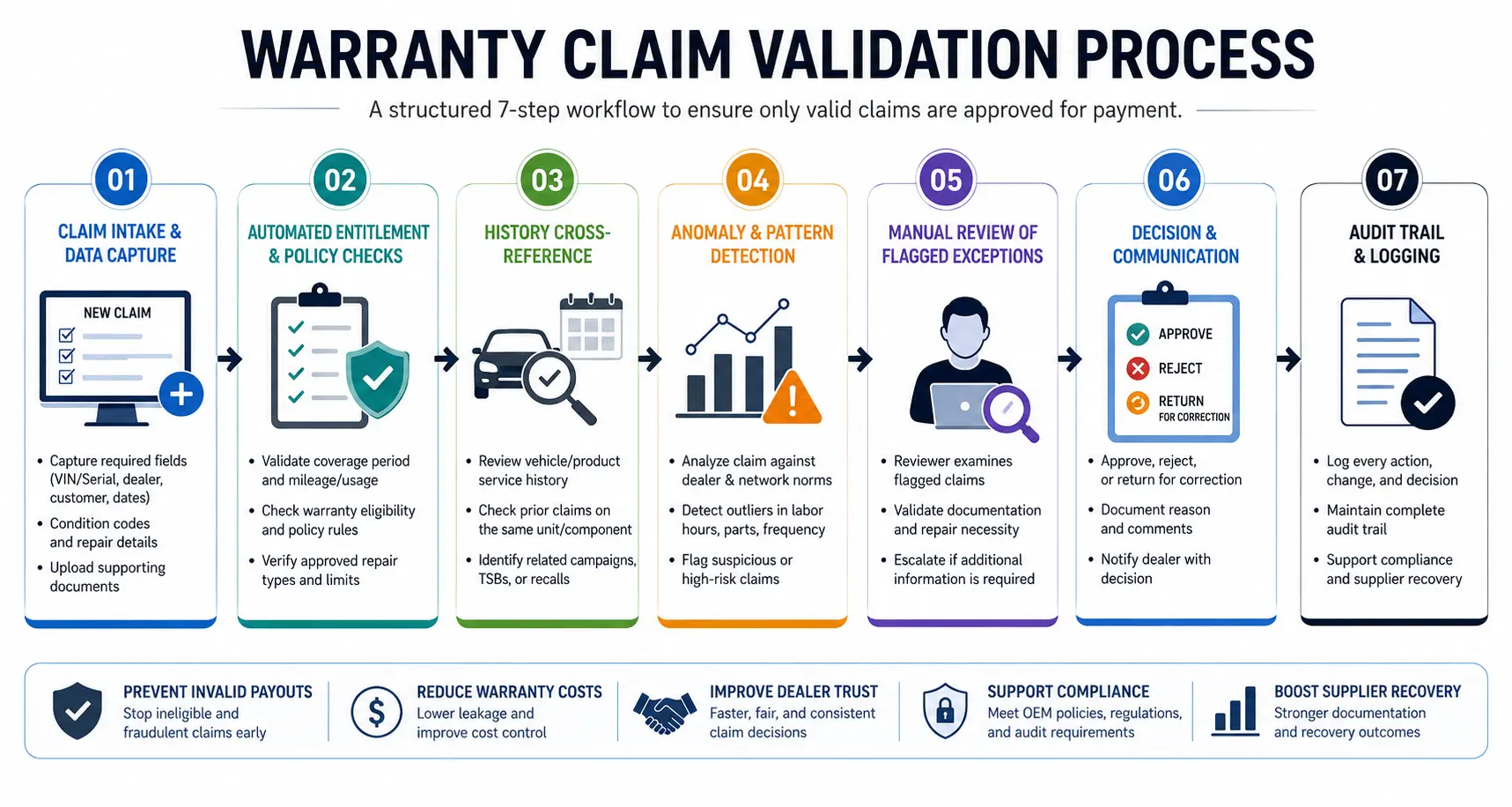
Notice that manual review only enters the picture for exceptions. That is what makes validation scalable: clean, well-documented claims that pass automated checks move straight to approval, while the team’s attention goes to the smaller set of claims that actually need it.
What Validation Gaps Quietly Inflate Warranty Costs
Most warranty cost leakage is not outright fraud. It comes from validation gaps: manual bottlenecks, inconsistent policy enforcement, disconnected systems, and missing audit trails that allow inflated or duplicate claims to pass unnoticed.
- Manual, spreadsheet-based review that cannot scale with rising claim volume
- Inconsistent approval decisions because validation logic lives in an analyst’s judgment rather than in the system
- No automatic cross-check against prior claims on the same VIN, serial number, or component
- Disconnected dealer, ERP, and claims systems that prevent a single view of claim history
- Incomplete documentation approved anyway under time or volume pressure
- No anomaly detection at the dealer level, so a pattern of repeat claims goes unnoticed for months
These gaps can also make it difficult for OEMs to identify whether a problem is isolated to one claim, one dealer, one component, or a broader warranty process. A validation system that captures structured claim data creates the visibility needed to identify those patterns earlier.
The Business Case: What Weak Validation Actually Costs USA OEMs

Weak warranty claim validation rarely shows up as a single line item. It shows up as inflated payouts, missed supplier recovery windows, slower reimbursement cycles, and a warranty reserve that no longer matches actual claims experience.
Supplier recovery is one of the clearest examples. When a claim is validated and correctly tied to a supplier-caused failure, the OEM has a documented basis to recover that cost from the supplier. Most supplier agreements require recovery claims to be filed within a defined window. A claim that goes unvalidated or is validated too slowly can miss that window entirely, turning a recoverable cost into a permanent loss.
The same logic applies to reserve accuracy. If invalid claims are routinely approved, the gap between what the OEM accrued and what it actually pays widens over time, complicating financial planning and making warranty costs harder to forecast with confidence.
For this reason, OEMs should view claim validation as both a cost-control process and a data-quality process. Better validation creates cleaner claims data, clearer failure patterns, and a stronger basis for financial and supplier-recovery decisions.
Best Practices for Strong Warranty Claim Validation
Effective warranty validation combines automated policy checks, structured documentation requirements, anomaly detection, and clear audit trails, configured so that approval decisions do not depend on which analyst happens to review the claim.
- Encode warranty policy rules, coverage period, eligible repairs, and reimbursement caps directly into the system rather than relying on individual memory.
- Require structured claim submission with mandatory fields and documentation before a claim enters the review queue.
- Automatically cross-check every claim against VIN or serial history, prior records, or service history
- Flag statistical anomalies, dealer-level claim rate, labor hour outliers, and repeat claims for review before approval, not after
- Maintain a complete audit trail from submission through reimbursement for compliance and supplier recovery
- Review validation rules periodically against AIAG and other applicable warranty compliance standards
- Track validation performance: rejection rate, time to resolution, and supplier recovery rate
Tracking these metrics gives warranty leaders a clearer view of whether validation is preventing avoidable costs or simply adding another review step to the claims process.
How the Right Warranty Management Software Strengthens Validation
Warranty management software automates the parts of validation that manual review cannot reliably scale: entitlement checks, anomaly detection, documentation enforcement, and audit logging across every claim, every dealer, every day.
This is the gap that most spreadsheet-based or generic ERP-driven warranty operations run into. The rules exist on paper, but enforcing them consistently across hundreds of dealers and thousands of monthly claims is not realistic without a system built for it.
Platforms such as Intelli Warranty are built around this exact function: validating claims against entitlement rules, vehicle history, and documentation requirements before they reach an approver, while flagging anomalies that point to fraud or process gaps. A warranty claim validation layer like this typically includes:
- Automated entitlement and policy validation against coverage rules
- Anomaly and fraud detection across dealer and claim-pattern data
- A structured submission portal with mandatory documentation fields
- Supplier recovery workflows triggered automatically from validated claims
- Real-time dashboards for claim status, reserve exposure, and dealer performance
- A complete audit trail for every claim, from submission to reimbursement
When evaluating warranty claim validation software, OEMs should also consider how easily the platform can connect warranty claims with vehicle or product history, dealer systems, ERP data, parts information, and supplier recovery workflows. The objective is to make validation part of the existing claims ecosystem rather than create another isolated database.
For OEMs evaluating warranty validation tools, the integration question matters as much as the feature list. Warranty data needs to flow into existing financial and inventory systems, rather than a standalone tool creating another data silos.
Conclusion
Warranty cost control programs often look complete on paper: reserve models, dealer agreements, supplier contracts, recovery processes. What is frequently missing is the discipline of warranty claim validation at the point a claim enters the system. Without it, every other cost control effort is reacting to losses that better validation could have prevented in the first place.
The fix is not to slow down claims handling or treat every dealer with suspicion. It is to build a validation layer, automated entitlement checks, history cross-referencing, anomaly detection, and audit trails that apply the same standard to every claim, every time, regardless of volume. OEMs that close this gap recover more from suppliers, catch fraud earlier, and bring their warranty reserves back in line with what they actually pay. Warranty claim validation is not an additional control; it is the control that makes every other warranty cost control measure work as intended.
Connect with our experts to see how Intelli Warranty automates warranty claim validation, entitlement checks, anomaly detection, and supplier recovery workflows across your dealer network.
Frequently Asked Questions
What is the difference between warranty claim validation and warranty claims processing?
Claim processing is the workflow: routing a claim, assigning a reviewer, and tracking its status to a decision. Warranty claim validation is the truth-check within that workflow, confirming the claim is accurate, properly documented, and within entitlement before it is approved. A claim can move through processing quickly and still be invalid; validation is the step that prevents an invalid claim from becoming a paid liability.
Does stronger validation slow down legitimate dealer claims?
Not when validation rules are automated and built into the submission workflow. Claims with complete documentation that entitlement checks can move to approval without manual review at all. The slowdown most dealers experience comes from manual, review-everything models, not from rules-based automated validation. Automation actually narrows manual review down to the exceptions that genuinely need it.
What role do audit trails play in warranty claim validation?
An audit trail records every step a claim passes through: submission, validation checks, approval or rejection, and reimbursement. This documentation supports compliance with standards such as AIAG reporting and the Magnuson-Moss Warranty Act, and it is often required to support a supplier recovery claim, since most supplier agreements require documented proof within a defined filing window.
Can warranty claim validation be automated across a large, multi-tier dealer network?
Yes. Automated validation rules apply the same entitlement check, documentation requirements, and anomaly detection consistently across every dealer in a network, regardless of size or region. This is typically more consistent than manual review, where validation quality can vary by analyst or by which dealer relationship is involved. Warranty management software is built specifically to apply this consistency at scale.


Explore More Insights








.webp)


About the Author


Chandra Shekhar
Chandra Shekhar is the Senior Manager, Strategy & Business Development at Intellinet Systems. With over a decade of experience in the automotive industry, Chandra Shekhar has led digital transformation and aftersales strategy initiatives for OEMs across multiple markets. His background combines deep industry knowledge with a practical understanding of how technology can solve real operational challenges. He focuses on making complex ideas clear and relevant for automotive and aftermarket professionals navigating ongoing change.


