

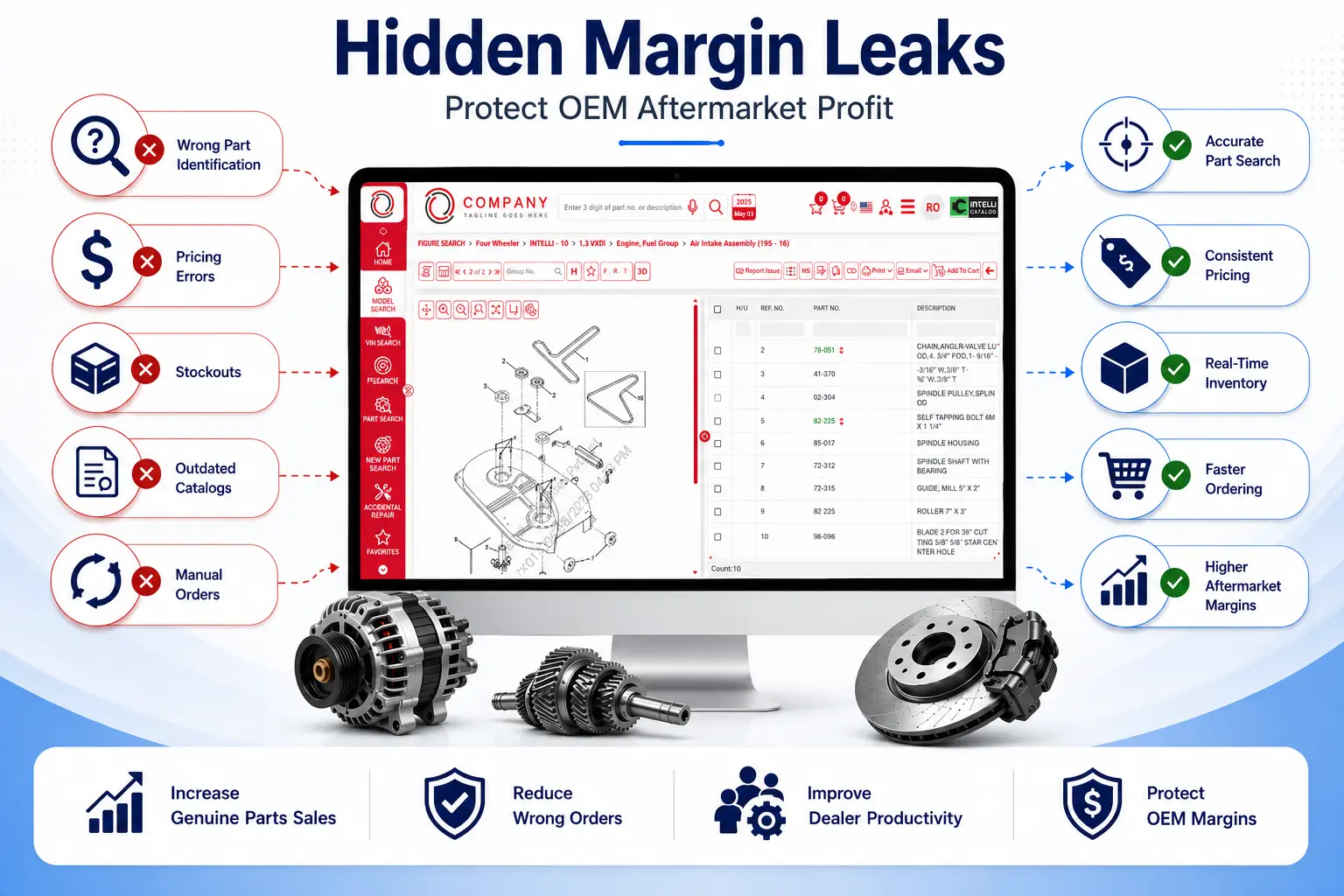
Overview: Hidden margin leaks in aftermarket parts are the small, recurring losses in pricing, ordering, and fulfillment that quietly reduce OEM profit without showing up as a single, obvious event. These leaks form at points like inaccurate parts catalogs, manual pricing overrides, dealer sourcing workarounds, and slow order fulfillment. Left unaddressed, margin leaks in aftermarket spare parts can pull 25 to 50 % of potential aftermarket revenue away from OEMs and toward independent suppliers. The fix is not a single policy change. It is closing visibility gaps across catalog accuracy, pricing control, and order execution, often with electronics parts catalog software that removes the friction driving buyers away from genuine parts.

Key Takeaways:
- Hidden margin leaks in aftermarket parts operations happen gradually, across pricing, catalog accuracy, and fulfillment, not in one visible event.
- Wrong part identification, manual ordering, and pricing inconsistencies are among the biggest sources of lost aftermarket revenue.
- Aftermarket revenue leakage can range from 25 to 50% of total revenue an OEM could otherwise capture.
- Spare parts and service margins run up to four times higher than new equipment sales, which makes every leak costly.
- Manual catalog lookups, pricing overrides, and dealer stockouts are the most common sources of margin leaks in aftermarket spare parts.
- Dealers often turn to third-party suppliers when OEM ordering is slow, hard to search, or lacks pricing and inventory visibility.
- Electronic parts catalog software closes the biggest leak points by standardizing part identification, pricing, and ordering across the dealer network.
Stop Hidden Margin Leaks Before They Reduce Your Aftermarket Profit. Book a Demo of Intelli Catalog Today
What Are Margin Leaks in Aftermarket Spare Parts Operations?
Margin leaks in aftermarket spare parts are recurring losses in revenue and profit caused by inefficiencies in part identification, pricing, inventory, and order fulfilment. Although each issue appears minor, together they reduce OEM profitability and increase reliance on non-genuine parts.
This is different from a pricing mistake or a one-time discount. A margin leak is structural. It repeats every time a dealer cannot find the right part quickly, every time a customer service rep applies inconsistent pricing, and every time a stockout pushes a buyer toward a non-genuine alternative. Each instance is small; together, they create a significant drag on OEM profitability.
Where Do Hidden Margin Leaks in Aftermarket Start?
Hidden margin leaks in aftermarket operations typically begin when dealers cannot quickly identify, price, or source the correct part. Catalog inaccuracies, outdated pricing, and limited inventory visibility create friction that delays purchases and encourages buyers to choose non-genuine alternatives.
Margin leakage rarely starts with one major failure. Instead, it spreads through multiple operational processes.
A dealer without real-time access to the parts catalog may quote the wrong part, leading to returns, order delays, and dissatisfied customers. A pricing team relying on outdated spreadsheets may underquote high-margin parts or overprice commodity items, while limited inventory visibility can cause dealers to lose sales even when stock exists elsewhere in the network.
Why Hidden Margin Leaks Are Hard to Detect
Hidden margin leaks are difficult to detect because they occur across multiple departments rather than appearing as a single financial loss. Small issues in pricing, ordering, inventory, and service accumulate over time, making the overall profitability impact easy to overlook.
These leaks typically show up as:
- Wrong spare parts ordered
- Dealers buying from third-party suppliers
- Obsolete inventory
- Manual order corrections
- Pricing inconsistencies
- Service delays
- Warranty-related rework
Because each loss occurs in a different workflow, teams tend to treat these as isolated operational issues instead of recognizing them as symptoms of one shared profitability problem.
1. Wrong Parts Identification
Wrong part identification occurs when dealers or technicians order the wrong component because they rely on outdated PDFs, printed catalogs, or manual part number searches. Each wrong order adds cost, delay, and rework across the entire service process.
Every incorrect part order creates several downstream costs including:
- Order cancellation
- Reverse logistics
- Additional shipping
- Delayed equipment repair
- Lower technician productivity
- Reduced customer satisfaction
2. Dealers Purchasing from Independent Aftermarket Suppliers
This leak occurs when OEM ordering is slow or difficult, so dealers turn to third-party suppliers for faster parts. The dealer still serves the customer, but the OEM loses the genuine parts sale and the margin that comes with it.
Dealers usually make this switch because of:
- Difficult part identification
- Long response times
- Poor catalog usability
- Lack of inventory visibility
- Outdated pricing
This is one of the largest and least visible margin leaks in aftermarket spare parts, because the lost revenue rarely shows up as a line item. The independent aftermarket already accounts for approximately 75% of overall US automotive part sales, according to Technavio research, a sign of how much OEM revenue is at stake when ordering friction pushes dealers elsewhere.
3. Outdated Part Numbers and Supersession Errors
This leak happens when engineering updates a part number, but the dealer catalog is not updated at the same time. Dealers then order discontinued parts, miss valid replacements, or call OEM support to confirm the right component, slowing down every repair.
Common results include:
- Ordering discontinued parts
- Missing compatible replacements
- Repeated calls to OEM support
- Delayed repairs
Managing supersession manually becomes harder as product portfolios grow.
4. Slow Parts Identification
Slow parts identification means technicians spend extra time searching PDFs, spreadsheets, printed manuals, or old ERP screens to find the correct part number. Across hundreds of dealers, those extra minutes turn into a real and recurring productivity cost.
Technicians commonly search across PDFs, Excel files, printed manuals, ERP systems, and internal emails.
5. Pricing Inconsistencies Across Markets
Pricing inconsistencies happen when a global OEM cannot push price updates to every dealer at the same time across different countries, currencies, and dealer tiers. Dealers then quote outdated prices, which create disputes and quietly erode margin.
This typically happens across countries, currencies, dealer tiers, and product variants. Without a centralized catalog, this creates incorrect quotations, margin erosion, customer disputes, and dealer confusion.
6. Manual Order Processing
Manual order processing means dealers still email requests, call support, or re-enter data into an ERP by hand. Every manual step adds delay and a chance for data entry errors that directly reduce order accuracy and profit.
This usually looks like dealers needing to:
- Email purchase requests
- Call support teams
- Verify availability manually
- Re-enter order information into ERP systems.
7. Limited Inventory Visibility
Limited inventory visibility means dealers cannot see real-time part availability, regional stock, or delivery timing before placing an order. Without that visibility, dealers order duplicates, request rush shipments, or lose the sale altogether.
Dealers frequently cannot see parts availability, regional inventory, warehouse stock, and delivery estimates. This uncertainty leads to:
- Duplicate orders
- Emergency shipments
- Lost sales
- Customer dissatisfaction
8. Missed Cross-Selling Opportunities
This leak occurs when dealers search only for the part they need and never see related accessories, maintenance kits, or consumables during checkout. Each missed recommendation may seem small on its own, but together they add up to significant lost incremental revenue.
Dealers often miss compatible accessories, maintenance kits, consumables, and related components.
9. Lack of Actionable Dealer Analytics
Without dealer-level data, OEMs cannot see which dealers generate the most wrong orders, which parts get misidentified most often, or where revenue is shifting to third-party suppliers. That blind spot makes it hard to fix the leaks that matter most.
Common unanswered questions include:
- Which dealers generate the most wrong orders?
- Which regions see the highest returns?
- Which parts are most frequently misidentified?
- Where is aftermarket revenue shifting to third-party suppliers?
The Business Impact of Ignoring Margin Leaks
Ignoring hidden margin leaks reduces aftermarket profitability by increasing wrong part orders, driving dealers to third-party suppliers, and lowering genuine parts sales. Because aftermarket parts generate some of the highest margins for OEMs, even small recurring leaks can significantly affect long-term revenue.
According to an analysis by Blue Ridge Partners, aftermarket revenue leakage in heavy and light equipment can range from 25 to 50% of total revenue an OEM could otherwise be capturing. That is not a rounding error. It is a structural gap that builds year over year as buyers form new purchasing habits around independent suppliers.
The stakes are higher than they first appear because, according to McKinsey research cited by Mirakl, spare parts and maintenance services can deliver margins up to four times higher than new equipment sales. Every dollar of aftermarket revenue that leaks away is worth more, in profit terms, than a dollar lost on equipment sales.
How Electronic Parts Catalog Software Plugs the Leaks
Electronic parts catalog software reduces margin leaks by providing dealers with accurate part identification, consistent pricing, integrated ordering, and real-time inventory visibility. This eliminates many of the operational gaps that lead to wrong orders, delayed fulfilment, and lost genuine parts sales.
A modern catalog platform replaces static PDFs and disconnected spreadsheets with searchable, illustrated part diagrams that support multiple lookup methods, including VIN search, model browsing, and visual identification. When a dealer can find and order the correct part in seconds rather than minutes, fewer sales are lost to friction or substitution.
Intelli Catalog, an electronic parts catalog software, provides OEMs a single, centralized catalog that stays consistent across the dealer network, along with visibility into which parts, dealers, and regions show signs of margin leakage. This turns catalog management from a static reference tool into an active part of margin protection.
Each of these capabilities addresses one or more of the margin leaks discussed earlier, from wrong part identification and supersession errors to pricing inconsistencies, dealer stockouts, and manual order processing. Together, they help OEMs standardize aftermarket operations while protecting genuine parts revenue.
- AI-powered part identification
- VIN, serial number, and model-based search
- Interactive 2D and 3D illustrated parts catalogs
- Automated supersession management
- Integrated dealer ordering
- Real-time inventory visibility
- Region-specific pricing
- Multi-language and multi-currency support
- ERP integration
- Centralized analytics and reporting
By making genuine parts easier to identify, order, and manage, Intelli Catalogs helps OEMs reduce wrong orders, improve dealer efficiency, and retain more aftermarket revenue.
Best Practices Checklist for Closing Margin Leaks

Closing margin leaks in aftermarket parts operations takes a combination of process disciplines and the right technology. The checklist below covers the areas that matter most for OEMs starting this work.
- Keep the parts catalog centralized, accurate, and updated on a set schedule.
- Standardize pricing rules and limit manual override authority to defined thresholds.
- Give dealers real-time, network-wide inventory visibility instead of location-only stock views.
- Track substitution and return rates by dealer, and follow up on outliers.
- Review dealer-level performance data monthly, not just at year-end.
- Choose parts catalog software that supports VIN, model, and visual search to reduce lookup errors.
Conclusion
Hidden margin leaks develop gradually through catalog inaccuracies, inconsistent pricing, inventory gaps, and disconnected ordering processes. Improving visibility across these areas enables OEMs to reduce revenue leakage, strengthen dealer efficiency, and retain more genuine aftermarket parts sales.
Closing these gaps starts with visibility: knowing where catalog errors happen, where pricing gets inconsistent, and which dealers are losing sales to substitution. Electronic parts catalog software gives OEMs the accuracy and dealer-level data needed to catch these leaks early and keep genuine parts revenue where it belongs, with the OEM and its authorized dealer network.
Book a demo to see how Intelli Catalog can help OEMs reduce wrong part orders, improve dealer efficiency, and protect aftermarket margins.
FAQ
What is the difference between margin leaks and normal discounting?
Normal discounting is a planned, one-time price reduction tied to a specific deal. Margin leaks in aftermarket spare parts are unplanned and repeat over time, caused by catalog errors, inconsistent pricing, or fulfillment gaps. They erode profit gradually, often without anyone noticing until the pattern is reviewed.
What are hidden margin leaks in aftermarket parts operations?
Hidden margin leaks in aftermarket parts operations are small, recurring inefficiencies, wrong part orders, manual processing, pricing gaps, and limited visibility that quietly reduce spare parts profit across a dealer network. Individually, they look minor, but across thousands of transactions they add up to a measurable, often unmeasured, loss in aftermarket revenue.
Why do dealers buy parts from third-party suppliers instead of the OEM?
Dealers usually switch to third-party suppliers when OEM ordering is slow, hard to search, or lacks pricing and inventory visibility. The dealer still serves the end customer, but the OEM loses the genuine parts sale, along with the margin and long-term dealer loyalty that comes with it.
How often should OEMs review margin leak data?
A monthly review is a reasonable starting point for most OEMs. This allows enough transaction volume to spot patterns in pricing exceptions, substitution rates, and dealer performance, while still catching problems early enough to correct them before they become habitual buyer behavior.
Is this only a problem for large OEMs with big dealer networks?
No. Smaller OEMs often feel margin leaks more acutely because they have less revenue volume to absorb the loss. A fragmented catalog or inconsistent pricing can affect a smaller dealer network just as much, proportionally, as it affects a larger one.
How does an electronic parts catalog reduce margin leaks in aftermarket spare parts?
An electronic parts catalog centralizes part search, pricing, ordering, and inventory data so every dealer sees the same accurate information. This lowers wrong part orders, speeds up search, keeps pricing consistent across markets, and gives OEMs the analytics needed to catch leaks early.


Explore More Insights




.webp)


About the Author


Chandra Shekhar
Chandra Shekhar is the Senior Manager, Strategy & Business Development at Intellinet Systems. With over a decade of experience in the automotive industry, Chandra Shekhar has led digital transformation and aftersales strategy initiatives for OEMs across multiple markets. His background combines deep industry knowledge with a practical understanding of how technology can solve real operational challenges. He focuses on making complex ideas clear and relevant for automotive and aftermarket professionals navigating ongoing change.


