

Overview: Aftermarket parts and service revenue makes up a significant share of OEM profits, and that revenue depends on how quickly dealers and technicians can find accurate repair information. Digital technical documentation replaces static PDF manuals with searchable, interactive content that can shorten repair times, improve first-time fix rates, and keep customers within the OEM’s parts and service network rather than directing them to third-party providers.
Key Takeaways:
- Digital technical documentation turns static PDF manuals into searchable, AI-powered content that technicians can use faster.
- Aftermarket parts and service revenue often carries higher margins than new equipment sales, so protecting it matters directly to OEM profit.
- Manuals that are hard to search slow down repairs, increase warranty errors, and push customers toward third-party service providers.
- OEM technical documentation that connects to parts catalogs and dealer systems helps turn a repair visit into a parts sale.
- Aftermarket technical documentation with built-in analytics shows OEMs how technicians actually use manuals, so content gaps get fixed before they cost revenue.
- Platforms like Intelli Manual convert existing PDF manuals into interactive digital manuals without requiring OEMs to rebuild content from scratch.
Turn your existing service manuals into a searchable, interactive knowledge platform. Schedule your demo today.
What Is Digital Technical Documentation?
Digital technical documentation is service and repair content delivered as searchable, interactive digital manuals instead of static PDF files. It includes features such as keyword search, zoomable diagrams, AI chatbots, and direct links to spare parts catalogs, so technicians can find the right repair step in seconds instead of paging through a PDF.
Most OEMs still distribute service manuals as large PDF files. These files were designed for printing, not for searching or updating. A technician looking for a single torque value may have to open the file, navigate through the table of contents, and scroll through page after page to find the relevant section. Digital technical documentation removes that friction. Content is converted into HTML or a similar web format, indexed for full-text search, and organized so a technician can search by keyword, part number, or fault code. The manual becomes a tool the technician actually uses on the shop floor, rather than a reference they avoid because it takes too long to open.
Why Does Aftermarket Revenue Depend on Documentation Quality?
Aftermarket parts and service already generate a large share of OEM profit, since parts sales typically carry gross margins well above those of new equipment. When technicians cannot find the right procedure quickly, repairs slow down, first-time fix rates drop, and dealers lose business to independent shops that stock non-OEM parts.
According to McKinsey, parts sales typically produce gross margins of over 30%, compared with an average of 10% for maintenance services, which is one reason parts and documentation-driven service work carries so much weight in OEM profitability. Every minute a technician spends searching a manual instead of ordering the correct part is a minute that either delays the repair or raises the risk of ordering the wrong part. Both outcomes cost the OEM revenue: one through lost labor efficiency, the other through returns, warranty disputes, or a customer who buys the replacement part from a third-party seller instead.
How Do Static PDF Manuals Put Aftermarket Revenue at Risk?
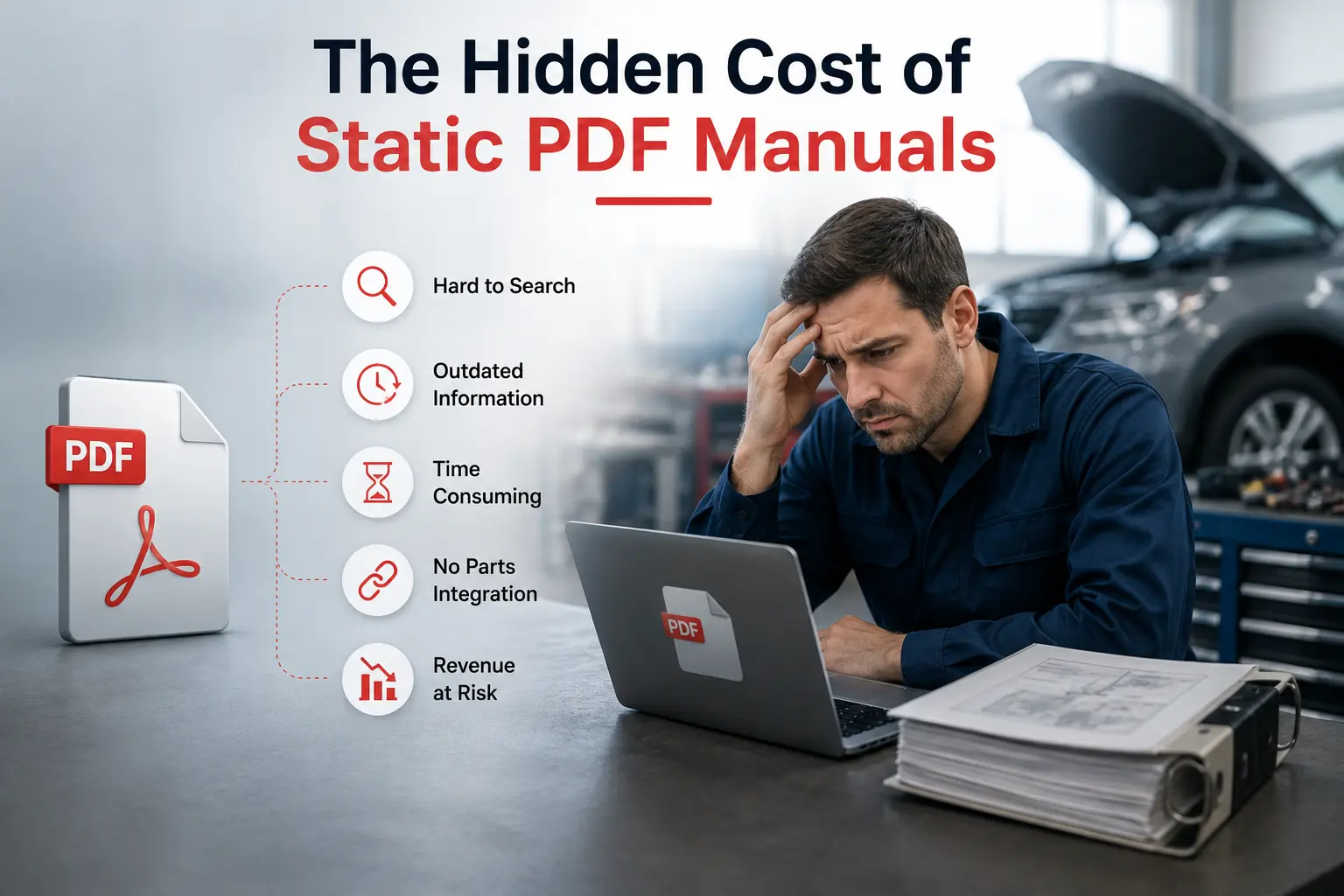
Static PDF manuals lack real search, reliable version control, and integration with parts systems, so technicians waste time locating information instead of completing repairs. Research shows that many service technicians spend 30 minutes to two hours each day searching for the right procedure, time that never gets billed to a job. Data compiled by Fluid Topics found that roughly 80% of field service engineers spend between 30 minutes and 2 hours a day looking for information to do their job. These are not small inconveniences. Six problems repeat across almost every OEM that still relies on PDF manuals:
- Search is limited to basic keyword matching, so technicians often cannot find the exact section they need.
- Updating a PDF and distributing the revised version to every dealer takes time, allowing outdated information to remain in circulation.
- Multiple technicians cannot easily work inside the same manual at once.
- Complex diagrams are hard to zoom or navigate within a flat PDF page.
- Version control breaks down across a large dealer network, so some technicians work from outdated files.
- PDFs do not connect to parts catalogs, diagnostic tools, or dealer management systems, so manual lookups and parts orders remain two separate steps.
Each of these gaps slows down the service process and adds a point where the customer or dealer can drop out of the OEM’s aftermarket channel.
How Does Digital Technical Documentation Protect Aftermarket Revenue?
Digital technical documentation protects aftermarket revenue by keeping repairs within the OEM’s authorized network, speeding up technician workflows, reducing warranty errors caused by outdated information, and linking directly to parts ordering, turning each repair job into a parts sale rather than a missed opportunity.
When a manual is searchable and interactive, a technician spends less time reading and more time repairing. Faster repairs mean more jobs completed per day, which is direct revenue for the dealer and the OEM. Accurate, up-to-date content also reduces the number of warranty claims caused by technicians following outdated procedures or overlooking revised specifications. Perhaps most important for aftermarket revenue, digital technical documentation can link a repair step directly to the exact part needed, so the technician orders that part from the OEM’s catalog rather than guessing a part number or turning to a generic aftermarket supplier. That single connection between documentation and parts ordering is one of the more direct ways OEM technical documentation protects revenue that would otherwise leak to third parties.
What Key Features Should OEM Technical Documentation Software Include?
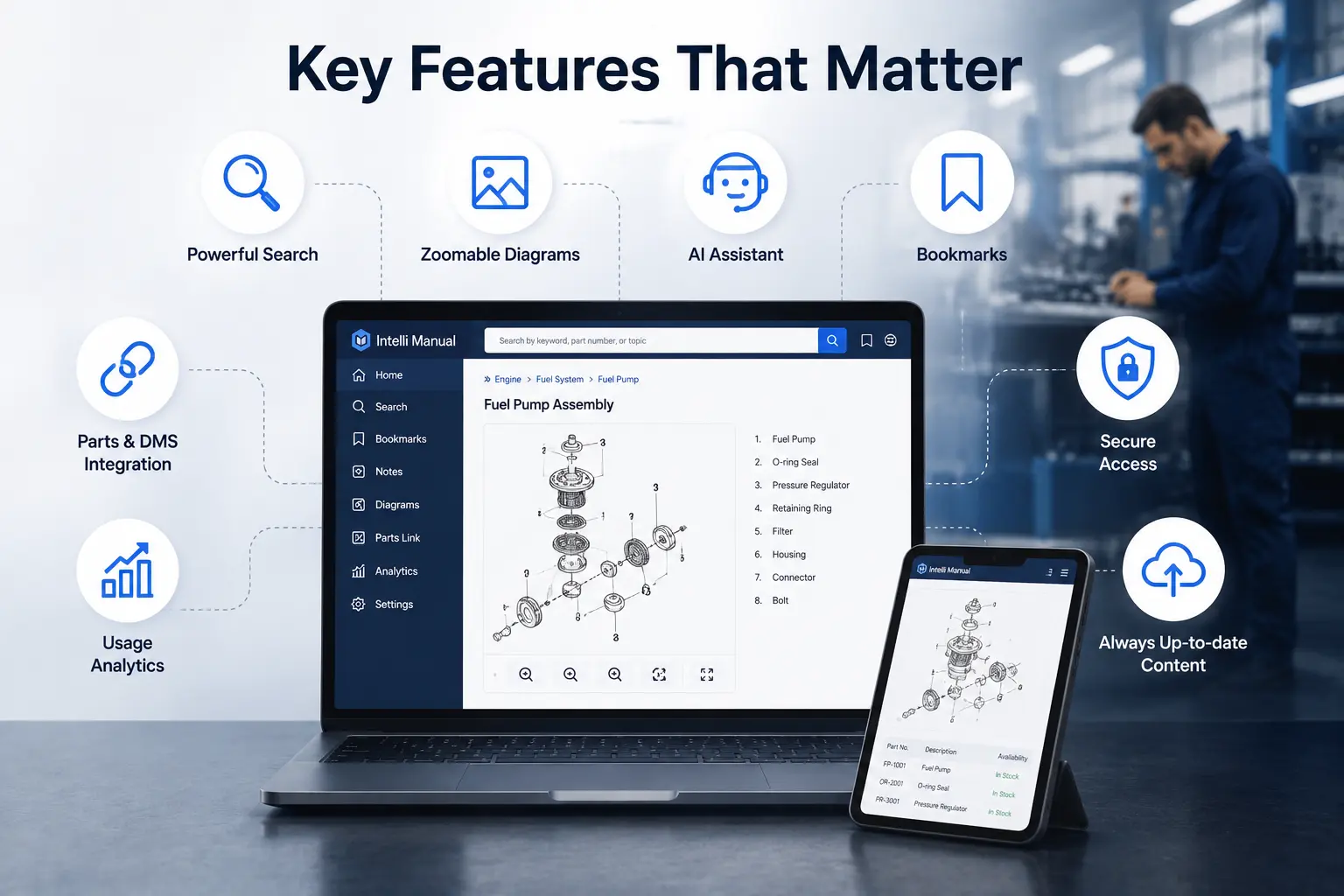
The features that matter most in OEM technical documentation software are full-text search, zoomable diagrams, AI-assisted search or chat, bookmarking, and direct integration with parts catalogs or dealer management systems. Without these, a digital manual is just a PDF with a different file extension.
- Full content search: lets a technician search every page of a manual instantly and see every matching result, not just the current page.
- Index and topic search: lets users jump straight to a topic by typing its name, instead of browsing a table of contents.
- Image zoom: converts diagrams into a format that can be zoomed in without blur, useful for wiring diagrams and exploded parts views.
- AI chatbot and auto-generated FAQs: answers technicians' questions in natural language and surfaces the most common questions for a given manual.
- Bookmarking: lets a technician save frequently used pages for one-click access later.
- Integration with parts catalogs and DMS: connects repair procedures directly to part availability and ordering.
- Usage analytics: shows which sections technicians search for most, which searches return no results, and where documentation needs improvement.
- Digital rights management: controls who can view or download manual content, which matters for OEMs protecting proprietary repair information.
How Does Aftermarket Technical Documentation Improve Dealer Network Productivity?
Aftermarket technical documentation affects productivity across an entire dealer network, not just a single shop. Consistent, centrally updated digital manuals mean every dealer works from the same accurate information, which reduces inconsistent repairs and repeat visits caused by technicians in different locations following different versions of the same manual.
A large OEM network can include hundreds of dealers spread across many regions. Distributing a revised PDF manual to every one of these dealers and confirming they actually replaced the outdated file is difficult to manage in practice. Centrally hosted digital technical documentation solves this by updating content in one place and making the current version instantly available to every dealer with access. This also gives OEMs visibility into how their aftermarket technical documentation performs across the network, as analytics can show which regions or dealers search for information most often, helping identify training gaps or recurring product issues.
How Does Intelli Manual Convert Static Manuals into Revenue-Protecting Digital Documentation?
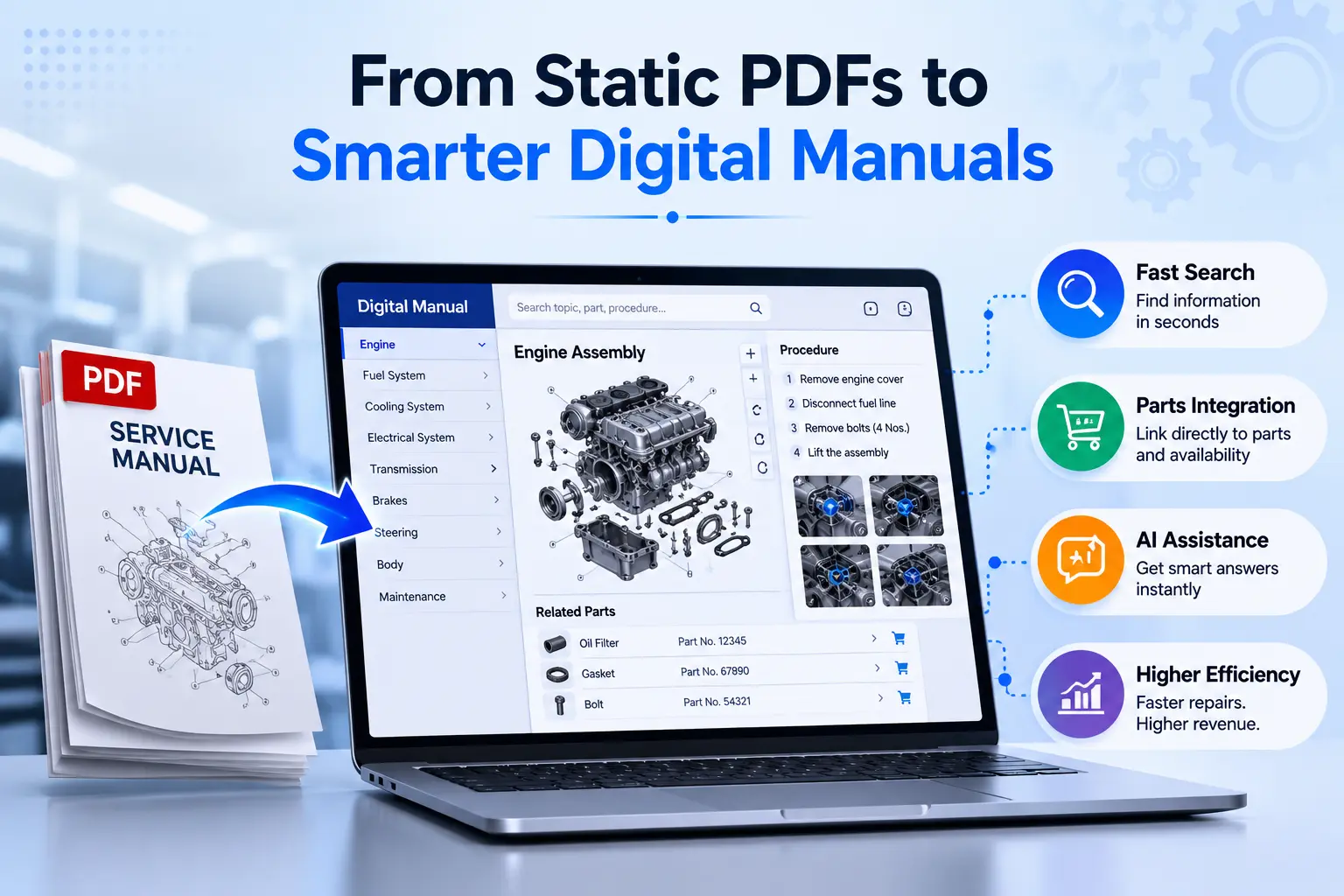
Intelli Manual is a platform that converts existing PDF service manuals into interactive digital manuals, without requiring an OEM to recreate content from scratch. It adds full content search, image zoom, AI chatbot support, and direct integration with parts catalogs so a repair procedure and a parts order live in the same workflow.
For OEMs that already have years of PDF manuals in circulation, rebuilding that content manually is not realistic. Intelli Manual takes the manuals an OEM already has and converts them into searchable, interactive HTML, complete with a topic tree, full-text search, and zoomable diagrams that avoid the blur common in scanned PDFs. Its AI capabilities include a chatbot that answers technician questions in natural language, auto-generated FAQs based on real usage, and text summarization for long procedures. When integrated with an electronic parts catalog such as Intelli Catalog, a technician working inside a manual can click a part number and check availability or place an order without leaving the manual. The result is a single digital technical documentation environment that shortens repair time and keeps parts sales within the OEM’s own channel.
Conclusion
Aftermarket parts and service revenue is one of the most profitable parts of an OEM’s business, and it depends heavily on how quickly technicians can find accurate repair information. Static PDF manuals slow that process down, increase warranty errors, and give customers reasons to look outside the OEM’s authorized network. Digital technical documentation addresses each of these problems directly: it speeds up search, keeps content current across an entire dealer network, and connects repair procedures to parts ordering so a service visit stays inside the OEM’s revenue stream. For OEMs still relying on static PDF manuals, moving to digital technical documentation is a direct way to protect revenue that is already at risk of leaking to third parties.
Book a demo to see how Intelli Manual can turn your existing service manuals into interactive digital technical documentation.
FAQ
What is digital technical documentation?
Digital technical documentation is service, repair, and parts information delivered through a searchable, interactive digital manual instead of a static PDF. It typically includes full-text search, zoomable diagrams, and links to parts catalogs, allowing technicians and dealers to find accurate repair steps quickly instead of scrolling through hundreds of PDF pages.
How does digital technical documentation improve first-time fix rates?
It gives technicians faster, more accurate access to the correct repair procedure, current specifications, and related diagrams. When technicians are not guessing from outdated or hard-to-find information, they complete repairs correctly on the first visit more often, reducing repeat jobs and improving customer satisfaction.
Can digital technical documentation reduce warranty costs?
Yes. Many warranty claims trace back to technicians following outdated procedures or missing an updated part specification. Centrally updated digital technical documentation ensures that every technician works from the current version, reducing errors caused by outdated content and reducing avoidable warranty claims.
Do we need to rebuild our manuals from scratch to go digital?
No. Platforms such as Intelli Manual convert existing PDF manuals into interactive digital formats, so OEMs do not need to recreate content. The original manual content is preserved and enhanced with search, zoom, and AI features rather than rewritten from the ground up.
How does OEM technical documentation connect to aftermarket parts sales?
OEM technical documentation that integrates with a parts catalog lets a technician move directly from a repair step to placing a parts order. Instead of searching separately for a part number, the technician clicks the part referenced in the manual, which keeps the parts sales inside the OEM’s own system.


Explore More Insights




.webp)


About the Author


Nishant Sharma
Nishant Sharma is the Head of Demand Generation at Intellinet Systems, specializing in B2B marketing, sales, digital transformation, and automotive aftermarket solutions. He shares insights on emerging technologies, industry trends, and strategies that help OEMs and businesses improve operational efficiency, customer experience, and aftermarket growth.


