

Overview: A commercial vehicle DMS helps truck and fleet dealers manage service, SLAs, parts, repair orders, billing, and warranty in one connected workflow. It handles multi-line repair orders, uptime pressure, fleet billing rules, and parts matched to a specific build. Fleet customers judge a dealer by downtime as much as by the invoice. Dealers therefore need a single record that follows a unit from check-in to release, with timestamps that support service-level agreements (SLAs) and parts allocated to the job. For OEMs, the value is comparable data across the network: turnaround, parts fill, and warranty timing.

Key Takeaways:
- Downtime matters. Fleet customers pay close attention to how long a unit is out of service, so the system must track time between statuses, not just repair order totals.
- SLAs need timestamps. Without recorded check-in, approval, parts, and release times, an SLA becomes an argument instead of a measurement.
- Parts drive turnaround. A repair waiting on a part is a routine cause of extended downtime, so allocation and stock visibility should be included in the repair order.
- OEM implication. Network reporting works only when every dealer captures the same statuses, hold reasons, and codes.
- Limit to respect. Dealer management software records what dealers enter. Catalog quality, staff habits, and process rules still decide the result.
Manage commercial vehicle service operations with Intelli DMS. Connect fleet service, job cards, technicians, parts, billing, warranty, and OEM reporting in one platform. Book a Demo
What Is a Commercial Vehicle DMS and How Does It Differ from a Car Dealer System?
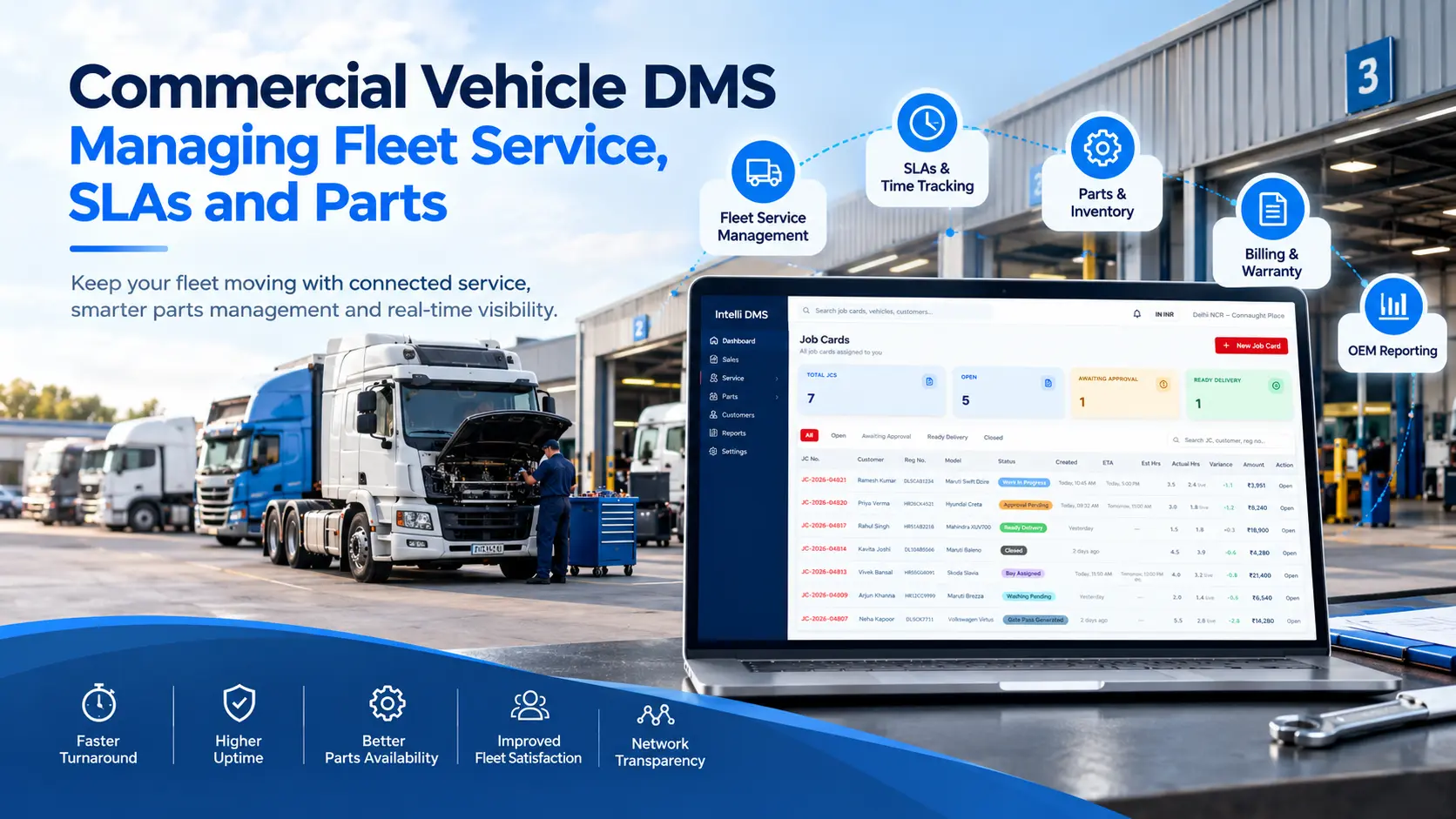
A commercial vehicle DMS is dealer management software for truck, trailer, and bus dealers that manages service, parts, billing, and warranty around fleet needs. It differs from a car dealer system in how repair orders are built, how parts are matched to a specific chassis or engine, and how fleet accounts approve and pay for work.
Passenger car service is built around a retail owner, a short visit, and a fairly standard menu. Truck service rarely works that way.
This comparison describes franchised truck dealers. Independent truck repair shops, fleet-owned shops, and mobile service operators run differently, and a system chosen for one will not automatically fit another.
One point that only shows up after years in service departments: the repair order is the center of a truck dealer’s business, and it is rarely a single event. A unit can sit in the shop for three days, with new findings added on day two. If the system treats that as one line and one status, the fleet manager phones the service manager for updates. Every one of those calls is a sign the system is not doing its job.
Why Does Fleet Service Management Break Down at Truck Dealers?
Fleet service management is the coordination of scheduled maintenance, breakdown repairs, approvals, and parts across a customer’s trucks. At the dealer, it breaks down when work arrives unpredictably, findings expand mid-repair, and nobody records when each wait began, so both sides argue about downtime from memory.
Consider an ordinary Tuesday. A preventive maintenance visit is booked for 8:00 a.m. At 7:30 a.m., a tow-in arrives with a derate fault, and that truck takes the bay. The preventive maintenance (PM) unit waits. When it finally goes up, the technician finds worn brake components that were not on the estimate. The fleet manager is on the road and does not answer until the afternoon.
Nobody did anything wrong. But if no one recorded when each wait started, the dealer and the fleet would remember the day differently.
The failure points are usually the same:
- Triage: breakdowns and PMs compete for the same bays with no clear rule on which goes first.
- Findings: extra work is discovered mid-repair and approved by phone or text, outside the system.
- Parts: a needed part is not on the shelf, and the promised completion time is never updated.
- Status: the fleet asks where its truck is, and an advisor has to walk to the bay to find out.
- Billing: the work is done, but the invoice waits on a missing PO or approval reference.
Cost pressure makes fleets less patient with this. ATRI's 2026 Analysis of the Operational Costs of Trucking found that repair and maintenance costs rose 8.6% in 2025, one of the largest percentage increases among carrier cost lines. That is a carrier-side figure, not a dealer figure, but it explains why fleet managers scrutinize estimates and time in the shop.
Hypothetical downtime example: If a fleet assigns an internal cost of $500 per truck per day and a repair is delayed by two days because of an approval or parts hold, the delay represents $1,000 in internal downtime cost before considering any additional towing, substitute-vehicle, or missed-delivery costs. The actual cost varies by fleet, route, vehicle, and contract, so the figure should be treated as an illustration rather than an industry benchmark.
Good fleet service management does not make the truck repair itself. It makes the waiting visible, so someone can act on it.
How Do You Manage Fleet Service in a Truck Dealer Management System?
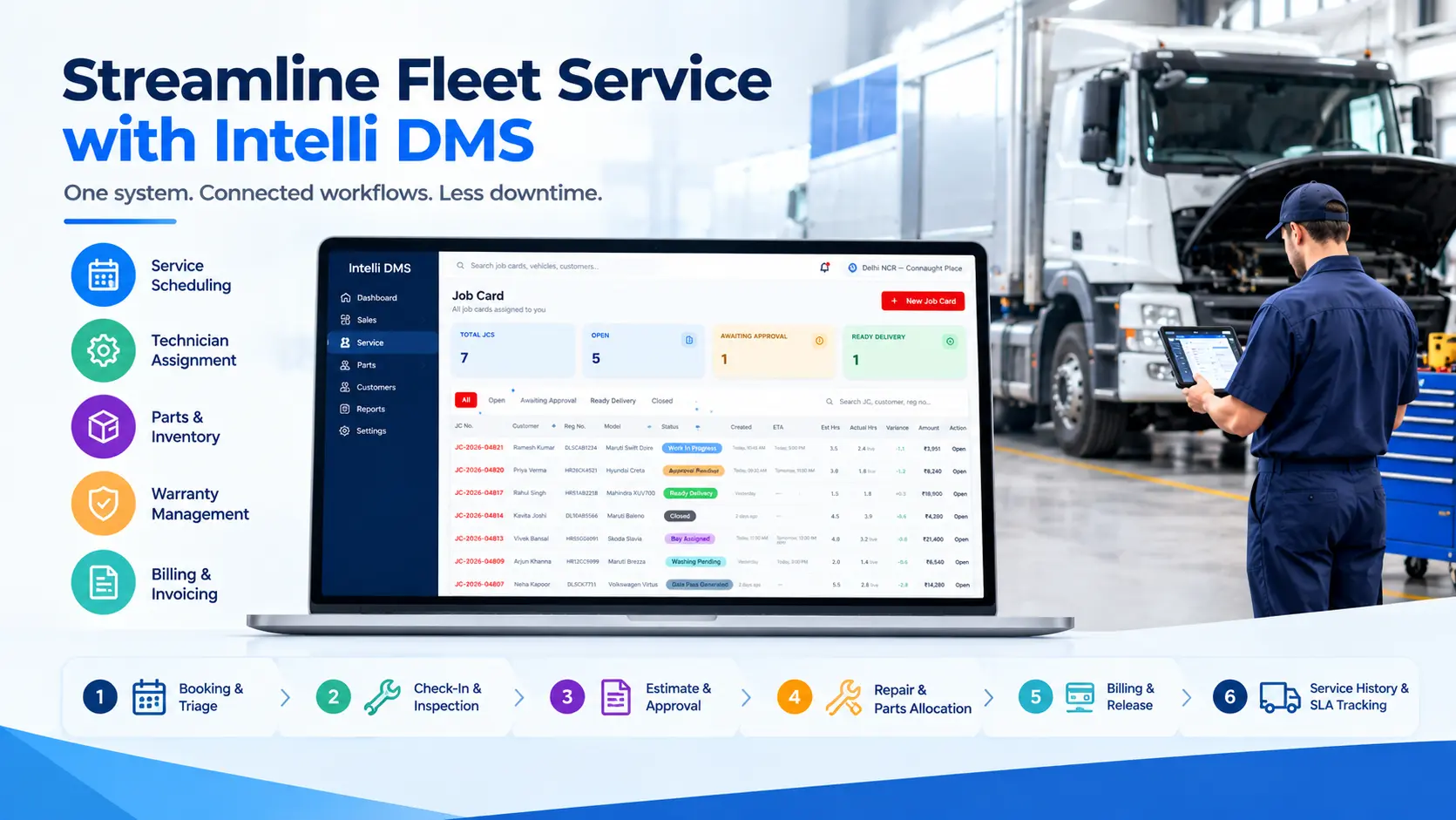
A truck dealer management system should carry each unit through six controlled steps: booking and triage, check-in, inspection and estimate, approval, repair with parts allocated, and release with billing. Each step needs an owner, a status, and a timestamp, so the dealer, the fleet, and the OEM see the same picture.
- Book and triage: Classify each arrival as PM, breakdown, or warranty, and set a priority rule before the bays fill up.
- Check in the unit: Capture VIN, mileage or hours, the driver complaint, and the fleet contact who can approve work.
- Inspect and estimate: Record findings with photos, then build the estimate with labor and parts. Anything beyond the original scope goes back for approval.
- Log the approval: Record who approved, when, and for which lines. That trail matters when billing questions come up weeks later.
- Repair with parts allocated: Assign the technician by skill, reserve the parts for the job, and keep status current as the work moves.
- Release and bill: Confirm quality, release the unit, and split billing between the fleet, warranty, and any other payer.
Skill-based assignment matters more in a truck shop than in a car shop. Engine, aftertreatment, and electrical diagnostics are different competencies, and sending a unit to the wrong bay costs hours.
Be realistic about the payoff. The gain is fewer status calls, less rework at the counter, and a cleaner record for warranty and billing. It will not shorten a repair that is waiting on a backordered part.
How Do SLAs Work in Commercial Vehicle Service?
SLAs in commercial vehicle service are measurable time commitments, such as how fast a breakdown is triaged, how long an estimate takes, or how quickly a warranty claim is filed. They hold up only when the DMS captures the timestamps and pauses the clock when the delay belongs to someone else.
There are two layers. The first is dealer to fleet: response time on breakdowns, estimate turnaround, and promised completion. The second is OEM to dealer: expectations on things like warranty claim submission windows and response to uptime-related cases. The specifics differ by manufacturer.
Hypothetical example: A truck is in the shop for 72 hours. Of that time, 30 hours are spent waiting for fleet approval and 20 hours waiting for a backordered part. If both periods are excluded under the agreed SLA rules, 22 hours remain on the dealer's clock. Without timestamps and documented hold reasons, the fleet may count all 72 hours against the dealer.
The argument is rarely about the repair itself. It is about whose clock the waiting time belongs to. Agree on the hold reasons up front: awaiting fleet approval, parts, sublet work, and driver. Keep the list short, or advisors will pick whatever is fastest.
One caution. The DMS enforces nothing on its own. Someone has to define the SLA, configure the statuses, and review exceptions every week. Clean timestamps do not improve turnaround; they show where the time went so a service manager can fix it.
How Should a Commercial Vehicle DMS Handle Truck Parts?
Truck parts should be tied to the repair order, not managed separately at the counter. That means matching parts to the unit’s VIN and component details, reserving stock for the job, flagging backorders early, and tracking transfers and returns, so the advisor knows what is on the shelf before promising a completion time.
A parts counterperson has three questions to answer quickly: is this the right part for this unit, do we have it, and if not, when can we get it? The system should support each one.
- Identification: match by VIN, then configure engine, transmission, axle, or component serial where the catalog requires it.
- Supersessions and alternates: old numbers roll to new ones, and the counter should see the current part with its history.
- Assemblies and kits: a technician often needs a kit, not five loose parts.
- Cores: remanufactured components carry core charges, and a missed core return turns into a billing dispute.
- Allocation: parts requested for a job are reserved for that job, not sold out from under it.
- Transfers and stock orders: multi-branch dealers need to see stock at the other locations before placing an emergency order.
- Wrong-part returns: capture a reason code, so the OEM can tell a catalog problem from a counter entry problem.
The DMS should support parts requests, issues, returns, stock transfers, and reorder levels against the digital job card, while connecting parts identification to the applicable catalog data.
Here, technology has a limit. A DMS parts lookup is only as good as the catalog and build data behind it. It cannot correct an application listed wrongly. Reorder suggestions have the same dependency: if parts are written to the wrong repair order, the usage history is wrong and so are the reorder points.
What Should OEMs Measure Across a Truck Dealer Network?
OEMs should measure downtime per repair order, first-time fix rate, parts fill rate, warranty claim lag, and preventive maintenance completion. These show whether dealers keep trucks earning. They compare fairly only when every dealer records the same statuses, hold reasons, and codes, which is a process decision before it is a software one.
Two practical points. First, dealer adoption. Dealers will not enter data carefully for a system that only benefits the OEM. Give the dealer principal a dashboard that helps run the shop, and the data quality follows.
Second, data access. In the U.S., how much dealer data an OEM can see is usually set by the dealer agreement and applicable law. Scope it early, before configuration starts.
How Intelli DMS Supports Commercial Vehicle Dealers
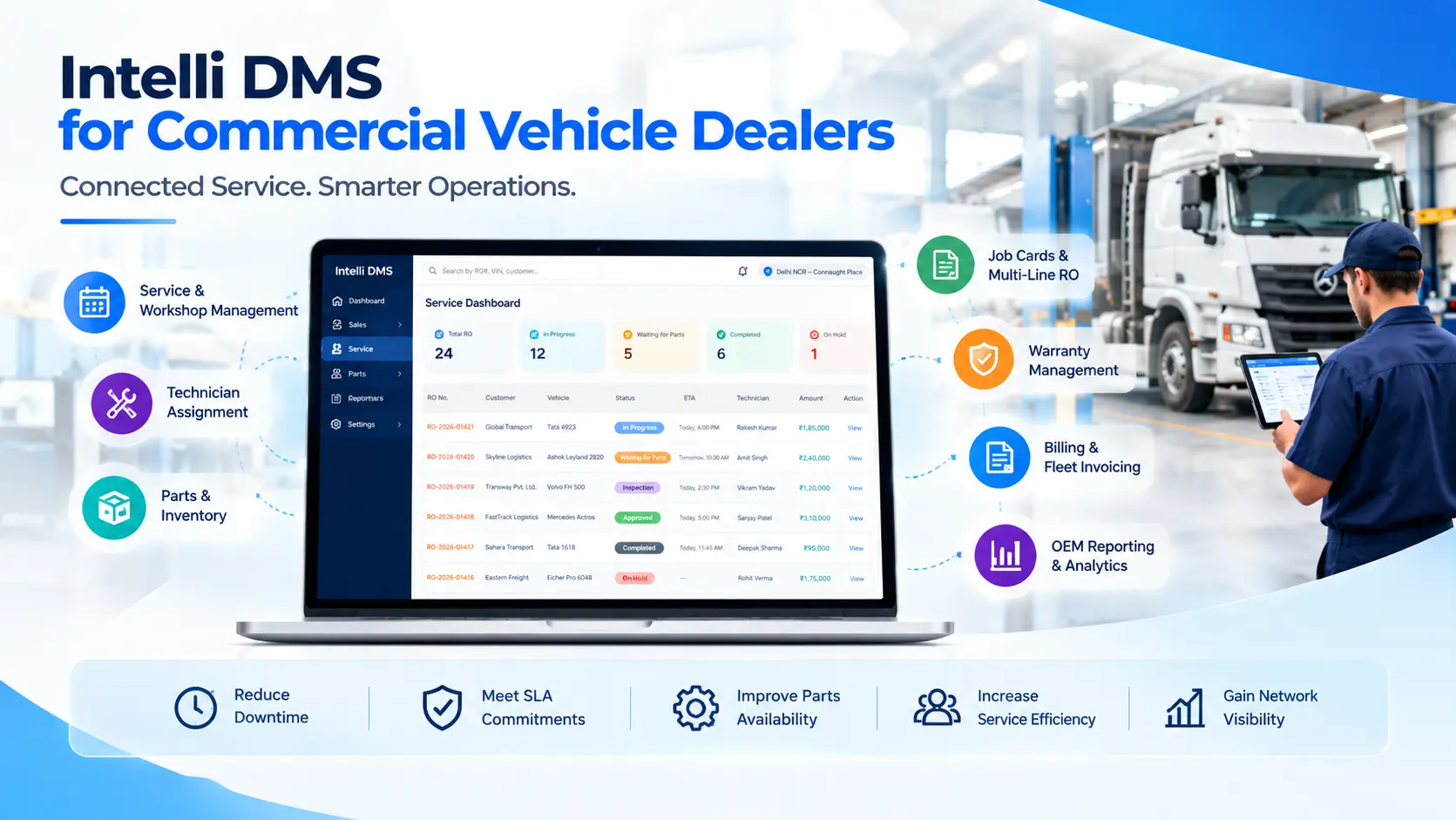
Intelli DMS, a cloud-based dealer management system, covers appointments, front-office check-in, job cards, technician assignment, parts and inventory, billing, and warranty in one platform. Dealers work from a single repair record, and OEM network teams get role-based dashboards covering turnaround time, technician productivity, parts usage, warranty performance, first-time fix rate, parts fill rate, and preventive maintenance completion.
- Front-office and job cards: Appointments, check-ins, and digital job cards with inspection details and repair history, so advisors and technicians share one record.
- Workshop tracking: Assignment by skill and availability, with repair progress and pending jobs visible as they change.
- Parts and inventory: Stock availability, requests, issues, returns, transfers, and reorder levels linked to the job.
- Billing and warranty: Invoices generated from approved jobs, split across payers, with job cards linked to warranty claims.
- Reporting and audit: Dashboards provide visibility into turnaround time, technician productivity, parts usage, warranty performance, first-time fix rate, parts fill rate, and preventive maintenance completion, with audit trails for network teams.
- Integration: Connections to ERP systems through APIs, plus electronic parts catalog integration for part numbers, alternates, and supersessions. Customer updates can be sent by SMS or email.
What the dealer still owns
Intelli DMS can capture and organize the operational data, but dealers still control the quality of that data. Advisors must record accurate statuses and hold reasons, technicians must update job progress, and parts teams must maintain correct inventory and catalog information. The system cannot eliminate delays caused by fleet approvals, supplier shortages, staffing constraints, or incorrect data.
Conclusion
A commercial vehicle DMS earns its place by making the gap between a truck arriving and a truck leaving visible, measurable, and actionable. Fleet service, SLAs, and parts are one workflow: statuses, timestamps, hold reasons, and allocated parts on a single repair record. The DMS does not eliminate backordered parts or approval delays, but it shows where time is being lost so dealers can shorten the stages of the process they can control.
For OEMs, that record also makes dealer performance more comparable, provided dealers capture the same statuses, hold reasons, and codes, and the underlying parts and build data is accurate.
Book a demo to see how a truck repair order moves from check-in to release in Intelli DMS: job card status tracking, parts requests against the job, and the turnaround and warranty dashboards your network team would use.
Frequently Asked Questions
What is a commercial vehicle DMS?
A commercial vehicle DMS is dealer software for truck, trailer, and bus dealers. It manages service appointments, repair orders, parts, billing, and warranty in one system. Compared with a car dealer system, it puts more weight on uptime, unit-level parts matching, multi-line repair orders, and fleet account billing.
How does a truck dealer management system track SLAs for fleet customers?
It timestamps each repair order status: check-in, diagnosis, estimate sent, approval received, parts received, and release. Hold reasons pause the clock when the delay belongs to the fleet or a supplier, under the agreed SLA terms. Managers then review exceptions against targets that the dealer and fleet must agree on first.
How does a DMS help avoid parts delays during a truck repair?
It reserves stock against the job card, shows on-hand quantities across branches, and flags shortages while the estimate is still being built. That lets the advisor promise a realistic completion time. It cannot fix a wrong catalog application, so parts data quality still matters.
Can a commercial vehicle DMS integrate with OEM warranty and ERP systems?
Usually, through APIs or standard connectors, but scope varies by vendor. Ask which warranty and ERP systems have been connected before, what data moves in each direction, and who maintains the connection. Confirm integration depth in the demo and the contract rather than assuming it from a feature list.


Explore More Insights







.webp)


About the Author


Nishant Sharma
Nishant Sharma is the Head of Demand Generation at Intellinet Systems, specializing in B2B marketing, sales, digital transformation, and automotive aftermarket solutions. He shares insights on emerging technologies, industry trends, and strategies that help OEMs and businesses improve operational efficiency, customer experience, and aftermarket growth.


