

Overview: A digital job card is an electronic record that replaces the paper repair order in a dealership service department. It captures vehicle details, customer complaints, technician assignments, parts usage, labor hours, and repair status in a single system, ensuring every update is available in real time. For OEMs and dealer principals, moving from paper to a digital job card for dealership operations means faster service turnaround, fewer billing errors, better technician utilization, and clear visibility into every job in the workshop, from check-in to vehicle delivery.

Key Takeaways:
- A digital job card centralizes vehicle, customer, technician, parts, and repair information in a single real-time system.
- It eliminates delays and manual errors by connecting job cards with parts management, billing, and reporting.
- Service advisors, technicians, and managers work from the same live information, improving collaboration and service turnaround.
- OEMs gain standardized workflows and real-time visibility across dealer networks, making it easier to monitor performance and enforce consistent service processes.
- As workshops face growing service demand and technician shortages, digital job cards help dealerships improve productivity, reduce costs, and deliver a better customer experience.
What Is a Digital Job Card?
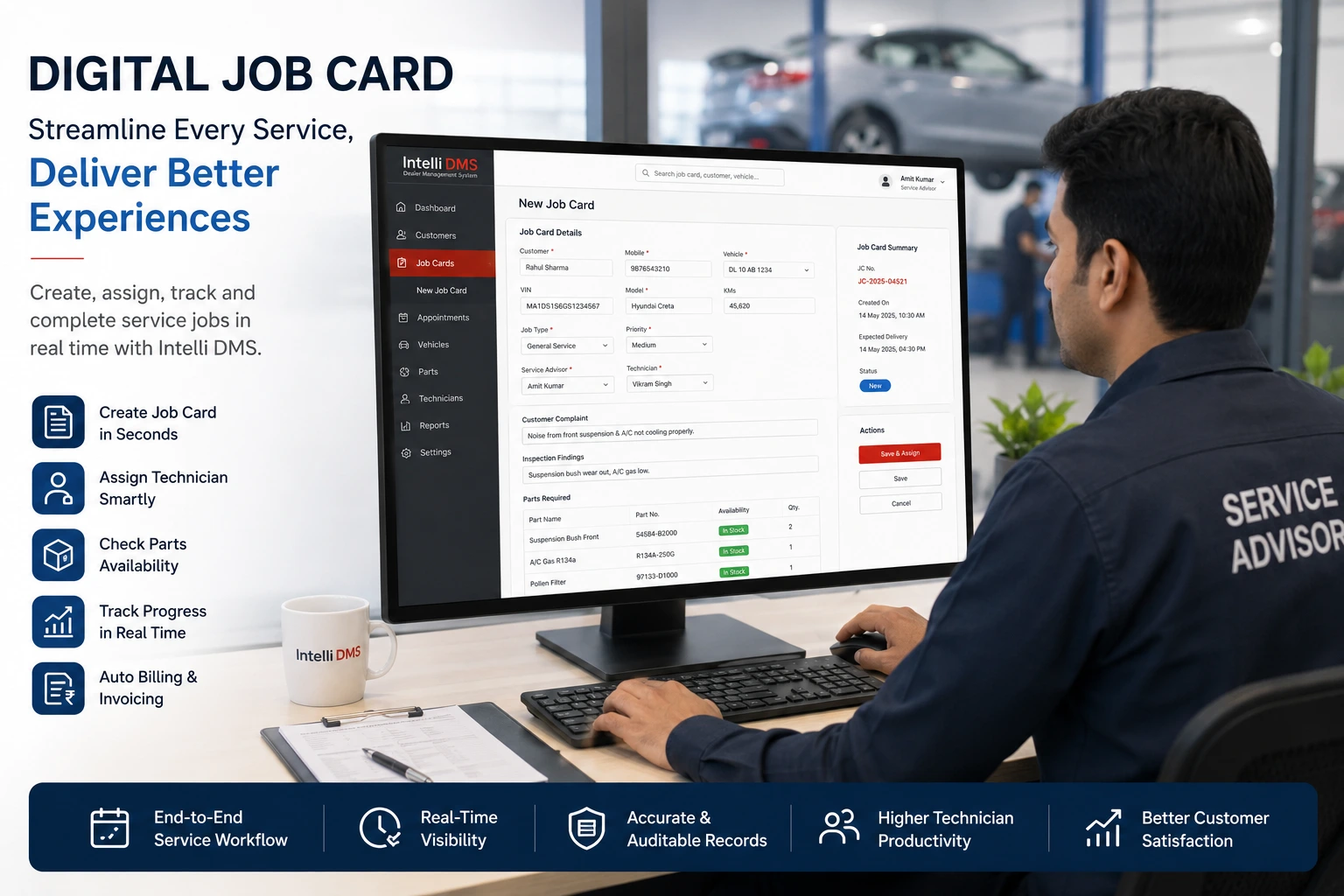
A digital job card is the electronic version of the paper repair order used to track a vehicle through a service visit. It records the customer's complaint, the assigned technician, the requested parts, the labor performed, and the current repair status in a single digital file that anyone on the service floor can access instantly.
Unlike a paper form, a digital job card for dealership use does not sit on a clipboard or in a filing tray. It lives inside the dealer management system, so a service advisor, technician, parts counter staff, and service manager are all looking at the same live information at the same time. This is the core difference between an electronic job card and a traditional one: visibility that updates as the work happens, not after it is written down.
What Information Should a Digital Job Card Include?
A digital job card should capture all the information needed to complete a service job accurately while keeping every stakeholder working from the same real-time record. Instead of scattered notes and manual updates, all service details remain in one place, making it easier to track progress, reduce errors, and maintain a complete service history.
A comprehensive digital job card typically includes:
- Customer and vehicle details such as customer name, contact information, vehicle registration number, VIN, model, and odometer reading.
- Customer complaints and service requests to clearly document reported issues and requested repairs.
- Inspection findings including technician observations, diagnostic results, and recommended repairs.
- Technician assignment and job priority based on technician skills, availability, and workshop workload.
- Parts requirements with requested parts, inventory availability, and issue status linked to the parts department.
- Labour operations and time tracking to record repair activities, labour hours, and technician productivity.
- Repair status updates that provide real-time visibility into each stage of the service process.
- Customer approvals for repair estimates and any additional work before repairs begin.
- Quality inspection and final sign-off to ensure the vehicle meets dealership and OEM quality standards before delivery.
- Billing, warranty, and service history so labour, parts, taxes, and warranty information flow directly into invoicing and become part of the vehicle’s permanent service record.
Why Paper Job Cards Slow Down Dealer Service Operations
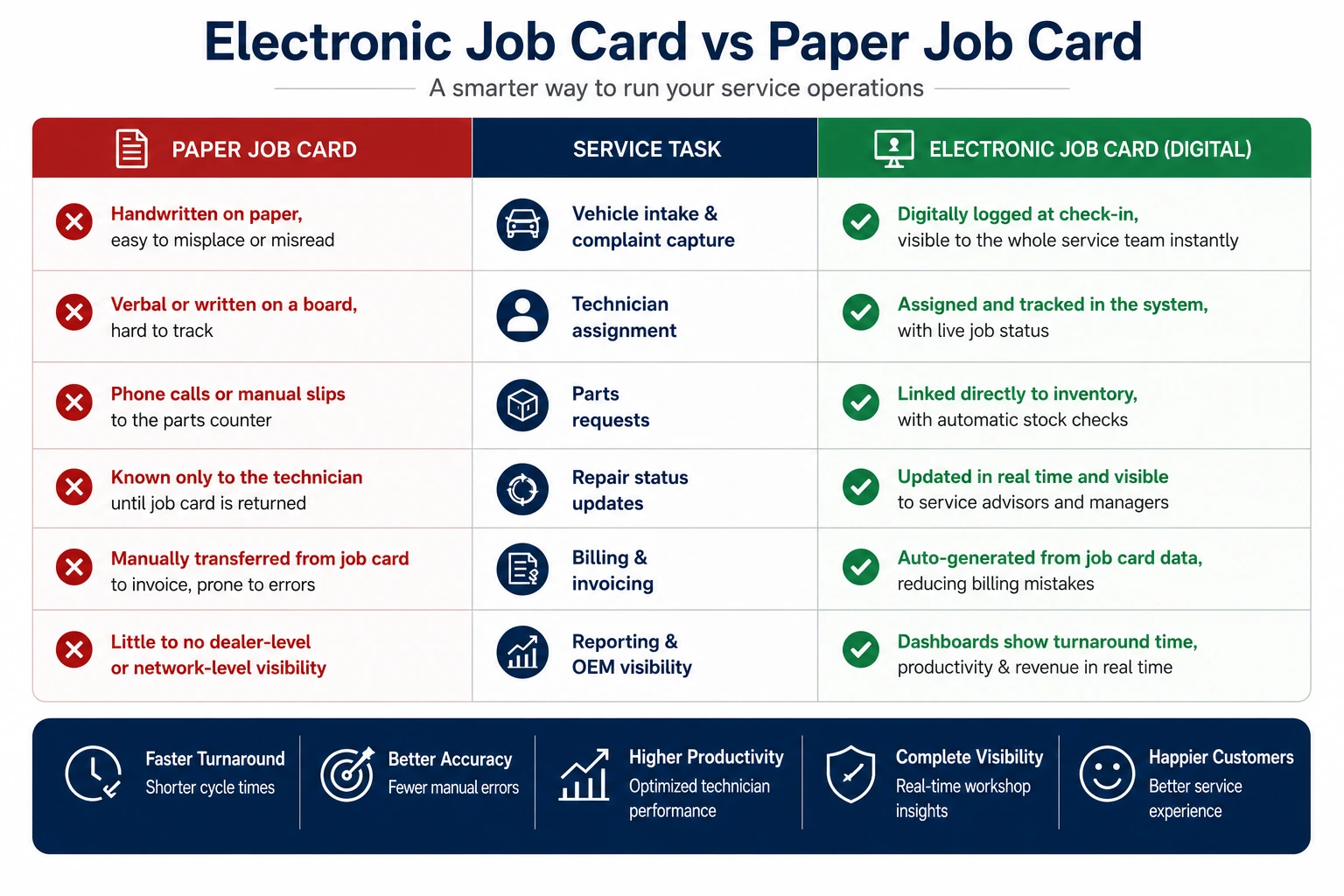
Paper job cards slow down dealer service operations because repair information exists in only one place at a time: the physical job card. Anyone who needs an update has to walk over, call, or wait, which adds delay to every step of the service process and makes it difficult to spot bottlenecks before they affect delivery time.
Many dealerships still run service departments on a patchwork of tools: inquiry registers, Excel sheets, phone calls, WhatsApp messages, manual job cards, physical inspections, and paper checklists. Each of these is useful on its own, but together they create a fragmented picture of the workshop. Common problems include:
- Manual data entry that has to be repeated across the job card, the billing system, and the parts register.
- Paper-based approvals that require a physical signature before work can proceed.
- Multiple follow-ups by phone or message because there is no shared record of where a job stands.
- Scattered information across different tools, making it hard to trace a repair’s full history.
- Data inconsistency when different people write down the same details more than once.
- Delayed decision-making because managers rely on real-time visibility into workshop workload.
For OEMs, this creates an additional problem: different dealers in the same network often follow different processes, making it hard to enforce a consistent standard of service, track inquiry-to-booking conversion, or benchmark workshop productivity across the network.
How a Digital Job Card Works: From Check-In to Delivery
A digital job card works by following the vehicle through every stage of its service visit, updating automatically as each task is completed. Instead of a form that is filled in and filed away, the job card becomes a live record that the whole service team can see and act on at the same time.
- Vehicle check-in: the service advisor logs the customer’s complaint, vehicle details, and odometer reading directly into the system, creating the job card.
- Job card creation and technician assignment: the job is assigned to a technician based on skill and availability, and the assignment appears instantly on the shop floor view.
- Inspection and estimate: the technician records findings, and the system generates a repair estimate for customer approval.
- Parts request: any parts needed are requested directly from the job card, with automatic visibility into stock availability.
- Repair execution and status updates: as the technician completes each task, the job card status updates in real time, so advisors always know where a job stands.
- Quality check and approvals: completed work is reviewed and approved digitally, maintaining a clear audit trail for warranty and OEM compliance
- Billing and invoicing: labor, parts, and taxes recorded on the job card flow directly into the invoice, reducing manual re-entry and billing errors.
- Delivery and follow-up: once the vehicle is delivered, the completed job card becomes part of the customer’s permanent service history for future visits and follow-ups.
Key Benefits of Digital Job Cards for Dealers
The main benefit of digital job cards for dealers is faster, more accurate service delivery with full visibility into every stage of a repair. This shows up as shorter turnaround times, fewer billing disputes, better technician utilization, and stronger customer satisfaction scores.
- Faster service turnaround because technicians, service advisors, and parts staff work from the same live job status instead of waiting for paper updates.
- Fewer manual errors because the labor performed and parts used on the job card flow directly into the invoice.
- Better technician productivity, since jobs are assigned and tracked based on real workload and skill rather than a whiteboard estimate.
- Accurate, auditable records for warranty claims and OEM compliance reviews.
- Standardized service processes across every dealer in a network, since the same digital workflow applies at every location.
- Real-time dashboards for service managers and OEM teams that track turnaround time, technician utilization, and revenue.
- Improved customer communication, since status updates can be shared with the customer as soon as they happen rather than at pickup.
The average age of vehicles on U.S. roads has climbed to 12.8 years, according to S&P Global Mobility, which means more vehicles are moving into the 6- to 14-year range that typically drives the highest volume of maintenance and repair work. At the same time, NADA estimates the industry needs to replace close to 76,000 service technicians each year but produces only about 39,000 new graduates, resulting in an annual shortfall of approximately 37,000 trained technicians. With fewer technicians handling more aging vehicles, dealer service operations cannot afford the delays caused by manual, paper-based job cards.
Electronic Job Card vs Paper Job Card: What Changes for Dealers
The biggest change from a paper job card to an electronic job card is where information lives and who can see it. A paper card holds information in one physical place until someone transfers it elsewhere. An electronic job card stores the same information in a shared system that every relevant team member can view and update in real time as work progresses.
How Intelli DMS Powers Digital Job Cards for Dealers
Intelli DMS brings the digital job card into a single dealer management platform that also covers appointments, billing, parts, and reporting, so dealers are not managing job cards in isolation from the rest of the workshop.
With Intelli DMS, the Service module lets service advisors create a job card at the vehicle check-in, assign it to a technician based on skill and availability, and track its status as work moves from inspection to repair to quality check. Parts requested on the job card connect directly to inventory, so technicians and parts staff are working from the same stock data. Once a job is marked complete, billing and invoicing are generated directly from the job card, reducing manual re-entry and the disputes it can cause.
For OEMS and dealer network managers, Intelli DMS adds a layer that a standalone job card tool cannot: real-time dashboards that show turnaround time, technician productivity, warranty performance, and service revenue across every dealer in the network, alongside the same standard operating procedures at every location. This gives OEM quality managers and aftersales heads the visibility they need to compare dealer performance and address gaps before they affect customer satisfaction.
Transform Your Dealer Service Operations with Intelli DMS. Book a Free Demo Today
Best Practices for Rolling Out Digital Job Cards Across a Dealer Network
Rolling out digital job cards successfully depends on how well the transition is planned, not just the software chosen. OEMs and dealer groups get the best results when they treat implementation as a structured change initiative rather than a one-time software installation.
- Map the current paper-based job card workflow before digitizing it, so no step gets lost in translation.
- Pilot the digital job card at one or two dealer locations before a full network rollout.
- Train service advisors and technicians on the new workflow, not just the software screens.
- Set a standard job card process that every dealer in the network follows from day one.
- Connect the job card to parts, billing, and reporting from the start, rather than adding these later.
- Review turnaround time and technician productivity dashboards weekly during the first few months.
- Collect feedback from service advisors and technicians and adjust the workflow where it creates friction.
Conclusion
A digital job card replaces the paper repair order with a live, shared record that follows a vehicle from check-in through delivery. It removes the delays and errors caused by manual data entry, phone-based follow-ups, and scattered paper records, and it gives service advisors, technicians, and managers the same real-time picture of every job in the workshop.
For dealer principals and service directors, this means faster turnaround and fewer billing disputes. For OEM quality managers and dealer network managers, this means a standardized service process and comparable performance data across every dealer location. As vehicles on the road keep getting older and technician supply keeps getting tighter, dealer service operations need every advantage they can get from a system that removes friction rather than adding to it.
Book a demo to see how Intelli DMS connects digital job cards with parts management, billing, and reporting, creating a single source of truth for OEMs and dealers.
Frequently Asked Questions
What is a digital job card in a dealership?
A digital job card is the electronic version of the paper repair order used to track a vehicle’s service visit. It records the customer’s complaint, technician assignment, parts used, labor hours, and repair status in a single system, so service advisors, technicians, and managers all see the same live information rather than relying on a physical form.
How is an electronic job card different from a paper job card?
An electronic job card updates in real time and is visible to everyone on the service floor at once. A paper job card stores information in a single physical document until someone manually transfers it, which creates delays and increases the chance of errors between the job card, billing, and parts records.
Does a digital card system connect to dealer billing and parts inventory?
Yes, in a full dealer management system like Intelli DMS, the digital job card connects directly to parts and inventory as well as billing and invoicing. This means parts requests check stock automatically, and labor and parts recorded on the job card carry through to the final invoice without manual re-entry.
How long does it take to implement a digital job card system at a dealership?
Timelines vary by dealer size and network scale, but most dealerships can pilot a digital job card system at one location within a few weeks. A full network rollout across multiple dealers typically takes longer and should be phased, starting with a pilot location before expanding to the rest of the network.
Can OEMs enforce standard job card processes across a dealer network with a digital system?
Yes. A digital job card system built into a dealer management platform lets OEMs configure a standard workflow, from check-in through delivery, that applies across every dealer location. This gives OEM quality managers and dealer network managers a consistent process and comparable performance data across the network.


Explore More Insights







.webp)


About the Author


Chandra Shekhar
Chandra Shekhar is the Senior Manager, Strategy & Business Development at Intellinet Systems. With over a decade of experience in the automotive industry, Chandra Shekhar has led digital transformation and aftersales strategy initiatives for OEMs across multiple markets. His background combines deep industry knowledge with a practical understanding of how technology can solve real operational challenges. He focuses on making complex ideas clear and relevant for automotive and aftermarket professionals navigating ongoing change.


