

Overview: Commercial vehicle warranty management is the process OEMs use to track, validate, and reimburse warranty claims for trucks and buses throughout their service life, including claims involving multiple vehicles from the same fleet customer. For truck and bus OEMs, commercial vehicle warranty management differs from passenger vehicle warranty management because a single fleet operator may submit dozens of truck fleet warranty claims for the same component defect across multiple VINs. These claims need to be reviewed together, not one at a time, to ensure faster resolution, consistent decisions, and accurate reimbursement. Effective fleet warranty management therefore requires centralized workflows, VIN-level traceability, automated validation, and purpose-built bus OEM warranty software for handling high claim volumes and complex fleet-wide warranty events at scale.

Key Takeaways
- Truck and bus manufacturers paid approximately US$4.13 billion in warranty claims in 2024, highlighting the growing financial impact of commercial vehicle warranty management.
- Truck downtime costs fleets an average of US$637 per day in lost revenue, making fast and accurate warranty claim processing critical for fleet customers.
- Commercial vehicle warranty management covers tracking, validating, and paying warranty claims for trucks and buses, including claims tied to fleet-wide defects.
- Multi-unit fleet claims differ from single-vehicle claims because one fleet customer can submit many claims linked to the same root cause at once.
- A strong fleet warranty management workflow needs claim validation rules, VIN-level history, batch processing, and supplier recovery tracking.
- Bus OEMs face added complexity from split chassis and body warranties and transit agency reporting requirements.
- Heavy-duty vehicle manufacturers paid a record high in total warranty claims in 2024, with some OEMs seeing claims costs rise sharply.
- Modern warranty management software centralizes multi-unit claims, automates validation, and supports supplier recovery for truck and bus OEMs.
What is Commercial Vehicle Warranty Management?

Commercial vehicle warranty management is the process truck and bus OEMs use to track, validate, and pay warranty claims for their vehicles, including claims filed by fleet operators covering multiple units at once. It spans claim submission, eligibility checks, parts-and-labor reimbursement, and recovery from suppliers when a defect originates upstream.
Passenger vehicle warranty programs typically handle claims for one vehicle and one owner at a time. Commercial vehicle warranty management must account for fleet customers who may own or lease 20, 100, or 500 units of the same model, all built during similar production runs and often experiencing the same failure at nearly the same time. A strong commercial vehicle warranty management program must validate claims submitted across the same fleet or component batch rather than reviewing each claim in isolation.
For truck and bus OEMs, this process also has to account for extended service contracts, chassis-versus-body warranty splits, particularly for buses, and multiple dealer or service center touchpoints across a wide geographic footprint.
Why Are Multi-Unit Fleet Claims Different from Single-Vehicle Claims?
Multi-unit fleet claims differ from single-vehicle claims because one component defect can generate dozens of truck fleet warranty claims across multiple VINs within the same fleet, even though each claim still requires individual VIN-level validation. Handling multi-unit fleet claims individually, as with single-vehicle claims, slows the entire claims process and delays resolution for high-value fleet customers.
- Volume and timing: A single fleet operator may file claims for the same part failure across dozens of vehicles within days of each other, especially after a batch of trucks reaches a similar mileage or age.
- Shared root cause: Many multi-unit fleet claims originate from the same supplier defect, production batch, or software issue, making it more effective to review them as a related group rather than as individual cases.
- Higher stakes per customer: A fleet account can represent hundreds of vehicles and a large share of an OEM’s aftersales revenue, so slow or inconsistent claims handling puts a bigger relationship at risk than a single retail claim would.
- Documentation load: Each claim within a batch still requires its own VIN, mileage, labor time, and parts documentation, significantly increasing administrative effort when the process is not automated.
What Are the Biggest Challenges in Fleet Warranty Management at Scale?
The most common challenges in fleet warranty management are claim backlogs during batch failure, inconsistent approval decisions across similar claims, and slow recovery from suppliers when a defect originates outside the OEM. These operational challenges become more pronounced when large fleet customers submit multiple warranty claims in a single wave.
- Claim backlogs: A spike of claims from one fleet after a defect surfaces can overwhelm a warranty team working from spreadsheets or a system built for one-off claims.
- Inconsistent decisions: Without a shared rules engine, two similar claims from the same fleet can get approved differently depending on which review handles them.
- Slow supplier recovery: When a defect traces back to a supplier, OEMs need to track and recover those costs, which is harder to do accurately across dozens of linked claims.
- Limited fleet-level visibility: Many warranty systems process claims one at a time, making it difficult to recognize that dozens of claims from the same fleet customer stem from the same component failure.
- Manual documentation: Chasing down VIN history, service records, and proof of maintenance across many units slows down both approval and payment.
Core Components of a Fleet Warranty Management Workflow
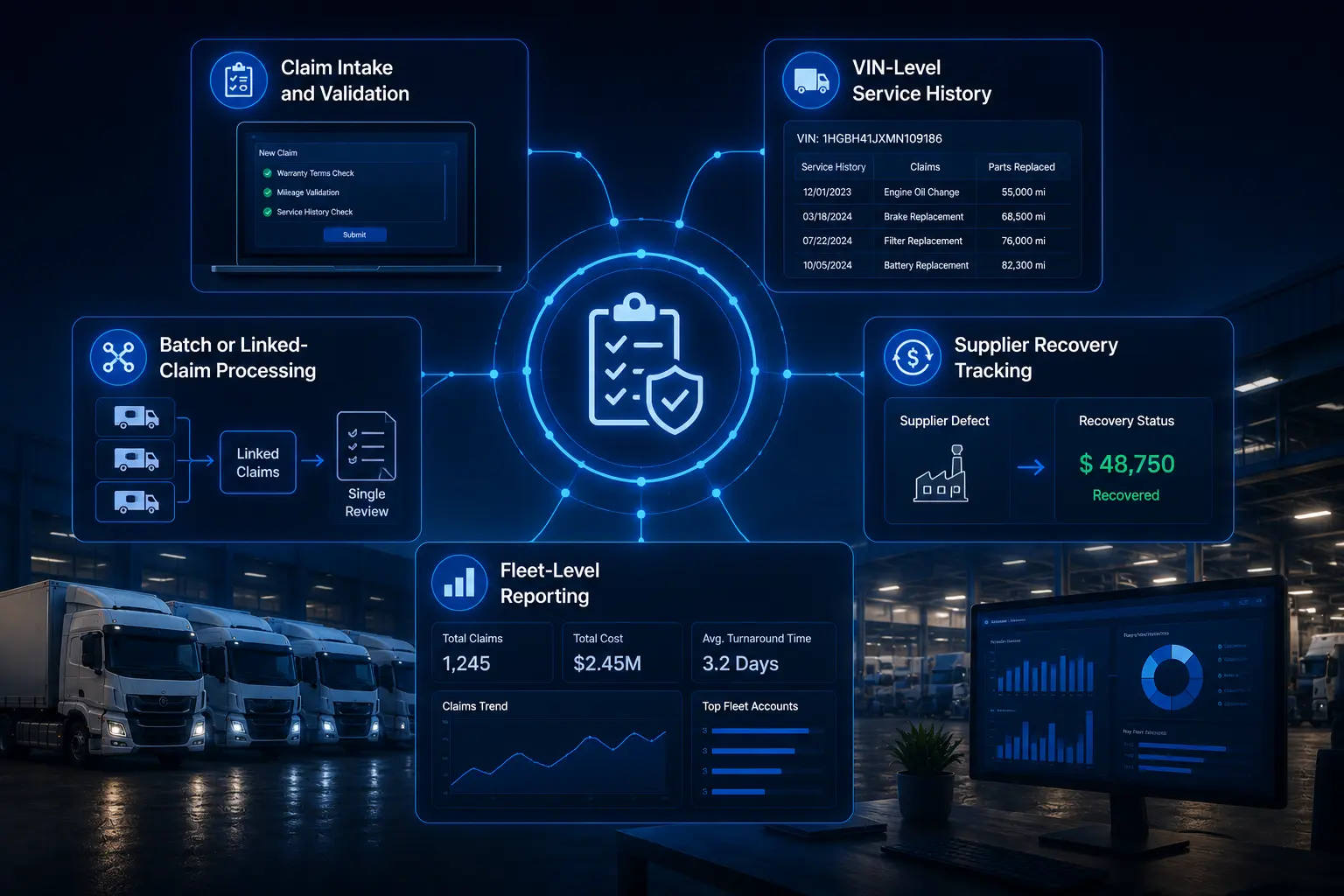
A fleet warranty management workflow should combine automated claim validation, VIN-level service history, linked-claim processing, supplier recovery tracking, and fleet-level reporting. Together, these capabilities help OEMs process high-volume fleet claims accurately, reduce administrative effort, and maintain consistent claim decisions across related warranty events.
- Claim intake and validation: Automated checks against warranty terms, mileage, and service history before a claim reaches a human reviewer.
- VIN-level service history: A record for every unit that shows prior claims, maintenance, and parts replacements, so reviewers see the full picture.
- Batch or linked-claim processing: The ability to group claims that share a root cause so a fleet’s claims move through review together instead of one by one.
- Supplier recovery tracking: A system to flag which claims are tied to a supplier defect and track recovery of those costs separately from OEM-absorbed claims.
- Fleet-level reporting: Dashboards that slow claim volume, cost, and turnaround time by fleet account, not just by individual vehicle.
Why Bus OEMs Need Purpose-Built Warranty Software
Bus OEMs need purpose-built warranty software because a single vehicle often includes components covered by different manufacturers, warranty terms, and approval workflows. The software must manage split chassis-and-body warranties, automate claim routing, and meet fleet and transit agency reporting requirements while giving OEMs and customers a unified view of every claim.
Many transit and school buses are built on a chassis from one company and a body from a separate body builder, which means a warranty claim on the same vehicle can involve two different warranty terms, two different suppliers, and sometimes two different approval workflows. Public transit agencies and school districts also often have their own procurement and reporting requirements that a warranty claim needs to satisfy before payment is released.
Bus OEM warranty software needs to track which portion of a claim falls under chassis warranty versus body warranty, route each portion to the right party for approval, and still give the fleet customer, often a transit authority or school district, one clear answer rather than two separate processes to navigate.
Why Does Commercial Vehicle Warranty Management Matter?
Commercial vehicle warranty management matters because warranty costs for heavy-duty vehicle manufacturers are rising, and every day a fleet vehicle sits waiting on a claim decision costs the fleet customer real revenue. Faster, more accurate claims handling protects both the OEM’s warranty budget and the fleet relationship.
Warranty costs remain substantial for commercial vehicle manufacturers. In 2024, the truck and bus industry alone paid approximately US $4.13 billion in warranty claims, while the broader U.S. vehicle sector paid a record US $19.87 billion, according to Warranty Week's Twenty-Second Annual Product Warranty Report. On the fleet side, the cost of downtime adds pressure to resolve claims quickly: the average truck generates roughly $637 a day in revenue, so every day a vehicle is down waiting on a warranty decision represents lost earning potential for the fleet customer, according to Penske Truck Leasing, citing American Transportation Research Institute data.
- Faster claim turnaround for high-volume fleet accounts
- More consistent approval decisions across similar claims
- Better recovery of supplier-caused costs
- Clearer reporting for warranty reserve planning
- Stronger fleet customer retention through predictable, fast claims handling
Best Practices Checklist for Managing Multi-Unit Warranty Claims
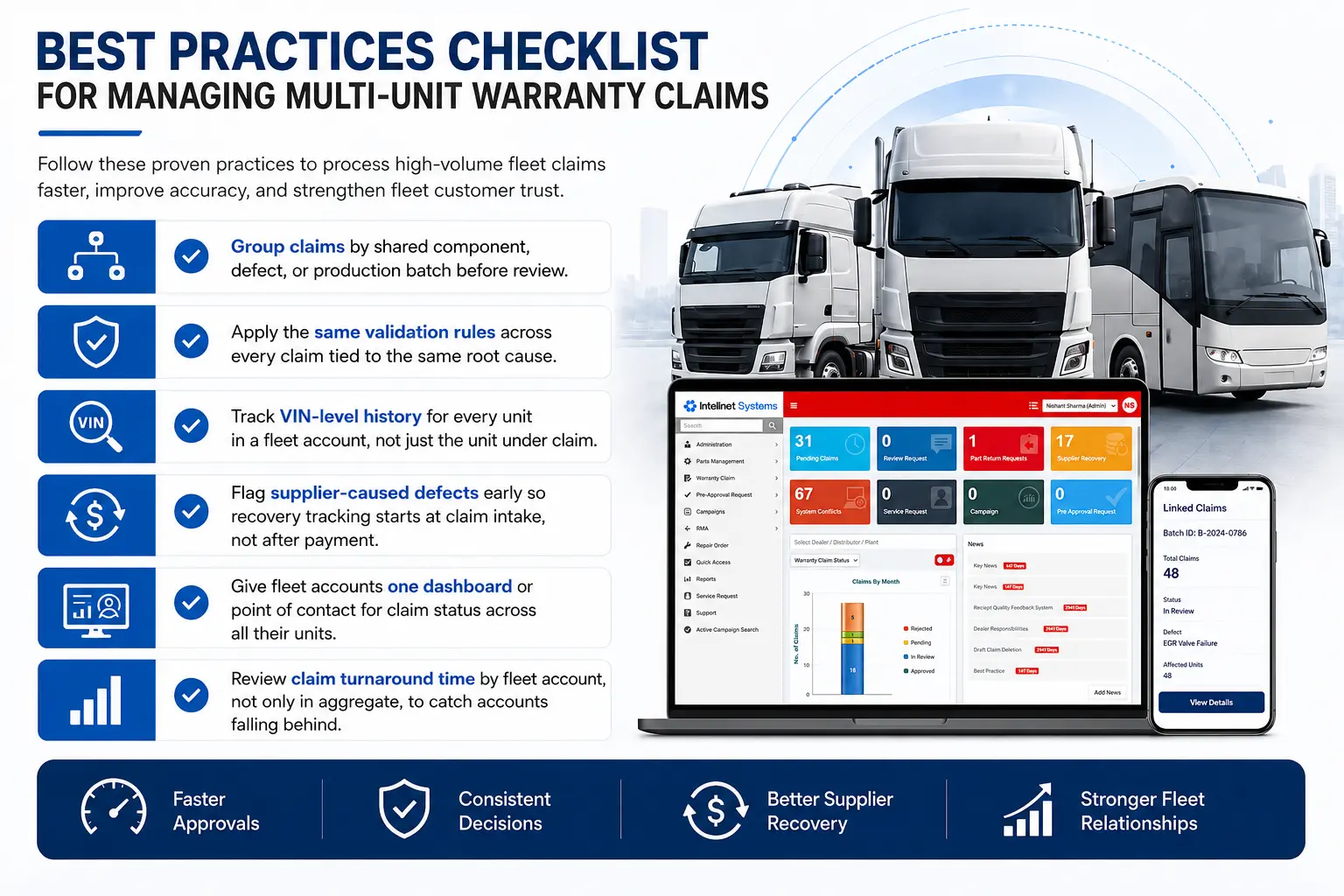
Managing multi-unit warranty claims effectively requires OEMs to group related claims, apply consistent validation rules, maintain VIN-level visibility, and monitor supplier recovery from the start. Following these practices reduces processing delays, improves claim accuracy, and delivers a more consistent experience for fleet customers.
- Group claims by shared component, defect, or production batch before review
- Apply the same validation rules across every claim tied to the same root cause
- Track VIN-level history for every unit in a fleet account, not just the unit under claim
- Flag supplier-caused defects early so recovery tracking starts at claim intake, not after payment
- Give fleet accounts one dashboard or point of contact for claim status across all their units
- Review claim turnaround time by fleet account, not only in aggregate, to catch accounts falling behind
How Intelli Warranty Supports Truck and Bus OEMs with Multi-Unit Claims
Intelli Warranty is warranty management software that helps truck and bus OEMs automate claim validation, maintain VIN-level service history, and track supplier recovery, enabling them to manage multi-unit fleet claims without delaying individual claim approvals.
For a fleet account filing claims across dozens of units, Intelli Warranty can link related claims tied to a shared defect, apply the same validation logic across all of them, and separate supplier-caused costs from OEM-absorbed ones automatically. For bus OEMs managing split chassis-and-body warranties, it routes each portion of a claim to the correct party while still giving the fleet customer one clear status.
This reduces the manual cross-checking that typically slows down commercial vehicle warranty management when a defect affects many vehicles from the same customer at once.
Conclusion
Commercial vehicle warranty management is not just about paying individual claims correctly. For truck and bus OEMs, it is about handling the reality that fleet customers file claims in batches, tied to shared defects, and expect fast, consistent answers across every unit they own. Treating multi-unit fleet claims the same way as single-vehicle claims slows down approvals, creates inconsistent decisions, and puts high-value fleet relationships at risk.
OEMs that build fleet warranty management around linked-claim processing, VIN-level history, and supplier recovery tracking protect both their warranty budget and their biggest customers. Intelli Warranty gives truck and bus OEMs a practical way to manage multi-unit claims at scale without adding headcount to the warranty team.
Simplify Commercial Vehicle Warranty Management
Book a demo to see how Intelli Warranty helps truck and bus OEMs manage fleet warranty claims with faster approvals and complete VIN-level traceability.
FAQ
What is commercial vehicle warranty management?
Commercial vehicle warranty management is the process truck and bus OEMs use to track, validate, and pay warranty claims for their vehicles, including claims filed by fleet operators covering multiple units at once. It includes claim intake, eligibility checks, parts-and-labor reimbursement, and recovery from suppliers when a defect originates upstream.
How are truck fleet warranty claims different from single-vehicle claims?
Truck fleet warranty claims often involve many vehicles from the same customer tied to one shared defect, filed within a short window of each other. Each claim still needs its own VIN-level validation, but reviewing them as a linked group, rather than one at a time, speeds up approval and keeps decisions consistent across the fleet.
Why do bus OEMs need different warranty software than truck OEMs?
Bus OEM warranty software has to account for split ownership, since many buses combine a chassis from one manufacturer with a body from a separate builder. This means a single claim can involve two different warranty terms and approval paths. Purpose-built bus OEM warranty software routes each portion correctly while still giving the fleet customer one clear answer.
How does fleet warranty management reduce costs for OEMs?
Fleet warranty management reduces costs by catching shared defects early, applying consistent validation rules so claims are not overpaid or underpaid, and tracking which costs should be recovered from suppliers rather than absorbed by the OEM. Faster turnaround also reduces the risk of losing a large fleet account over slow or inconsistent claims handling.
What should OEMs look for in warranty management software for fleets?
OEMs should look for software that supports batch or linked-claim processing, VIN-level service history, supplier recovery tracking, and fleet-level reporting. These features matter most when a single customer files many claims tied to the same defect, since generic single-claim tools slow down and create inconsistent decisions at that volume.


Explore More Insights







.webp)


About the Author


Chandra Shekhar
Chandra Shekhar is the Senior Manager, Strategy & Business Development at Intellinet Systems. With over a decade of experience in the automotive industry, Chandra Shekhar has led digital transformation and aftersales strategy initiatives for OEMs across multiple markets. His background combines deep industry knowledge with a practical understanding of how technology can solve real operational challenges. He focuses on making complex ideas clear and relevant for automotive and aftermarket professionals navigating ongoing change.


