

Overview: Digitization of the aftersales service journey is transforming how automotive dealerships manage service operations. Instead of relying on disconnected phone calls, paper job cards, spreadsheets, and manual billing processes, dealerships are increasingly using Dealer Management Systems (DMS) to connect every stage of the service lifecycle within a single platform. From appointment booking and vehicle reception to workshop management, parts handling, billing, and invoicing, a modern DMS ( like Intelli DMS) enables information to flow seamlessly across departments without repeated data entry. This creates faster service turnaround, greater operational visibility, improved customer experiences, and more consistent processes across dealer networks. For OEMs, digitized aftersales operations provide the real-time insights and standardization needed to improve dealer performance, customer retention, and long-term profitability.
Key Takeaways:
- After-sales is the most profitable part of a dealership, but it is also the part most often run on phone calls, WhatsApp threads, and paper job cards.
- Digitization of the aftersales service journey connects every stage of a service visit, from booking to invoicing, inside one system instead of several disconnected tools.
- Appointment booking in DMS reduces missed calls and no-shows by giving customers a direct, traceable way to schedule service.
- Job cards, workshop tracking, and parts requests move in real time instead of being re-keyed at every handoff.
- Invoicing in DMS closes the loop by pulling labor, parts, and warranty data directly from the job card, cutting billing errors and delays.
- Intelli DMS is built to digitize this entire journey on one platform for OEMs and their dealer network.
Digitize Every Stage of Your Aftersales Service Journey: Request a Demo of Intelli DMS Today
Digitization of the aftersales service journey is the process of converting every step of a vehicle service visit, appointment booking, reception, job card creation, workshop execution, parts handling, and invoicing into a single connected digital workflow managed through a Dealer Management System. Instead of a service advisor working from a paper register, a technician filling a handwritten job card, and an accountant re-entering the same data into a billing tool, one system carries the record from the first phone call to the final invoice. The result is fewer handoffs, fewer errors, and a service department that an OEM can actually see into.
This matters more in 2026 than it did even three years ago. According to Congruence Market Insights, 2025, over 72% of U.S. dealerships now run on cloud-based Dealer Management Systems, and after-sales and service management already account for roughly 21% of how dealer technology platforms are applied across the business. As reported by Cox Automotive, via SalesFuel, customer behavior has shifted just as fast: among service customers who booked an appointment online, 76% said they would do it again. The dealerships still running after-sales on phone trees and paper are not just slower. They are increasingly out of step with what their own customers expect.
Why Most After-sales Departments Still Run on Manual Processes
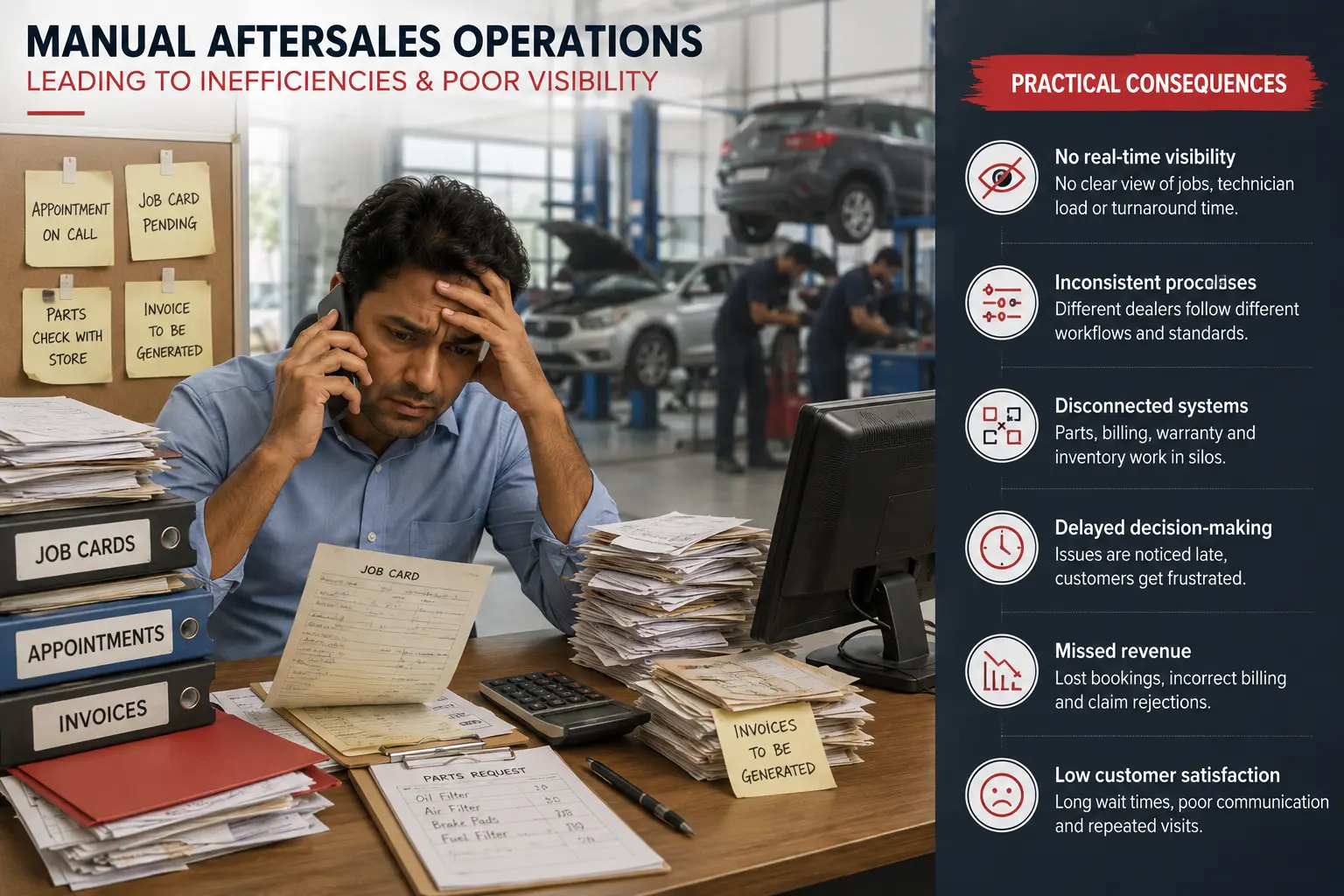
Most dealership service departments still rely on phone-based booking, paper job cards, and spreadsheet tracking because these tools were never replaced, only patched around, as service volume grew. The result is a workshop where no one, including the OEM, has a real-time view of what is actually happening on the floor.
This is not a new observation, nor is it unique to small, independent service centers. Even large dealer groups with substantial technology budgets face the same challenge: service advisors juggle phone calls and walk-in customers, technicians complete job cards manually or in systems that do not integrate with billing, and parts requests are tracked in separate spreadsheets from those used by finance to generate and close invoices. Every one of those handoffs is a place where data gets re-typed, and every re-typing is a place where something gets dropped, delayed, or simply wrong.
The practical consequences show up in a few consistent places:
- No real-time visibility: Dealer principals and OEM regional teams cannot see job card status, technician load, or turnaround time without calling the service manager directly.
- Inconsistent process across dealers: One dealership’s job card workflow can look completely different from another’s within the same network, making it nearly impossible for an OEM to enforce a standardized operating procedure.
- Disconnected systems for parts, billing, and warranty: A technician requesting a part, a service advisor preparing an estimate, and an accountant generating an invoice are often working from three different tools that do not sync.
- Delayed decision-making: By the time a service manager notices a backlog or a billing dispute, the customer has often already noticed it first.
These are not abstract inefficiencies; they translate directly into missed revenue, frustrated customers, and an OEM that cannot enforce consistent service standards across its dealer network. That gap is exactly what digitization of the aftersales service journey is built to close.
What Digitization of the Aftersales Service Journey Actually Means
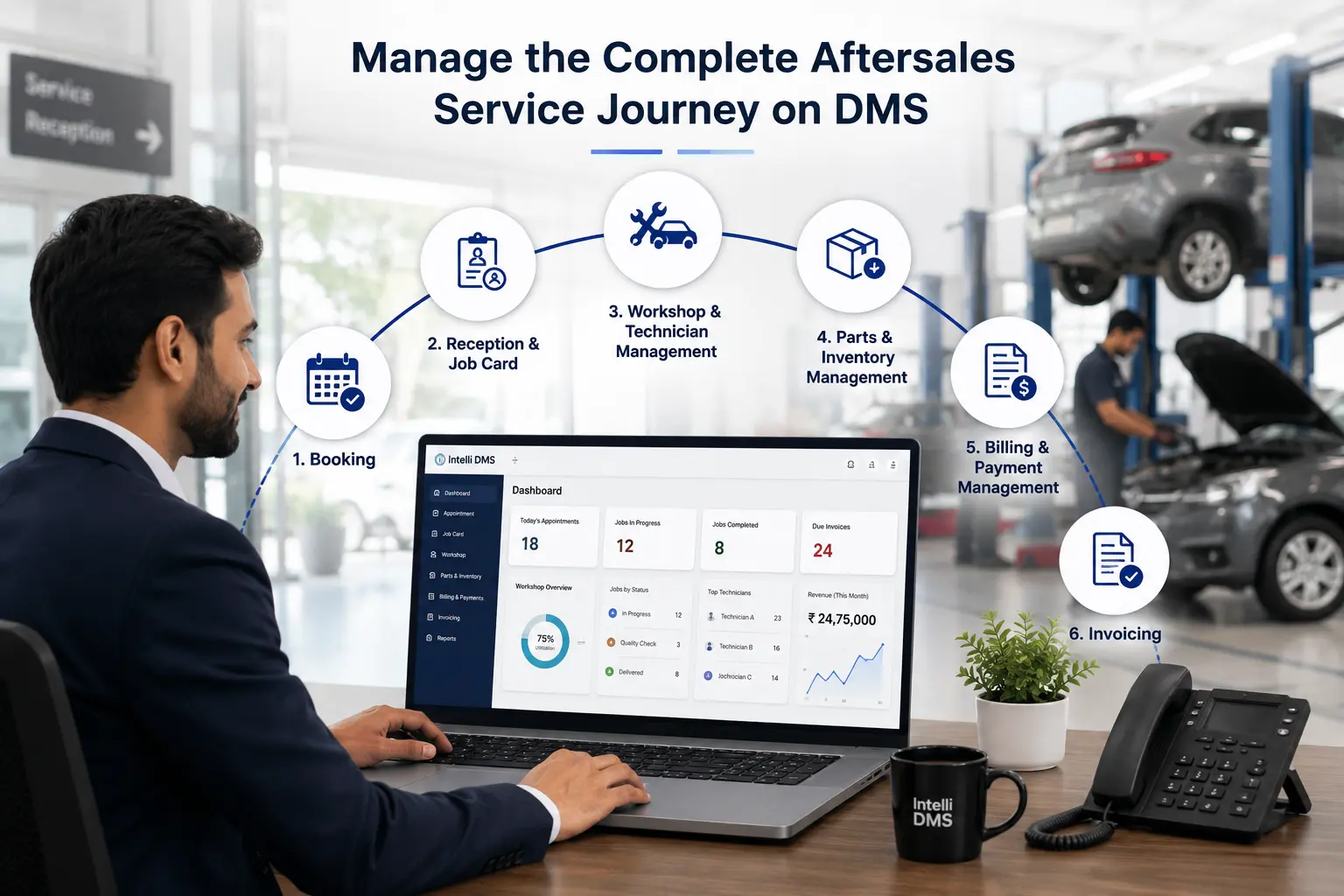
Digitization of the after-sales service journey means every stage of the service visit, booking, check-in, job card creation, workshop tracking, parts management, billing, and delivery runs inside one connected system instead of multiple disconnected tools. Information entered once at booking flows automatically through every subsequent stage, rather than being re-entered at each handoff.
It's worth being precise about what this is not. Digitization is not simply replacing a paper job card with a PDF version of the same form, nor is it giving a service advisor a table to do what they used to do on a clipboard. Real digitization means the data itself moves between stages without manual re-entry. When a customer books an appointment, the vehicle’s service history should automatically flow into the job card as soon as the car arrives. When a technician logs a part used, that part should already be reflected in the estimate the service advisor is preparing for the customer. When the job is marked complete, the invoice should already have the labor and parts data it needs, with nothing left to chase down.
A genuinely digitized after-sales journey, end-to-end, covers:
- Appointment booking and scheduling across phone, walk-in, and online channels.
- Vehicle reception and digital inspection at check-in.
- Job card creation, with the technician assigned based on skill and current load.
- Real-time workshop tracking as repair work progresses.
- Parts requests and inventory checks are tied directly to the job card.
- Billing and invoicing are generated from the actual work completed.
- Vehicle delivery and post-service follow-up.
When all seven stages sit on one platform, the OEM and the dealer principal are looking at the same data in real time, not waiting for an end-of-day report that someone compiled by hand. This is the core problem that Intelli DMS is built to solve for OEM dealer networks.
1. Appointment Booking in DMS: Where the Digital Aftersales Journey Begins
Appointment booking in DMS replaces phone-only scheduling with a structured, trackable process that captures the customer, vehicle, and service request in one record, the moment the appointment is made. That record then becomes the foundation for everything that follows, from reception to the final invoice.
The booking process is often the first point where service departments lose ground, and the data clearly supports this. According to CDK Global, the 2024 survey, nearly all service customers book an appointment before arriving, far more consistently than new vehicle shoppers do. But the booking experience itself is often the weak point: roughly one in three inbound service calls at the average dealership goes unanswered, and of the calls that do not connect, more than half land in voicemail as reported by Car Wars 2025 data, via Flai. A customer who cannot get through to book a service does not wait patiently. They call a competitor.
A DMS with structured appointment booking addresses this in a few concrete ways:
- Multi-channel capture: phone, walk-in, and online requests all land in the same appointment queue, instead of being tracked separately or tracked at all.
- Slot and capacity planning: service advisors see technician availability and bay capacity in real time before confirming a slot, instead of overbooking and discovering the conflict later.
- Automatic confirmations and reminders: the customer receives a confirmation and a reminder without anyone manually sending it, which directly addresses a documented gap. Industry researchers have found it surprisingly common for dealership systems to fail to send appointment confirmations at all
- Pre-loaded vehicle and customer history: By the time the customer arrives, the service advisor already has the vehicle’s service history, open recalls, and prior complaints on file.
That last point compounds over time. Service customers who book online have reported they would do it again at a 76% rate, and the same research found scheduled visits tend to bring in meaningfully more revenue per visit than walk-ins, largely because the dealership is prepared in advance rather than scrambling on arrival.
Inquiry Management and Appointment Management in Intelli DMS are built around this principle. Every inquiry, whether it comes by phone, walk-in, or digital channel, is logged in a structured workflow that carries through to slot planning and reminders, so the booking is not a disconnected first step but the opening record of the entire service journey.
2. From Reception to Job Card: Where Manual Handoffs Usually Break Down
Vehicle reception and job card creation are where a booked appointment turns into an actual work order, and they are also where most service departments lose the most time to re-entry and miscommunication. A digitized dealer management system turns this into a single continuous step instead of three separate ones.
In a manual workflow, this stage typically involves a service advisor writing down the customer’s complaint on a paper form, a technician later trying to interpret that handwriting, and a separate physical inspection sheet that may or may not make it back to the file. None of this is connected to the appointment record from the day before, so the advisor is often re-asking questions the customer already answered when they booked.
In Intelli DMS, this stage is handled through two connected modules:
- Front Office Management: handles customer check-in, service requests, vehicle allocation, and documentation in one screen, pulling forward the data already captured at booking.
- Job Card Management: creates and manages job cards directly from the check-in record, tracks service requests, and monitors work progress without a separate paper form.
Because the job card inherits the booking and inspection data automatically, the technician starts work with full context instead of a vague handwritten note. That single change, removing the gap between what the customer reported and what the technician sees, is one of the most common sources of comeback repairs and customer frustration in traditional dealership service.
3. Workshop and Technician Management: Turning the Job Card Into a Live Record
Workshop and technician management is what keeps a job card from going dark once the vehicle enters a bay. A digitized DMS gives the service advisor and the OEM a live view of repair progress, technician workload, and parts status, instead of a status that only updates when someone walks over and asks.
This stage is also where workshop productivity is won or lost. Assigning jobs based on technician skill, rather than whoever happens to be free, reduces comeback rates. Monitoring repair progress in real time lets a service manager catch a stalled job before the customer calls to ask where their car is. Intelli DMS handles this through its Workshop & Technician Management module, which assigns jobs, tracks technician productivity, and monitors repair progress against the original job card, with parts requests and completion checklists updating the same record that the service advisor and the billing teams are already looking at.
The operational benefits of real-time workshop tracking typically include:
- Faster identification of bottlenecks before they affect delivery time
- Clearer accountability for which technician is responsible for which stage of a repair
- Fewer status-check phone calls interrupt both the service advisor and the technician
- A documented repair checklist that supports warranty claims and quality audits later
None of this requires the dealership to add headcount. It requires the existing team to stop re-keying the same information into three different places throughout the day.
4. Parts, Inventory, and Estimates: Closing the Gap Between the Workshop & the Bill
Parts and inventory management in a digitized DMS connects the part to a technician request directly to the estimate a customer sees and the invoice that follows, so nothing has to be manually reconciled at the end of the job. This is one of the more overlooked points of friction in traditional service operations.
In a disconnected setup, a technician might request a part verbally or on a slip of paper, and the parts counter issues it from a separate inventory system, and the service advisor has to manually update the estimate after the fact, often after the customer has already asked why the price changed. Intelli DMS’s Parts & Inventory Management module ties spare parts requests, availability checks, issuance, and returns directly to the job card, so an estimate reflects real inventory and real pricing from the moment it is generated, not from a guess that gets corrected later.
5. Invoicing in DMS: Where the Aftersales Journey Closes the Loop
Invoicing in DMS means the final bill is generated directly from the completed job card, pulling labor, parts, taxes, discounts, and warranty adjustments from data that was already captured earlier in the process, rather than being rebuilt from scratch by an accountant at the end of the visit.
Billing is the stage where customer trust is either confirmed or lost. A customer who was told an estimated price at check-in and then received a different number at pickup, with no clear explanation of why, walks away with a worse impression of the visit than almost anything that happened during the actual repair. This is also the stage most exposed to manual error, because it depends on accurately combining data from three separate sources: the original job card, the parts that were actually used (which may differ from the original estimate), and any warranty or discount approvals that came in along the way.
In Intelli DMS, the Billing & Payment Management module is built specifically to remove that manual reconciliation step:
- Direct linkage to the job card: labor and parts charges populate the invoice automatically from the completed work order, not from a separate manual entry.
- Built-in tax, discount, and warranty handling: adjustments are applied within the same workflow instead of being calculated separately and then transcribed.
- Faster collections: because the invoice is ready the moment the job card closes, there is no lag between job completion and bill presentation.
- A clean audit trail: every approval, discount, and warranty adjustment is recorded against the original job card, which matters for OEM compliance reviews and dispute resolution.
This is also where the digitization story comes full circle. The appointment booked online, the inspection logged at reception, the parts issued in the workshop, and the labor hours tracked by the technician all converge into one invoice, generated from data that was true at every step, rather than assembled after the fact from memory and paper.
The Business Case: Why OEMs Are Pushing Dealers Toward Digitized Aftersales
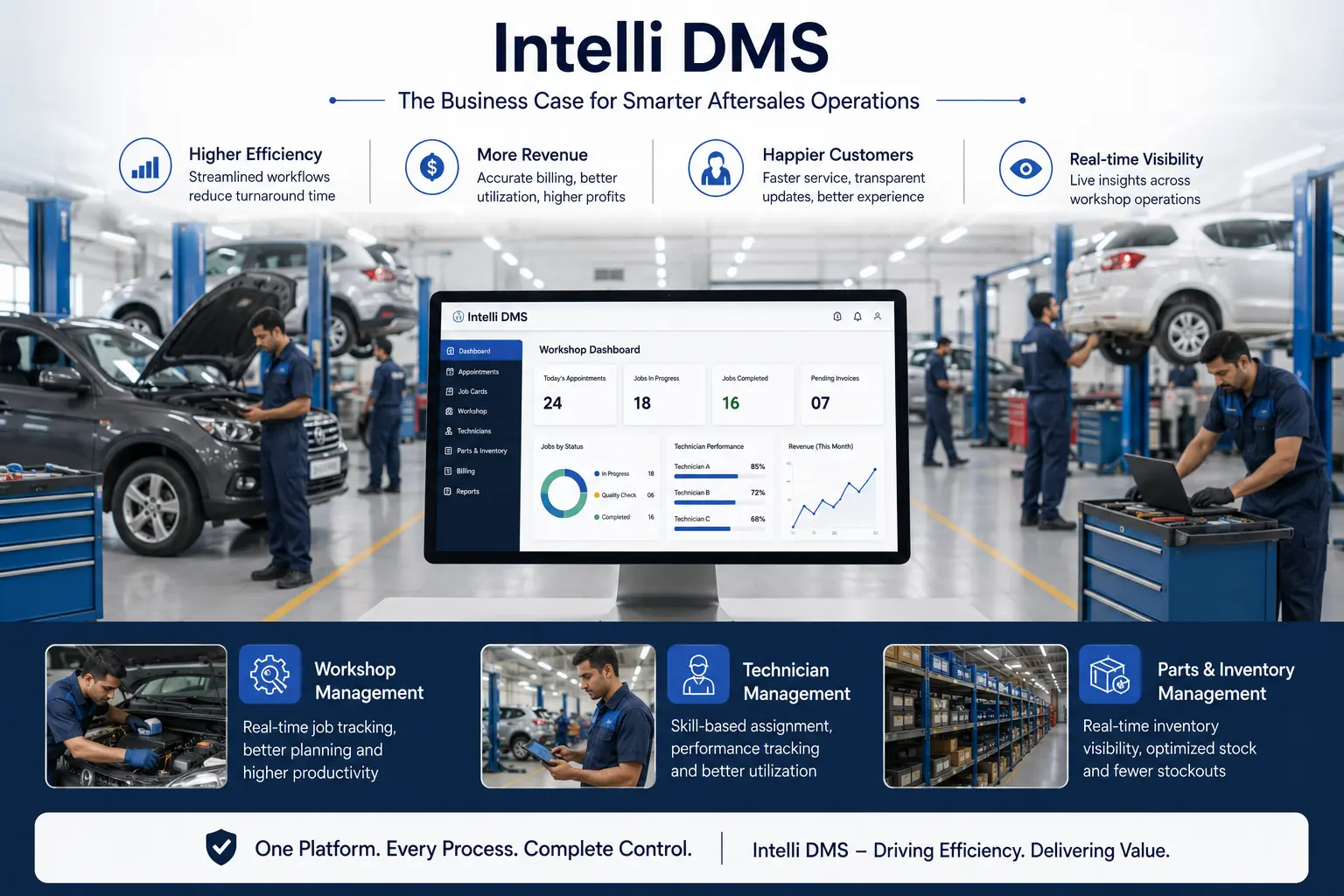
OEMs are pushing dealer networks toward digitized after-sales because it gives them something manual systems cannot: standardized processes across every dealer, plus real-time visibility into how the network is performing on service revenue, turnaround time, and customer satisfaction.
This is not a minor administrative preference. The market is moving fast: the U.S. dealer management system market alone was valued at roughly $3.08 billion in 2025 and is projected to grow toward $4.9 billion by 2035, driven in large part by rising digitalization in automotive retail and the need for streamlined service operations, as reported by Global Insight Services, 2026. Separately, Industry Research confirmed more than 85% of auto manufacturers globally have already launched digital retailing initiatives aimed at unifying their dealer networks. OEMs are not asking dealers to digitize after-sales as an experiment. They are aligning their entire networks around it.
For an OEM evaluating whether to standardize on a platform like Intelli DMS across its dealer network, the recurring benefits are:
- Higher inquiry-to-booking and booking-to-completion conversion, because fewer customers fall through the cracks between channels
- Standardized sales and service processes that hold up across every dealer in the network, not just the best-run ones
- Improved customer experience and satisfaction scores, driven by fewer billing surprises and faster turnaround
- Reduced vehicle service turnaround time, because work no longer waits on a phone call or a misplaced paper form
- Better workshop productivity and resource utilization, since technician assignment and parts availability are visible in real time
- Stronger OEM and dealer operational visibility, with dashboards that do not depend on someone compiling a report by hand
- Lower operational costs and manual effort across the dealer network
- Higher dealer profitability and revenue, since faster turnaround time and accurate billing both protect margin
These are the exact outcomes Intelli DMS is designed to deliver, and they apply equally to passenger vehicle dealers, two-wheeler networks, tractor and farm equipment dealers, and commercial vehicle service centers. The platform is built to handle the full aftersales lifecycle regardless of the vehicle category an OEM operates in.
Why OEMs Choose Intelli DMS for After-sales Digitization
OEMs choose Intelli DMS because it covers the complete aftersales journey, appointment booking, reception, job cards, workshops management, parts, billing, and invoicing, on one platform built specifically for OEM-dealer networks, rather than a patchwork of point solutions that each solve one piece of the problem.
A few things distinguish the platform for an OEM evaluating it across a dealer network:
- Full lifecycle coverage: Appointment Management, Front Office Management, Job Card Management, Workshop & Technician Management, Parts & Inventory Management, Billing & Payment Management, and Reports & Workshop Analytics all sit inside one system.
- Built for OEM-dealer relationships specifically, the platform is designed to enforce standard operating procedures across a dealer network, not just to run one dealership’s internal operations.
- Cross-category flexibility: the same platform supports passenger vehicles, two-wheelers, tractors, and commercial vehicles, which matters for OEMs with mixed product lines.
- Real-time dashboard: operational insights like appointment volume, pending approvals, average turnaround time, and technician productivity are visible without manual reporting.
- A track record with established OEMs: Intellinet Systems, the company behind Intelli DMS, is ISO 27001:2022 certified and counts Maruti Suzuki, Mahindra, Honda, Ford, Kawasaki, Tata Motors, and Ather Energy among the OEMs it works with.
For an OEM after-sales or dealer operations leader evaluating where to start, the practical entry point is usually the appointment booking and job card stages, since that is where customer-facing friction is highest and where the data trail for everything downstream begins.
Conclusion
Digitization of the after-sales service journey is not about adding more software to a service department. It is about removing the re-entry, the disconnected handoffs, and the paper trail that sit between a customer’s appointment and their final invoice. When appointment booking, job card, workshop tracking, parts management, and invoicing all run on one connected record instead of five separate ones, dealerships close jobs faster, bill more accurately, and give OEMs the real-time visibility that manual processes were never built to provide.
Intelli DMS was built around this exact problem. By covering the complete after-sales lifecycle, from the first appointment request to the final invoice, on a single platform, it gives OEMs a way to standardize service operations across an entire dealer network rather than hoping each dealership gets it right on its own. For OEMs evaluating where digitization delivers the fastest, most visible return, after-sales service, with its direct line to customer retention and dealer profitability, is the place to start.
Discover how Intelli DMS digitizes appointment booking, job card creation, workshop operations, parts management, and invoicing from a single platform. Book a demo today.
FAQ
What is the difference between a DMS and a CRM for after-sales service?
A CRM primarily manages customer communication, leads, and follow-ups, while a DMS manages the operational workflow of a service visit itself: job cards, technician assignment, parts, and invoicing. Many dealerships use both together. A DMS like Intelli DMS focuses on running the actual service operation end to end, from appointment booking through invoicing, while a CRM is better suited to managing the broader customer relationship before and after that visit.
How long does it take to implement a DMS across a dealer network?
Implementation timelines vary by dealer network size, existing system complexity, and how many modules an OEM chooses to roll out at once. A single dealership can often go live with core modules like appointment booking and job cards within a few weeks, while a full multi-dealer OEM rollout with data migration, staff training, and phased module activation typically takes longer. The right approach is usually to pilot with one or two dealerships before expanding network-wide.
Can a DMS integrate with existing OEM warranty and parts systems?
Most modern DMS platforms, including Intelli DMS, are built to integrate with existing OEM systems for warranty approvals, parts catalogs, and inventory data rather than replacing them outright. This integration is what allows warranty claims, parts issuance, and billing to stay connected to OEM-level systems while the dealer-facing workflow runs through the DMS. The specific integration scope should be confirmed during a technical evaluation with the OEM's existing systems.
Does digitizing appointment booking actually reduce no-shows?
Yes, primarily because digital booking systems send automatic confirmations and reminders, which many manual phone-based booking processes fail to do consistently. Customers who book online have reported high satisfaction with the process and a strong willingness to repeat it, which correlates with better attendance and preparedness on both sides. The bigger gain is usually in the quality of the visit itself, since the service advisor has the customer's history and request on file before the car arrives.
Is a cloud-based DMS like Intelli DMS suitable for smaller dealer networks?
Yes, cloud-based DMS platforms are generally well-suited to smaller and mid-size dealer networks because they avoid the upfront hardware investment that on-premise systems require and can scale module by module as the network grows. An OEM with a smaller network can start with core sales and service modules and add modules like billing automation or advanced analytics as operational needs expand, without a full system replacement later.


Explore More Insights




.webp)


About the Author


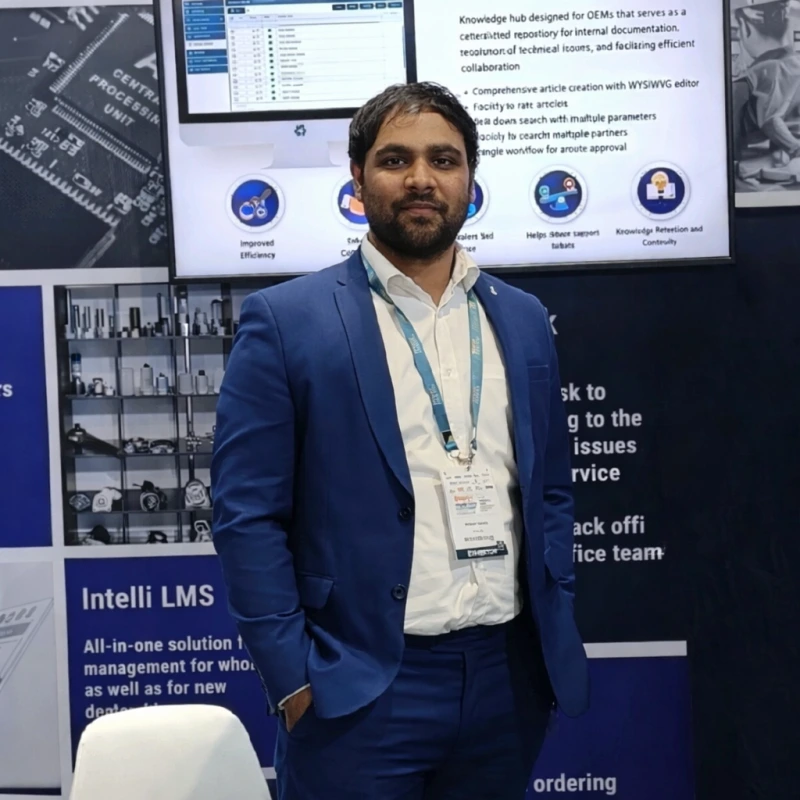
Chandra Shekhar
Chandra Shekhar is the Senior Manager, Strategy & Business Development at Intellinet Systems. With over a decade of experience in the automotive industry, Chandra Shekhar has led digital transformation and aftersales strategy initiatives for OEMs across multiple markets. His background combines deep industry knowledge with a practical understanding of how technology can solve real operational challenges. He focuses on making complex ideas clear and relevant for automotive and aftermarket professionals navigating ongoing change.


