

Overview: Digital Parts Catalog Software helps OEMs increase aftermarket sales by making genuine parts faster to identify, easier to order, and simpler to fulfill. By replacing static PDFs and printed catalogs with searchable, illustrated catalogs connected to ERP, inventory, and dealer systems, OEMs can reduce wrong-part orders, shorten parts lookup time, and improve dealer conversion.

Key Takeaways:
- Digital Parts Catalog replaces static PDFs and printed manuals with searchable, illustrated digital catalogs.
- OEMs use VIN, serial number, and model-based search to reduce wrong part orders and returns.
- Illustrated exploded views and hotspotting help dealers and technicians identify parts visually, without guesswork.
- ERP and DMS integration keeps pricing, inventory, and order data synchronized across every sales channel.
- Part supersession and alternate parts logic prevent lost sales when original components are discontinued.
- Mobile access and AI-assisted search extend catalog use to field technicians and independent repair shops.
- Choosing the right Digital Parts Catalog Software depends on its integration capabilities, scalability, and vendor support, not just its catalog features.
Book a free demo to see how Intelli Catalog helps OEMs improve parts identification, reduce ordering errors, and support aftermarket growth.
What is Digital Parts Catalog Software?
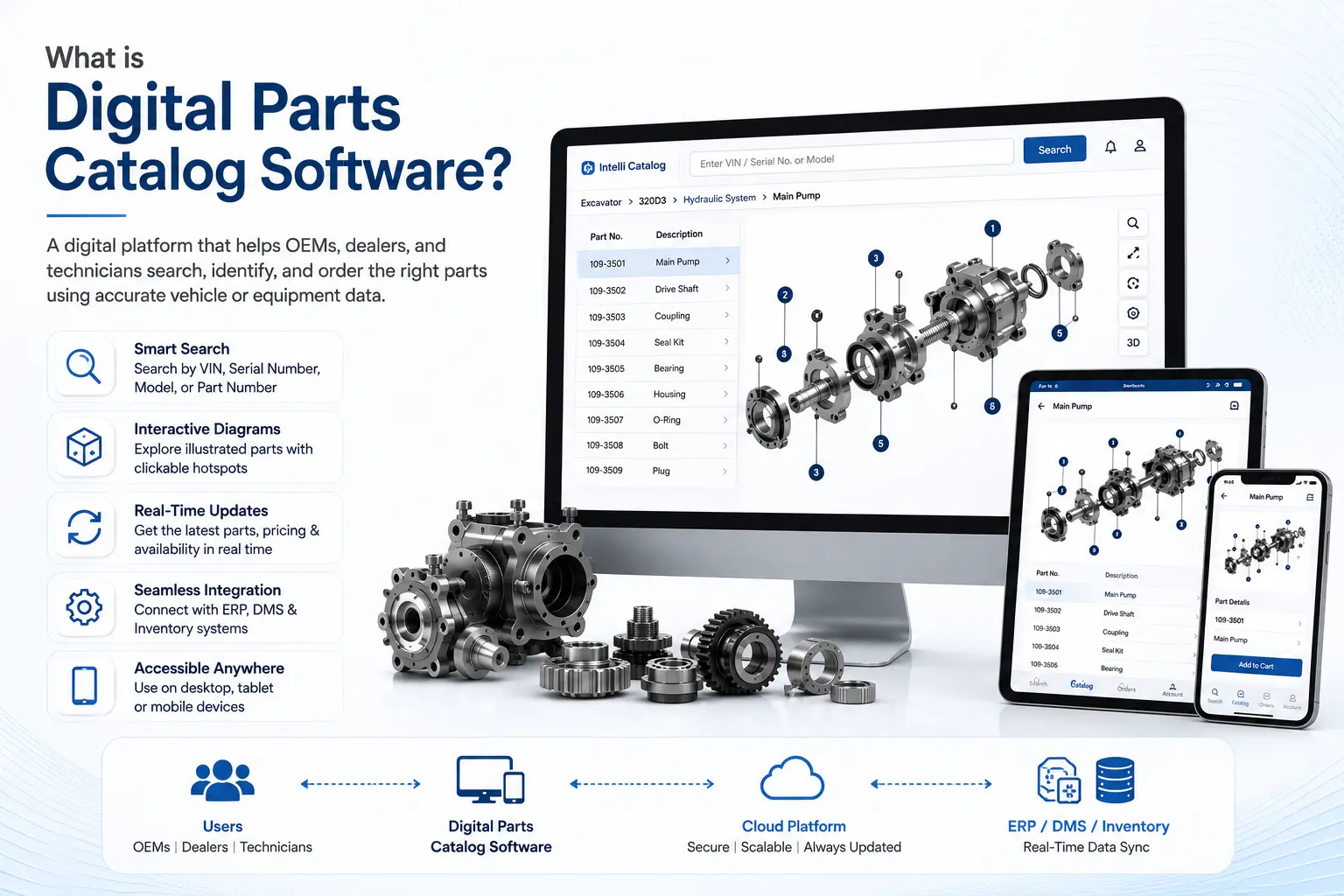
Digital Parts Catalog Software (EPC Software) is a digital platform that enables OEMs, dealers, and technicians to search, identify, and order the correct replacement parts using structured vehicle or equipment data instead of printed catalogs or static PDF manuals.
It typically includes illustrated diagrams, VIN or serial number lookup, and direct links to inventory and ordering systems. Unlike a PDF, it updates in real-time and works across desktop, tablet, and mobile devices.
OEMs adopt Digital Parts Catalog to reduce costly parts identification errors. Wrong part orders delay repairs, increase returns, and drive customers toward unauthorized suppliers. Because aftermarket parts and service represent one of the most profitable revenue streams for equipment manufacturers, making genuine parts easier to find, order, and fulfill across every dealer and service channel directly supports aftermarket growth.
A digital spare parts catalog usually includes:
- Searchable part numbers and descriptions
- Illustrated exploded-view diagrams with clickable hotspots
- VIN, serial number, or model-based filtering
- Part supersession and alternate parts data
- Integration with ERP, DMS, and inventory systems
For OEMs managing thousands of SKUs across multiple product lines, this structure turns a static reference document into a searchable sales and service tool.
Why Do Traditional Parts Catalogs Limit Aftermarket Growth?
Traditional PDF and printed catalogs slow parts identification, increase wrong-part orders, and cannot provide real-time updates to parts information, inventory availability, or pricing. This creates friction for dealers and pushes customers toward third-party or counterfeit part suppliers.
Aftermarket parts and service are among the most profitable revenue streams for OEMs, and the opportunity continues to expand. McKinsey projects the global automotive aftermarket will reach roughly $1.2 trillion by 2030, growing about 3% annually. As this revenue opportunity grows, legacy PDF and printed catalogs become an increasingly significant operational bottleneck because they slow parts identification, increase ordering errors, and make it harder for dealers to deliver fast, accurate service.
Most OEMs did not design their original catalogs for search speed or accuracy. They were built as static reference documents, not as sales tools. That gap now shows up directly in aftermarket performance.
Common limitations include:
- PDFs and printed catalogs: These require manual searching through hundreds of pages, with no way to filter by VIN or serial number.
- Wrong part orders: Ambiguous part descriptions and outdated diagrams lead technicians to order incorrect components.
- Slow dealer response: Dealers without instant lookup tools take longer to quote and fulfill parts, frustrating customers.
- Static information: Printed catalogs cannot reflect supersessions, price changes, or discontinued parts without a full reprint.
- Counterfeit risks: When genuine parts are hard to identify or source quickly, customers turn to unauthorized alternatives, cutting into OEM revenue.
Each of these issues compounds over time. As product lines expand and part numbers multiply, the gap between a static catalog and actual field needs only grows wider.
How Does Digital Parts Catalog Software Help OEMs Increase Aftermarket Sales?
Digital Parts Catalog Software helps OEMs increase aftermarket sales by making parts easier to identify, order, and deliver the first time correctly. Faster parts identification reduces ordering errors and returns, strengthens dealer confidence, and keeps customers buying genuine parts through the authorized dealer network.
The sections below break down each capability, the problem it solves, and the business impact it delivers.
Faster Parts Identification
Problem: Technicians spend an excessive amount of time searching printed manuals or unstructured PDFs to find the correct part.
Solution: The Digital Parts Catalog platform lets users search by keyword, part number, or diagram, returning accurate matches in seconds.
Business impact: Faster parts identification shortens repair cycles and increases the volume of parts orders a dealer can process each day.
VIN and Serial Number Search
Problem: Generic part lists do not account for configuration differences across individual units, resulting in mismatched orders.
Solution: VIN or serial number lookup narrows results to parts that fit the exact unit in question.
Business impact: This reduces incorrect orders and builds dealer trust in the catalog as an accurate source of truth.
Illustrated Exploded Views
Problem: Text-only part lists are difficult to interpret, especially for complex assemblies with many similar-looking components.
Solution: Illustrated exploded views with clickable hotspots let users visually confirm the exact part before ordering.
Business impact: Visual confirmation lowers return rates and improves first-time order accuracy for both dealers and end customers.
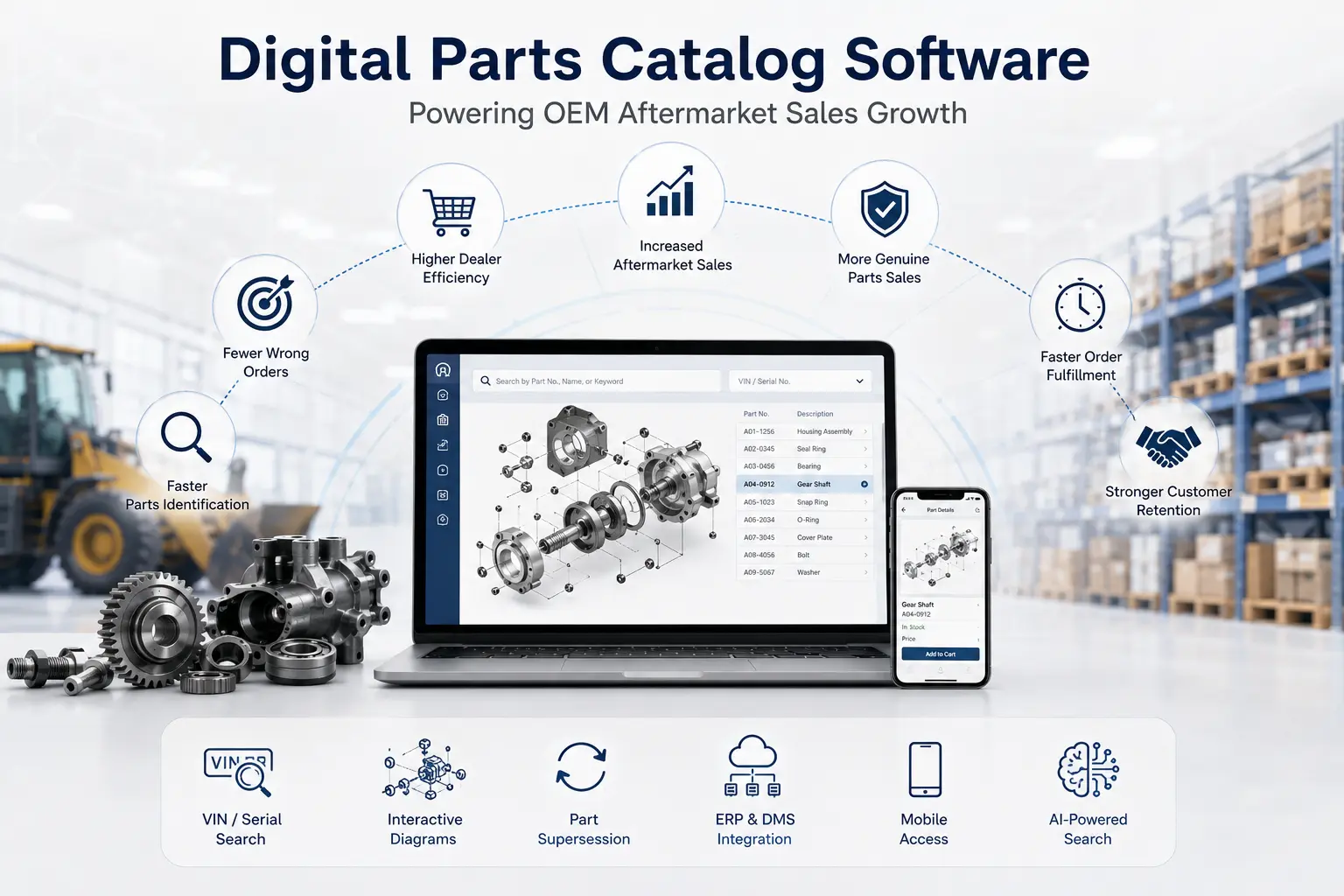
Part Supersession
Problem: When a part is discontinued or replaced, outdated catalogs still list the old part number, leading to failed orders.
Solution: Part supersession logic automatically points users to the correct current part number.
Business impact: OEMs retain the sale by helping dealers identify the correct part, reducing abandoned and canceled orders.
Dealer Self-Service
Problem: Dealers relying on manual quote requests or phone calls create bottlenecks and slow response times.
Solution: Self-service search and ordering let dealers complete transactions without waiting on OEM staff.
Business impact: Faster dealer transactions increase order volume while reducing the workload on OEM support teams, allowing them to focus on strategic dealer support and customer service.
ERP Integration
Problem: Disconnected catalog and ERP systems create pricing errors and delayed order confirmations.
Solution: Direct ERP integration synchronizes pricing, availability, and order status in real-time.
Business impact: Accurate, live data reduces order errors and builds confidence in the ordering process.
DMS Integration
Problem: Dealer management systems and parts catalogs often operate as separate silos, forcing duplicate data entry.
Solution: DMS integration connects catalog searches directly to dealer workflows and order history.
Business impact: Streamlined workflows reduce administrative time and speed up order fulfillment.
Inventory Visibility
Problem: Without real-time stock data, dealers cannot tell customers when a part will actually arrive.
Solution: Live inventory visibility shows stock levels across warehouses and distribution points.
Business impact: Accurate availability information improves customer communication and reduces canceled orders.
Mobile Access
Problem: Field technicians and service teams often need parts information away from a desktop terminal.
Solution: Mobile-ready catalogs allow lookup and ordering from a tablet or smartphone on the shop floor or in the field.
Business impact: Mobile access shortens repair downtime and extends catalog use to more of the service network.
AI Search
Problem: Traditional keyword search fails when users do not know the exact part name or number.
Solution: AI-assisted search interprets natural language queries and visual input to return relevant matches.
Business impact: This lowers the skill barrier for less experienced technicians and reduces failed searches.
Real-Time Updates
Problem: Printed and static catalogs cannot reflect engineering changes, recalls, or new part releases without a full reprint.
Solution: Cloud-based catalogs push updates instantly to every connected user.
Business impact: Dealers and technicians always work from the most current data, reducing costly errors.
What Are the Key Features to Look for in Digital Parts Catalog Software?
The right platform combines accurate parts data with the integration and search tools that make it usable at scale. When evaluating vendors, prioritize these core features:
- VIN, serial number, and model-based search
- Illustrated, clickable exploded-view diagrams
- Part supersession and alternate parts logic
- ERP and DMS integration
- Real-time inventory and pricing visibility
- Mobile and offline access for field use
- Role-based access for dealers, distributors, and internal teams
- Multi-language and multi-currency support for global operations
- Analytics on search behavior and order conversion
A platform that covers these areas gives OEMs a foundation that scales as product lines and dealer networks expand.
What Are the Business Benefits for OEMs and Dealers?
Digital Parts Catalog Software delivers measurable benefits across genuine parts sales, dealer productivity, and customer satisfaction. It also reduces operational costs associated with returns, equipment downtime, and manual order processing.
- Genuine parts sales: Accurate parts identification encourages customers to purchase genuine parts through the authorized dealer network instead of turning to unauthorized suppliers.
- Dealer productivity: Self-service search and ordering reduce the time dealers spend on manual lookups and support calls.
- Customer satisfaction: Faster, more accurate parts fulfillment shortens repair times and builds long-term trust.
- Reduced returns: Visual confirmation and part supersession reduce wrong-part orders and improve ordering accuracy.
- Better inventory management: Real-time visibility helps OEMs and dealers plan stock more accurately.
- Less downtime: Faster identification and ordering get equipment back in service sooner.
- Dealer adoption: Intuitive, mobile-friendly tools see higher usage rates than legacy PDF systems, increasing overall catalog engagement.
What Are the Industry Use Cases for Digital Parts Catalog Software?
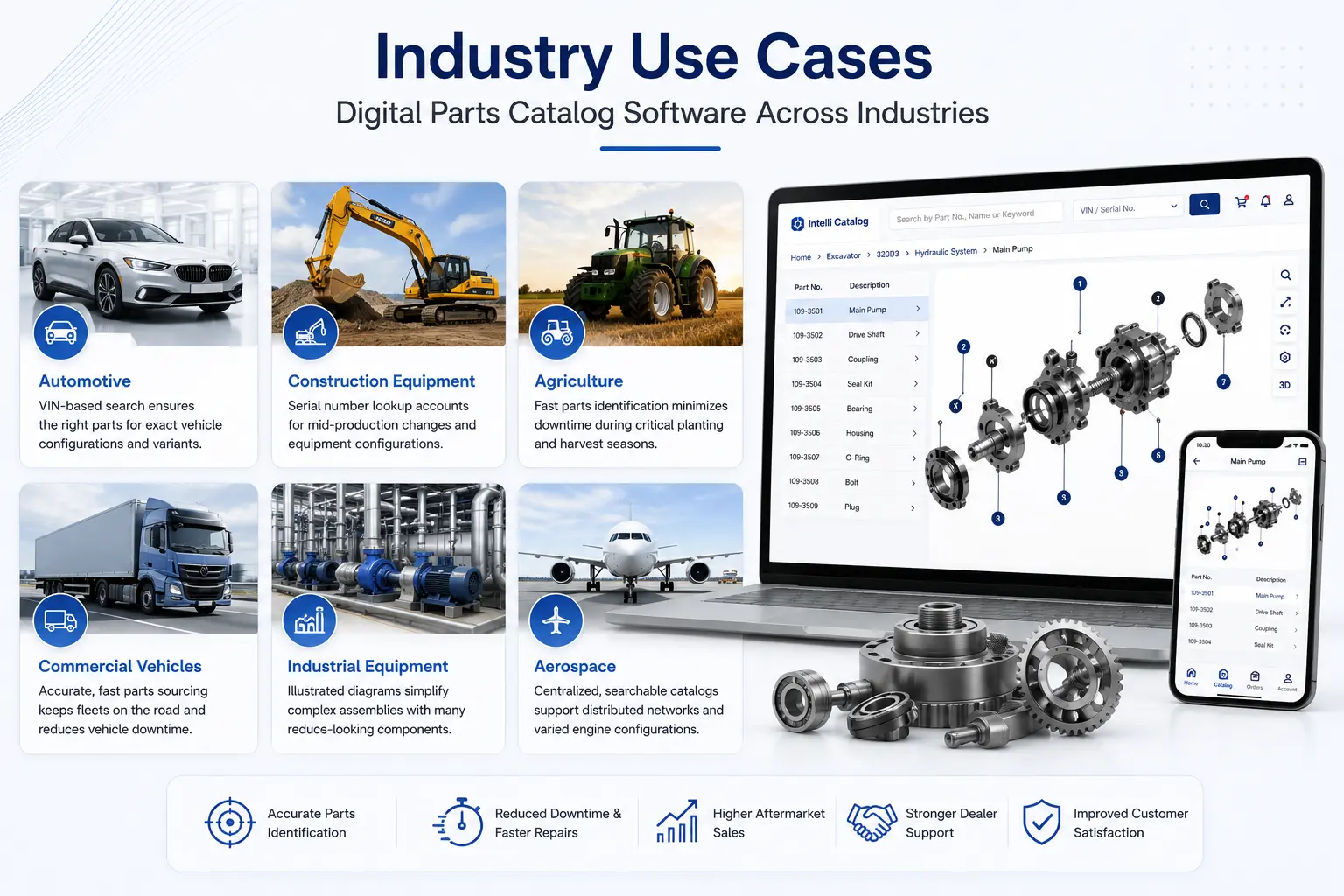
Digital Parts Catalog Software is valuable across industries where accurate parts identification directly affects equipment uptime, service efficiency, and aftermarket revenue. Each industry has distinct catalog needs, but the underlying goals are the same: faster search, fewer errors, and stronger dealer support.
- Automotive: VIN-based search helps dealers and service centers match parts to exact vehicle configuration, including trim and model-year variations.
- Construction Equipment: Serial number lookup accounts for frequent mid-production configuration changes on heavy machinery.
- Agriculture: Seasonal repair windows make fast parts identification critical to minimizing equipment downtime during planting and harvest.
- Commercial Vehicles: Fleet operators depend on accurate, fast parts sourcing to keep trucks and buses on the road.
- Industrial Equipment: Complex assemblies with many similar components benefit from illustrated exploded views and hotspotting.
- Aerospace: Distributed dealer networks and varied engine configurations make centralized, searchable catalogs especially valuable.
How to Choose the Right Digital Parts Catalog Software?
Choosing the right platform depends on how well it integrates with existing systems, supports sales across product lines, and supports your dealer network long-term. Feature lists matter less than implementation fit and ongoing vendor support.
Use this checklist when evaluating vendors:
- Integration: Does the platform connect cleanly with your existing ERP and DMS systems?
- Scalability: Can it handle your full parts catalog as product lines and SKUs grow?
- Implementation: What is the realistic timeline and internal resource requirement for rollout?
- Customization: Can the catalog reflect your specific supersession rules, dealer tiers, and branding?
- Support: Does the vendor offer ongoing technical support and catalog data maintenance?
- Vendor evaluation: Request references from OEMs in a similar industry and product complexity.
Treat the selection process as a long-term operational decision, not a one-time software purchase. The right vendor becomes a partner in maintaining catalog accuracy as your product line evolves.
How Intelli Catalog Supports OEM Aftermarket Operations?
Intelli Catalog is an electronic parts catalog platform built for OEMs managing complex, multi-product parts data across dealer networks. It centralizes illustrated catalogs, VIN and model lookup, and ordering tools into a single connected system.
Dealers and technicians can search by VIN, model, or part number and view illustrated diagrams with clickable hotspots to confirm the exact component before ordering. This visual approach reduces incorrect orders and speeds up repair cycles across service locations.
Part supersession is built into the search logic, so users are automatically directed to current part numbers when older components are discontinued. This keeps orders moving instead of stalling on outdated references.
It connects directly with OEM ERP systems, keeping pricing and inventory data synchronized in real-time. Dealers can place orders through the same interface they use for parts lookup, removing the need for separate manual steps.
The platform is also built for mobile use, allowing field technicians and service teams to search and order parts from a tablet or smartphone without returning to a desktop terminal.
For OEMs focused on protecting genuine parts revenue and improving dealer efficiency, digital catalog provides the search accuracy, integration depth, and mobile accessibility needed to support a growing aftermarket business.
Conclusion
Digital Parts Catalog Software addresses a problem that costs OEMs real revenue: slow, error-prone parts identification. By replacing static PDFs with searchable, illustrated, and connected digital catalogs, OEMs reduce wrong orders, speed up dealer response, and keep customers buying genuine parts.
As product lines expand and dealer networks grow, the gap between legacy catalogs and actual field needs only widens. OEMs that invest in Digital Parts Catalog Software position their aftermarket business for sustained growth by improving parts accuracy, dealer productivity, and customer satisfaction.
Ready to see how a connected parts catalog can support your dealer network and protect genuine parts revenue? Book a demo of Intelli Catalog today.
FAQ
What is Digital Parts Catalog Software used for?
It is used to help OEMs, dealers, and technicians search, identify, and order replacement parts using VIN, model, or serial number data instead of printed catalogs, reducing errors and speeding up fulfillment.
How does a digital parts catalog reduce wrong part orders?
It uses illustrated diagrams, VIN-based filtering, and supersession logic to confirm the exact part needed, instead of relying on ambiguous text descriptions in a static document.
Can Digital Parts Catalog Software integrate with ERP systems?
Yes. Most platforms connect directly to ERP and DMS systems, syncing pricing, inventory, and order status in real-time across dealer and OEM systems.
Is Digital Parts Catalog Software only for automotive OEMs?
No. It is used across construction, agriculture, commercial vehicle, industrial equipment, and marine sectors wherever accurate parts identification affects service speed and revenue.
How do OEMs choose the right parts catalog vendor?
OEMs should evaluate integration depth, scalability, implementation timeline, customization options, and ongoing vendor support rather than comparing feature lists alone.


Explore More Insights







.webp)


About the Author


Chandra Shekhar
Chandra Shekhar is the Senior Manager, Strategy & Business Development at Intellinet Systems. With over a decade of experience in the automotive industry, Chandra Shekhar has led digital transformation and aftersales strategy initiatives for OEMs across multiple markets. His background combines deep industry knowledge with a practical understanding of how technology can solve real operational challenges. He focuses on making complex ideas clear and relevant for automotive and aftermarket professionals navigating ongoing change.


