

Overview: The best dealer management system for automotive OEMs is a platform that connects inquiry, sales, workshop, parts, and billing operations into one system, so the OEM gets real-time visibility across every dealer and the dealer runs a faster, more consistent operation. For OEMs evaluating options in 2026, the right DMS should cover the full sales and service lifecycle, support OEM-wide standard operating procedures, and produce dashboards that management can act on the same day. Intelli DMS is built specifically for this OEM-to-dealer relationship, and this article explains what to look for, how Intelli DMS compares against common dealer management software evaluation criteria, and what OEMs should ask before signing a contract.

Key Takeaways:
- What a DMS does: Runs a dealership’s sales, service, parts, and billing operations from one connected platform instead of separate spreadsheets, apps, and paper records.
- Why OEMs need it: Dealers running different tools for inquiry tracking, job cards, and reporting create inconsistency that a standardized DMS fixes at the network level, not just at one location.
- What good looks like: The best DMS software for OEMs in 2026 covers inquiry-to-booking, workshop and technician management, parts and inventory, billing, warranty, and OEM-facing analytics, all inside one platform.
- Where Intelli DMS fits: Built by Intellinet Systems as a single Sales and Service DMS that standardizes dealer operations across a network and gives OEM leadership real-time dashboards.
- How to evaluate: Focus on module completeness, OEM-wide standardization, real-time reporting, ease of dealer adoption, and the vendor's track record with OEMs of similar scale.
Transform Your Dealer Network with Intelli DMS. Request a Demo Today
What is a Dealer Management System (DMS) for Automotive OEMs?
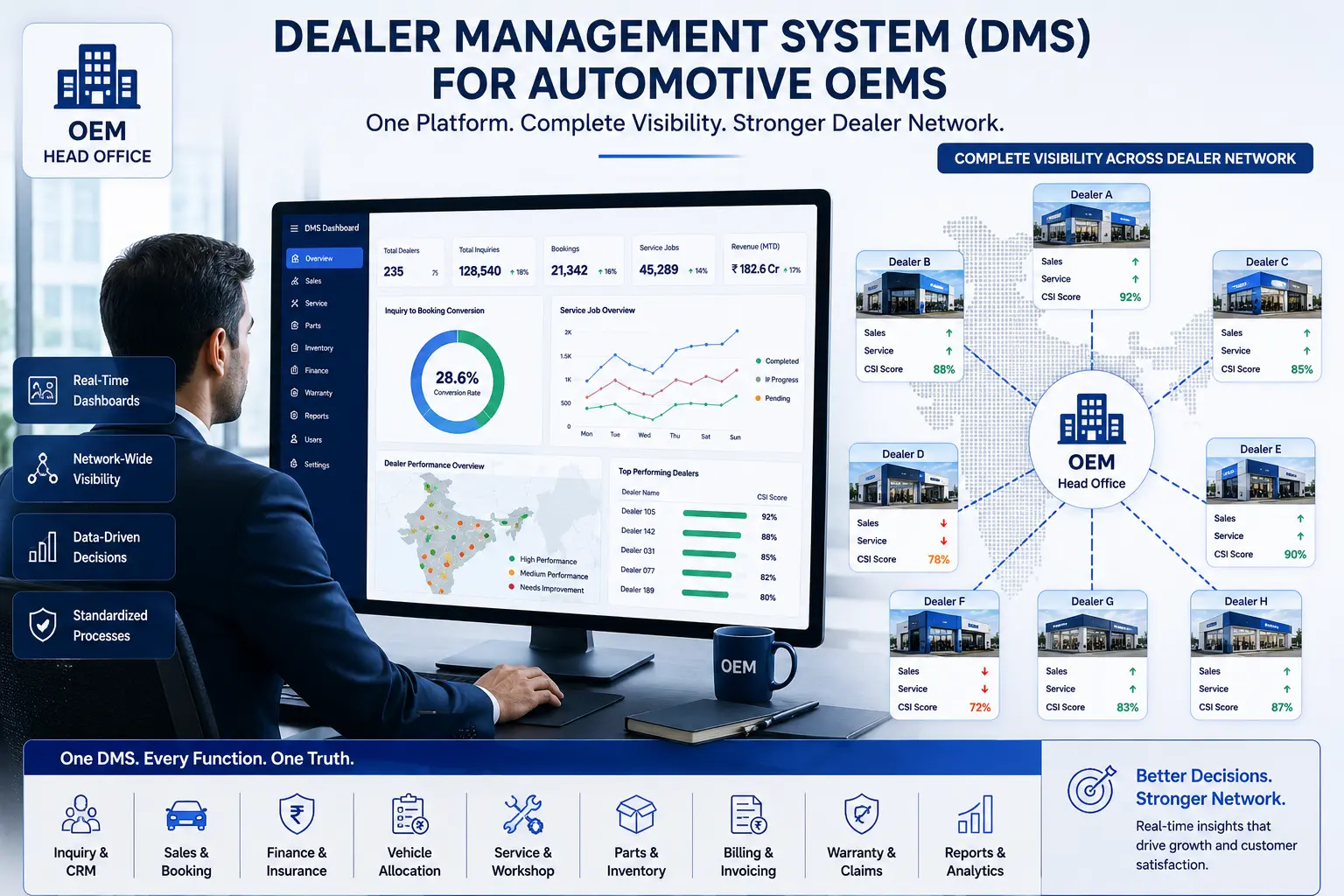
A dealer management system (DMS) is software that digitizes a dealership’s complete operating cycle, from customer inquiry and vehicle booking to workshop service, billing, and delivery, within a single connected platform instead of scattered tools.
For an OEM, a DMS is not just dealership software. It is the operating layer that sits between head office and every dealer in the network. Without it, dealers tend to run their own mix of inquiry registers, Excel sheets, WhatsApp groups for service updates, and paper job cards. Each dealer ends up solving the same problems differently, and the OEM is left piecing together performance data from inconsistent sources.
A proper DMS standardizes how a dealer logs an inquiry, books a vehicle, opens a job card, orders a part, and closes an invoice. That consistency is what makes OEM-level reporting possible in the first place. Intelli DMS approaches this exact problem with two connected modules, one for sales and one for service, that share customer and vehicle data across the dealership.
Why Traditional Dealer Operations Fail to Scale
Traditional dealer operations fail to scale because they rely on disconnected tools: inquiry registers, Excel sheets, phone calls, WhatsApp, paper job cards, and physical inspection checklists. These create manual data entry, inconsistent records, and delayed decision-making across the dealer network.
Most dealerships did not choose this setup deliberately. It built up over years as different departments adopted whatever tool solved their immediate problem. The sales team kept a register for inquiries. The service desk used paper job cards because that’s what the workshop floor understood. Someone started a WhatsApp group for parts requests because it was faster than email.
The result, multiplied across a dealer network, is a set of operational problems that show up the same way at almost every OEM:
- Manual data entry that duplicates work and introduces errors
- Paper-based approvals that slow down discounts, exchanges, and finance sign-offs
- Multiple scheduling that double-books technicians or leaves bays idle
- Multiple follow-ups on the same customer because no one owns the full record
- Scattered information that makes it hard to answer a simple question like “how many vehicles are pending delivery today”
- Data inconsistency between what the dealer reports and what actually happened on the floor
- Delayed decision-making because reports take days to compile instead of being available in real time
None of these problems are visible on their own. Together, they create the gap between what an OEM thinks is happening across its network and what is actually happening at each dealer.
What Key Challenges OEMs Face Without a Standardized DMS
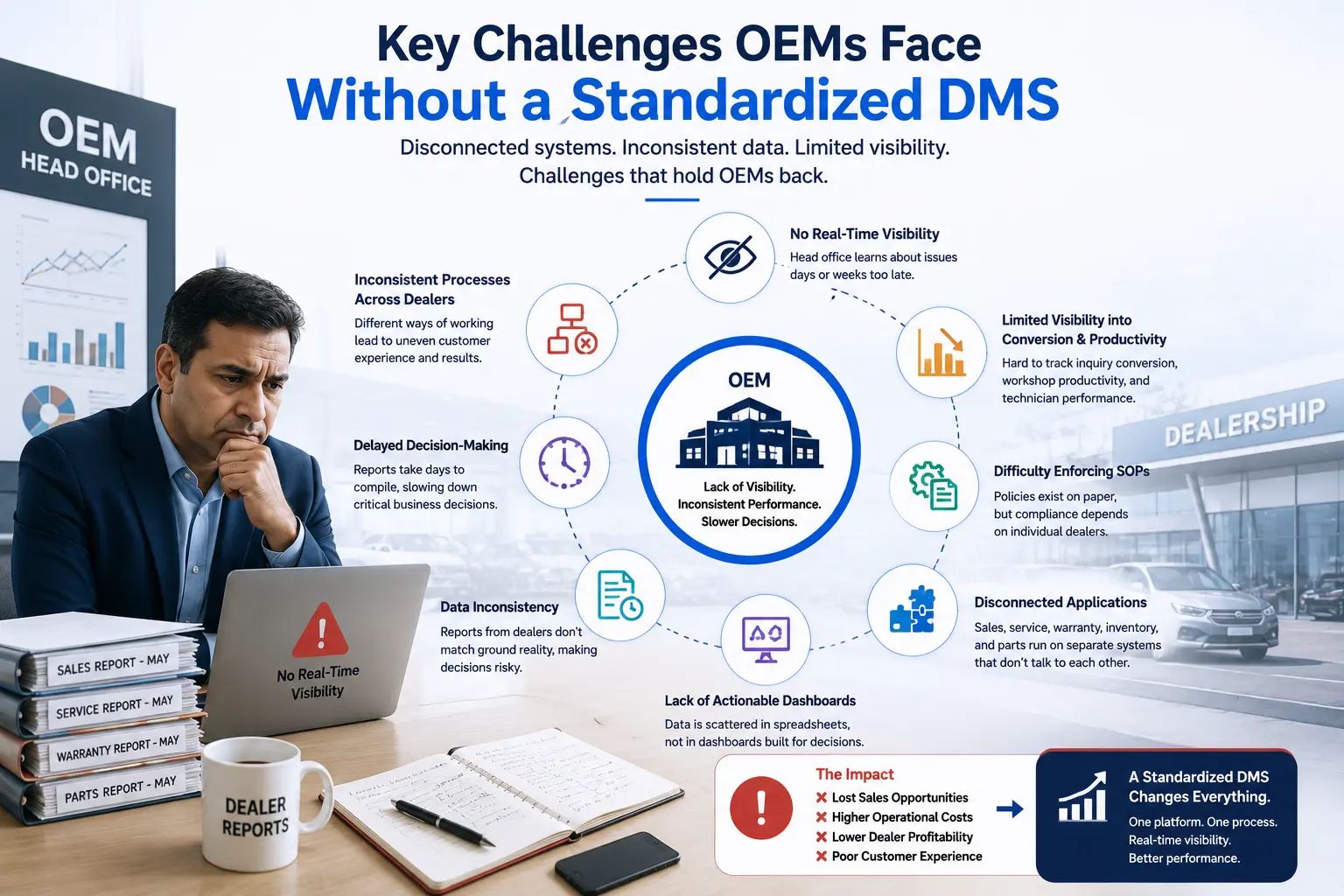
OEMs without a standardized DMS face six recurring challenges: no real-time visibility into dealer operations, inconsistent sales and service processes across dealers, weak conversion and productivity tracking, difficulty enforcing SOPs, disconnected applications, and a lack of dashboards that management can actually use.
These challenges compound each other. If every dealer runs a different process, then standardizing reporting on top of that is nearly impossible, because you are comparing apples to oranges across the network. Here is how each challenge typically plays out:
- No real-time visibility
Head office finds out about a problem at a dealer days or weeks after it started, usually through a complaint rather than a dashboard.
- Inconsistent processes across dealers
One dealer’s job card workflow often differs significantly from another’s, making training, audits, and quality checks more difficult to standardize and manage consistently.
- Limited visibility into conversion and productivity
Without structured inquiry and job card data, it’s difficult to know which dealers are converting inquiries well and which are not, or which workshops are actually productive versus just busy.
- Difficulty enforcing SOPs
OEM policy documents provide guidance, but without a system to enforce workflows, compliance ultimately depends on individual dealer practices and discipline.
- Disconnected applications
Sales, service, warranty, inventory, and parts operations often run on separate systems that do not communicate with one another, forcing staff to re-enter the same customer and vehicle information multiple times.
- Lack of actionable dashboards
Even when data exists, it's often trapped in spreadsheets that aren’t built for OEM-level decision-making.
A connected DMS, used consistently across the network, is what closes this gap. This is the specific problem Intelli DMS is built to solve for OEMs running multi-dealer networks across automotive, two-wheeler, tractor, and commercial vehicle segments.
What to Look for in the Best Dealer Management System Software for Automotive OEMs
The best dealer management system for automotive OEMs should cover the full sales and service lifecycle in one platform, support OEM-wide process standardization, and provide real-time, role-based dashboards. It should also be easy for dealer staff to adopt without lengthy retraining.
When OEMs evaluate DMS vendors, the conversation often gets pulled toward feature checklists. That’s useful, but it’s not sufficient. The more reliable way to evaluate is against the actual operational outcomes the system needs to produce. Use this checklist:
- Lifecycle coverage: Does the platform manage inquiry, test drive, quotation, booking, finance and insurance, vehicle allocation, billing, and delivery on the sales side, and appointment, job card, workshop, parts, billing, and warranty on the service side?
- OEM-wide standardization: Can the OEM enforce a consistent workflow and approval structure across the entire dealer network, rather than allowing each dealer to follow its own process?
- Real-time reporting: Are dashboards built for OEM management ( network-wide KPIs) as well as dealer-level operations (today’s job cards, pending approvals)?
- Approval and workflow automation: Can discount, exchange, finance, and warranty approvals be routed and tracked automatically instead of through phone calls and paper sign-offs?
- Workshop and technician management: Does the system assign jobs based on technician skill and track repair progress in real time, rather than relying on a whiteboard or a register?
- Parts and inventory visibility: Can a service advisor see part availability at the moment of writing an estimate, instead of finding out later that the part isn’t in stock?
- Ease of adoption: Will front-line staff, sales executives, and service advisors adopt the system as part of their daily workflow, or will it become another underutilized tool?
- Vendor track record with OEMs: Has the vendor deployed at OEM scale before, across multiple dealer locations and vehicle categories?
Intelli DMS is built around exactly this checklist. It runs as a single platform covering Sales DMS and Service DMS, with inquiry management, test drive and quotation tracking, booking, finance and insurance, vehicle allocation, billing and invoicing, and delivery and follow-up on the sales side, and appointment management, front office, job cards, workshop and technician management, parts and inventory, billing and reports, and analaytics on the service side.
Intelli DMS: Sales Module Overview
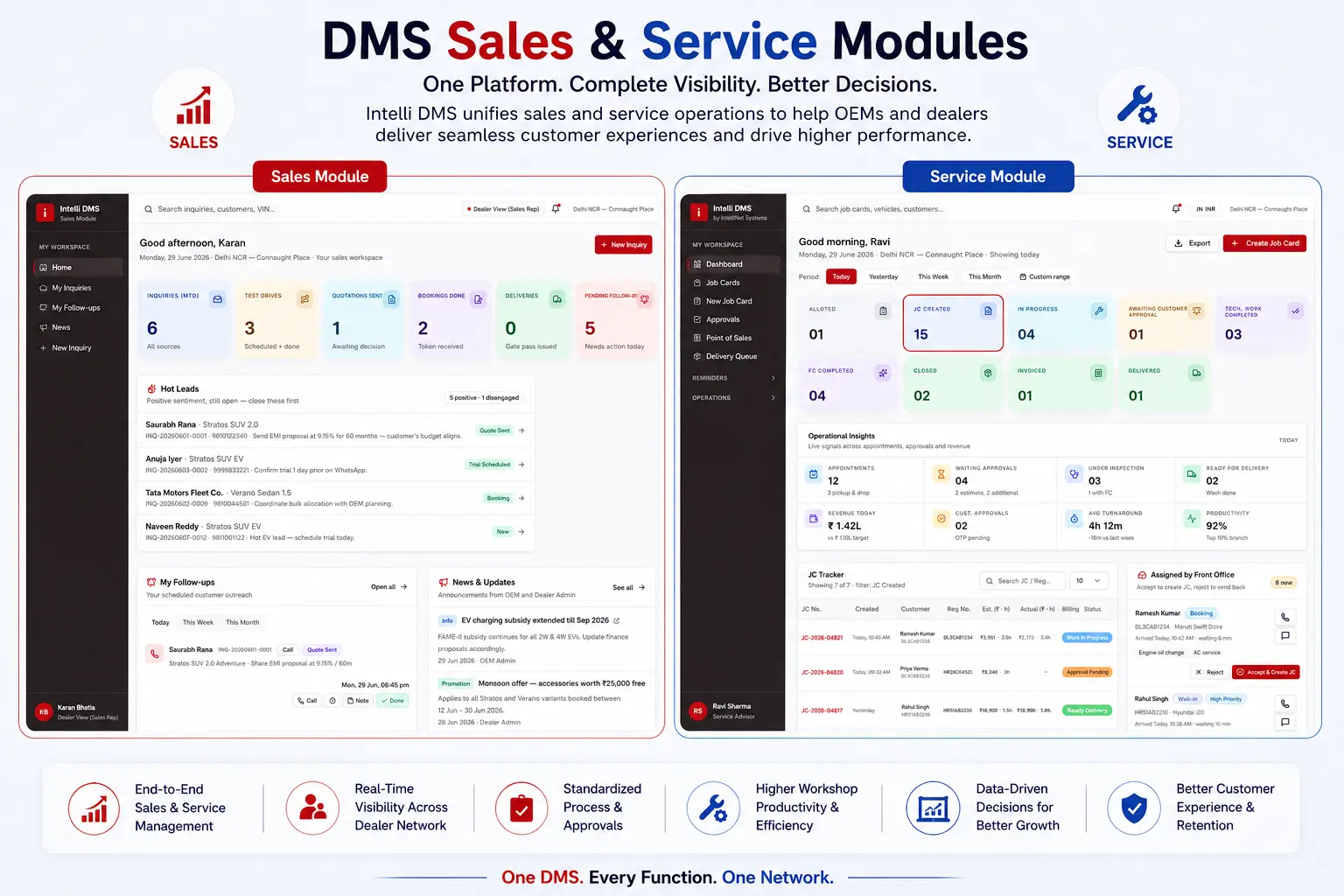
Intelli DMS Sales Module manages the complete vehicle sales journey, from inquiry capture through test drive, quotation, booking, finance and insurance, vehicle allocation, billing, and delivery, inside a single workflow that tracks every customer interaction.
The sales lifecycle in most dealerships passes through the hands of multiple people: a receptionist who logs the inquiry, a sales executive who runs the test drive, a finance officer who processes the loan paperwork, and a delivery coordinator who hands over the keys. If each of these steps lives in a different tool, the customer record fragments and follow-ups fall through.
Intelli DMS keeps this as one continuous record. The sales modules include:
- Inquiry Management: captures walk-in, phone, website, and digital inquiries in one place
- Customer Management: maintains customer profiles, preferences, and communication history
- Test Drive Management: schedules and tracks test drives along with customer feedback
- Quotation Management: creates and customizes quotations with pricing and offers
- Booking Management: manages bookings, token collection, and approval tracking
- Finance and Insurance: handles finance plans, insurance options, and documentation
- Exchange Management: evaluates exchange vehicles, pricing, and settlement
- Vehicle Allocation: manages stock allocation, reservation, and tracking
- Billing and Invoicing: generates invoices, manages taxes, discounts, and documentation
- Vehicle Delivery and Follow-up: manages delivery documentation and post-delivery follow-ups
On top of these modules, Intelli DMS adds configurable approval workflows for quotations, discounts, exchanges, and finance, so OEM policy gets enforced at every dealer rather than interpreted locally. Real-time dashboards then surface inquiry conversion, booking trends, and sales performance across the network, which is what OEM sales leadership actually needs to act on.
Intelli DMS: Service Module Overview
Intelli DMS Service Module manages the complete workshop cycle, from appointment booking and vehicle reception through job card creation, technician assignment, parts issuance, billing, and delivery, with full visibility into repair progress and workshop performance.
After-sales service is where dealer profitability and customer retention are usually decided, yet it’s often the most paper-heavy part of dealership operations. A typical workshop runs on a mix of paper job cards, verbal handoffs between advisors and technicians, and manual parts requests. Intelli DMS replaces that with a structured digital workflow:
- Appointment Management: manages online and walk-in appointments, scheduling, and reminders
- Front Office Management: handles customer check-in, service requests, and vehicle allocation
- Job Card Management: creates and tracks job cards and monitors work progress
- Customer and Service History Management: maintains complete service history, feedback, and follow-ups
- Parts and Inventory Management: manages spare parts availability, requests, and returns
- Workshop and Technician Management: assigns jobs based on technicians' skills and tracks repair progress
- Billing and Payment Management: generates invoices and manages discounts, taxes, and collections
- Reports and Analytics Management: tracks turnaround time, workshop performance, and revenue
The advantage for an OEM here is consistency: every dealer workshop in the network logs jobs, requests parts, and bills customers through the same structured process, which is what makes network-wide turnaround time and productivity benchmarking possible in the first place.
Business Benefits of Implementing Intelli DMS for OEM Dealer Networks
OEMs that implement Intelli DMS gain higher inquiry-to-booking conversion, standardized sales and service processes across dealers, reduced turnaround time, better workshop productivity, lower operational costs, and clearer visibility into network-wide performance for faster business decisions.
These benefits aren’t isolated wins. They build on each other: standardized processes lead to cleaner data, cleaner data leads to better dashboards, and better dashboards lead to faster decisions. In practical terms, OEMs and dealers running Intelli DMS can expect to:
- Increase inquiry-to-booking conversion through structured follow-up tracking
- Standardize sales and service processes across the entire dealer network
- Improve customer experience and satisfaction through consistent service delivery
- Reduce vehicle sales and service turnaround time
- Enhance workshop productivity and technician resource utilization
- Improve dealer and OEM operational visibility through shared dashboards
- Streamline sales, service, and after-sales operations into one connected workflow
- Enable faster and better business decisions with real-time data
- Reduce operational costs and manual effort across the network
- Increase dealer profitability and revenue through better conversion and productivity
For an OEM managing dozens or hundreds of dealer locations, the value isn’t any single benefit on this list. It’s all ten compounds at the network level rather than at one dealership.
Why OEMs Across Multiple Vehicle Categories Choose Intelli DMS
OEMs across passenger vehicles, two-wheelers, tractors, and commercial vehicle segments choose Intelli DMS because it is built specifically for the OEM-to-dealer relationship rather than as a generic retail tool, and because Intellinet Systems has direct, long-running experience inside this industry.
A DMS built for general retail will get sales and inventory right. Still, it usually won't understand the specifics of vehicle allocation against OEM stock, warranty workflows tied to OEM policy, or PDI documentation requirements. This is where industry-specific experience matters more than feature count.
Intellinet Systems is ISO 27001:2022-certified and has worked with OEMs across passenger vehicles, two-wheelers, tractors, and commercial vehicles, including dealer networks, for brands such as Mahindra, Maruti Suzuki, Honda, Tata, Kawasaki, Ather Energy, Force Motors, and Ford Motor Company in select markets. The company was recognized by Forbes in 2023 as one of 200 companies with global potential, and has received Mahindra USA's Core Value Award and Driving Positive Change recognition in earlier years. That kind of sustained presence across vehicle categories is part of why OEMs evaluating a DMS for a multi-brand or multi-category network look at Intelli DMS specifically.
How the DMS Market Is Shifting in 2026
Industry estimates put the global automotive dealer management systems market at roughly USD 5 billion in 2026, with steady growth projected through the next decade as more OEMs move dealer networks onto cloud-based, centralized platforms. Meanwhile, most US vehicle purchases still close in person at the dealership.
Business Research Insights, 2026 estimates that the global automotive dealer management systems market will be worth roughly USD 5 billion in 2026, with steady annual growth projected through the next decade as more OEMs move dealer networks onto cloud-based, centralized platforms. Separately, Global Insight Services, 2026 data shows that the majority of vehicle purchases in the US are still completed in person at dealerships, even as more research and comparison shopping takes place online before customers ever walk in.
Both data points point to the same conclusion for OEMs: the dealership remains the place where the sale and the service relationship actually get completed, but the tools running that dealership are shifting away from spreadsheets and paper toward connected, cloud-based systems. An OEM that delays this shift isn't avoiding the cost of a DMS. It's paying that cost anyway, in the form of inconsistent dealer performance and reporting that the head office can't fully trust.
How to Evaluate and Implement a DMS Across Your Dealer Network
Implementing a DMS across an OEM dealer network works best as a phased rollout: define standard workflows first, pilot with a small group of dealers, refine based on real usage, then scale network-wide with structured training and ongoing support.
Trying to roll out a new DMS to every dealer at once usually backfires, because issues that show up in week one at a pilot dealer would otherwise show up at fifty dealers simultaneously. A more reliable sequence looks like this:
- Define standard workflows first. Decide, at the OEM level, what the inquiry-to-booking process and the appointment-to-delivery process should look like before configuring the system.
- Select a vendor with OEM-specific experience. Generic retail DMS platforms often miss OEM-specific requirements like warranty workflows and PDI documentation.
- Pilot with a small group of dealers. Choose a mix of high-performing and average dealers to get a realistic picture of adoption challenges.
- Train by role, not by location. Sales executives, service advisors, and technicians need different training content, even within the same dealership.
- Review pilot data before scaling. Look at adoption rates, data quality, and dealer feedback, then refine workflows before rolling out further.
- Roll out network-wide in batches. Expand in manageable batches rather than all at once, so support resources aren't stretched too thin.
- Monitor OEM-level dashboards post-launch. Use the same dashboards intended for ongoing management to catch early signs of low adoption or data gaps.
This is also where vendor support matters as much as the software itself. A platform is only as useful as the dealer staff who actually use it every day, which is why structured training and responsive support during rollout should be part of any DMS evaluation, not an afterthought.
Conclusion
A dealer management system is only as valuable as the consistency it creates across an OEM's dealer network. The real cost of staying on spreadsheets, paper job cards, and disconnected tools isn't visible on any single day, but it shows up over time as inconsistent dealer performance, slow decision-making, and a head office that can't fully trust its own reports.
The best dealer management system for automotive OEMs solves this by covering the complete sales and service lifecycle, standardizing how every dealer operates, and turning scattered data into dashboards that leadership can actually use. Intelli DMS was built around this exact requirement, with connected Sales and Service modules, configurable approval workflows, and real-time reporting designed for OEMs running multi-dealer networks.
For an OEM evaluating its options in 2026, the decision isn't really about adding software. It's about deciding how much longer the network should run on inconsistent, disconnected processes before that inconsistency starts costing more than the system would.
Book a Free Demo and discover how Intelli DMS helps automotive OEMs build smarter, more connected dealer networks.
Frequently Asked Questions
What is the best dealer management system software for automotive OEMs in 2026?
The best dealer management system software for automotive OEMs covers the full sales and service lifecycle, supports network-wide process standardization, and provides real-time dashboards for both dealer and OEM management. Intelli DMS is built specifically for this OEM-to-dealer relationship, with connected Sales and Service modules used across passenger vehicle, two-wheeler, tractor, and commercial vehicle networks.
How is a DMS different from a basic dealer CRM?
A CRM mainly tracks customer interactions and leads. A DMS goes further, connecting inquiry management, booking, billing, workshop operations, parts inventory, and warranty into one system. Intelli DMS includes CRM-style customer management as one module within a larger platform that also runs the dealership's day-to-day sales and service operations.
Can a DMS really standardize operations across dealers that all run differently today?
Yes, but only if the OEM defines the standard workflow before rollout and the DMS is configurable enough to enforce it. Intelli DMS supports configurable approval workflows for quotations, discounts, exchanges, and finance, which lets an OEM apply one consistent process across every dealer in the network instead of leaving it to local discretion.
How long does it typically take to roll out a DMS across a dealer network?
Timelines vary by network size, but a phased approach, starting with a small pilot group before scaling network-wide, is the most reliable path. Most OEMs see realistic adoption data within the first few weeks of a pilot, which then informs how workflows are refined before a full rollout.
Does Intelli DMS work for vehicle categories beyond passenger cars?
Yes. Intelli DMS is used across passenger vehicles, two-wheelers, tractors, and commercial vehicles. Its Sales and Service modules are built to handle the inquiry, booking, workshop, and billing workflows common across these categories, which is part of why Intellinet Systems works with OEMs spanning multiple vehicle segments.


Explore More Insights




.webp)


About the Author


Chandra Shekhar
Chandra Shekhar is the Senior Manager, Strategy & Business Development at Intellinet Systems. With over a decade of experience in the automotive industry, Chandra Shekhar has led digital transformation and aftersales strategy initiatives for OEMs across multiple markets. His background combines deep industry knowledge with a practical understanding of how technology can solve real operational challenges. He focuses on making complex ideas clear and relevant for automotive and aftermarket professionals navigating ongoing change.


