

Overview: Reducing dealership operating costs means lowering the recurring cost of running sales and service day-to-day: labor hours lost to manual work, money tied up in excess parts inventory, revenue lost to billing errors, warranty claim leakage, and the cost of keeping staff trained across several disconnected tools. Modern dealer management software drives this kind of operating cost reduction with DMS by automating the workflows that quietly eat into staff time and dealer margin: appointment booking, job cards, parts ordering, billing, and warranty claims. Intelli DMS is structured around this exact goal, with modules built specifically to remove the manual steps that drive cost in a dealership's daily operations.

This guide covers:
- What “reduces dealership operating costs” actually means at the department level, not just on a software invoice
- Where operating costs typically hide in a dealership's daily sales and service work
- How modern dealer management software drives operating cost reduction with DMS, mechanism by mechanism
- A module-by-module look at how Intelli DMS targets each of those cost centers directly
- A checklist for evaluating any DMS vendor specifically on cost impact, not just feature count
- The common cost mistakes OEMs make when they stay on legacy, disconnected systems
- A phased plan for capturing cost savings during rollout without disrupting daily operations
- The business outcomes to expect, with verified industry benchmarks
Book a demo with our expert to see how Intelli DMS helps OEMs reduce dealership operating costs.
Most OEMs think about DMS cost savings in terms of the software’s own price tag, one license fee compared to another. That approach misses where the higher costs actually occur: labor hours lost to manual processes, parts sitting idle in inventory, billing leakage, delayed warranty recovery, and inefficiencies created by disconnected systems.
The real value of a modern dealer management system comes from removing these hidden operational costs. By automating workflows, standardizing processes across the dealer network, and providing real-time visibility iinto cost leakage, Intelli DMS helps OEMs reduce the expenses that accumulate every day but rarely appear as a single line item.
What ‘Reduces Dealership Operating Costs’ Actually Means
Reducing dealership operating costs means lowering the recurring cost of running sales and service day-to-day: labor hours lost to manual work, money tied up in excess parts inventory, revenue lost to billing errors and warranty claim leakage, and the cost of keeping staff trained across multiple disconnected tools.
Most OEMs think about DMS cost savings in terms of the software’s own price tag, one license fee compared to another. That misses where the real cost lives. The bigger number is what a dealership spends every month working around a system that does not connect sales, service, parts, and billing into one place. Intelli DMS is built to close that gap, which is why its module sets maps so closely to where dealership cost actually sits, not just where a demo happens to look good.
Where Do Dealership Operating Costs Actually Hide?
Operating costs in a dealership rarely show up as one line item. These costs are often hidden within labor hours, parts inventory carrying costs, warranty claim leakage, billing errors, and the expense of maintaining multiple disconnected systems instead of a single integrated platform. Each of these adds up faster than most OEMs track at the network level.
- Labor hours lost to manual job cards, paper checklists, and re-entering the same customer data more than once
- Parts sitting in inventory too long, or the wrong part being fitted because nobody had the right number at the estimate stage
- Billing errors and missed line items that show up as written-off revenue rather than collected cash
- Warranty claims that get rejected or delayed because the paperwork trail does not match what the supplier requires
- Technician turnover and retraining costs, made worse when process knowledge lives in one person’s head instead of in a system
- License and maintenance costs for several disconnected tools covering sales, service, parts, and billing separately
How Does Modern Dealer Management Software Reduce Operating Costs?
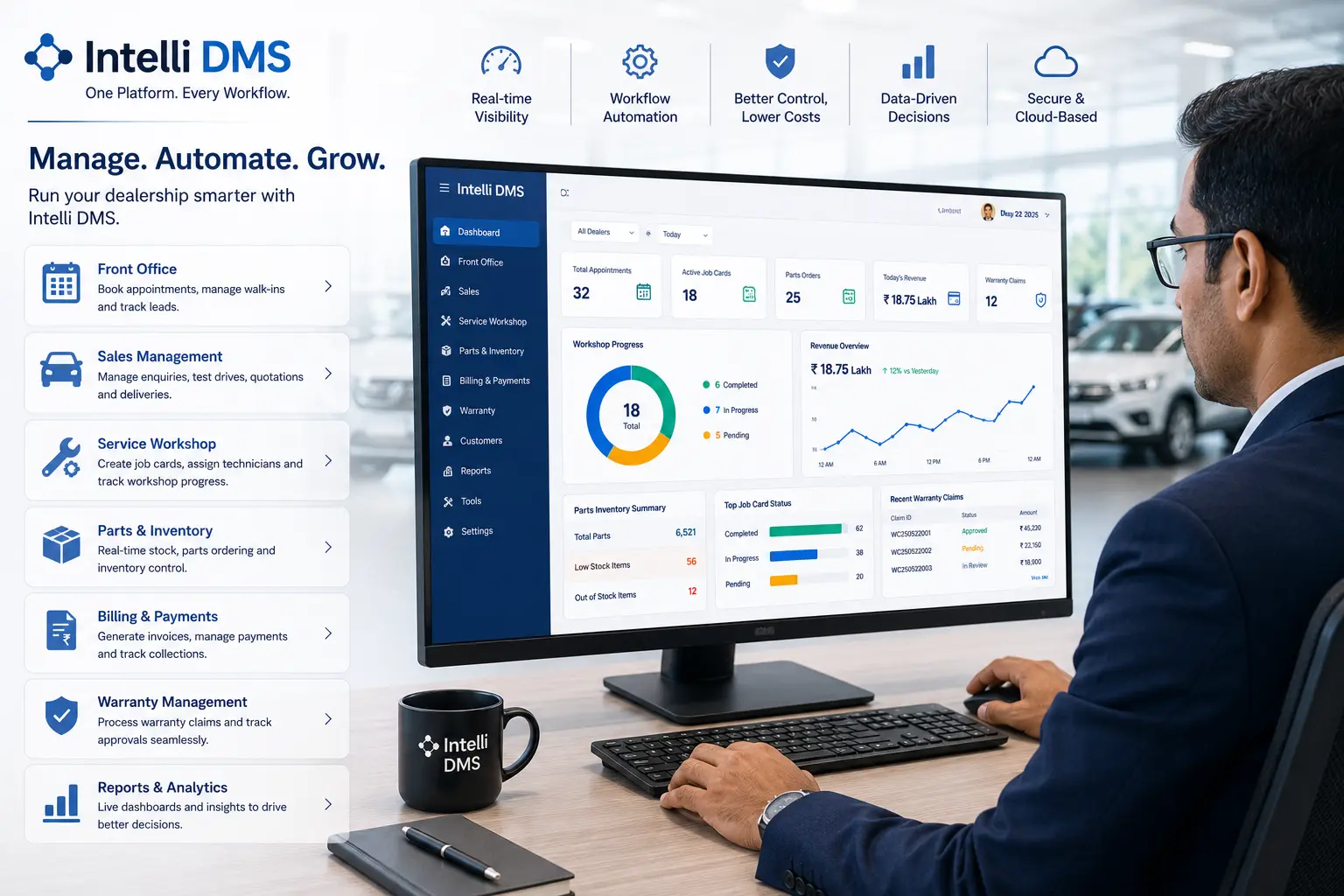
Modern dealer management software reduces dealership operating costs by removing manual work, preventing revenue leakage, improving resource utilization, and giving OEMs real-time control over sales, service, parts, and warranty operations.
These cost reductions happen through four key mechanisms: automating repetitive processes, standardizing workflows across the dealer network, providing real-time visibility into cost leakages, and replacing disconnected tools with a single integrated platform. Intelli DMS delivers these benefits together by connecting every major dealership workflow on one system.
- Automation: Job cards, billing, and parts requests move without someone re-keying the same information into three different screens.
- Standardization: Every dealer in the network follows the same approval workflow for discounts, warranties, and financing, ensuring consistent cost control and reducing variations caused by individual dealer practices.
- Visibility: Dashboards show where costs are building up, including aged inventory, slow job cards, and warranty rejections, before they turn into write-offs.
- Consolidation: A single platform replaces the cost and complexity of managing separate booking software, parts spreadsheets, billing tools, and warranty trackers.
How Does Intelli DMS Target Each Dealership Cost Center?
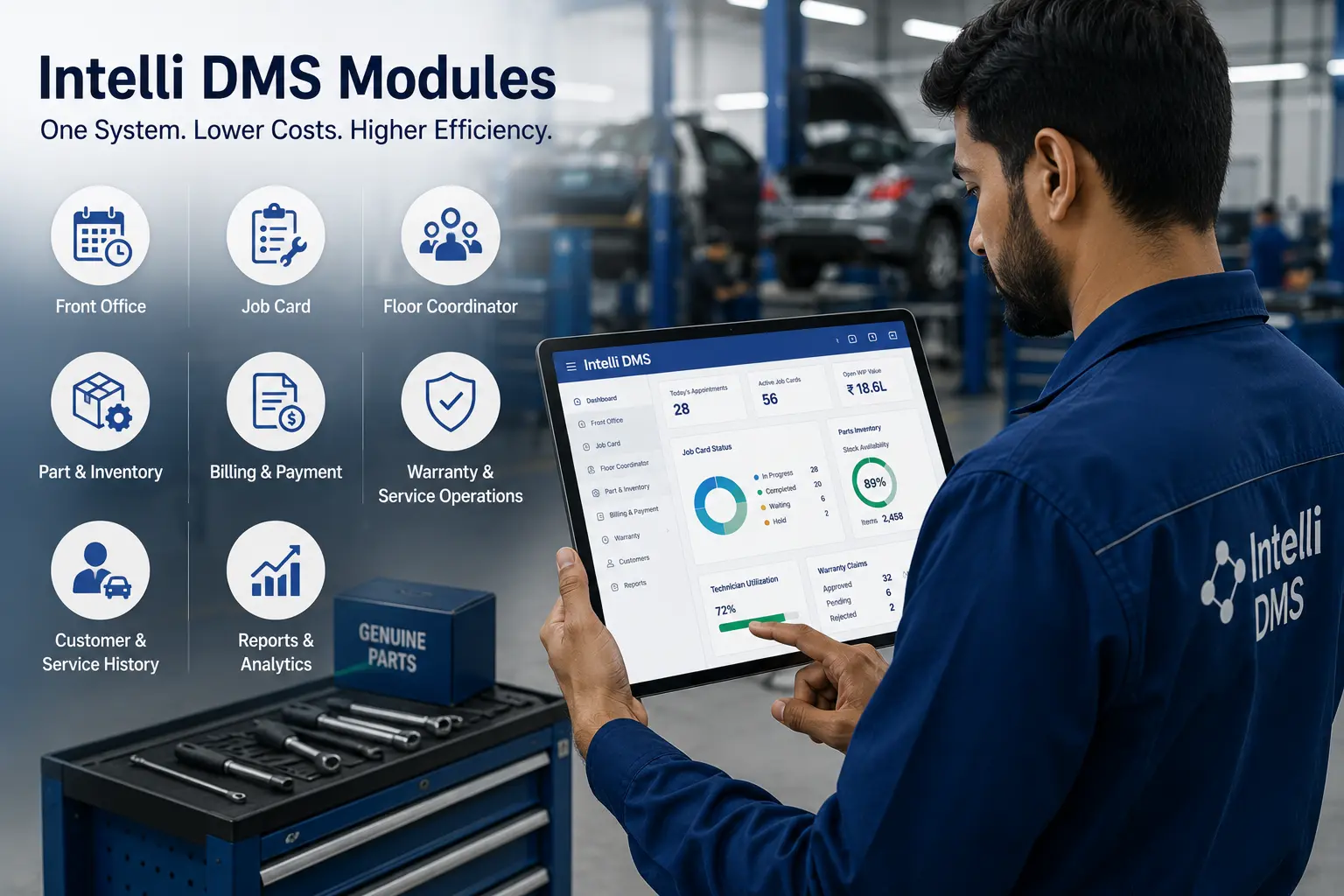
Intelli DMS, the best dealer management system, maps its modules directly onto the cost centers above, rather than offering one generic dashboard. Each module is built to remove a specific source of manual cost: scheduling, job cards, technician allocation, parts tracking, billing, and warranty management.
- Front Office Module
Books and allocates appointments automatically, reducing front-desk labor costs associated with manual scheduling and minimizing no-shows that leave service bays idle.
- Job Card Module
Captures customer complaints, repair details, and required parts in one digital record, reducing rework caused by miscommunication and eliminating delays from paper-based processes across departments.
- Floor Coordinator Module
Assigns jobs by technician skill and load, which reduces idle bay time and the labor cost of jobs sitting unassigned on the shop floor.
- Part & Inventory Module
Tracks parts inventory in real time, reducing stockouts that delay service jobs while minimizing the carrying costs of excess inventory sitting unused on shelves.
- Billing & Payment Module
Generates invoices as soon as a job card is closed, reducing revenue leakage from missed billable items and accelerating the cash collection cycle.
- Warranty & Service Operations Module
Links job cards directly to warranty claims, reducing claim rejections and accelerating supplier reimbursements, both of which can become significant cost burdens when handled incorrectly.
- Customer & Service History Module
Maintains a single, comprehensive customer record, reducing the time and labor required for advisors to reconstruct a vehicle’s service history at each visit.
- Reports & Analytics Module
Gives OEMs a live view of cost drivers, aged inventory, technician utilization, warranty rejection rate, at every dealer, instead of waiting on a monthly spreadsheet roll-up.
Evaluation Checklist: What to Look for in a DMS Built for Cost Reduction
Not every DMS is built with cost reduction as the design goal. Before signing with any vendor, score them against a short checklist focused specifically on where cost actually gets removed, not just on feature count or screen design.
- Does it automate job cards and billing, or just digitize the same paper form? Intelli DMS automates both from one shared record.
- Does it track parts in real time against the estimate, or only after the fact? Intelli DMS links parts and inventory at the estimate stage.
- Does it link warranty claims to the job card automatically? Intelli DMS does, through its Warranty & Service Operations module.
- Are approval workflows configurable to OEM policy, so dealers cannot bypass cost controls? Yes, on quotations, discounts, exchanges, finance, and warranty.
- Are dashboards available at the dealer and OEM level in real time? Yes, covering inventory, billing, warranty, and technician productivity.
- Is it cloud-based, avoiding the IT overhead cost of local servers at every dealer? Yes, Intelli DMS runs as a cloud platform.
- Does the vendor carry a recognized security certification? Intellinet System, the company behind Intelli DMS, is ISO 27001:2022 certified.
- Does the vendor have a deployment track record with OEMs of a similar size? Intellinet System’s clients include Ford, Mahindra, Maruti Suzuki, Honda, Tata and Kawasaki.
Common Cost Mistakes OEMs Make When Running on Legacy Systems
Most of the cost that a DMS removes was never visible as a single expense line in the first place. It was spread across departments, which is exactly why these mistakes are so easy to repeat year after year without anyone flagging the total.
- Keeping separate tools per department: A booking tool, a parts spreadsheet, and a billing system each carry their own license cost and their own reconciliation labor.
- Treating warranty tracking as a spreadsheet: Manual warranty logs make claim rejections and missed deadlines far more likely, and both are direct cost.
- Not centralizing parts data across dealers: Each dealer ends up holding its own buffer stock against uncertainty, which raises carrying cost network-wide.
- Measuring cost only at month-end: By the time a spreadsheet roll-up shows a problem, the cost has already been incurred for a full month.
- Underestimating retraining cost from technician turnover: When process knowledge lives in someone’s head rather than in a system, every departure has a real cost attached to it.
How Can Dealerships Capture Cost Savings Without Disrupting Operations?
Cost savings from a DMS are not automatic on day one. They depend on a rollout that targets the biggest sources of leakage first, rather than switching every dealer over at once and hoping the savings show up on their own.
- Audit current cost leakage by department: Quantify labor hours, aged parts inventory, billing write-offs, and warranty rejections at a sample of dealers before choosing a starting point.
- Prioritize pilot dealers with the highest leakage: Starting where the cost problem is largest makes the savings visible early and builds the case for network-wide rollout.
- Train staff on the new workflow, not just the screen: Cost savings depend on people changing how they work, not only on which software they click into.
- Roll out in phases by region or dealer group: This keeps support load manageable and lets you fix issues before they repeat across the whole network.
- Track cost KPIs on the dashboard monthly: Aged inventory, billing write-offs, and warranty rejection rate should be visible to OEM management, not buried in a department report.
Business Impact: The Numbers Behind Operating Cost Reduction with DMS
The impact of reducing operating costs with a DMS is not theoretical. It shows up in measurable categories: labor productivity, parts carrying cost, warranty recovery, and the fixed cost that service and parts departments are expected to absorb.
- Lower labor cost per job through fewer manual, repeated steps
- Lower parts carrying cost through real-time inventory tracking
- Higher warranty recovery through fewer rejected or delayed claims
- Fewer billing write-offs through invoices generated at job close
- Lower retraining cost through standardized, system-driven workflows
- Lower OEM-side reporting cost through live dashboards instead of manual roll-ups
Service and parts operations carry more of a dealership’s fixed cost than most OEMs give them credit for. NADA reports that the national average fixed absorption rate, the share of overhead covered by service and parts profit alone, stood at 63.9% in August 2025, up from 61% a year earlier. The absorption rate is influenced by how efficiently service and parts departments operate, which is precisely what modules like Job Card, Floor Coordinator, and Parts & Inventory in Intelli DMS are built to improve.
On the overhead side, McKinsey’s Auto retail productivity in the digital era, 2025 analysis of dealership financials found that average SG&A costs have risen 8% in recent years, while staff turnover across the industry has averaged 34%. Standardized, system-driven workflows can help address both challenges, since they reduce how much cost depends on any one employee’s tenure or habits, which is the gap Intelli DMS is built to close.
Why OEMs Choose Intelli DMS to Reduce Operating Costs
Intelli DMS is structured around the cost centers covered in this guide rather than as a single-function tool added on top of a dealership's existing process. It runs sales and service on one platform, with configurable approval workflows and real-time dashboards built for both dealers and OEMs.
A few points worth noting for OEMs running cost-focused due diligence:
- ISO 27001:2022 certified for information security
- Recognized by Forbes in 2023 as one of 200 companies with global potential
- Dealer network clients include Ford, Mahindra, Maruti Suzuki, Honda, Tata, Kawasaki, and Ather Energy
- Deployments span India, the United States, Saudi Arabia, Malaysia, Israel, Mexico, and Canada
- Module coverage built specifically around cost centers: front office, job cards, workshop and technician allocation, parts and inventory, billing and payment, and warranty operations
None of this replaces running your own numbers against your own dealer network. But for OEMs working through a cost-reduction business case, Intelli DMS is one of the few platforms built to answer that case module by module rather than feature by feature.
Conclusion
Reducing dealership operating costs is not a software feature; it is the outcome of removing the manual, disconnected work that quietly drives up labor hours, parts carrying cost, billing errors, and warranty leakage across a dealer network. Modern dealer management software earns its cost case by automating those steps, standardizing how every dealer works, and giving the OEM real-time visibility into where money is actually going.
Intelli DMS was built against this exact cost structure: front office, job card, workshop and technician allocation, parts and inventory, billing and payment, and warranty operations, all on one platform. For an OEM building the business case for operating costs reduction with DMS, Intelli DMS is worth evaluating against the actual cost centers in your network, not just against a feature list.
Book a Free Demo Today to see how Intelli DMS can reduce your dealership operating costs.
Frequently Asked Questions
How quickly can a dealership expect to see operating cost savings after implementing a DMS?
Most dealerships see the first measurable savings within the first two to three months of going live, usually in reduced billing errors and faster job card turnaround, since those processes change immediately once they move off paper. Savings from parts carrying cost and warranty recovery tend to show up over a longer window, typically two to three full inventory and warranty claim cycles, since those benefits compound as historical data builds up inside the system.
Does a DMS reduce costs more in sales or in service operations?
Service operations usually carry the larger and more immediate cost reduction, since labor hours, parts carrying cost, and warranty claims are recurring, day-to-day expenses. Sales-side savings tend to show up as higher conversion and lower discount leakage rather than a direct line-item cost cut. A platform like Intelli DMS captures both, but most OEMs see the cost case land first in the workshop and parts department.
How does the cost of a DMS itself compare to the savings it generates?
DMS pricing is typically structured around the number of dealers, modules used, and rollout timeline, so the cost scales with the size of the network rather than being a flat fee. For most OEMs, the savings from reduced labor cost, parts carrying cost, and warranty leakage outweigh the license cost within the first year of full deployment, provided the rollout is phased and adoption is tracked rather than assumed.
Can a DMS reduce warranty-related costs specifically?
Yes, and this is often one of the faster payback areas. Linking job cards directly to warranty claims, as Intelli DMS does through its Warranty & Service Operations module, reduces the paperwork mismatches that cause claims to be rejected or delayed. Fewer rejections means faster supplier recovery and less revenue absorbed by the dealership instead of being reimbursed.


Explore More Insights





.webp)


About the Author


Chandr Shekhar
Chandra Shekhar is the Senior Manager, Strategy & Business Development at Intellinet Systems. With over a decade of experience in the automotive industry, Chandra Shekhar has led digital transformation and aftersales strategy initiatives for OEMs across multiple markets. His background combines deep industry knowledge with a practical understanding of how technology can solve real operational challenges. He focuses on making complex ideas clear and relevant for automotive and aftermarket professionals navigating ongoing change.


