

Overview: Standardizing dealer operations across an OEM network means running every outlet, whether it is 5 dealers or 500, on the same sales workflow, service process, and reporting structure through one connected platform. Today, most OEMs manage dealer networks through a mix of spreadsheets, phone calls, WhatsApp messages, and paper job cards. Each dealer follows its own version of the sales and service process, which makes performance comparison, compliance tracking, and customer experience inconsistent across the network.

Key Takeaways:
- Standardizing dealer operations means ensuring every dealer, regardless of size or location, follows the same workflows, uses a consistent data structure, and reports performance in a standardized format through a single shared platform.
- Fragmented tools such as Excel sheets, WhatsApp threads, and paper job cards lead to delayed decisions, inconsistent customer experiences, and unreliable OEM-level reporting.
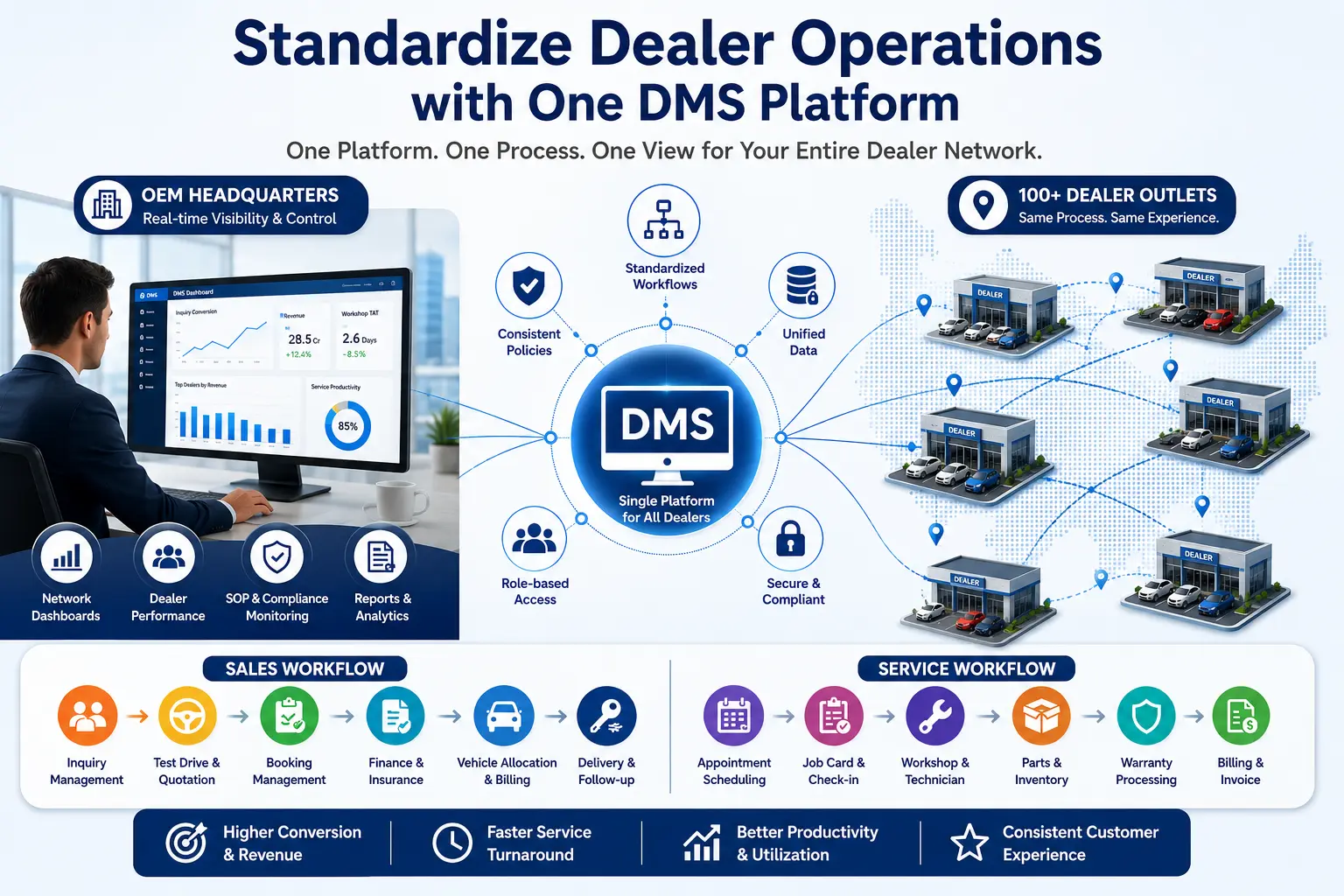
- A single DMS platform standardizes the entire sales journey from inquiry to delivery and the service journey from appointment to invoice across every dealer in the network.
- Standardization gives OEM leadership real-time visibility into inquiry conversion, workshop turnaround time, and SOP compliance across all outlets.
- A phased rollout, pilot first, then regional expansion, then full network, reduces resistance from dealers and keeps day-to-day operations running during the transition.
Standardize Your Dealer Network with Intelli DMS. Request a Personalized Demo
What Does It Mean to Standardize Dealer Operations Across an OEM Network?
To standardize dealer operations across an OEM network means every dealer, regardless of location or size, follows the same sales process, service workflow, and data structure inside a single shared system. It replaces dealer-specific spreadsheets and manual processes with a single, consistent operating model that OEM leadership can monitor and audit from the head office.
Right now, dealer operations vary widely from one outlet to the next. One dealer may log a walk-in inquiry in a paper register, while another tracks it in an Excel sheet, and a third handles it purely over WhatsApp. Job cards, discount approvals, and delivery checklists follow whatever process the local team is used to. When an OEM compares Dealer A's conversion rate with Dealer B's, the figures may not tell the same story because the underlying sales processes differ.
Standardizing dealer operations OEM-wide fixes this at the root. Every dealer captures the same fields for an inquiry, follows the same discount approval chain, and generates invoices in the same format. The process is identical whether the outlet is in a metro city or a small town, and whether it handles 50 vehicles a month or 500.
Why Fragmented Dealer Operations Hurt OEM Growth
Fragmented dealer operations create blind spots for OEMs. When each outlet tracks inquiries, job cards, and approvals differently, OEM teams cannot accurately compare dealer performance, identify underperforming outlets early, or maintain a consistent customer experience across the network.
This is not a small problem. According to the 2026 Urban Science Harris Poll Study, more than half of dealers (53%) say brand compliance requirements are difficult to keep up with, and 82% say their networks need a simpler way to manage brand contracts and standards. When compliance and reporting are this hard to manage even for contracts, the same fragmentation shows up in daily sales and service operations: delayed decisions at the OEM level, inconsistent SOP adherence, and customers getting a different experience depending on which dealer they walk into.
For an OEM with 100 or more outlets, these gaps can quickly become costly: slow follow-ups lead to missed sales opportunities, workshop inefficiencies remain hidden until customers complain, and unreliable data makes meaningful comparisons across dealers difficult.
What Is Multi-Dealer Management Software?
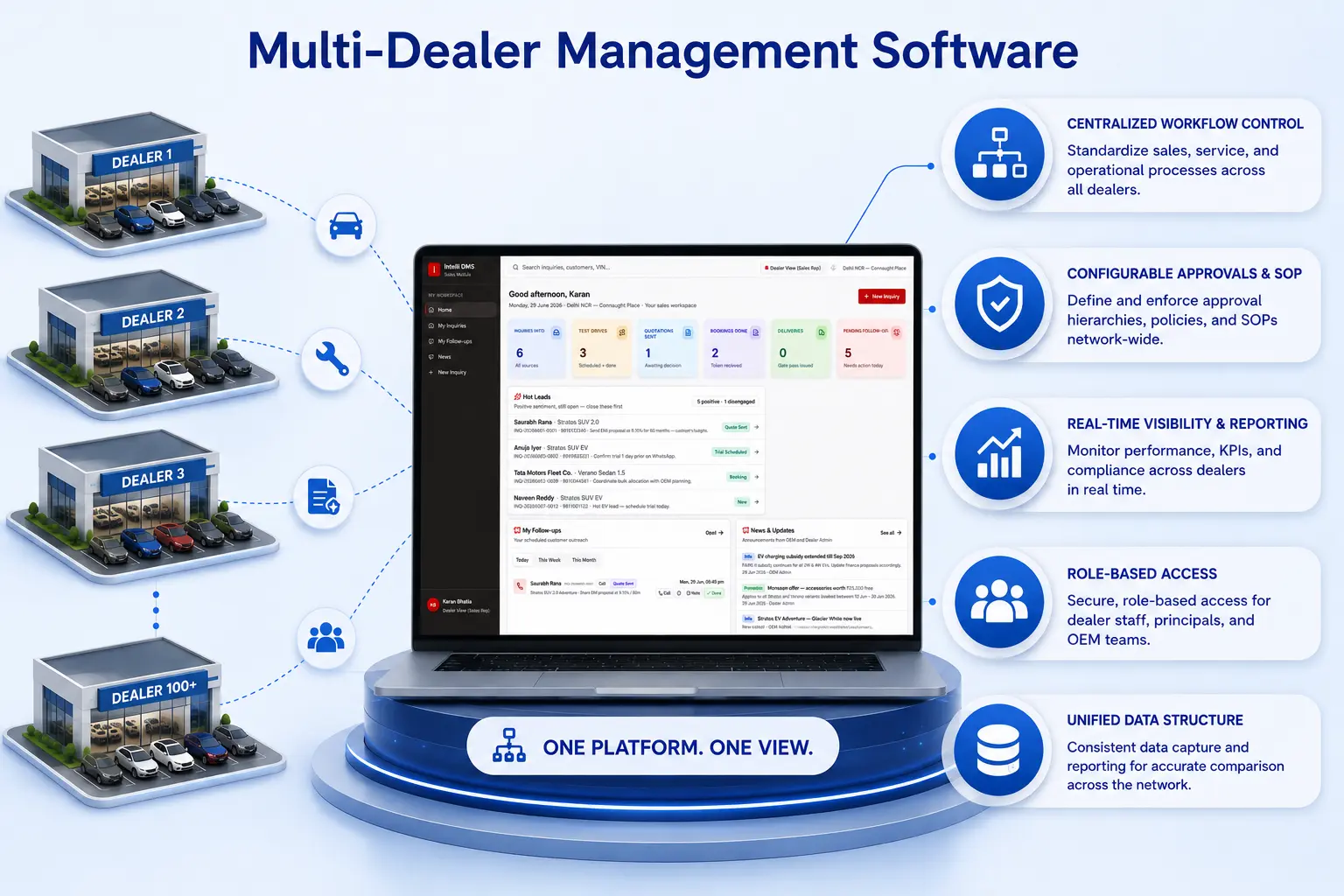
Multi-dealer management software is a DMS platform that manages sales and service operations across multiple dealer outlets from a single system. Each dealer gets role-based access to its own operations, while the OEM retains network-wide visibility and control.
Unlike a single-location dealer tool, multi-dealer management software is built around a clear hierarchy: dealer staff works within their own outlet's data, dealer principals monitor their outlet's performance, and OEM teams get a consolidated view of the entire network. Core workflows, such as converting an inquiry into a booking or a job card into an invoice, remain consistent across every outlet, enabling OEMs to compare dealer performance using standardized data.
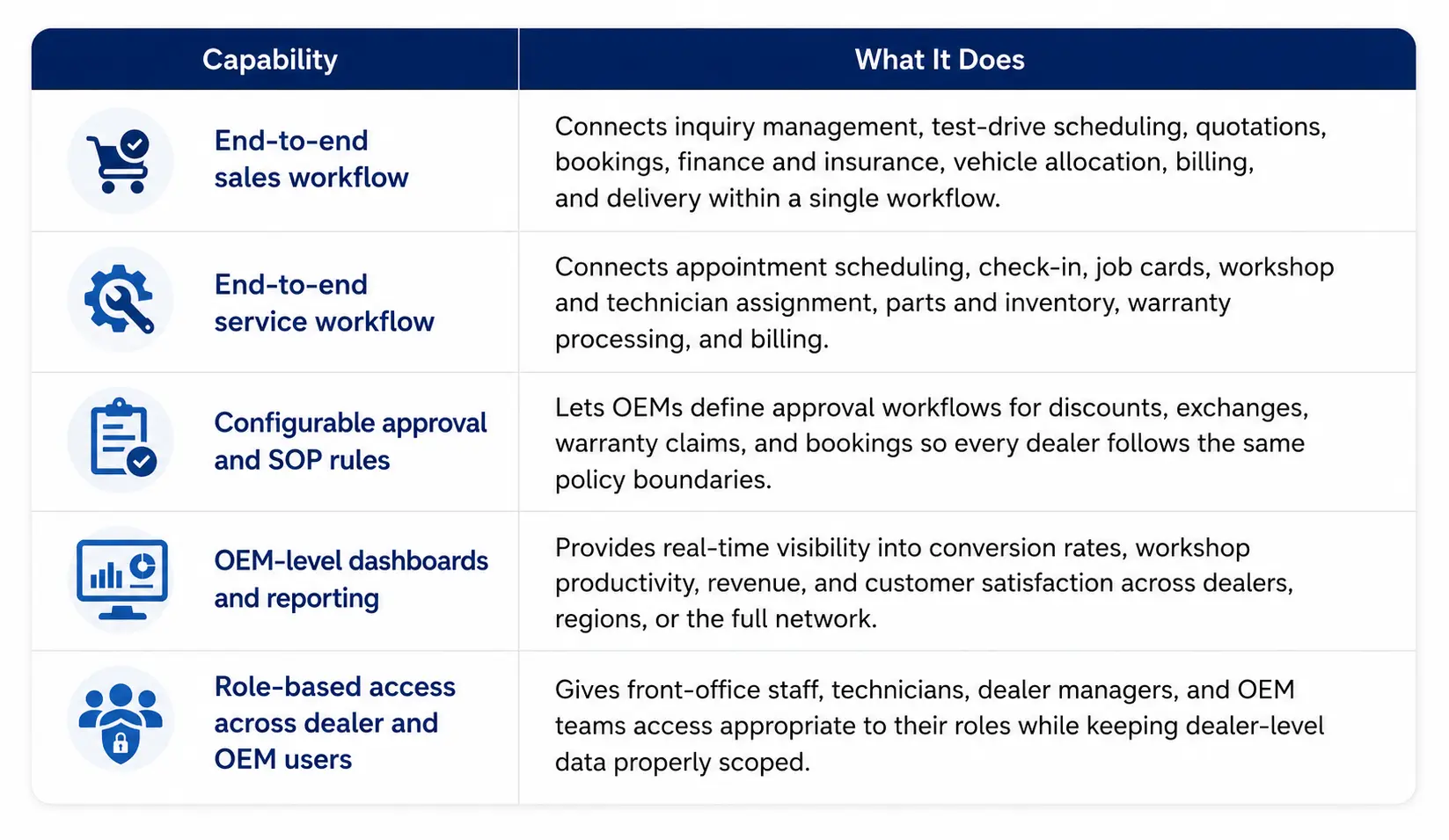
This is different from simply giving every dealer the same software license. True dealer network standardization requires the platform to enforce the process, not just host the data. Approval rules, mandatory fields, and workflow stages are configured once by the OEM and applied automatically to every dealer using the system.
Core Capabilities: Multi-Dealer Management Software Must Have
Multi-dealer management software built for 100+ outlets needs centralized workflow control, role-based approvals, real-time dashboards, and modules that cover the full sales and service lifecycle. Without these, an OEM ends up with a system that is centralized in name but still fragmented in practice.
How a Single DMS Platform Enables Dealer Network Standardization
A single DMS platform standardizes dealer operations by giving every outlet consistent digital workflows for sales and service, while providing OEM teams with a centralized dashboard to monitor inquiry conversion, turnaround time, and compliance across 100+ locations without relying on manual reports.
Intelli DMS digitizes the full dealership lifecycle, from customer inquiry and vehicle booking through workshop operations, invoicing, delivery, and post-sales follow-up, inside a single integrated platform used across the entire dealer network. Instead of each dealer relying on its own mix of Excel sheets and paper-based processes, every outlet operates within the same structured system, giving OEM management a single, reliable source of truth across the entire network.
Sales Standardization: From Inquiry to Delivery
Sales standardization in DMS means every dealer runs the same sequence: inquiry capture, test drive, quotation, booking, finance and insurance, vehicle allocation, billing, and delivery, all logged in the same system with the same data fields, regardless of which outlet the customer visits.
In practice, this covers several connected modules working as one workflow:
- Inquiry management for walk-in, phone, website, and digital leads, so no inquiry gets lost between a call log and a notebook.
- Customer management that centralizes customer profiles, preferences, and communication history across every touchpoint.
- Test drive and quotation management with structured scheduling, variant comparison, and negotiation tracking.
- Booking management that records token collection, approvals, and booking status consistently across dealers.
- Finance, insurance, and exchange management, standardized so approvals follow OEM policy rather than dealer discretion.
- Vehicle allocation, billing, invoicing, and delivery, tracked through to a documented, follow-up-ready handover.
Because every dealer follows the same stages, an OEM can compare inquiry-to-booking conversion across 100 outlets and know the comparison is fair.
Service Standardization: From Appointment to Invoice
Service standardization means every workshop, across every outlet, follows the same appointment, job card, technician assignment, parts, and billing process, so turnaround time and repair quality no longer depend on which dealer a customer chooses.
The service side typically standardizes:
- Appointment management for online and walk-in bookings, with consistent scheduling and reminders.
- Front-office and job card management, covering vehicle check-in, inspection, and documentation.
- Workshop and technician management, assigning jobs and tracking repair progress against a common set of stages.
- Parts, inventory, and estimate management, so parts availability and repair estimates follow the same process everywhere.
- Billing, payment, and warranty operations, standardized for tax, discount, and compliance handling.
- Reports and workshop analytics, covering technician efficiency, turnaround time, and service revenue.
This consistency makes OEM-wide service KPIs, such as average turnaround time and first-time-fix rate, meaningful and comparable across dealers.
Real-Time Visibility and Dashboards for OEM Leadership
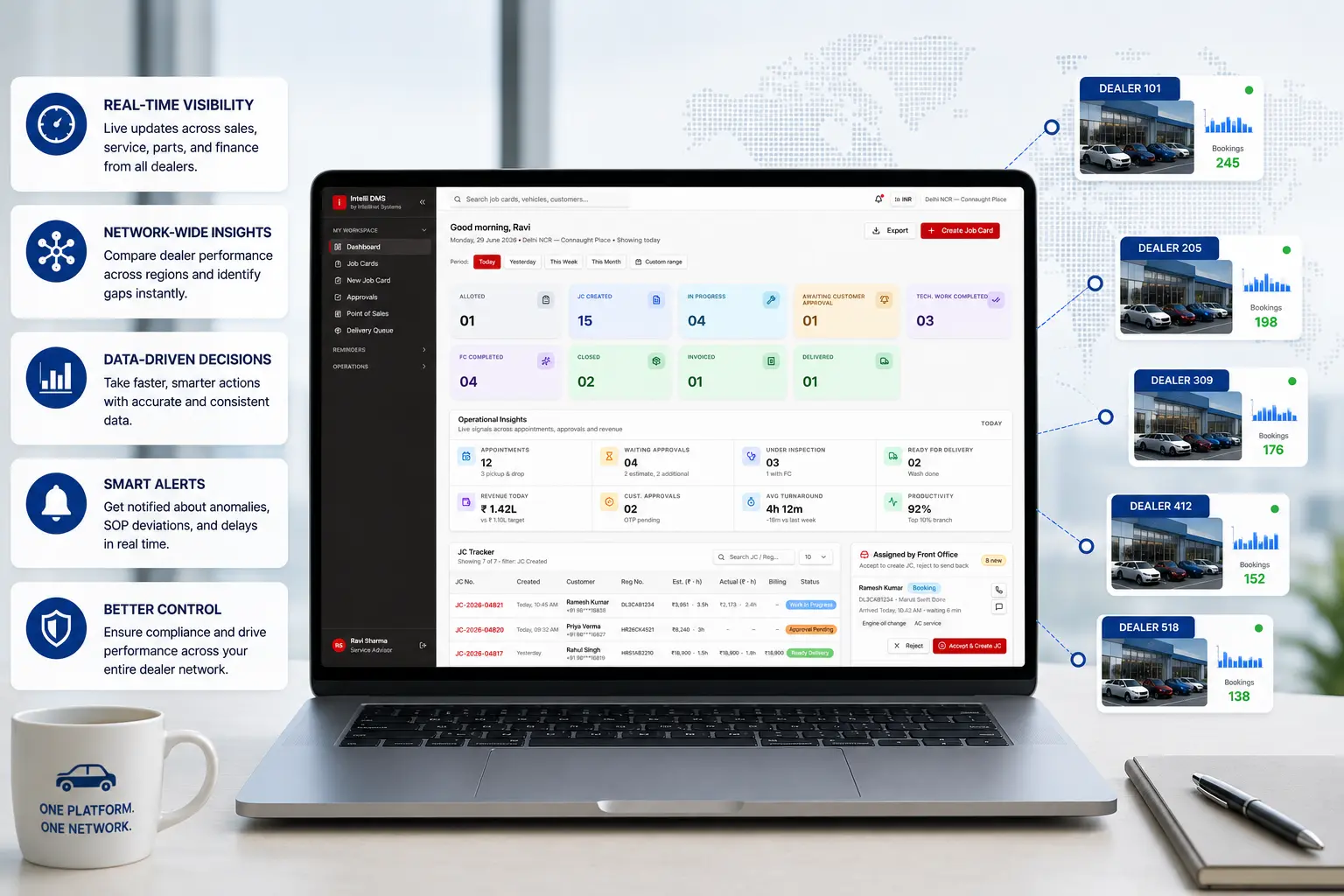
Real-time dashboards give OEM leadership a live, network-wide view of inquiry conversion, booking trends, workshop turnaround, and revenue, replacing the delayed, manually compiled reports that most dealer networks still rely on.
Centralized platforms are becoming increasingly important as dealer networks grow more complex. For OEMs managing multiple outlets, standardized data and real-time dashboards provide a consistent view of sales, service, inventory, and dealer performance across the network. This reflects a simple operational reality: OEMs cannot effectively manage what they cannot consistently see. Dashboards built on standardized data give leadership a reliable, real-time view of performance across 100+ outlets.
With one DMS platform, an OEM's regional or national team can open a single dashboard and immediately see which dealers are converting inquiries well, which workshops are falling behind on turnaround time, and where approvals are stuck, without calling each dealer individually.
Step-by-Step: How to Roll Out Standardized Operations Across 100+ Dealers
Rolling out standardized dealer operations across a large network works best in phases: define the standard, pilot it with a small group of dealers, refine it, then expand region by region until the full network is live. Trying to switch all 100+ outlets at once usually creates more resistance than it resolves.
- Define one SOP for sales and service before selecting or configuring software, so the platform reflects a decision the OEM has already made, not the other way around.
- Choose a DMS platform that natively supports both sales and service workflows, so dealers are not stitched together across separate systems.
- Run a pilot with 5 to 10 dealers across different sizes and regions to surface real-world gaps before a wider rollout.
- Build dealer-specific training and a simple onboarding checklist, since the biggest rollout risk is usually adoption, not the software itself.
- Expand in regional batches, tracking the same KPIs at each stage so the OEM can compare performance across rollout waves.
- Set a firm cutover date for each rollout batch so dealers transition fully to the new system without running old and new processes in parallel longer than necessary.
- Review dashboards monthly at the OEM level to catch dealers who are falling behind the standard early, not after a quarter has passed.
This phased approach matters because dealer networks are rarely uniform. A flagship urban outlet and a smaller rural dealer will adopt a new system at different speeds, and a staged rollout lets the OEM adjust support and training without slowing down dealers who are ready to move faster.
What Are the Business Benefits of Standardizing Dealer Operations?
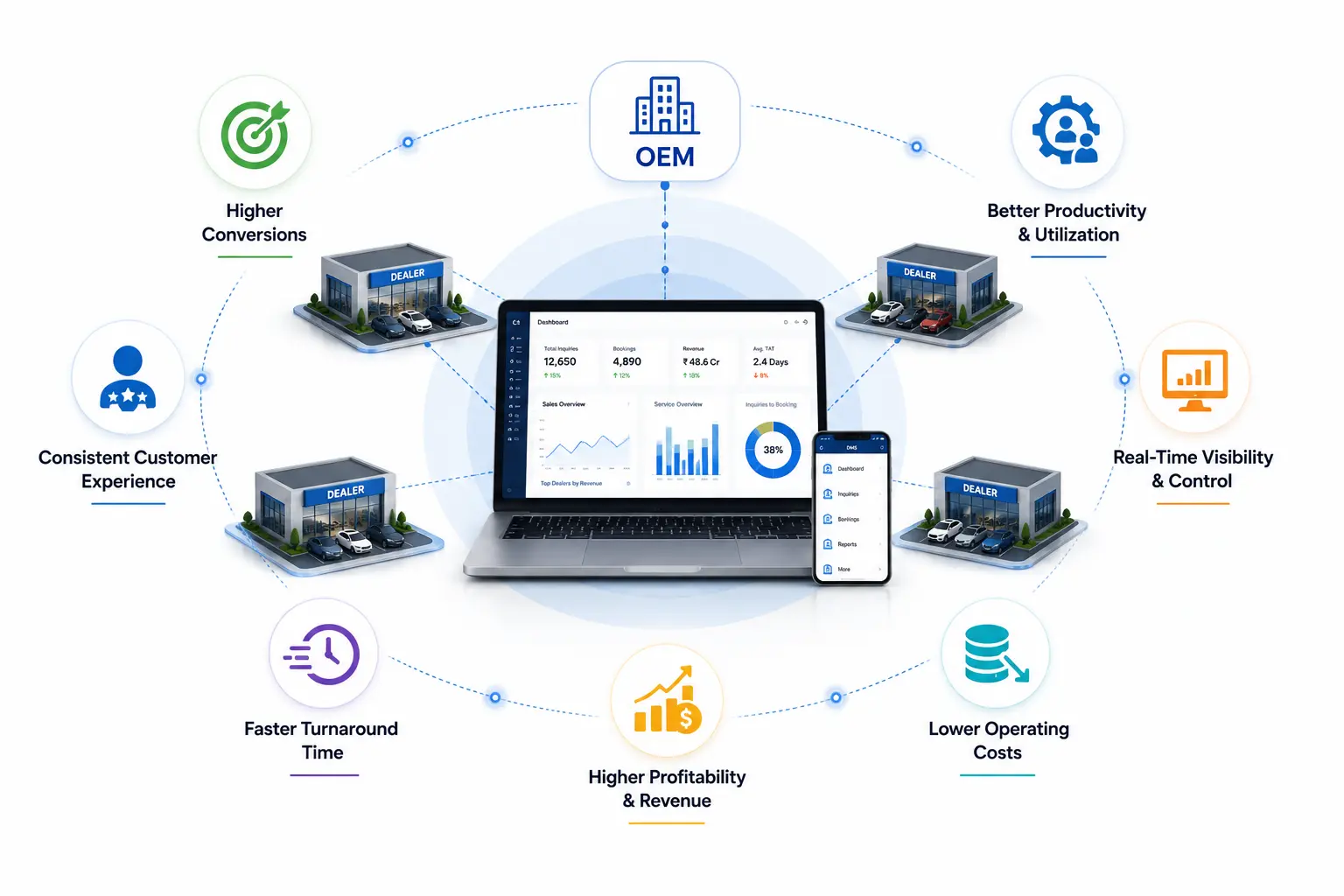
Standardizing dealer operations delivers measurable benefits for OEMs, including higher inquiry-to-booking conversion, a more consistent customer experience, shorter service turnaround times, improved workshop productivity, and lower operating costs across the dealer network.
- Higher inquiry-to-booking conversion, because no lead is lost between a phone call and a spreadsheet.
- Consistent sales and service processes across every dealer, regardless of size or location.
- Improved customer experience and satisfaction, since the buying and service journey feels the same at any outlet.
- Reduced vehicle sales and service turnaround time, from faster approvals and clearer workshop scheduling.
- Better workshop productivity and resource utilization, through structured technician and parts management.
- Stronger OEM and dealer visibility, with real-time dashboards replacing delayed manual reports.
- Lower operating costs and reduced manual effort by eliminating paper-based approvals and duplicate data entry.
- Higher dealer profitability and revenue, driven by faster, better-informed business decisions.
Conclusion
Running 100 or more dealer outlets on spreadsheets, phone calls, and paper job cards makes it impossible for an OEM to see its own network clearly. Standardizing dealer operations OEM-wide through one connected DMS platform replaces fragmented processes with a single sales and service workflow, standardized approval rules, and a real-time view of performance across every outlet. The result is faster conversion, shorter service turnaround, consistent customer experience, and a dealer network an OEM can actually manage from the center, not just monitor from a distance.
See Intelli DMS in Action
If your dealer network is still running on spreadsheets, WhatsApp, and paper job cards, it may be time to see what one connected platform can do across every outlet. Book a demo to see how Intelli DMS helps OEMs standardize sales and service operations across 100+ dealer outlets from a single platform.
FAQ
What does "standardize dealer operations" mean for an OEM?
It means every dealer in the network, regardless of size or location, follows the same sales and service workflows, approval rules, and reporting standards within a single shared platform, rather than running its own processes through spreadsheets or paper.
How is multi-dealer management software different from a regular DMS?
A regular DMS is often designed for a single location, while multi-dealer management software adds a network-wide layer. Dealer staff access only their outlet’s data, while OEM teams get a consolidated view of every outlet through a single dashboard, with standardized workflows enforced across the network.
How long does it take to roll out a DMS across 100+ dealer outlets?
Most OEMs use a phased approach, starting with a 4- to 8-week pilot involving a small group of dealers, followed by regional rollouts in batches. Rolling out a DMS across a 100+ outlet network typically takes several months, depending on data migration complexity, training requirements, and dealer readiness.
Can each dealer still customize workflows within a standardized DMS?
Core workflow stages, approval rules, and required data fields stay standardized across the network, since that is what makes OEM-level comparison possible. Dealers can customize non-critical settings, such as staff assignments and local notification preferences, without compromising network-wide standardization.
What is the biggest ROI from standardizing dealer operations?
The fastest and most significant ROI often comes from real-time visibility: OEMs can identify underperforming dealers, stalled approvals, and workshop delays early, rather than discovering them weeks later. This enables faster intervention and can improve conversion rates and service turnaround times across the network.


Explore More Insights


.webp)


About the Author

Nishant Sharma
Nishant Sharma is the Marketing & Sales Lead at Intellinet Systems, specializing in B2B sales, digital marketing, and automotive aftermarket solutions. With extensive experience in driving business growth, lead generation, and go-to-market strategies, he is passionate about helping businesses adopt innovative technologies that enhance operational efficiency and customer experience. Through his articles, Nishant shares practical insights on industry trends, emerging technologies, and best practices shaping the future of the automotive aftermarket.


