

Overview: Fragmented service records, unclear coverage, parts wear, and complex rental histories are reasons due to which heavy equipment rental fleets face warranty leakages. With automated warranty software, OEMs are enabled to validate claims, track equipment and part histories, and reduce avoidable payouts. Intelli Warranty helps streamline claim management and processing, policy administration, and supplier recovery. This helps improve financial control and visibility across heavy equipment service networks.

Introduction
The rental fleets of heavy equipment operate in environments where the machinery is often exposed to continuous workloads, harsh terrain, and extreme operating conditions. Equipment such as excavators, bulldozers, wheel loaders, and mini trucks often move between projects, operators and job sites, which makes warranty management very complex.
There are important questions raised for OEMs, dealers and rental fleet operators with every equipment failure: Does warranty cover the failed component? Has the operating hour limit been exceeded on the machinery? Who is responsible for the repair cost?
When disconnected systems manage warranty records, service history, and rental agreements, answering these questions becomes challenging. In such cases, eligible claims could be missed, invalid claims might be approved, and it also results in unclaimed supplier recovery opportunities.
These situations create financial leakage through unnecessary repair costs, delayed reimbursements, and administrative inefficiencies.
Modern warranty software supports OEMs and rental fleet managers in establishing structured workflows for claim management and coverage validation, and helps maintain visibility into warranty costs.
Rental fleet managers can strengthen financial controls while supporting more efficient aftersales operations by automating claim processing and supporting more efficient part-level traceability.
Key Takeaways:
- Effective management of equipment guarantees requires meticulous monitoring of operational hours, component lifecycle data, and specific policy terms.
- Frequent movement of machinery across diverse clients, site personnel, and work environments adds a significant layer of operational complexity.
- Distinct evaluation standards are required when assessing wear on undercarriages, hydraulic system breakdowns, or drivetrain maintenance.
- Relying on manual processes for handling requests elevates overhead expenses, delays payout schedules, and causes financial leakage.
- Automating coverage verification facilitates the detection of policy exclusions, missing records, and irregular filing trends.
- Intelli Warranty empowers organisations with adaptable rule configuration, streamlined approvals, advanced reporting, and vendor recovery tracking.
Gain better control over warranty costs and improve aftersales efficiency with AI-powered warranty management. Request a Free Demo of Intelli Warranty Today!
Why Is Heavy Equipment Warranty Management More Complex for Rental Fleet
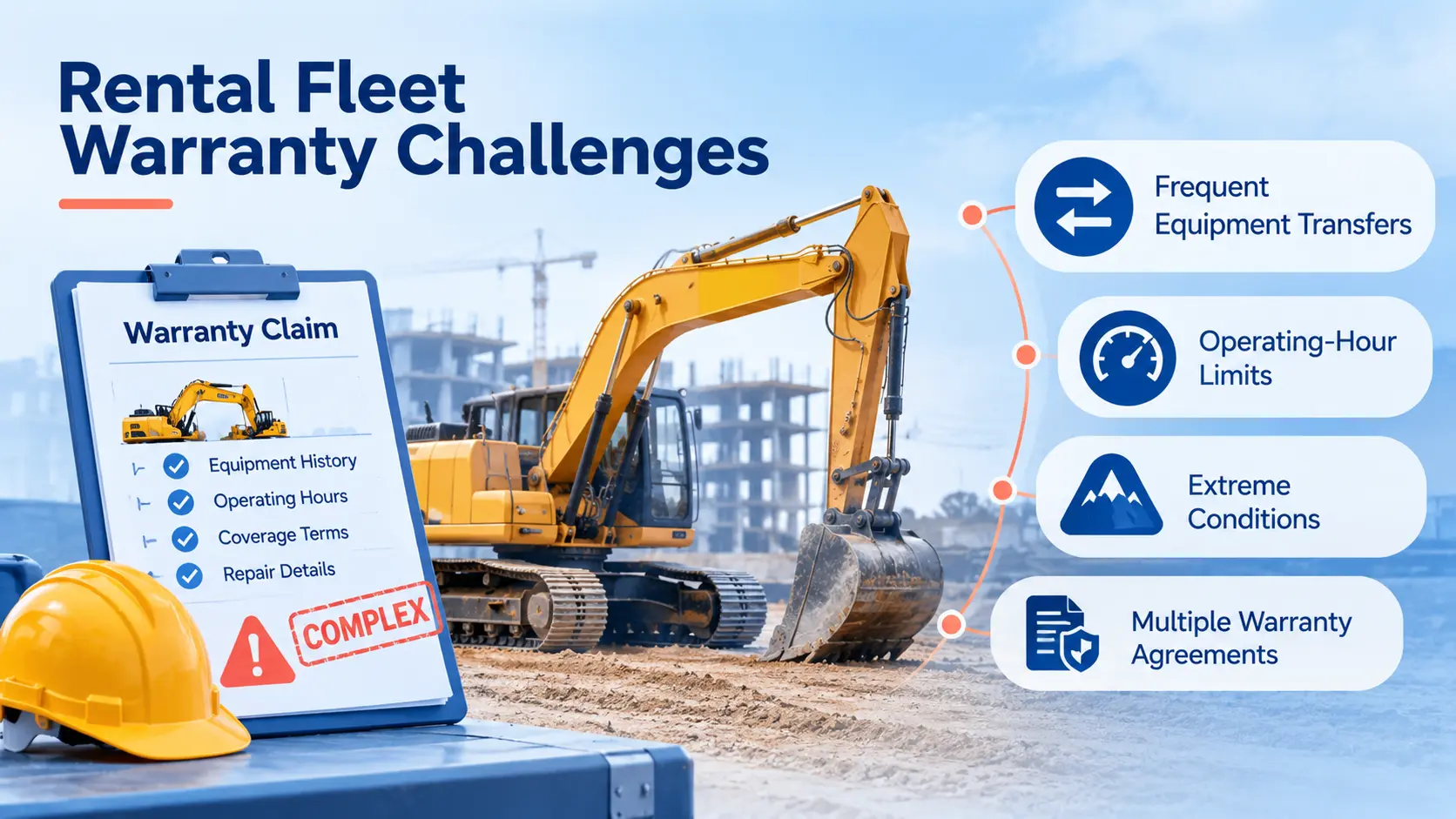
As rental machinery is used across multiple projects by different operators throughout its service lifecycle, its warranty management becomes more complex compared to privately owned equipment.
With each deployment, different risks associated with operating conditions, service requirements and potential damage risks are introduced.
Frequent Equipment Transfers and Changing Operators
As rental equipment frequently moves between customers and locations, each transfer creates a new operating record that adds relevance to a future warranty investigation.
Without accuracy in machine identification, rental dates, and service history, it becomes difficult to establish the first occurrence of an issue.
Operating-Hour-Based Warranty Coverage
In addition to calendar-based coverage periods, heavy equipment warranties often include operating-hour limits. This means that a machine might still be under warranty but could have exceeded its operating-hour threshold.
Warranty teams, therefore, need reliable hour-meter readings and service records to determine eligibility.
Extreme Operating Conditions
Mining and construction equipment often work in extreme conditions, which involve dust, vibration, heavy loads, abrasive materials, and temperature extremes.
Due to these conditions, the wear and tear of parts increases, resulting in increased maintenance costs.
A structured claim process helps reviewers take these factors into consideration.
Multiple Warranty and Service Agreements
Rental fleets often have multiple service and warranty coverage agreements. These could include OEM warranty, part-specific warranty, extended service contracts, and maintenance agreements.
Each agreement could have different exclusions, reimbursement conditions, and coverage periods.
Understanding Financial Leakage in Heavy Equipment Warranty Claims
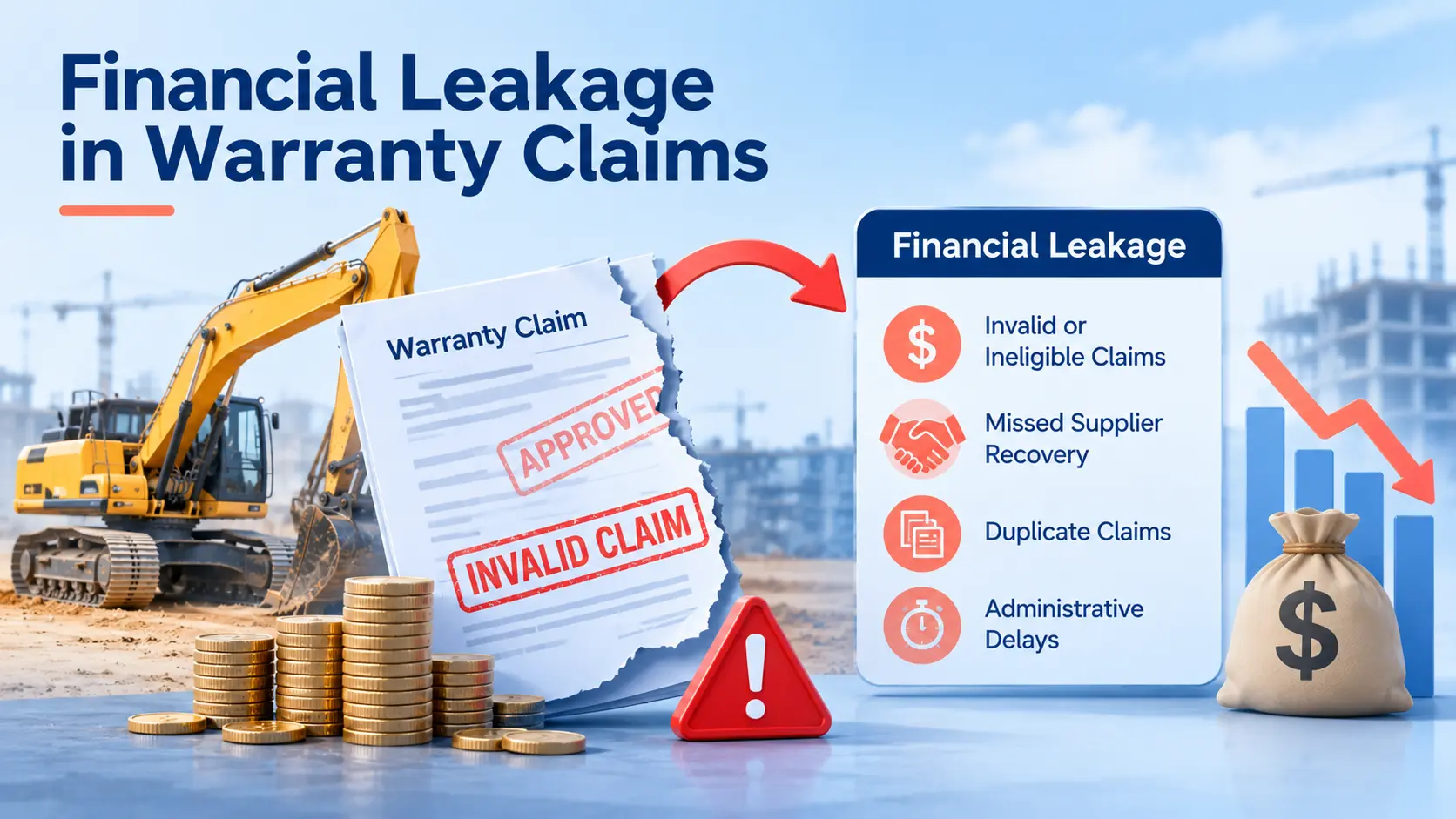
Warranty leakage happens when unnecessary financial expenditure is created due to inconsistencies in claim validation, policy administration, or recovery processes.
For heavy equipment rental fleets, this could add more than just part replacement costs.
Invalid or Ineligible Claim Payments
Many times, claims may be approved even when the coverage has expired, damage is excluded, repairs are unsupported, or maintenance documentation is missing.
Inconsistencies in claim validation can result in similar claim types receiving different decisions across dealers and service locations.
Missed Supplier Recovery Opportunities
Heavy equipment contains parts that are supplied by multiple manufacturers. These parts could be the hydraulic systems, electronic controls, powertrain assemblies and other specialised parts.
In the absence of clear parts identification and supporting evidence, supplier recovery opportunities could be missed or delayed.
Duplicate Claims and Repeated Repairs
When equipment transitions across rental branches, a single component breakdown frequently produces multiple disconnected service entries.
Without centralised visibility into past filings, claims assessors face difficulties in detecting redundant submissions or recurring mechanical failures.
Administrative Costs and Delayed Settlements
When rental fleets use manual claim processes, they have to collect documents, verify coverage, review repair costs, and coordinate approvals.
Each additional manual step increases the administrative effort and delays reimbursements.
According to the Cost of Quality framework established by the American Society for Quality (ASQ), warranty claim processing, equipment repair, and ongoing servicing represent significant external failure costs.
What Is Warranty Software for Heavy Equipment Rental Fleets?
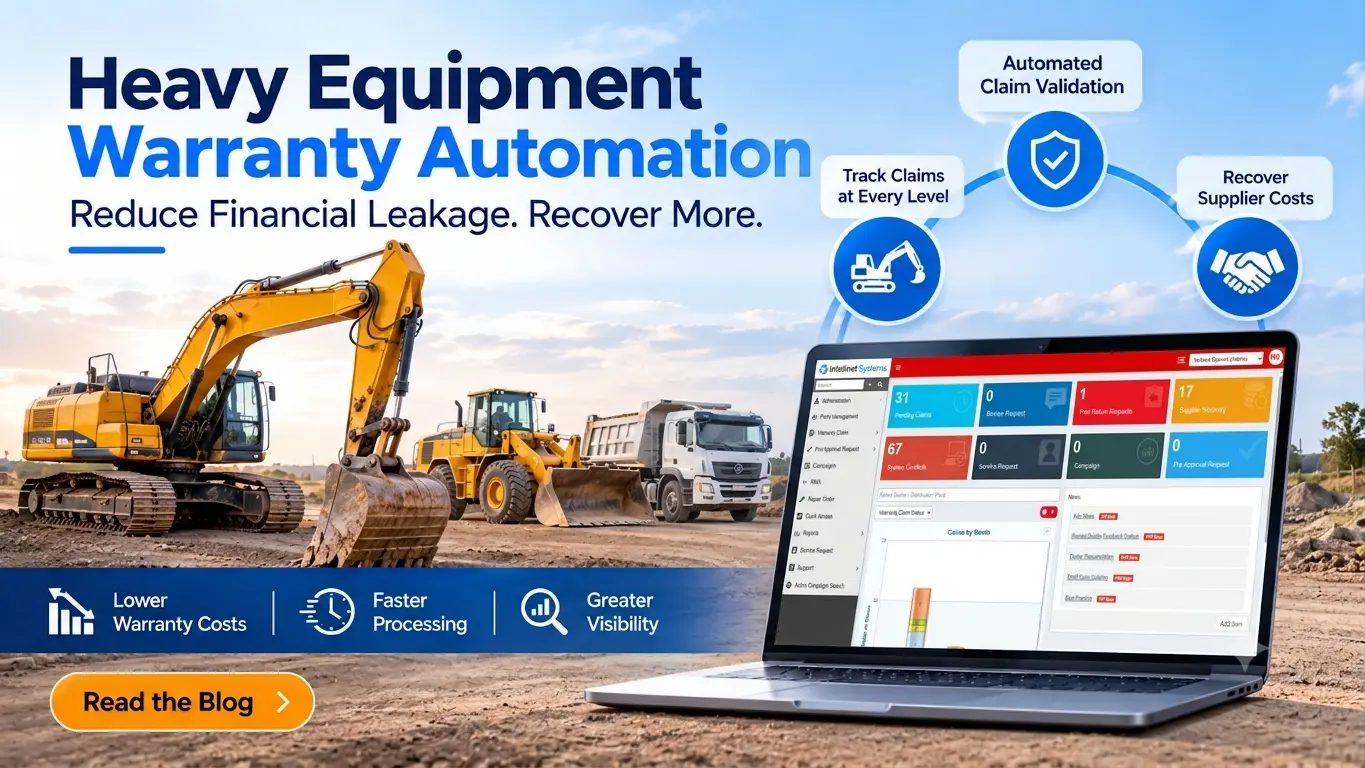
Warranty software is a digitised platform that helps manufacturers and rental fleet managers manage warranty policies, claim submissions, validations, approvals, and supplier recovery.
In the case of heavy machinery environments, it offers a standardised framework for evaluating submissions against machine-specific policy guidelines.
A thorough warranty file typically encompasses:
- Machinery designation and unique serial tracking identifier.
- Coverage effective dates and policy expiration benchmarks.
- Accrued operating hour metrics logged during component breakdown.
- Detailed identification of failed parts and root cause assemblies.
- Historical servicing records and preventative maintenance logs.
- Diagnostic fault indicators and technical evaluation observations.
- Itemised labour expenses and replacement component costs.
- Photographic evidence and formal site inspection paperwork.
- Governing warranty terms or supplemental service contract details.
- Filing authorisation status and financial reimbursement progress.
The warranty software uses all this information and helps support consistency in claim assessment and improves visibility into warranty expenditure.
Critical Warranty Challenges in Heavy Equipment Components
There are different warranty assessment criteria for different equipment. When every failure is treated as a standard replacement claim, it can create unnecessary costs and inconsistent decisions.
Undercarriage Wear and Warranty Eligibility
Normal wear and tear of undercarriage parts may be excluded from warranty coverage, whereas a defect in materials or workmanship could qualify for repair or replacement.
Warranty reviewers, therefore, need information related to inspection findings, maintenance records, and applicable coverage terms and policies to distinguish between such situations.
Hydraulic Pump Swaps and Component History
Causal part tracking is particularly important, as the part replaced during repair work might not be the part responsible for the original failure or issue.
When a hydraulic pump is replaced, the claim has to identify the failed part, replacement part and other relevant information related to the repair.
So, accurate information about part failure helps support warranty decisions.
Powertrain Coverage and Major Repairs
Substantial repair costs are incurred with the engine, transmission, axles, and other powertrain parts.
Eligibility for warranty could depend on operating hours, service intervals, and maintenance compliance.
Automated policy checks help match the claim with the underlying coverage policies and conditions before it progresses through approval.
Extended Policy Service Agreements
Many fleet operators purchase extended coverage or service protection plans to manage repair costs, even when the warranty period has expired.
These agreements could cover specific parts while not including normal wear and tear.
The Role of Rental Contract Tracking in Warranty Decisions
The operational context for warranty investigations is laid out by rental contract tracking.
Rental contracts help outline essential operational details, including client identity, lease timelines, machinery baseline status, authorised operational parameters, and designated obligations regarding maintenance routines or physical damages.
Relevant rental information can be used by warranty software when it is supplied through an integration or claim documentation.
As rental operations continue to expand in scope and importance, the necessity of robust service contracts becomes increasingly critical.
It was reported in EquipmentWatch’s 2025 State of Construction Equipment Economy that about 72% of total contractors surveyed had rented equipment in the last 12 months.
This report reinforces the need for rental equipment in the construction industry and the requirement for reliable asset and service information.
Business Benefits of Automating Heavy Equipment Warranty Claims
With the help of a structured warranty management process, measurable improvements can be made across finance, service operations, and supplier management.
Better Warranty Cost Control
Ineligible claims, unusual repair costs, and documentation gaps can be identified before payments are made. This can be achieved with the help of automated warranty claim validation.
Faster Claim Processing
There are many delays that are associated with manual review processes. Service teams can benefit from clear documentation requirements and more predictable claim decisions.
Improved Supplier Accountability
Linking claim submissions directly to part history and vendor documentation enables manufacturers to detect repetitive component failures while capturing valid supplier recovery opportunities.
Stronger Warranty Analytics
With warranty data, rental fleet managers can identify recurring failures and issues, high-cost equipment models, and unusual claim patterns. This can help them take corrective measures before there are more financial losses.
Improved Rental Fleet Service Experience
Rental fleet operators can plan repairs and communicate expected outcomes clearly when claim handling is more consistent and fast.
How Does Intelli Warranty Help Manage Warranty Claims for Rental Fleets?
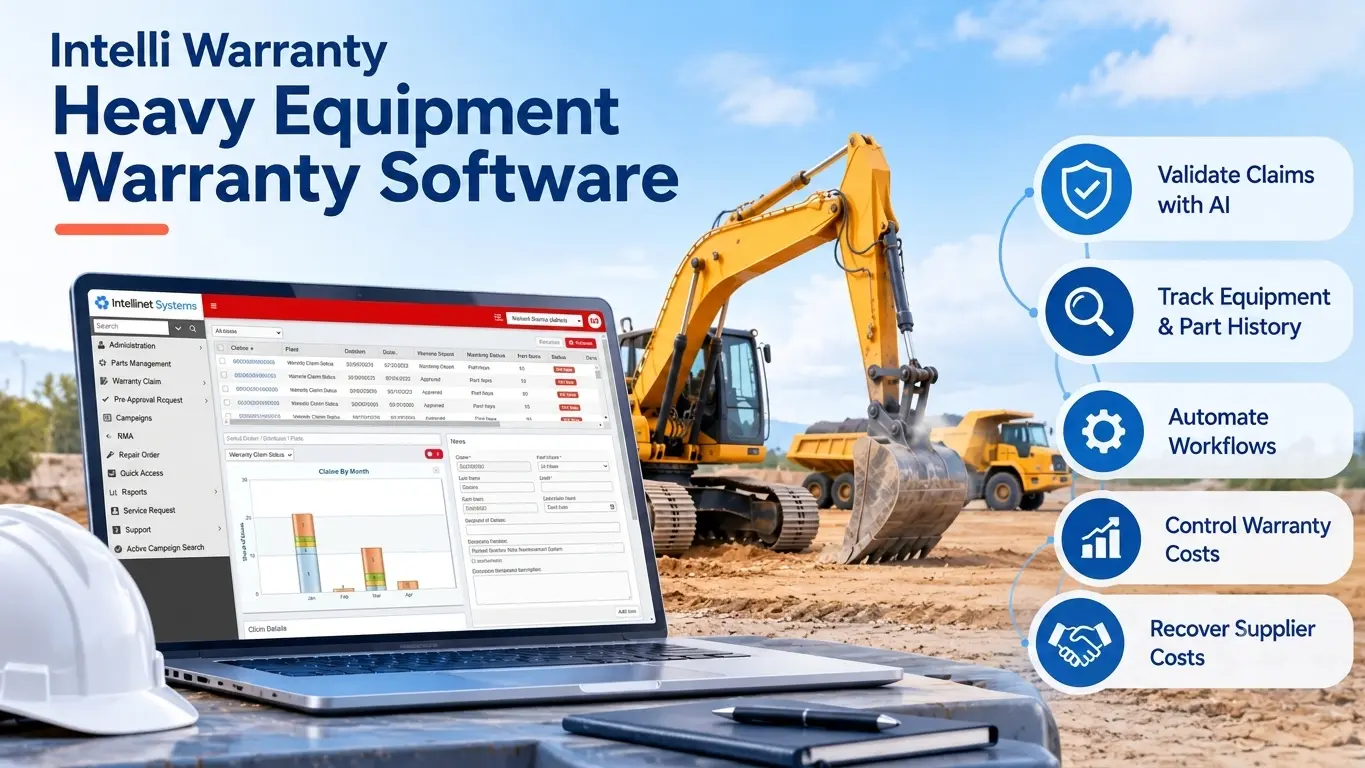
Intelli Warranty is an AI-powered warranty software designed by Intellinet Systems that helps manage warranty claims and automate supplier recovery.
In the case of heavy equipment rental fleet operators, it can help manage key activities such as policy administration, claim validation, approvals, and supplier recovery into a more structured process.
Configurable Warranty Policy Administration
With the help of Intelli Warranty, administrators can define part coverage, warranty terms, and parts categories.
This enables equipment OEMs with the management of multiple warranty rules across its equipment models and part categories.
AI-Powered Claim Validation
AI-powered analysis of claims helps in the identification of irregular values, repair patterns, dealer behaviour, and issues with the supporting documentation and evidence.
Automated Supplier Recovery
There is an inbuilt supplier recovery module that enables OEMs to manage recovery processes that are linked to approved warranty claims.
This warranty software also supports integration with ERP, DMS and CRM systems, thereby helping OEMs and rental fleet operators with a more connected and consistent system.
Guided Claim Submission and Approval Workflows
Intelli Warranty has structured workflows for claim submission, document uploads, automated validation, and configurable approval routing.
Work queues can be used to assign claims. This can be done using parameters such as product model, claim cost, and region.
By deploying Intelli Warranty, equipment manufacturers establish structured digital workflows that effectively mitigate warranty leakages while enhancing operational consistency across after-sales service networks.
To know more about Intelli Warranty and schedule a free demo, use the following link: Warranty Management Software
Conclusion
Heavy equipment rental fleets often move between projects and locations, have different operators and work under extreme conditions. This makes the management of warranty claims complex in this case.
In the absence of a consistent and reliable claims process, rental fleet managers can experience higher warranty costs and delayed or missed supplier recovery opportunities.
Warranty software can help rental fleet managers bring these activities into a connected workflow. It lays out a structured way for claim validation, approval management, tracking of costs, and supplier recovery.
Intelli Warranty is a state-of-the-art warranty software that helps bring policy administration, AI-powered claim validation, approval workflows, and supplier recovery into a unified platform.
For heavy equipment rental fleet operators looking to reduce financial leakage, reduce warranty costs, and implement a more organised and automated approach to warranty claims management, Intelli Warranty is the solution.
Take control of warranty costs with a more structured approach to claim validation, policy administration, and supplier recovery. Intelli Warranty helps heavy equipment OEMs streamline warranty workflows, identify irregular claims, manage approvals, and track eligible supplier recoveries. Schedule a Free Demo
Frequently Asked Questions
What is heavy equipment warranty software?
Heavy equipment warranty software enables OEMs and rental fleet operators to manage warranty policies, claim submissions, eligibility checks, and supplier recovery. It provides them with a unified platform and structured processes to automate the warranty management process.
What is causal part tracking in warranty management?
Causal part tracking helps in the identification of the part responsible for a failure or an issue. With causal part tracking, the difference between the part responsible for the failure and all parts replaced during repair can be distinguished.
How does Intelli Warranty help heavy equipment OEMs?
Intelli Warranty is a state-of-the-art warranty software that helps OEMs and rental fleet operators support configurable warranty policies, structured claim submissions, AI-powered claim validation, supplier recovery, and warranty analytics. These capabilities help improve financial control and reduce leakage in warranty processes.


Explore More Insights




About the Author

Nishant Sharma
Nishant Sharma is the Head of Demand Generation at Intellinet Systems, specializing in B2B marketing, sales, digital transformation, and automotive aftermarket solutions. He shares insights on emerging technologies, industry trends, and strategies that help OEMs and businesses improve operational efficiency, customer experience, and aftermarket growth.


