

Overview: Warranty leakage is the portion of an OEM’s warranty spend paid unnecessarily due to process gaps, data errors, or missed recovery, not necessarily fraud. Common causes include incorrect policy application, outdated parts or pricing data, inconsistent claim adjudication, and missed supplier recoveries. While individual gaps may seem small, they can become significant across thousands of claims. Reducing leakage requires consistent rules, accurate data, automated validation, and systematic recovery processes, supported by software such as Intelli Warranty.
Key Takeaways:
- Warranty leakage is primarily a process and data problem. Fraud is one contributor, but significant leakage can also result from claim entry errors, incorrect policy application, missed approvals, and supplier recovery opportunities that are never triggered.
- OEM warranty leakage is often hard to see because dealer claims, supplier recovery, and parts and pricing data typically live in separate systems.
- Reducing leakage means enforcing policy and parts validation rules at the point of claim entry, not reviewing claims after they have already been paid.
- Supplier recovery is one of the largest and most avoidable sources of leakage because it is manual, time-bound, and easy to miss without a system trigger.
- Warranty management software can reduce leakage by automating rule checks, approvals, and supplier recovery, but it cannot fix poor catalog, parts, or coverage data on its own.
Reduce Warranty Leakage Before It Becomes a Cost Problem. Request a Free Demo
What Is Warranty Leakage in Automotive OEM Operations?
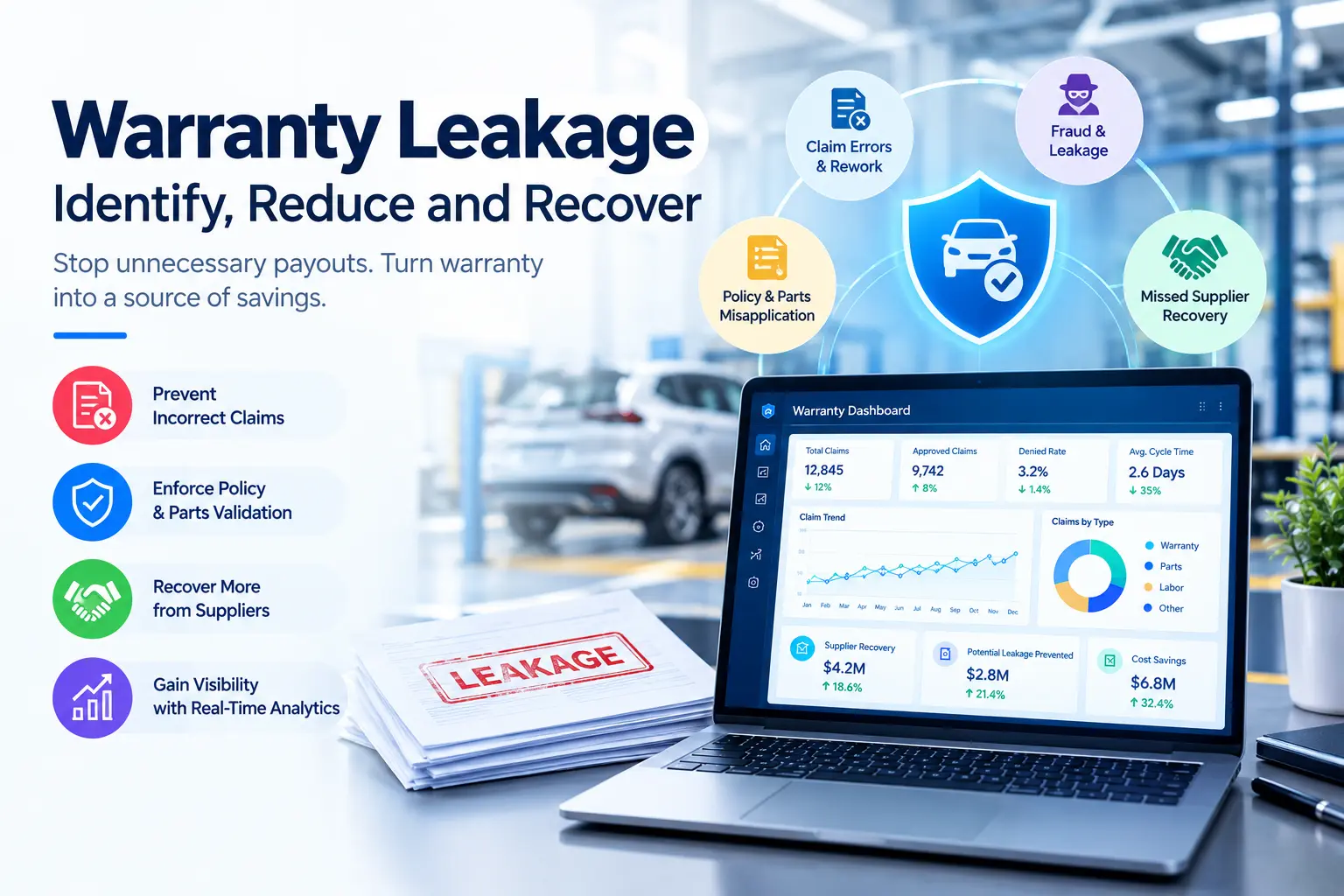
Warranty leakage is warranty spend an OEM did not need to pay: claims that should have been rejected or reduced, supplier costs that were never recorded, and payouts based on outdated policy terms, incorrect part numbers, or inconsistent adjudication. It is a byproduct of process gaps, not simply a synonym for fraudulent claims.
Warranty fraud is real and does contribute to leakage. It can include a dealer or repair shop submitting a claim for work that was never performed or misrepresenting a failure to qualify for coverage. However, in many OEM warranty operations, fraud represents only part of the problem. A significant share of leakage comes from routine process breakdowns, such as incorrect claim entries, policy misapplication, missed approvals, and supplier recovery opportunities that are never triggered. Common examples include:
- A claim submitted under “Post-Sale” when it should have been logged as a campaign claim, so it never gets matched to the campaign’s separate reimbursement terms.
- A part listed on the claim that was superseded months earlier, so the supplier back-charge goes to the wrong supplier code or gets rejected outright.
- Labor time approved based on the technician’s requested hours rather than the OEM’s published standard repair time because the adjudicator did not have the approved labor standard available.
- A goodwill claim approved outside policy because a service advisor escalated it and the reviewer wanted to protect the customer relationship, without a record of why the exception was made.
Each of these is explainable on its own. Multiplied across thousands of claims a quarter, they add up to real dollars that never should have left the business.
Where Does Warranty Cost Leakage Actually Happen?
Warranty cost leakage concentrates at five points in the claim lifecycle: claim submission, policy interpretation, parts and pricing validation, supplier recovery, and adjudication consistency. Each stage depends on a different team and a different system, which is exactly why gaps between them are hard to catch with manual review.
Why Do Manual Warranty Processes Make Leakage Hard to Catch?
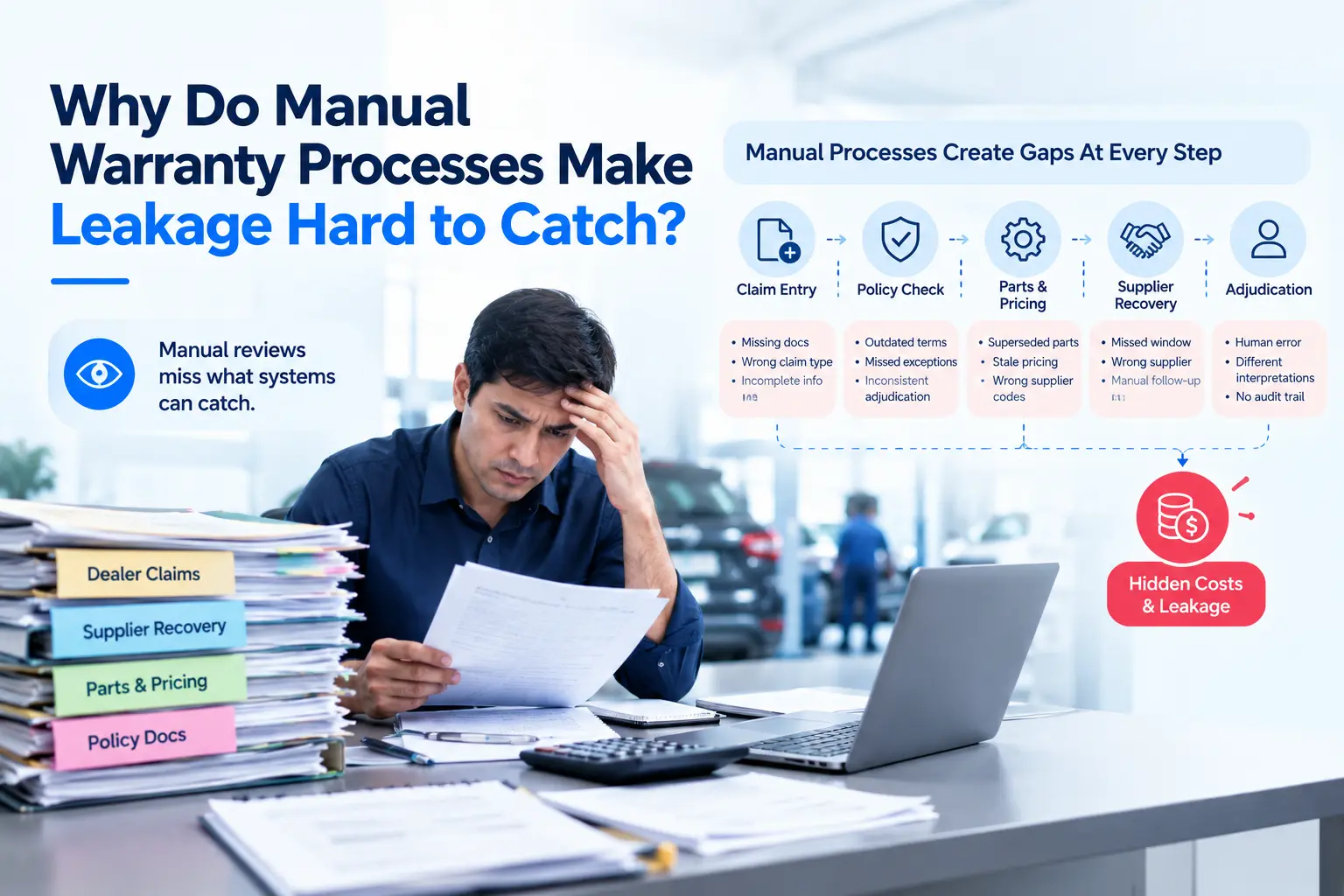
Manual claim review does not scale to the volume an OEM warranty department actually handles. Reviewers process claims one at a time, against whatever reference material they have open, with no automatic cross-check against parts data, standard repair times, or prior claims on the same VIN. Leakage hides in that gap.
This is not a knock on warranty teams. It is a reflection of how the work is structured when it depends on spreadsheets, email approvals, and separate systems for parts, policy, and supplier data. A few operational realities that make leakage hard to see until an audit or a supplier dispute surfaces it:
- Adjudicators reviewing high claim volumes rarely have time to cross-reference every part number against the current catalog or every labor line against the published standard time.
- Supplier recovery is often a separate, downstream step, so an approved claim can sit for weeks before anyone checks whether the cost is recoverable from a supplier.
- Without a system that aggregates claims across dealers and regions, a pattern (the same failure code spiking at one dealer, or one supplier) does not become visible until someone runs a manual report.
- There is usually a lag between when a claim is paid and when anyone reviews it for accuracy, by which point recovery windows with suppliers may already have closed.
How Can OEMs Reduce Warranty Claims Leakage?
OEMs reduce warranty claims leakage by moving validation earlier, to the point of claim entry, rather than reviewing claims after payment. That means configuring policy rules once at the parameter level, automatically validating parts and pricing, and triggering supplier recovery as soon as a claim is approved rather than treating it as a separate manual process.
In practical terms, this looks like a specific set of operational changes rather than a single tool purchase:
- Standardize policy configuration: define coverage, terms, model versions, and reimbursement rules centrally so every dealer and reviewer works from the same rules, reducing errors caused by inconsistent or local interpretation.
- Validate parts and pricing at submission: cross-check part numbers, supersessions, and current supplier pricing against the claim as it is entered, using integration with the parts catalog and ERP (for example, SAP), rather than after the fact.
- Automate supplier recovery on approval: generate the supplier claim automatically the moment a dealer claim is approved, so recovery does not depend on a separate team remembering to act within the supplier’s filing window.
- Keep an audit trail for every decision: record why a claim was approved, rejected, or approved as an exception, making goodwill and partial approvals traceable rather than informal.
- Monitor claims data for outliers: compare claim volumes, failure codes, and repair times across dealers, suppliers, and regions to identify unusual patterns early, rather than waiting for an annual audit.
This is the operational core of what warranty management software for OEMs is meant to do: enforce the rules consistently, at scale, across every claim, rather than relying on a reviewer’s memory or a spreadsheet macro.
The Role of Technology, and Where It Depends on Data
Technology can enforce rules consistently and flag anomalies faster than a manual review process, but it cannot compensate for bad catalog data, undefined policy rules, or inconsistent business logic. AI-based anomaly detection is only as useful as the historical claims data and part-fitment data it is checking against.
This distinction matters for OEM decision-makers evaluating a system. Dashboards that flag an unusual spike in a failure code are useful, but only if the underlying claim, part, and dealer data feeding the dashboard is clean and consistently coded. Anomaly detection that compares claim behavior across dealers depends on those dealers using the same claim types and part numbers in the first place. A system can highlight where a supplier recovery was missed, but only if the parts and pricing master data it references is current. In other words: the software automates the checking and the workflow, and the OEM still owns the underlying data quality and policy definitions that make the checking meaningful.
Intelli Warranty: Reducing Warranty Leakage for OEMs
Intelli Warranty is a warranty claim and supplier recovery management software built for OEMs, covering the full cycle from dealer claim submission to supplier cost recovery. It is designed to close specific leakage points: inconsistent policy application, missed supplier recovery, and limited visibility into claim status and trends.
Rather than positioning this as a general claims tool, it is worth being specific about what the system actually does, based on how it is structured:
- Policy administration and configuration: OEMs define part and component coverage, warranty terms, model versions, and reimbursement terms centrally so dealers and adjudicators are applying the same rule set.
- Claim workflow for dealers: claim creation uses templates, document upload, and validation checks, and supports multiple claim types (OEM PDI, Dealer PDI, Post-Sale, Campaign, Goodwill, and Spare Parts).
- Parts management and integration: integrate with SAP and other systems to maintain part pricing, supplier information, and exceptions, with EPC integration supporting automated parts validation.
- Supplier recovery automation: supplier claims are generated automatically once a dealer claim is approved, with system logic driving the identification and an option for manual regeneration when a claim needs correction.
- Claim administration with an audit trail: log every decision, with configurable auto-approval rules and support for partial approvals, so exceptions are consistently documented and traceable rather than handled informally.
- Dashboards and reporting: pre-built dashboards support drill-down from KPIs to transaction-level detail, anomaly flagging on unusual claim behavior, and peer benchmarking across dealers, suppliers, and geographies, alongside Excel, PDF, and Microsoft SSRS reporting.
Intelli Warranty is available across web, native Android, and native iOS, which matters for dealer technicians who are more likely to file a claim from a mobile device on the shop floor than from a desktop terminal.
What Does Reducing Warranty Leakage Mean for OEM Operations?
Reducing warranty leakage does not automatically generate savings; it removes the specific process gaps that were causing unnecessary payouts. The realistic outcomes are a warranty reserve that better reflects actual risk, more supplier costs recovered within contractual windows, and fewer claims decided inconsistently across dealers.
At the end of 2024, Ford, General Motors, and Tesla together held $31.32 billion in warranty reserves, the largest combined total ever recorded, according to Warranty Week’s analysis of the companies’ SEC filings. That figure reflects rising parts and labor costs across the industry, but it also underscores why even a small percentage of avoidable leakage, spread across a reserve of that size, represents a material amount of money. An OEM does not need to eliminate all leakage to see a difference; closing the most common gaps (missed supplier recovery and inconsistent adjudication) is usually where the first real reduction in unnecessary spend shows up.
None of this replaces sound engineering quality control. Warranty leakage reduction addresses what an OEM pays out beyond what the actual failure rate justifies. It does not reduce the underlying failure rate itself, which remains a product quality and design question.
Conclusion
Warranty leakage is not a single failure; it is an accumulation of small, explainable gaps in claim submission, policy interpretation, parts validation, and supplier recovery. Because OEM warranty programs run at scale across many dealers and suppliers, those small gaps compound into a real cost that shows up in claims expense and reserve accuracy. Reducing warranty leakage means enforcing policy and part rules consistently at the point of claim entry, automating supplier recovery so it does not depend on manual follow-up, and keeping a clear audit trail so exceptions are visible rather than informal. Systems such as Intelli Warranty support this by structuring workflows and automating key checks, but the OEM’s policy definitions and data quality ultimately determine how much leakage can actually be closed.
Calculate Your Warranty Leakage
If supplier recovery, policy consistency, or claim visibility is where your team suspects the leakage is happening, the fastest way to find out is to put your own claim volume, supplier recovery rate, and adjudication patterns against Intelli Warranty’s policy administration, supplier recovery automation, and audit trail features. Calculate Your Warranty Leakage with Intelli Warranty and see where your OEM’s claim types, supplier terms, and dealer volume are costing you more than they should.
FAQ
What is warranty leakage in the automotive industry?
Warranty leakage is warranty spend an OEM pays out unnecessarily due to process gaps rather than legitimate repair costs. It includes claims that should have been rejected or reduced, missed supplier recovery, and payouts based on outdated policy or part data, rather than deliberate misrepresentation alone.
How is warranty leakage different from warranty fraud?
Warranty fraud is a deliberate misrepresentation, such as billing for work not performed. Warranty leakage is broader: it includes fraud, but most of it comes from honest process breakdowns like inconsistent adjudication, missed part supersessions, and supplier recovery that was never filled in time.
What causes OEM warranty leakage?
Common causes of OEM warranty leakage include inconsistent policy interpretation across dealers, incomplete claim documentation, outdated part or pricing data, missed supplier back-charges, and adjudicators approving claims without cross-checking standard repair times or current coverage terms.
How can OEMs reduce warranty cost leakage?
OEMs reduce leakage by centralizing policy configuration, validating parts and pricing at the point of claim entry, automating supplier recovery on approval, keeping an audit trail on every decision, and monitoring claims data for outliers across dealers and suppliers.
Does warranty management software eliminate warranty leakage?
No single system eliminates it. Software can enforce rules consistently and automate recovery and reporting, but it depends on accurate parts, pricing, and policy data. Poor catalog data or undefined business rules will limit what any system can catch.


Explore More Insights




.webp)


About the Author


Nishant Sharma
Nishant Sharma is the Head of Demand Generation at Intellinet Systems, specializing in B2B marketing, sales, digital transformation, and automotive aftermarket solutions. He shares insights on emerging technologies, industry trends, and strategies that help OEMs and businesses improve operational efficiency, customer experience, and aftermarket growth.


