

Overview: Logistics inspection blind spots are unmonitored handoff points between the port, carrier, and dealer where vehicle condition may go unrecorded. As responsibility shifts with each custody change, damage that occurs during these transitions can be discovered late, making it harder to trace, assign accountability, and resolve. This article maps where blind spots form across the port-to-dealer journey, why manual inspection cannot close them on its own, and how VIN-level digital inspection, including pre-delivery inspection software, gives OEMs the audit trail needed to catch damage early and assign it correctly.
Key Takeaways:
- Vehicle logistics inspection blind spots often emerge during custody changes, including port unloading, rail transfers, yard storage, and final-mile delivery.
- Vehicle damage during transportation is usually discovered at the dealer, days or weeks after it actually happened.
- Paper-based, spot-check inspections cannot keep pace with high-volume vehicle movement, which is why gaps persist.
- A documented vehicle condition inspection at every handoff builds the audit trail needed to assign liability correctly.
- Vehicle inspection before dealer delivery, run through software, cuts disputed claims and speeds up dealer acceptance.
Close Logistics Inspection Gaps with Digital PDI -See how Intelli PDI creates VIN-level, photo-backed inspection records across every handoff. Request a Free Demo
What Are Logistics Inspection Blind Spots?
Logistics inspection blind spots are the points in the port-to-dealer journey, port terminals, rail yards, transload facilities, and carrier handoffs, where no formal inspection or documentation takes place. Vehicle condition is assumed instead of verified at these points, so damage can occur without anyone recording when or where it happened.
A finished vehicle typically changes hands five or six times between the plant or port and the dealer lot: ocean carrier, port processor, rail or truck carrier, regional storage yard, final mile hauler, and the dealer. Each handoff is a potential blind spot unless someone performs and logs a vehicle condition inspection at that exact point, with a timestamp, photos, and a signature.
Common blind spot locations include:
- Port unloading from RoRo vessels, where hundreds of vehicles move in a short window
- Transfer from rail car to truck at intermodal ramps
- Storage yards where vehicles sit for days or weeks with no active custody check
- Multi-car hauler loading and unloading
- The final leg into the dealer lot
When a vehicle arrives at the dealer with a new scratch or dent, the OEM is often looking at three or four possible parties and no clear record of who had the vehicle when the damage occurred. That is the practical cost of a blind spot: not just the repair, but the time spent figuring out who pays for it.
Where Does Vehicle Damage During Transportation Happen Most?
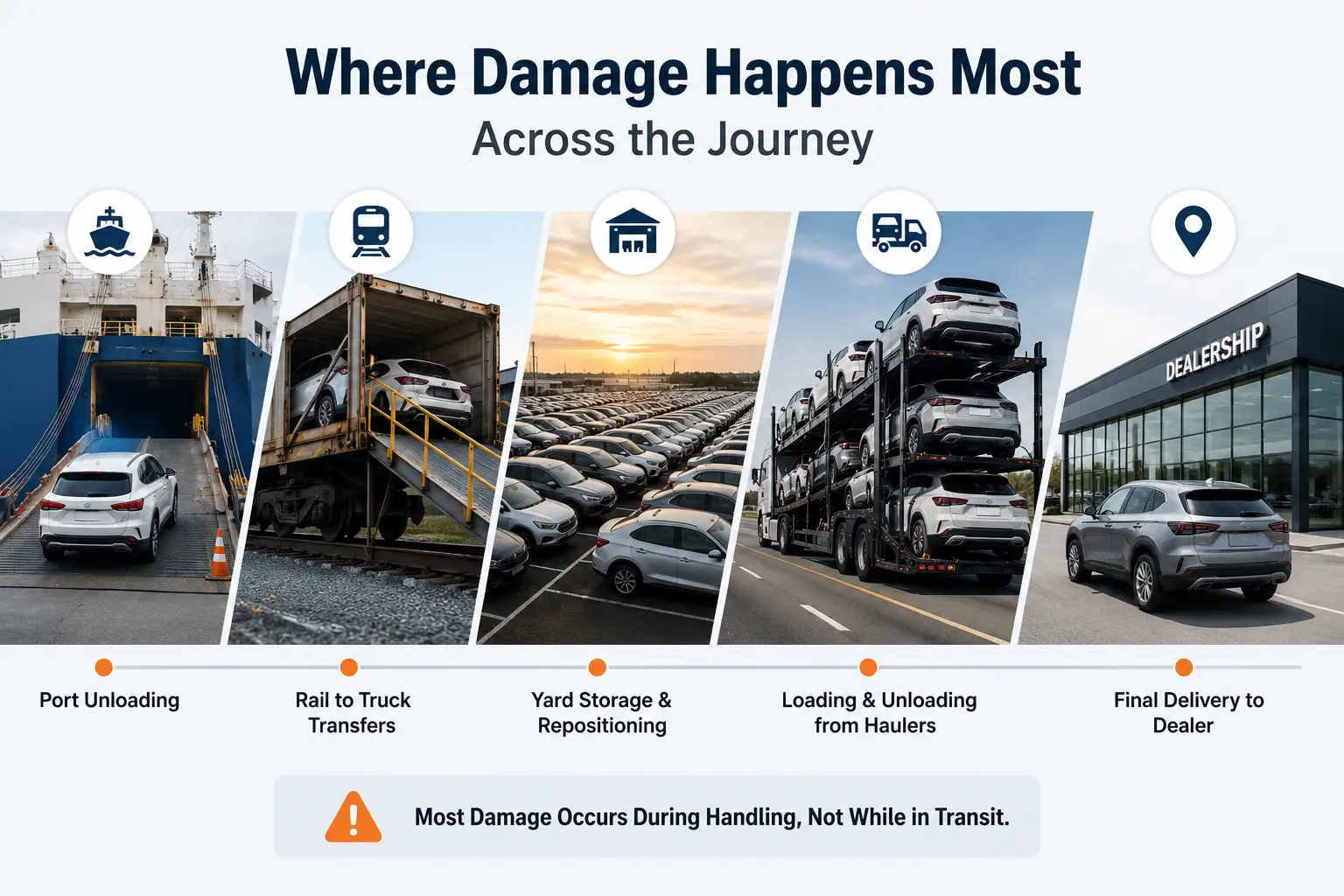
Vehicle damage during transportation happens most often during loading, unloading, and yard handling, not while the vehicle is moving on the highway or rail line. Ramps, chains, forklifts, and repeated handling by different crews create the highest risk points in the entire journey.
According to AIAG's most recently published estimate, based on 2018 vehicle sales figures, roughly 1 percent of the 17.2 million vehicles sold in the United States each year are damaged during transportation. That translates to approximately 172,000 damaged vehicles and nearly $172 million in annual repair costs, excluding additional inventory carrying costs and lost sales caused by delayed deliveries.
High-risk handling points include:
- RoRo vessel unloading at the port
- Rail to truck transfers at intermodal ramps
- Yard storage and repositioning
- Loading and unloading from multi-car haulers
- Final mile delivery to the dealer
Each of these events involves physical contact with the vehicle by a different crew, using different equipment, often under time pressure to hit a schedule. Damage at these points is rarely intentional. It is the byproduct of speed, tight spacing, and inconsistent inspection standards from one facility to the next.
Why Vehicle Inspection During Logistics Fails to Catch Everything?
Vehicle inspection during logistics often falls short when they rely on paper checklists, inconsistent standards across facilities, and rushed inspectors trying to keep vehicles moving. Without a shared digital record, each party inspects its own standard, and the gaps between those standards become blind spots.
Paper-based inspection has three built-in weaknesses:
- No timestamp or location proof: a handwritten note does not confirm when or where an inspection happened
- No photo evidence: without images, a damage claim comes down to one party's word against another's
- No shared visibility: each company keeps its own paper trail, so the OEM cannot see the full journey in one place
Even facilities that inspect every vehicle can still miss damage if their process only checks for large, obvious issues. Smaller items, hairline scratches, minor dents, interior wear, are easy to skip when an inspector is processing hundreds of vehicles a shift.
What Is the Business Cost of Skipping Vehicle Condition Inspection at Each Handoff?
Skipping a vehicle condition inspection at any handoff shifts the cost of damage onto whichever party is holding the vehicle when the damage is finally noticed, usually the OEM or the dealer. This creates disputed claims, delayed dealer acceptance, and vehicles held out of sellable inventory while the issue is investigated.
The delay can extend well beyond the initial inspection. Automotive logistics benchmarks put serious damage and service dispute resolution at roughly 7–10 business days, while programs averaging 20 days or more can accumulate high downstream administrative costs. For a vehicle held out of sellable inventory, every additional day adds carrying costs and delays its delivery to the customer.
- Disputed liability: without a record at each point, it is hard to prove which carrier or facility caused the damage
- Delayed dealer acceptance: dealers may refuse or delay accepting a vehicle until damage is documented and resolved.
- Idle inventory: a vehicle under dispute cannot go on the lot, which ties up capital and slows turnover
- Reputational cost: repeated damage issues affect dealer trust in a specific carrier or transport lane
For OEMs managing thousands of vehicle movements a month, even a small percentage of undocumented damage adds up to a meaningful cost, both in direct repairs and in the administrative time spent chasing down responsibility.
How Vehicle Inspection Before Dealer Delivery Closes the Gap
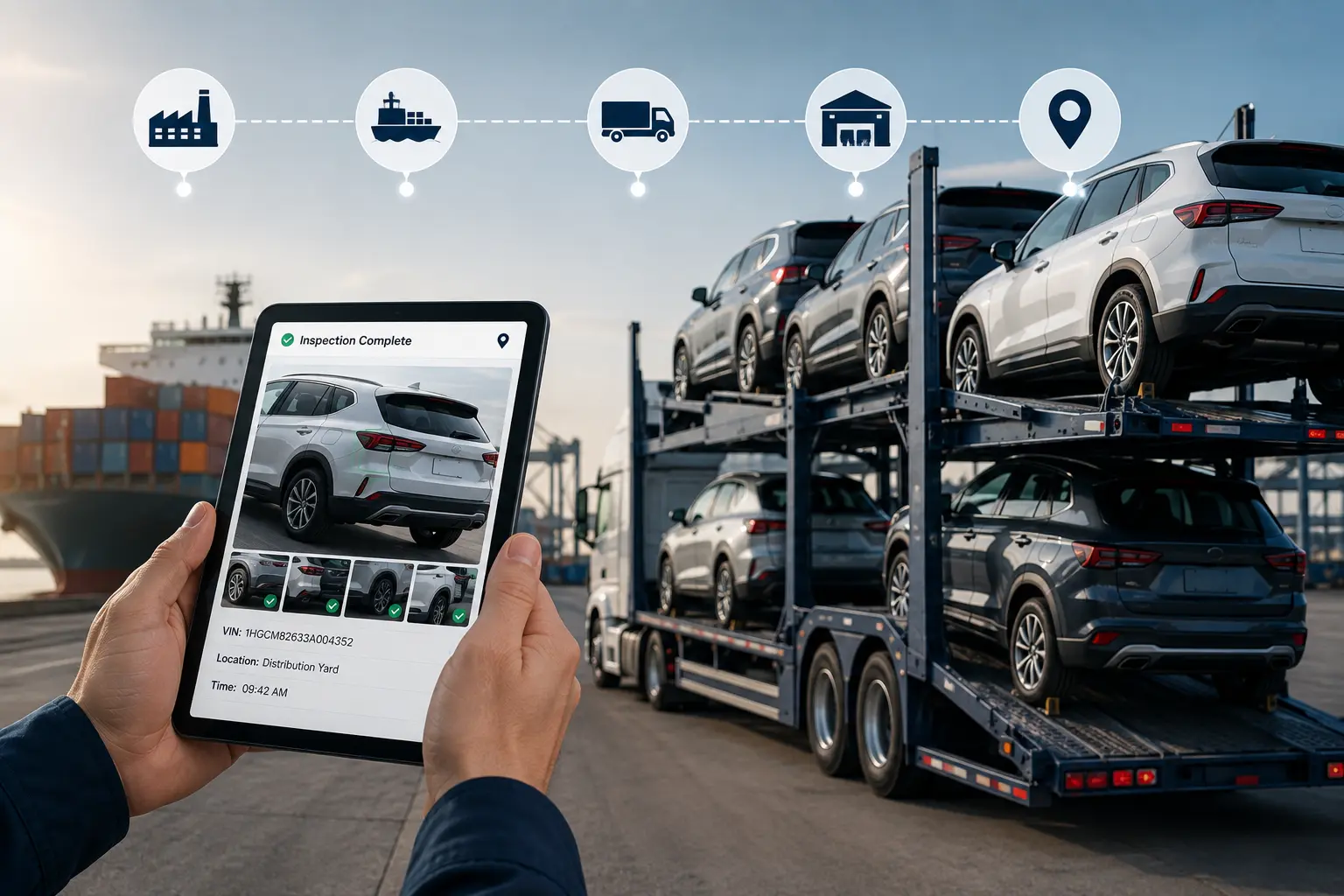
Vehicle inspection before dealer delivery closes the gap by creating a final, documented condition check that either confirms the vehicle is clean or flags damage before the dealer takes ownership. This shifts disputes back to the correct point in the chain and gives the dealer confidence in what they are accepting.
A pre-delivery inspection is most useful when it is:
- VIN specific: tied to the individual vehicle, not a batch or lot
- Photo documented: images attached to the record, not just a checklist
- Time-stamped: proving exactly when the inspection happened
- Standardized: using the same damage codes and severity scale across every facility
When this step is consistent, it becomes the reference point for resolving disputes that follow. If damage is identified after delivery, the pre-delivery record can show whether it was already present or occurred afterward.
How Does Manual Vehicle Damage Detection Compare With Digital Tools?
Manual vehicle damage detection depends on an inspector's attention, lighting, and available time, which makes it inconsistent across shifts and facilities. Digital tools use structured photo capture, guided checklists, and sometimes AI-assisted image review to catch damage that manual checks are more likely to miss.
Manual inspection:
- Depends on individual inspector judgment
- Hard to standardize across multiple facilities
- Limited photo documentation, if any
- Slow to search or retrieve historical records
Digital inspection:
- Guided capture points ensure the same angles are checked every time
- Photos and notes are tied to the VIN automatically
- Records are searchable and shareable across every stakeholder in the chain
- Patterns across lanes, carriers, or facilities become visible over time
The difference matters most at scale. A single dealer can manage paper records for a handful of vehicles a week. An OEM moving thousands of vehicles a month across multiple regions cannot get the same visibility without a digital system.
Closing Blind Spots with Digital PDI Software
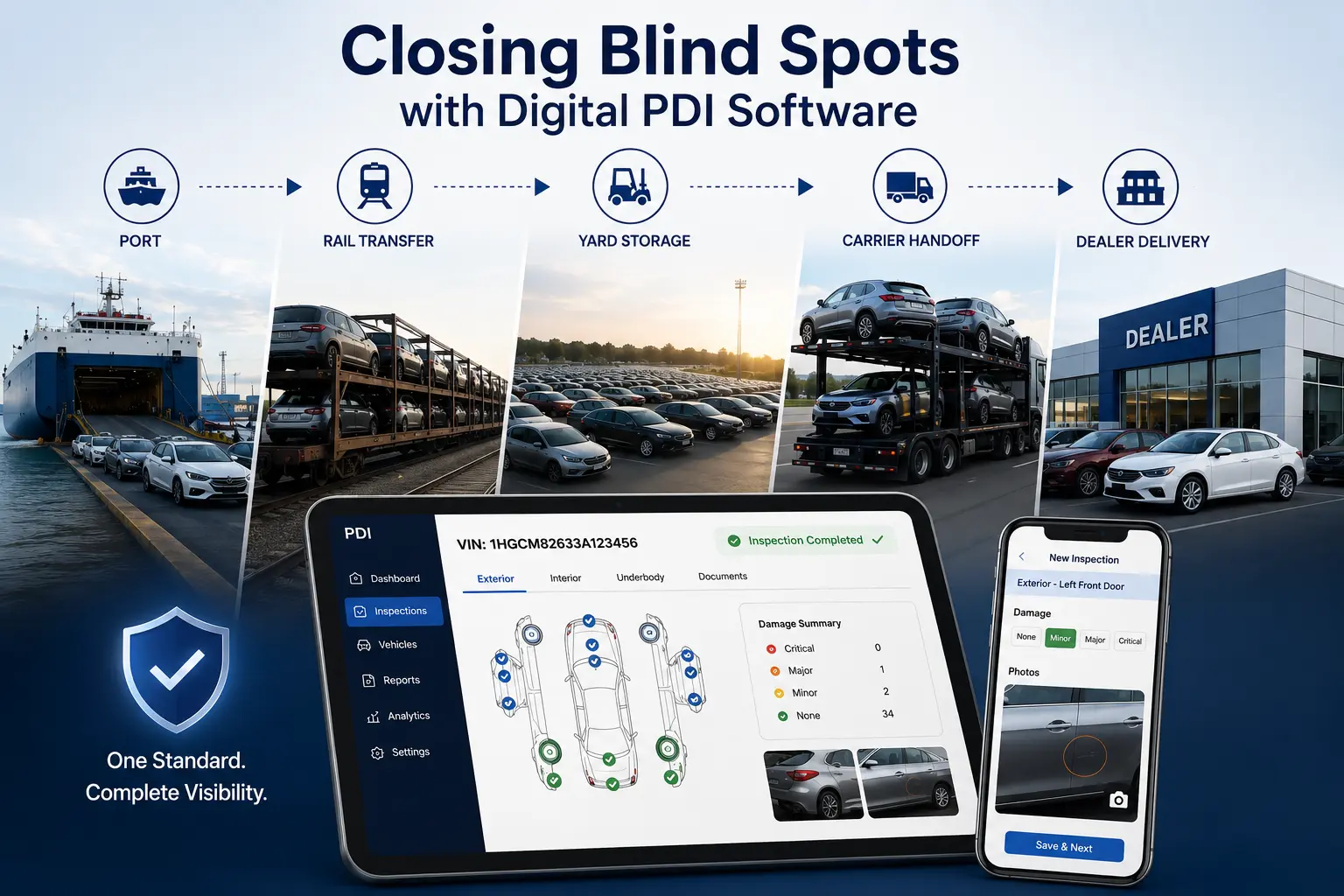
Digital PDI software closes logistics inspection blind spots by giving every stakeholder- port, carrier, yard, and dealer- the same digital process to record vehicle condition at each handoff. This creates a continuous, VIN-level record, replacing disconnected paper trails with a single traceable history.
Intelli PDI standardizes vehicle condition inspections through guided photo capture, structured damage codes, and VIN-level records that remain linked to the vehicle from initial inspection through final delivery.
For OEMs and dealer networks, this means:
- A consistent inspection standard across every facility in the network
- Photo-backed evidence that supports or resolves damage claims quickly
- Faster dealer acceptance because condition is verified before the vehicle arrives
- Visibility into which lanes, carriers, or facilities generate the most damage over time
Instead of discovering blind spots after a dispute, OEMs can use this data to close them before they cost money.
Conclusion
Logistics inspection blind spots are not a minor operational detail. They are the reason damaged vehicles reach dealers without a clear record of what happened or who is responsible. The gap forms at every custody change between the port and the dealer lot, and it grows wider wherever inspection is inconsistent, paper-based, or skipped under time pressure.
Closing that gap does not require slowing down vehicle movement. It requires consistent, VIN-level vehicle condition inspections at every handoff, supported by timestamped photos that provide clear evidence when a claim is disputed. OEMs that build this into their process before dealer delivery see fewer disputed claims, faster dealer acceptance, and a clearer picture of where damage actually happens across their network.
See Your Inspection Gaps Before They Cost You
Book a demo to see how VIN-level inspection at every handoff closes logistics inspection blind spots between port and dealer delivery.
FAQ
What are logistics inspection blind spots?
They are handoff points in the vehicle supply chain, such as port terminals, rail yards, and carrier transfers, where vehicle condition is not formally inspected or recorded. Because no one documents the vehicle at these points, damage that happens there is often discovered later and hard to trace back to a specific cause.
Why does vehicle inspection before dealer delivery matter?
A pre-delivery inspection creates the final documented checkpoint before a dealer accepts a vehicle. It documents the vehicle’s condition with timestamped photos, protecting both the OEM and dealer when a damage dispute arises after the vehicle changes hands.
Can software actually reduce vehicle damage during shipping?
Software cannot prevent every incident, but it can improve damage detection by standardizing how and when inspections are performed. Consistent, VIN-level records help OEMs identify the lanes, carriers, or facilities associated with recurring damage, making it easier to address root causes instead of absorbing the same losses repeatedly.
Who is responsible for vehicle condition inspection during logistics?
Responsibility usually shifts with custody: the port, carrier, yard operator, and dealer each handle the vehicle at different stages. Without a shared inspection standard, that shared responsibility becomes a gap. Structured digital inspections at every handoff clearly establish accountability, eliminating disputes over where damage or issues occurred.


Explore More Insights



.webp)


About the Author


Nishant Sharma
Nishant Sharma is the Head of Demand Generation at Intellinet Systems, specializing in B2B marketing, sales, digital transformation, and automotive aftermarket solutions. He shares insights on emerging technologies, industry trends, and strategies that help OEMs and businesses improve operational efficiency, customer experience, and aftermarket growth.


