

Overview: A legacy warranty system in an automotive OEM environment is a claims setup that relies on manual review, disconnected DMS and ERP data, and policy rules that only IT can change. For U.S. OEMs, it shows up as slow dealer payments, inconsistent approvals between reviewers, late supplier recovery, and quality data that arrives too late to use. Modern warranty management works best when introduced in phases, starting with data and policy rules and ending with supplier recovery and analytics. Clean parts, labor, and failure-code data matter as much as the software. Done in order, the change can reduce avoidable payouts and speed up decisions.

Key Takeaways:
- Definition: A legacy warranty system is characterized by manual steps and disconnected data, not by the software's age.
- Where the cost sits: Leakage hides in inconsistent approvals, rejected-then-resubmitted claims, and supplier credits that nobody pursues.
- Sequence: Map the claim path, clean reference data, configure policy rules, integrate core systems, automate intake and validation, pilot with dealers, then add supplier recovery and analytics.
- Automation limits: Rules and anomaly flags are only as good as the parts, labor, and failure-code data behind them, and flagged claims still need a human decision.
- Dealer impact: Adoption depends on faster payments, fewer rejections, and no double-entry from the dealer management system.
Intelli Warranty helps automotive OEMs build a more connected warranty process across dealers, ERP, DMS, parts data, and suppliers. Schedule a Demo
What Is a Legacy Warranty System in an OEM Environment?
A legacy warranty system is any warranty claims process that depends on manual review, spreadsheets, email, and disconnected systems for claim submission, validation, approval, and supplier recovery. It can run on old software or on newer software that was never connected to the parts, dealer, and finance systems. Age is not the test. Manual handoffs are.
Picture the typical claim. A dealer warranty administrator raise the claim from the repair order: VIN, mileage, labor operation, causal part, and the complaint, cause, and correction. A reviewer at the OEM then checks the part against the catalog, checks coverage in a policy document, and checks labor time against the guide. If it passes, it is paid. Any supplier responsibility is worked out later, often in a spreadsheet.
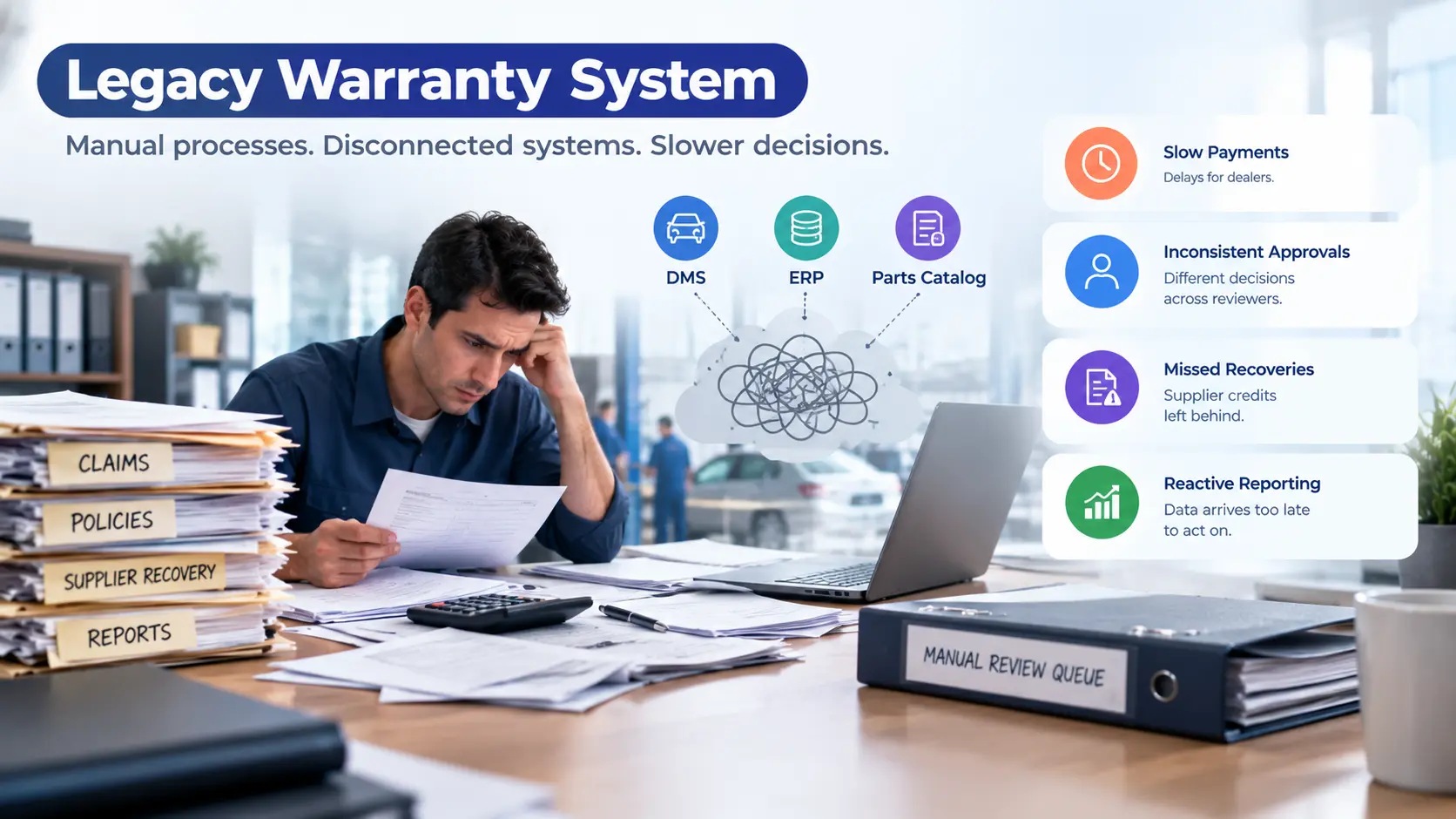
Common signs that an OEM is still running a legacy warranty system:
- Claims are validated from review experience and side spreadsheets.
- Coverage terms live in documents, and any change needs an IT ticket.
- Causal part numbers are not checked against the current catalog, including supersessions.
- Supplier recovery starts after payout and sits outside the claim record.
- Warranty reports are built by hand from system extracts.
- Regions or reviewers apply the same rule differently.
One boundary matters here. This article covers OEM warranty between the manufacturer and its franchised dealers. Aftermarket parts warranty, where a distributor or shop returns a defective part to a manufacturer, follows different rules and is a separate topic.
Where Do Legacy Warranty System Costs Show Up for U.S. OEMs?
A legacy warranty system creates costs through manual claim handling, delayed decisions, resubmissions, inconsistent approvals, and missed supplier recovery. These costs are rarely reported as a single “legacy system” line item. Instead, they appear as additional processing effort, longer payment cycles, avoidable claim rework, and warranty dollars that are not recovered from responsible suppliers.
The scale of the underlying warranty operation is significant. Warranty Week reported that U.S.-based Cars & Cycles manufacturers paid $13.35 billion in warranty claims in 2025, an 8% increase from 2024. The category includes passenger-car manufacturers along with manufacturers of motorcycles, boats, ATVs, and other light-duty vehicles.
Illustrative example: If an OEM processes 1,000 warranty claims a day and a manual process requires an additional 10 minutes of administrative work per claim for re-keying, checking documents, or correcting submissions, that represents about 167 staff-hours per day. At the same volume, reducing that additional work by half would eliminate roughly 83 staff-hours of daily administrative effort. This example measures administrative effort only; it does not estimate avoided claim leakage or additional supplier recovery. Actual savings depend on claim volume, labor cost, process design, and the percentage of claims requiring manual intervention.
Here is where the loss usually sits:
Dealers carry part of this operational burden too. Warranty administrators may need to re-key data, wait for approvals, and correct claims rejected because of missing or inconsistent reference data. That adds administrative work on the dealer side and makes faster, clearer claim processing an operational requirement, not only a finance concern.
What Should a Modern Warranty Management System Cover?
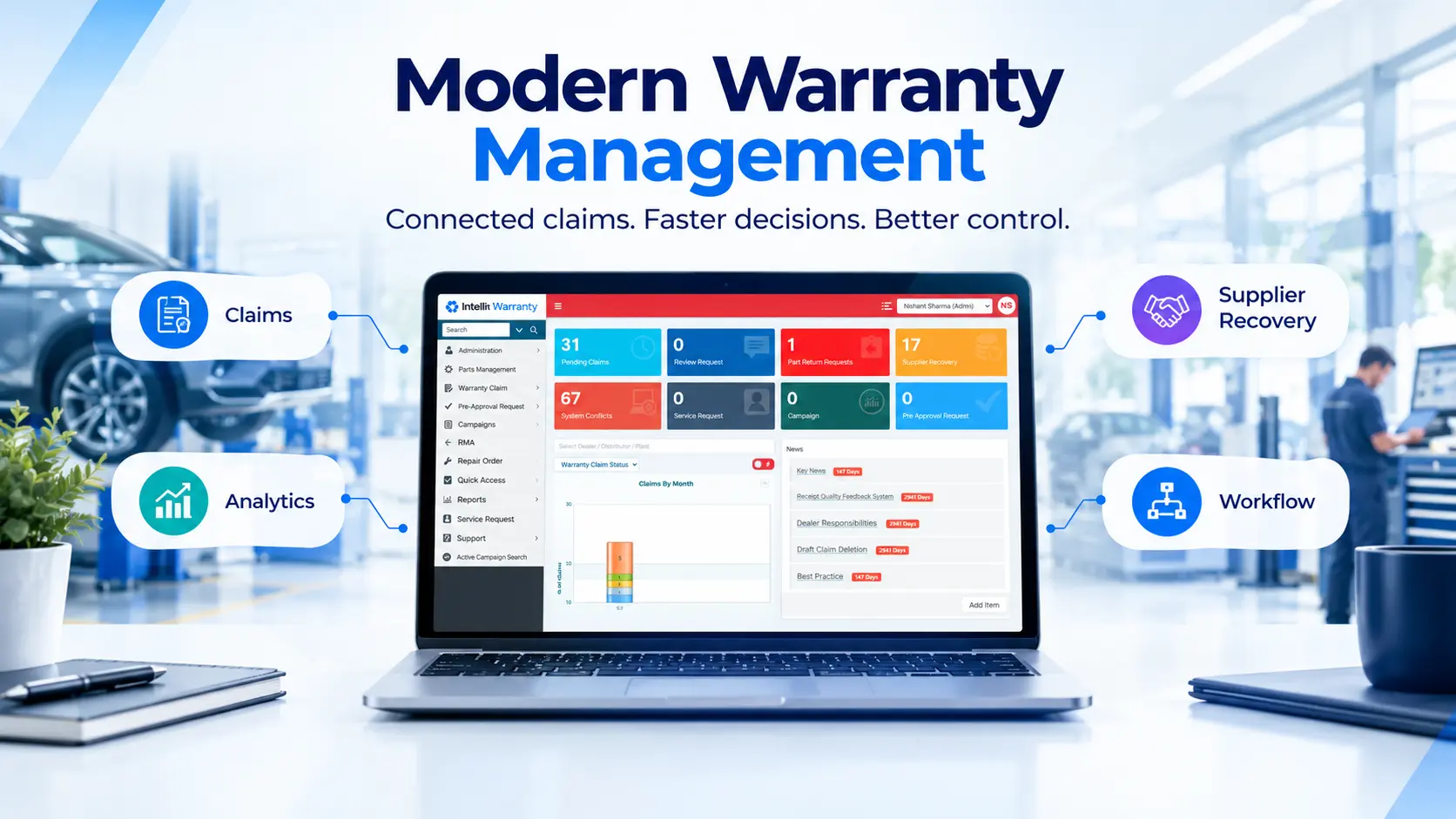
Modern warranty management system covers the full claim path in one connected workflow: policy setup, dealer claim entry, validation, approval routing, parts return, supplier recovery, and reporting. The test is simple. A claim should carry its data from the repair order to the supplier credit without being re-keyed or rebuilt in a spreadsheet.
In practice, that means the following capabilities:
- Configurable policy: Coverage by model, model year, part, and claim type, with administrators able to change terms without a development ticket.
- Separate claim types: Post-sale, campaign, goodwill, pre-delivery, and spare parts claims follow different rules and need different checks.
- Guided dealer entry: Templates, required fields, and document upload, so errors are caught before submission rather than at review.
- Catalog-linked validation: The causal part is checked against the current electronic parts catalog, including supersessions.
- Approval routing and auto-approval rules: Clean, low-cost claims move through. High-cost or unusual claims go to the right reviewer.
- Audit trail and partial approvals: Every decision has a reason on record, which matters when a dealer disputes a chargeback.
- Supplier recovery tied to the approved claim: The recovery claim starts from the same record, not from a separate list.
- Drill-down reporting: Managers can move from a KPI to the individual claim behind it.
How Does Intelli Warranty Support the Move to Modern Warranty Management?
Intelli Warranty is a cloud-based warranty claims management and supplier recovery platform for automotive OEMs, connecting dealer claims, warranty policies, approvals, parts data, and supplier recovery in a single workflow. The platform supports the transition from manual warranty processes by bringing claim submission, validation, review, approval, recovery, and reporting into one system.
- Six claim types: OEM pre-delivery inspection, dealer pre-delivery inspection, post-sale, campaign, goodwill, and spare parts.
- Configurable warranty policies: Administrators can configure coverage by product, part, model version, and reimbursement terms without requiring a development ticket.
- Dealer claim submission: Templates, required fields, document uploads, and validation checks help dealers submit complete claims.
- Configurable approval workflows: Claims can be routed according to parameters such as model, variant, claim cost, and region. Auto-approval and partial approval are supported, with an audit trail for decisions.
- Parts and ERP integration: Intelli Warranty integrates with ERP systems including SAP and Oracle, dealer management systems, dealer portals, and electronic parts catalogs, depending on the OEM's implementation scope.
- Supplier recovery: Approved dealer claims can initiate supplier recovery using the same claim record, with manual regeneration available when required.
- Analytics and risk flags: Dashboards provide drill-down from KPIs to individual claims, while anomaly flags and dealer, supplier, and regional comparisons help reviewers identify claims requiring further investigation.
- Access: The platform is available through web, Android, and iOS interfaces.
For an OEM replacing a legacy warranty system, the important question is not simply whether a platform has these features. It is whether the platform can support the OEM's actual claim types, policy rules, parts catalog, ERP, DMS, dealer network, and supplier-recovery process. During evaluation, ask vendors to demonstrate a representative claim from dealer submission through approval and supplier recovery, and confirm which integrations are standard versus implementation-specific.
How Do OEMs Move from a Legacy Warranty System to Modern Warranty Management?
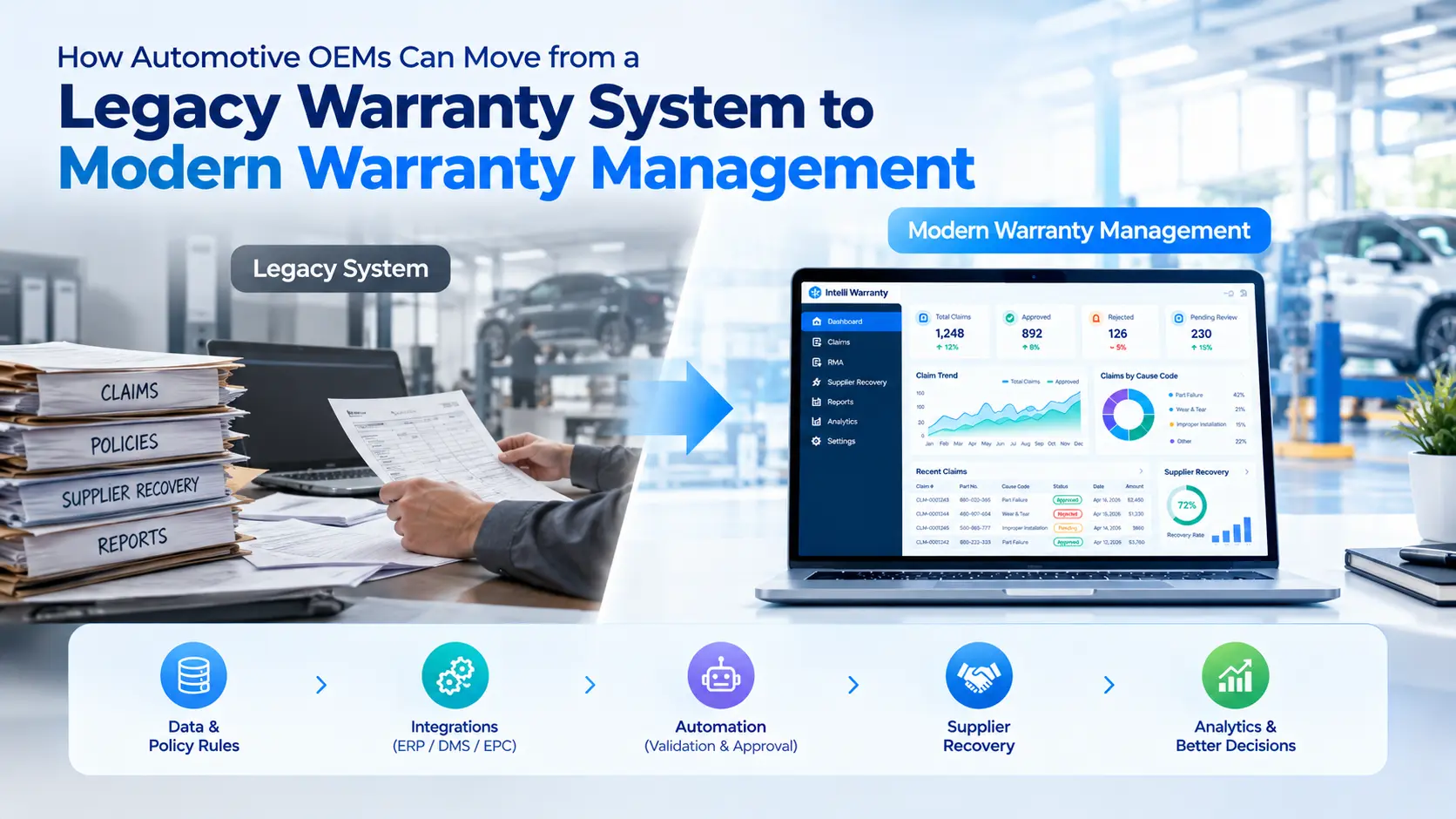
OEMs can approach warranty transformation in phases: map the current claim path, clean the reference data, configure policy rules, integrate the ERP, DMS, and parts catalog, automate claim intake and validation, pilot with a small dealer group, then add supplier recovery and analytics. Each phase should leave the operation running while the next one is built.
- Map the claim path. Trace one claim from repair order to supplier credit. Note every re-key, email, and spreadsheet. That map defines the scope of the warranty transformation and identifies the manual handoffs the new system needs to eliminate.
- Clean the reference data. Check the parts master, supersessions, labor times, failure codes, and dealer hierarchy. Validation rules will expose every gap here.
- Move policy into configurable rules. Document coverage by model, model year, part, and claim type. Decide who owns each rule and who approves changes.
- Integrate before you automate. Connect the warranty platform to the ERP, DMS, or dealer portal, and electronic parts catalog. Confirm the specific interfaces and implementation requirements for your technology stack before configuration begins.
- Start with the highest-volume claim type. For most OEMs, that is post-sale claims. Automate intake and validation for this claim type first. Campaign and goodwill logic can follow.
- Run old and new side by side. In an anonymized OEM pilot, the side-by-side review uncovered differences between documented policy rules and how claims were actually being reviewed. The team used those findings to correct the rules before expanding the rollout.
- Add supplier recovery, then analytics. Recovery needs clean causal part data first. Analytics needs a few months of consistent claims before trends mean anything.
A connected platform turns these capabilities into digital warranty management: policy rules, dealer submissions, validation, approvals, supplier recovery, and reporting operate from the same claim record. Skipping the data work is the most common reason a new system produces the same rejections as the old one.
What Can Warranty Process Automation Do, and What Can't It?
Warranty process automation can route claims, apply approval rules, check entries against policy, and flag unusual patterns for review. It cannot repair bad part masters, inconsistent failure codes, or missing repair history. Automation applies your rules faster and more consistently, so unclear rules and dirty data become visible quickly.
Intelli Warranty applies this approach with claim-level risk checks, dealer billing comparisons against peers, and attachment checks for duplicate images and mismatched metadata. These checks produce flags for reviewers, not final decisions.
That distinction matters in a franchised network. A flag is a reason to look, not proof of misconduct. Reviewers should record the reasons for any denial or chargeback, because dealers will ask.
How Do OEMs Keep Dealers On Board and Measure Results?
Dealers adopt a new warranty process when it pays faster, rejects less, and removes re-keying. Track first-pass acceptance, days from submission to payment, share of claims auto-approved, supplier recovery, and claims per 1,000 units by part and model. Set baselines before launch so results can be judged against facts, not impressions.
Practical steps for dealer adoption:
- Train dealer warranty administrators, not only service managers.
- Give clear reject reasons that point to the field and the fix.
- Reduce double entry by integrating with the dealer’s DMS wherever the OEM can support it.
- Keep a fast path for dealer questions during the pilot.
Also check state timing rules. For example, California Vehicle Code § 3065(d)(1) requires franchisors to approve or disapprove warranty claims within 30 days after receipt; claims not specifically disapproved in writing within that period are deemed approved, and approved claims must be paid within 30 days after approval. Florida Statutes § 686.405(2)(a) similarly requires warranty claims covered by the statute to be approved or disapproved within 30 days after receipt, with approved claims paid within 30 days after approval. These requirements can vary by state and vehicle category, so confirm the current rules with legal counsel for each state in which you operate.
Do not promise dealers or executives fixed savings before the pilot. Payout reduction, cycle time, and recovery gains depend on the starting condition of your data and processes.
Conclusion
A legacy warranty system is a manual, disconnected claim path, and its costs show up in slow decisions, inconsistent approvals, claim rework, and unrecovered supplier credits. A successful warranty transformation starts with clean data and clear rules, then progresses through system integration, claim automation, dealer piloting, supplier recovery, and analytics.
For U.S. automotive OEMs, the goal is not simply to replace an old application. It is to create a connected warranty process that gives dealers clearer submissions and faster decisions while giving warranty, finance, and quality teams better claim and recovery data.
Before selecting a new system, map your current claim path, identify the manual handoffs, and document the integrations and policy rules the replacement must support.
Ready to assess your current warranty process? Book a demo to see a walkthrough of how dealer claims, approvals, parts validation, and supplier recovery can work in one workflow.
Frequently Asked Questions
What is a legacy warranty system?
A legacy warranty system is a claims process built on manual review, spreadsheets, and disconnected systems. It may be old software or newer software that was never integrated with parts, dealer, and finance data. The defining trait is manual handoffs between claim entry, approval, and supplier recovery, not software age.
How do you migrate from a legacy warranty system to a modern one?
Migrate in phases: map the claim process, clean reference data, define policy rules, integrate core systems, automate claim validation, and pilot with a small dealer group. Use the pilot to identify data or rule gaps before broader rollout, then add supplier recovery and analytics.
What is warranty process automation?
Warranty process automation uses configured rules to route claims, check entries against policy, approve low-risk claims, and flag unusual ones for review. It reduces manual touches. It does not replace reviewer judgment or fix poor data, so approval rules and reference data still need a named owner. Rules apply consistently across regions.
Can a modern warranty system integrate with our ERP and dealer DMS?
Usually, but scope varies by platform and by your own systems. ERP integration typically covers parts, prices, and supplier data. DMS integration reduces double entry at the dealer. Ask each vendor to document which interfaces exist and which need custom work. Also confirm who maintains each interface after go-live.
How does digital warranty management help with supplier recovery?
When supplier recovery starts from the approved claim, the causal part and failure data are already captured. Teams do not rebuild the case from spreadsheets after payout. That can shorten the gap between paying a dealer and billing a supplier, provided causal part data and supplier assignments are accurate.
How long does it take to replace a legacy warranty system?
There is no fixed timeline. The main drivers are data readiness, integration scope, number of claim types, dealer-network size, and policy complexity. Most implementations move through discovery, configuration, integration, pilot deployment, and broader rollout rather than switching every dealer at once.


Explore More Insights







.webp)


About the Author


Nishant Sharma
Nishant Sharma is the Marketing & Sales Lead at Intellinet Systems, specializing in B2B sales, digital marketing, and automotive aftermarket solutions. With extensive experience in driving business growth, lead generation, and go-to-market strategies, he is passionate about helping businesses adopt innovative technologies that enhance operational efficiency and customer experience. Through his articles, Nishant shares practical insights on industry trends, emerging technologies, and best practices shaping the future of the automotive aftermarket.


