

Overview: Warranty claim cycle time is the number of days from when a dealer submits a warranty claim to when the OEM completes its approval and payment. When this window stretches, warranty reserves remain tied up longer, dealers wait longer for reimbursement, and supplier recovery can fall further behind the original repair. Most delays are not caused by high-risk or fraudulent claims. Instead, they often stem from incomplete documentation, manual policy lookups, and approval queues without clear routing logic. Reducing cycle time without weakening control requires OEMs to identify and address the points where claims actually stall rather than simply adding more reviewers to the process.

Key Takeaways:
- Most warranty claim delays stem from incomplete documentation and inefficient routing rather than claims that genuinely require additional scrutiny.
- Reducing cycle time means fixing validation and approval logic, not rushing reviewers through the same manual process faster.
- Supplier recovery usually lags claim approval by weeks because the two processes run on separate data and separate timelines.
- OEMs that reduce warranty claim cycle time see faster reserve turnover and fewer dealer disputes over payment timing.
See how Intelli Warranty helps OEMs automate claim validation, policy checks, approval routing, and supplier recovery to eliminate avoidable delays. Schedule a Demo
Where Does Warranty Claim Cycle Time Actually Break Down?
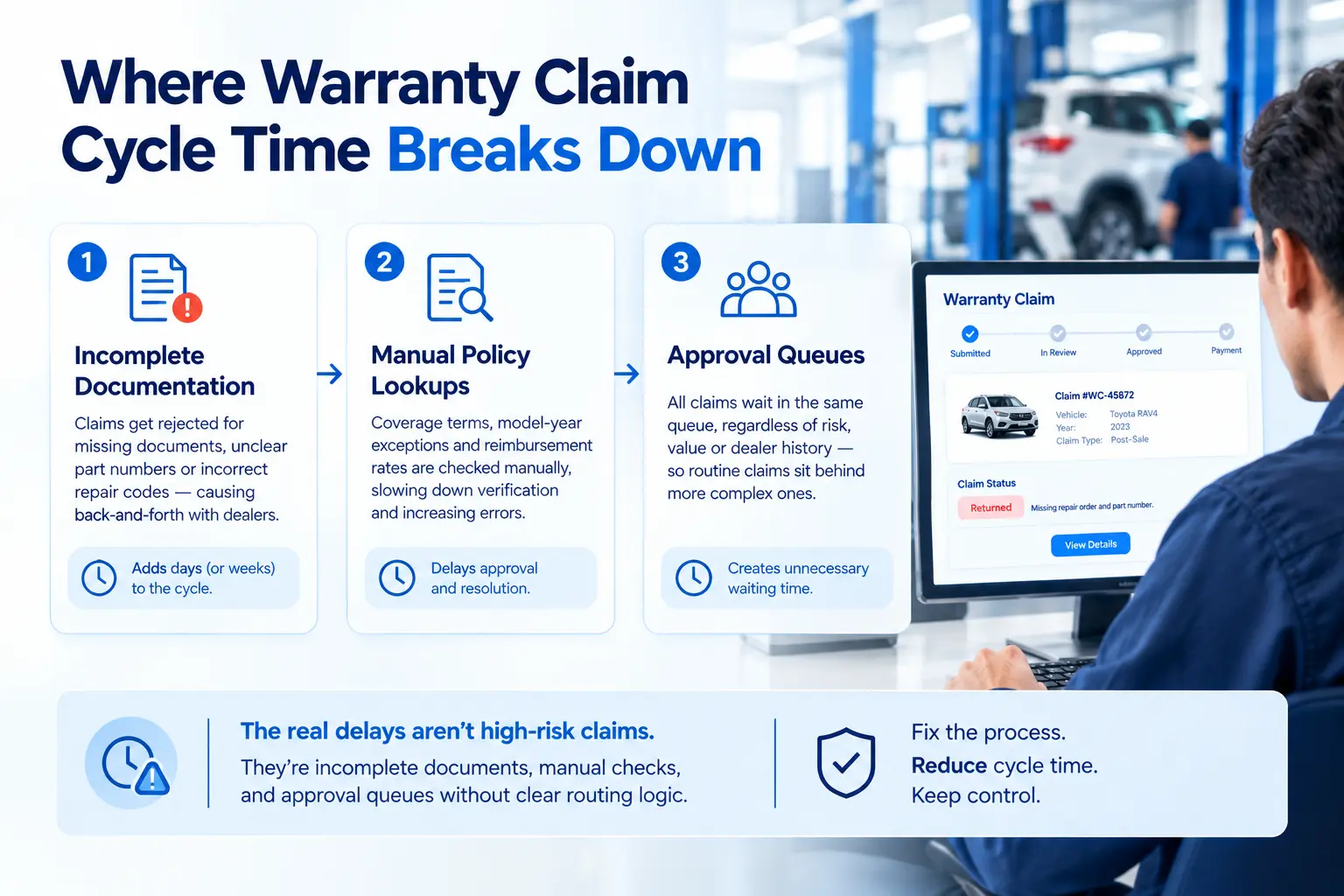
Warranty claim cycle time typically breaks down at three points: incomplete claims that bounce back to the dealer for missing documentation, manual policy lookups that slow down coverage verification, and approval queues where every claim, regardless of risk, waits behind the same reviewer.
A claim that gets rejected for a missing repair order or an unclear part number does not just lose a day. It loses the round trip: back to the dealer, back into the queue, and back to whatever reviewer picks it up next. On a high-volume claim desk, this single failure mode accounts for a disproportionate share of aging claims.
Policy lookups are the second bottleneck. When coverage terms, model-year exceptions, and reimbursement rates are managed through spreadsheets or reviewer knowledge rather than a structured policy engine, each claim requires manual verification against the applicable terms. As warranty policies become more detailed and complex, these checks take longer, adding friction to the claims process.
The third is queue design. Treating every claim the same, regardless of dollar value, claim type, or dealer history, means a routine spare-parts claim can sit behind a large post-sale claim that genuinely needs senior review. Cycle time suffers not because reviewers are slow, but because the queue has no sense of priority.
Five Ways to Reduce Warranty Claim Cycle Time
OEMs reduce warranty claim cycle time by catching documentation gaps before submission, automating policy and coverage checks, routing claims by risk rather than queue order, triggering supplier recovery at the point of approval, and tracking cycle time by claim type so bottlenecks are visible rather than anecdotal.
- Validate at claim submission, not after review. Structured claim forms that require the correct documentation, part numbers, and repair codes before submission can prevent avoidable rejections and resubmissions before they occur.
- Automate policy and coverage checks. A configurable policy engine can automatically apply model, variant, and warranty-term rules, eliminating manual lookups for most claims that do not require exception review.
- Route claims by risk, not by arrival order. Claims involving unusual repair costs, short repair durations, or repairs submitted close to warranty expiry can be routed to senior reviewers for additional scrutiny. Routine, low-value claims can move through faster using programmable auto-approval thresholds based on predefined criteria.
- Trigger supplier recovery at approval. If an approved dealer claim is linked to a supplier-caused defect, the corresponding supplier claim should be generated automatically rather than relying on someone to initiate it as a separate task.
- Track cycle time by claim type. Post-sale, campaign, goodwill, and spare-parts claims can have different typical cycle times. Tracking them as a single blended metric can mask which claim category is driving delays.
Some warranty management software, including Intelli Warranty, builds all these directly into the claim workflow: structured submission templates, an automated policy engine, and configurable approval routing based on claim parameters rather than a single fixed queue.
Where Does Supplier Recovery Fit Into Cycle Time?
Supplier recovery is often handled as a separate process after the warranty claim has been paid, potentially adding weeks to the OEM’s total cost recovery even when the original claim was resolved quickly. Linking recovery to claim approval, rather than treating it as a follow-up task, keeps cash flow moving in step with claims.
The documentation that supports a supplier recovery claim, such as part numbers, failure codes, and repair details, is largely the same documentation already captured on the original warranty claim. When the two processes run on separate systems, someone has to reconstruct that data a second time to file the supplier claim, and that reconstruction is where recovery timelines slip.
This matters because supplier recovery affects more than just OEM cash flow. A defect pattern that shows up across multiple claims is also product quality data. If recovery and root-cause tracking are disconnected from the original claim, that signal takes longer to reach the teams who need it, whether that is procurement, quality engineering, or supplier management.
How Does Intelli Warranty Shorten Warranty Claim Cycle Time?
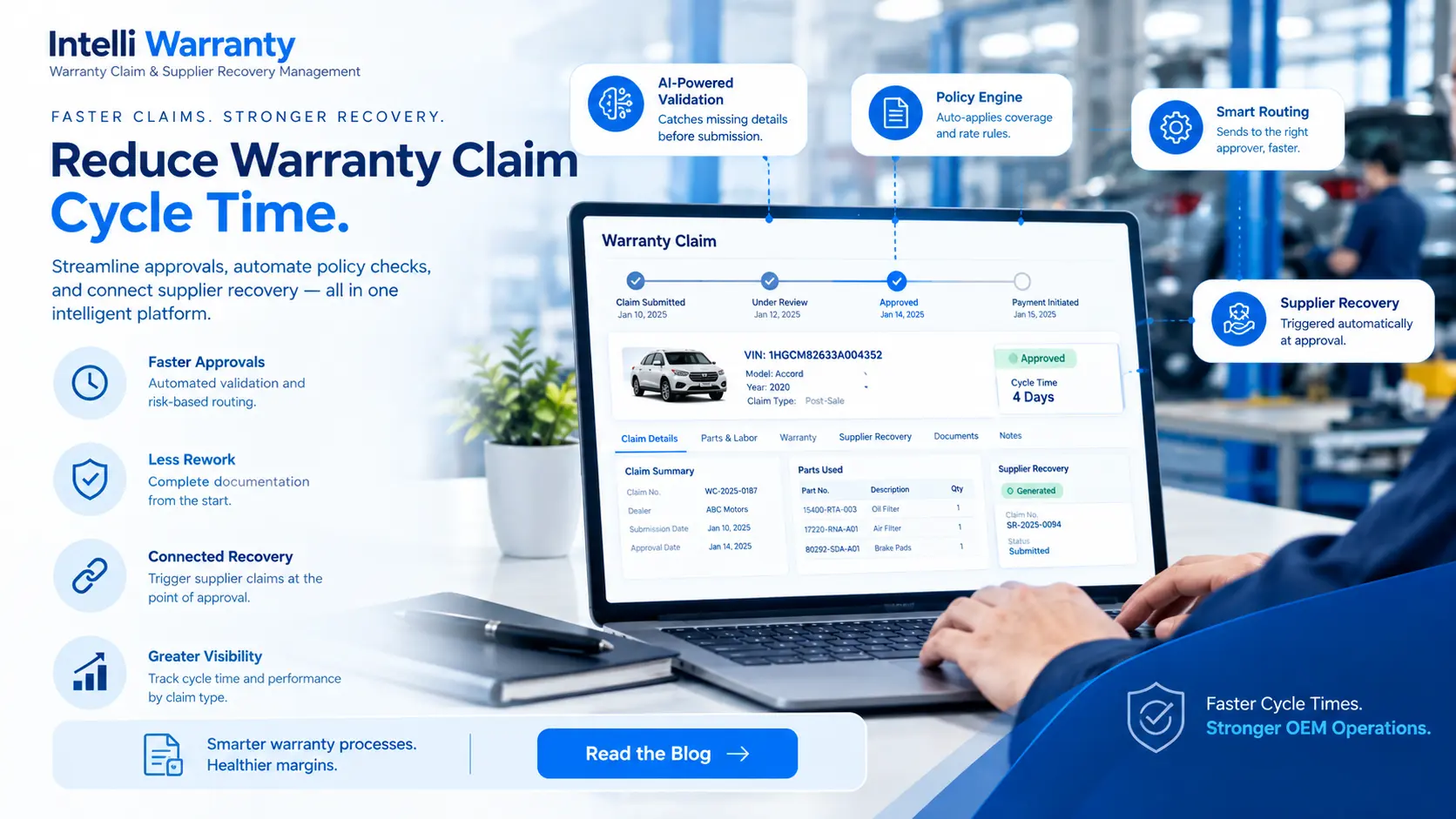
Intelli Warranty is warranty claim and supplier recovery management software built for OEMs, and it targets cycle time directly by validating claims against policy and documentation rules before they reach a reviewer, routing claims to the right approver automatically, and generating supplier recovery claims at the point of dealer approval rather than afterward.
The platform supports the claim types OEMs commonly manage, including OEM PDI, Dealer PDI, Post-Sale, Campaign, Goodwill, and Spare Parts claims, with claim-specific policy rules and documentation requirements rather than relying on a single generic claim form. Its work queue assigns approvers based on configurable parameters, including product model, claim cost, and region, so routine claims do not wait behind claims that need senior review.
On the supplier side, approved dealer claims generate supplier recovery claims automatically, with manual regeneration available when a claim needs to be corrected or resubmitted. Claim-level dashboards give warranty teams visibility into where claims are sitting in the queue, not just how many were closed last month.
It is worth being precise about what the anomaly detection in a system like this actually does. It flags claims with unusual patterns, such as inflated repair costs, unusually short repair durations, or documentation inconsistencies, for review. It does not independently determine whether a claim is fraudulent; its effectiveness depends on the quality of the claim data and the policy rules configured within the system. The value is in surfacing the claims that need a closer look faster, not in removing human review from the process.
According to Intellinet Systems, Intelli Warranty has helped reduce dispute closure time by 60% and avoidable liability payouts by 20% in its implementations. Because these are vendor-reported results rather than independent benchmarks, OEMs should review the underlying claim volumes, baseline measurements, and deployment context before using them for comparison.
What to Track Once Cycle Time Improves?
Cycle time improvements are meaningful only when measured by claim type and reviewer queue, rather than as a single blended average. An aggregate figure can mask aging claims that still take weeks to resolve when faster, low-value approvals bring down the overall average.
Tracking warranty claim turnaround time alongside cycle time by claim category gives OEMs a fuller picture of where the process is actually slowing down.
- Average approval time, broken out by claim type (post-sale, campaign, goodwill, spare parts).
- Percentage of open claims aging beyond a defined threshold, such as 15 or 30 days.
- Supplier recovery lag, measured from OEM claim approval to supplier claim submission.
- Dispute and rejection rate, to confirm faster approval is not coming at the cost of control.
The scale of U.S. warranty exposure underlying these processes is significant. According to Warranty Week, 23rd Annual Product Warranty Report, U.S.-based manufacturers paid a total of $30.37 billion in warranty claims in 2025, based on an analysis of SEC filings. Every day a claim sits unresolved is a day that exposure stays on the books longer than it needs to.
Conclusion
Warranty claim cycle time rarely stretches because of a handful of genuinely difficult claims. It stretches because documentation gaps, manual policy checks, and undifferentiated approval queues slow down the majority of claims that should move quickly. Fixing that, along with connecting supplier recovery to the original claim rather than running it as a separate process, is what actually reduces warranty claim cycle time without giving up control over high-risk claims. For OEMs managing warranty programs across a large dealer network, that distinction between faster processing and faster approval without review is the one worth getting right.
If warranty claims are aging in your queue because of avoidable process delays rather than risk, see how Intelli Warranty’s validation, routing, and supplier recovery workflows can help streamline your claim process. Request a demo today.
Frequently Asked Questions
What is a good warranty claim cycle time for an OEM?
There is no universal industry benchmark for warranty claim cycle time because targets vary by claim type, product complexity, and dealer network size. A more useful approach is to track cycle time by claim category over time and identify which categories take longer than the OEM’s defined policy timelines.
Does reducing warranty claim cycle time increase fraud risk?
Not when the reduction comes from removing avoidable delays rather than bypassing review. Risk-based routing allows routine, low-risk claims to move faster while claims with unusual cost patterns or timing receive full scrutiny. This preserves control while reducing unnecessary review time for straightforward claims.
How does warranty management software reduce warranty claim cycle time?
It reduces cycle time by validating documentation before submission, automating policy and coverage checks that would otherwise require manual lookup, and routing claims to reviewers based on risk rather than a fixed queue order. The reduction comes from removing avoidable steps, not from approving claims faster without review.
Why does supplier recovery take longer than warranty claim approval?
Supplier recovery is often handled as a separate process using separate data, requiring teams to recreate documentation already captured in the original warranty claim. When recovery is triggered automatically at claim approval, that duplication is eliminated, and the existing claim data can flow directly into the supplier recovery process.
Can AI actually shorten warranty claim review, or just flag claims faster?
AI-based tools can flag unusual claims, such as inflated costs or suspicious timing, faster than manual spot checks. They do not replace policy logic or human judgment on disputed claims, and their accuracy depends on the quality of the underlying claim and policy data feeding them.


Explore More Insights








.webp)


About the Author


Nishant Sharma
Nishant Sharma is the Head of Demand Generation at Intellinet Systems, specializing in B2B marketing, sales, digital transformation, and automotive aftermarket solutions. He shares insights on emerging technologies, industry trends, and strategies that help OEMs and businesses improve operational efficiency, customer experience, and aftermarket growth.


