

Overview: Warranty management software is a dedicated system that automates warranty claim registration, validation, approval, and supplier recovery for original equipment manufacturers (OEMs). This guide explains why warranty costs are rising for US OEMs in 2026, the nine operational challenges driving most of those costs, how a purpose-built platform such as Intelli Warranty addresses each challenge, which industries see the fastest return on investment, what to evaluate before signing a contract, and what implementation typically involves.

Key Takeaways:
- The best warranty management software automates claims processing, dealer communication, supplier recovery, and compliance tracking for OEMs.
- US manufacturers paid $30.37 billion in warranty claims in 2025, a 4% increase from 2024, according to Warranty Week’s annual report.
- Manual, spreadsheet-based warranty processes increase claim errors, delay dealer communication, and result in missed supplier recovery deadlines.
- The New Year’s 2024 warranty labor reimbursement law raised the bar for accuracy for automotive OEMs, and similar bills are moving in other states.
- Automotive, EV, agriculture, construction, aerospace, and industrial equipment OEMs see the fastest return from platforms like Intelli Warranty.
- Intelli Warranty maps directly to the core evaluation criteria OEMs use: ERP integration, supplier recovery automation, fraud detection, and compliance configuration.
Book a Free Demo and see how Intelli Warranty can modernize your warranty operations.
What is Warranty Management Software?
Warranty management software is a dedicated system that manages the full warranty lifecycle: claim registration, validation, approval, supplier recovery, and reporting, connecting service, dealer, and supplier data in one place. It replaces spreadsheets and generic ERP add-ons with workflows built specifically for OEM warranty operations, not adapted from other systems.
For most OEMs, warranty operations span service, parts, finance, and supplier quality teams, and touch dealers, distributors, and Tier 1 and Tier 2 suppliers. Handled well, warranty management protects margins, keeps dealers satisfied, and feeds product quality data back to engineering. When managed through manual processes, it tends to lose money in three key areas:
- Fraudulent or duplicate claims that go undetected
- Supplier recovery claims that miss their filing window
- Analyst hours spent on manual review, error correction, and escalation
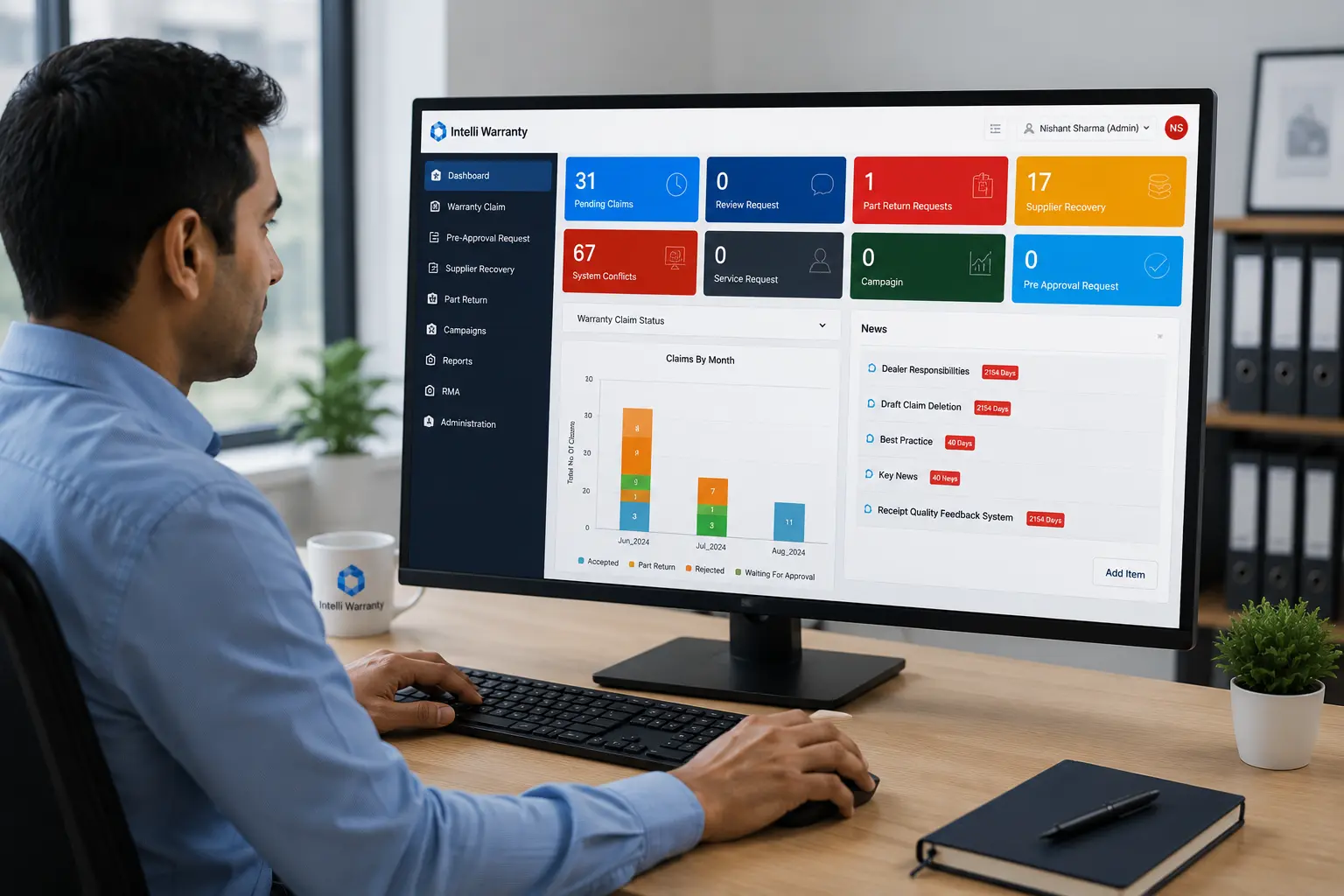
Intelli Warranty is built to close all three gaps at once. Instead of a warranty module bolted onto an existing ERP, it is a purpose-built system where claim validation, supplier recovery, and dealer communication run through a single configurable workflow.
Why Warranty Costs Are Rising for US OEMs in 2026
Warranty costs are rising for US OEMs in 2026 due to two forces: new state labor reimbursement laws that increase the cost of inaccurate claims, and higher dealer expectations for approval speed, driven by AI-powered competitors. Both trends increase the financial cost of manual, error-prone claims processing.
US manufacturers paid a combined $30.37 billion in warranty claims in 2025, a 4% increase from 2024, with total warranty reserves up 17% year over year, according to Warranty Week's 23rd Annual Product Warranty Report.
On the regulatory side, New York's warranty labor reimbursement law (signed September 2024) requires automakers to pay dealers based on the retail time guide the dealer actually uses, rather than the manufacturer's own flat-rate schedule. Illinois, Minnesota, Montana, and Alaska have passed comparable dealer-favorable warranty laws, and more states are tracking similar bills. That shift makes claims accuracy a financial issue, not just an administrative one.
On the dealer-expectation side, AI-driven claims processing has reset what counts as an acceptable turnaround. Many US OEMs now benchmark claims approval against a 24-hour window. A system that still takes 7 to 10 business days is not just slow; it is a dealer trust problem in a market where switching costs between OEMs are manageable. Intelli Warranty's validation rules run automatically at intake, enabling OEMs to move claims from a multi-day queue to a same-day approval workflow.
9 Warranty Management Challenges Costing US OEMs the Most
The biggest cost drivers in warranty operations are manual processing errors, poor dealer communication, low supplier recovery, and undetected fraud. Each of the nine challenges below compounds the others when claims are still handled through spreadsheets and email, and each maps to a specific capability inside Intelli Warranty.
- Errors and Inefficiencies in Claims Processing
Manual warranty processing introduces errors at every stage, from claim submission and documentation review to parts validation, approval, and reimbursement. Even a small error can trigger additional reviews, rework, and approval delays. As claim volumes increase, these inefficiencies compound into a significant operational burden.
Manual processing also drives up operational costs. The fully loaded cost of a warranty analyst includes the time spent reviewing claims, correcting errors, and handling escalations. This cost is significantly higher than that of an automated process. For US OEMs processing more than 10,000 warranty claims each year, these inefficiencies are not minor. They represent a measurable and recurring cost center.
- Poor Communication Across Dealer Networks
US OEMs typically operate dealer networks ranging from dozens to thousands of locations. When warranty claims move through a fragmented system, with email in one place, a portal in another, and phone follow-ups elsewhere, communication breaks down. Dealers submit incomplete claims, OEM teams spend valuable time chasing documentation, and customers are left waiting.
The downstream effect on brand reputation is significant. Dealers who find the warranty process difficult to navigate are more likely to express dissatisfaction during day-to-day interactions and at the point of sale. In a market where dealer relationships are highly competitive, and OEM switching costs are manageable, a cumbersome warranty process can become a retention risk.
- Lack of Real-Time Visibility
For US service operations managers overseeing high-volume dealer networks, the inability to view claim status, approval rates, processing times, and backlogs in real time creates significant operational challenges. Without this visibility, it becomes difficult to identify bottlenecks, provide dealers with accurate timelines, or make informed staffing decisions based on actual workloads.
The problem becomes even more complex as dealer networks grow. A network of 200 dealers with 500 active claims at any given time is difficult to manage without a centralized dashboard that provides real-time visibility. The data exists, but it is often not presented in a way that supports timely and informed decision-making.
- Delayed Feedback Loops on Product Quality
Every warranty claim is a valuable source of product quality data. A cluster of claims related to a specific component, model year, or geographic region can indicate an emerging quality issue. In a well-designed warranty management system, these insights reach engineering and procurement teams within days. In a manual system, they may take months to surface or remain unnoticed altogether.
For US automotive and agricultural OEMs that follow AIAG reporting standards and supplier quality requirements, the absence of automated feedback loops creates both operational and compliance challenges. Delayed insights can increase warranty costs, slow corrective actions, and make it more difficult to demonstrate compliance with quality reporting requirements.
- Low Supplier Recovery Rates
Supplier recovery is the process of recovering warranty costs from parts suppliers whose components caused a failure. It is one of the highest-return activities in warranty operations. Industry estimates suggest that US OEMs recover only a fraction of the costs they are entitled to, primarily because supplier recovery claims are generated through manual, slow, and resource-intensive processes.
The situation becomes even more challenging because of strict filing deadlines. Most supplier agreements require recovery claims to be submitted within a defined time frame. Claims delayed because of inefficient processes often miss these deadlines, making recovery impossible. For OEMs sourcing components from Tier 1 and Tier 2 suppliers, these missed opportunities can result in millions of dollars in unrecovered warranty costs each year.
- Warranty Fraud
Warranty fraud is estimated to cost US manufacturers between 3% and 15% of their total warranty spend. This wide range reflects both the difficulty of detecting fraud and the differences in how rigorously OEMs monitor and investigate suspicious claims. Common types of warranty fraud include claims for work that was never performed, intentional product damage to obtain warranty coverage, duplicate claim submissions, and parts substitution.
Fraud often increases when it is not actively monitored. A dealer who submits one fraudulent claim without being detected may be more likely to submit additional fraudulent claims. In a manual warranty environment, systematic fraud at the dealer level can remain undetected for years, resulting in significant cumulative financial losses before it is identified.
- Compliance Exposure
US OEMs operate under a range of warranty compliance requirements, including federal and state consumer protection laws such as the Magnuson-Moss Warranty Act, AIAG warranty data standards, IATF 16949 quality management requirements, and industry-specific regulations for sectors such as automotive and aerospace, including FAA requirements. In addition, state-level right-to-repair legislation continues to expand, creating new expectations for how OEMs document, manage, and retain warranty data.
Manual compliance tracking is inherently inconsistent. When approval decisions rely on individual analysts instead of standardized validation rules, the way claims are reviewed and approved can vary significantly. This inconsistency increases legal exposure, complicates audits, and makes it more difficult to demonstrate compliance with regulatory and quality requirements.
- Scalability Constraints
Traditional warranty processing systems, whether based on spreadsheets, generic ERP modules, or legacy warranty tools, do not scale efficiently. As production volumes increase, dealer networks expand, and products become more complex, the manual effort required to manage warranty claims grows significantly. As a result, organizations often need more staff, processing times become longer, and error rates increase.
As US OEMs expand production and dealer networks, they need a warranty management platform that scales with their operations. The ideal solution can support significantly higher claim volumes without requiring a proportional increase in staffing.
- High Operational Costs
All of these challenges ultimately affect one critical metric: warranty cost per unit. Manual processing, limited supplier recovery, undetected fraud, and inefficient compliance processes each contribute to higher warranty costs. Together, they make warranty operations one of the most expensive and least optimized functions within the aftermarket organization.
For VPs of Aftermarket and Directors of Service Operations, these costs are not inevitable. They can be reduced with the right warranty management software, well-designed processes, and real-time visibility into warranty data.
How Warranty Management Software Solves These Challenges
Purpose-built warranty management software addresses each of the nine challenges outlined above with dedicated automation, replacing the manual workflows that many OEMs still manage through spreadsheets, email, and disconnected systems. Intelli Warranty helps overcome these challenges through capabilities designed to streamline the entire warranty lifecycle.
- Claims automation: Intelli Warranty checks eligibility, part coverage, and documentation before a claim reaches a human reviewer, cutting processing time from days to hours.
- Centralized dealer portal: guided templates and mandatory fields standardize how dealers submit claims and give them real-time status updates, so OEM teams stop fielding status emails.
- Real-time dashboards: a live view of claim volume, approval rate, processing time, and backlog by dealer, region, and product line, split across the OEM, dealer, and supplier tiers.
- Automated supplier recovery: approved claims that are supplier-attributable generate recovery claims automatically, inside the contractual filing window, which is where most manual programs lose money.
- Fraud detection logic: statistical analysis flags dealers with approval rates that deviate from network averages, repeat claims on the same serial number, and known fraud patterns, before a claim is paid.
- Policy and compliance configuration: OEM warranty policy, AIAG standards, and state-specific rules get encoded into the approval workflow itself, not left to individual analyst judgment.
- ERP integration: native connections to SAP S/4HANA, with Oracle Cloud and Microsoft Dynamics 365 also supported, keep parts pricing and reimbursement records in sync without manual transfer.
How a Claim Moves Through Intelli Warranty
A claim inside Intelli Warranty moves through seven automated steps, from dealer submission to product quality analytics, without manual handoffs between departments or duplicate data entry between systems. The workflow below shows each step in order, from intake to the analytics that feed back into engineering.
- Dealer submits the claim through the Intelli Warranty portal
- The system runs automatic validation against documentation and coverage rules
- A policy check confirms the claim matches the applicable warranty terms
- The claim enters the approval workflow, pre-validated for the reviewer
- Supplier-attributable claims trigger automatic recovery generation
- Dashboards update in real time for OEM, dealer, and supplier users
- Claim data feeds warranty analytics for product quality trends
Because validation and policy checks are completed before a claim reaches a reviewer, the analyst queue contains only claims that genuinely need a judgment call. That is the structural reason Intelli Warranty customers see same-day approval windows instead of the 7- to 10-day cycle common with manual processing.
Which US OEM Industries Benefit Most?

Automotive, EV, agriculture, construction, aerospace, and industrial equipment OEMs see the fastest return from warranty management software, largely because they manage high claim volumes, large dealer networks, or strict compliance requirements. Intelli Warranty is configured differently for each vertical rather than deployed as a one-size-fits-all workflow.
- Automotive
US automotive OEMs and their Tier 1 supplier networks operate high claim volumes and multi-component claims, and state labor rate laws make manual processing costly. Intelli Warranty natively supports AIAG B-6 warranty data exchange standards, helping automotive OEMs meet industry data exchange requirements.
- Electric Vehicles
US EV OEMs are navigating warranty complexity that legacy automotive systems were not built for, including battery pack warranties and software update claims, as failure patterns and warranty requirements continue to evolve across the industry. Intelli Warranty's analytics help catch a component failure pattern early, before it becomes a recall.
- Agriculture Equipment
Downtime in agricultural equipment is not just an inconvenience; it is a harvest delay. The seasonal nature of agricultural operations means that a claim filed during the harvest season needs to be resolved in days, not weeks. Intelli Warranty supports rural, distributed dealer networks through its dealer portal and parts coordination capabilities.
- Construction and Mining Equipment
US construction OEMs are managing warranty claims on equipment operating in remote and demanding environments. Claims frequently involve complex failures, multiple supplier components, and high-value parts, making fraud prevention and supplier recovery critical. Intelli Warranty’s high-value claims with full audit trails and automated supplier recovery are built for exactly this kind of claim.
- Aerospace
Aerospace warranty management in the US operates under FAA compliance requirements and contract terms that demand complete traceability: every claim, every approval decision, every part replaced, fully documented and auditable. Manual systems cannot provide this at scale, which Intelli Warranty's compliance configuration and audit trail are designed to support.
- Industrial Equipment
US Industrial equipment OEMs, covering everything from material handling to power generation to HVAC, are increasingly offering performance-based and extended warranties to stay competitive. Intelli Warranty's configurable policy engine avoids custom development per product line.
How to Choose the Best Warranty Management Software?
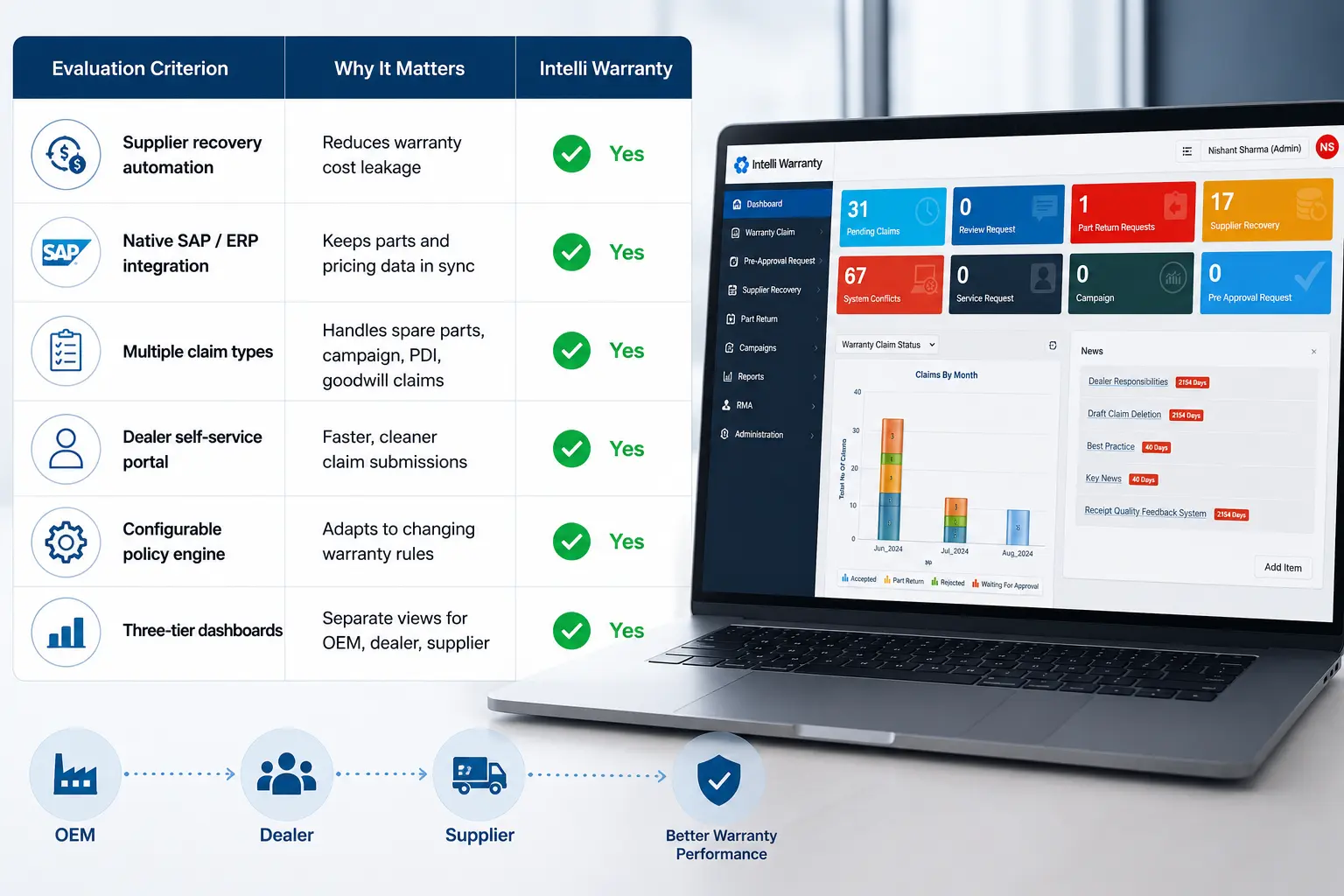
Choosing warranty management software is not simply about comparing feature lists. For an OEM, the right platform needs to fit existing warranty policies, dealer workflows, ERP systems, supplier relationships, and compliance requirements. Before selecting a vendor, evaluate how well each platform handles the following areas and ask for specific, verifiable evidence during the buying process.
- OEM-specific claim type support: Does the system handle spare parts, campaign, PDI, post-sale, goodwill, and dealer PDI claims natively, or does each require customization?
- ERP integration: Can the platform integrate with your existing SAP, Oracle, or Microsoft Dynamics environment? Ask vendors to explain the integration architecture rather than simply confirming compatibility.
- Supplier recovery automation: Can the system identify supplier-attributable claims and automatically generate recovery claims within contractual filing windows?
- Fraud detection: What fraud detection methods are built into the platform? Ask vendors to demonstrate how the system identifies duplicate claims, unusual dealer patterns, or repeat claims against the same serial number or VIN.
- Compliance and policy configuration: Can your warranty policies, reimbursement rules, and applicable regulatory requirements be configured directly into the workflow? Ask how decisions are documented for audit purposes.
- Implementation and deployment: How long will implementation take for an OEM with a similar dealer network, claim volume, and ERP environment? Ask for examples from comparable deployments.
- Reporting and analytics: Can the system provide the reports your warranty, finance, service, and supplier-quality teams need? Check support for Excel, PDF, SSRS, and existing BI tools.
- Data security: What security certifications and controls does the vendor provide? Ask how dealer, supplier, customer, and warranty data are protected.
- Role-based dashboards: Can OEM, dealer, and supplier users access different dashboards and information based on their roles?
What to Expect During Implementation
Implementation for warranty management software generally follows four phases: discovery, configuration, integration, and rollout. Timelines vary by OEM size and ERP complexity, so treat any vendor's estimate as a starting point to verify against reference customers of a similar size.
- Discovery: the vendor maps your current warranty policies, claim types, and dealer network structure.
- Configuration: coverage terms, reimbursement rates, and approval workflows are set up to match your existing policies.
- Integration: the system is connected to your ERP (SAP, Oracle, or Dynamics) and to dealer and supplier data sources.
- Rollout: dealers and internal teams are onboarded, typically starting with a pilot group before a full network rollout.
Once you have identified the capabilities your organization needs from the sections above, the next step is choosing a platform that brings them together in a single system. Intelli Warranty was built specifically for OEM warranty operations, combining claims automation, supplier recovery, dealer collaboration, and analytics in one platform, configured to your existing ERP and warranty policies rather than replacing them.
Why OEMs Choose Intelli Warranty
OEMs choose Intelli Warranty because it is built specifically for warranty operations, not adapted from a generic CRM or ERP module, and because it covers the full claim lifecycle in one system rather than requiring separate tools for claims, recovery, and analytics.
According to company deployment data, Intelli Warranty is in use across 70+ countries, spanning automotive, agriculture, construction, aerospace, and industrial equipment OEMs. What differentiates it from a generic workflow tool is that claim validation, supplier recovery, and compliance rules are configured to each OEM's actual warranty policy rather than a fixed template. That is the difference between a system you adapt your process to, and a system you configure around your process.
OEMs evaluating Intelli Warranty typically fall into one of three profiles:
- Medium and large OEMs with high claim volumes and active Tier 1 and Tier 2 supplier networks, who need full claims automation and supplier recovery at scale.
- Smaller OEMs that want a structured, digital warranty process without the overhead of a full enterprise deployment.
- Consumer goods manufacturers selling through multiple channels and need warranty registration, complaint handling, and technician dispatch in one system.
Intelli Warranty Editions and Capabilities
Intelli Warranty is available in three editions, each matched to a different OEM profile by size, claim volume, and industry, but all built on the same core platform for claims and supplier recovery management. The right edition depends on how many dealers and claim types you manage.
1. Intelli Warranty
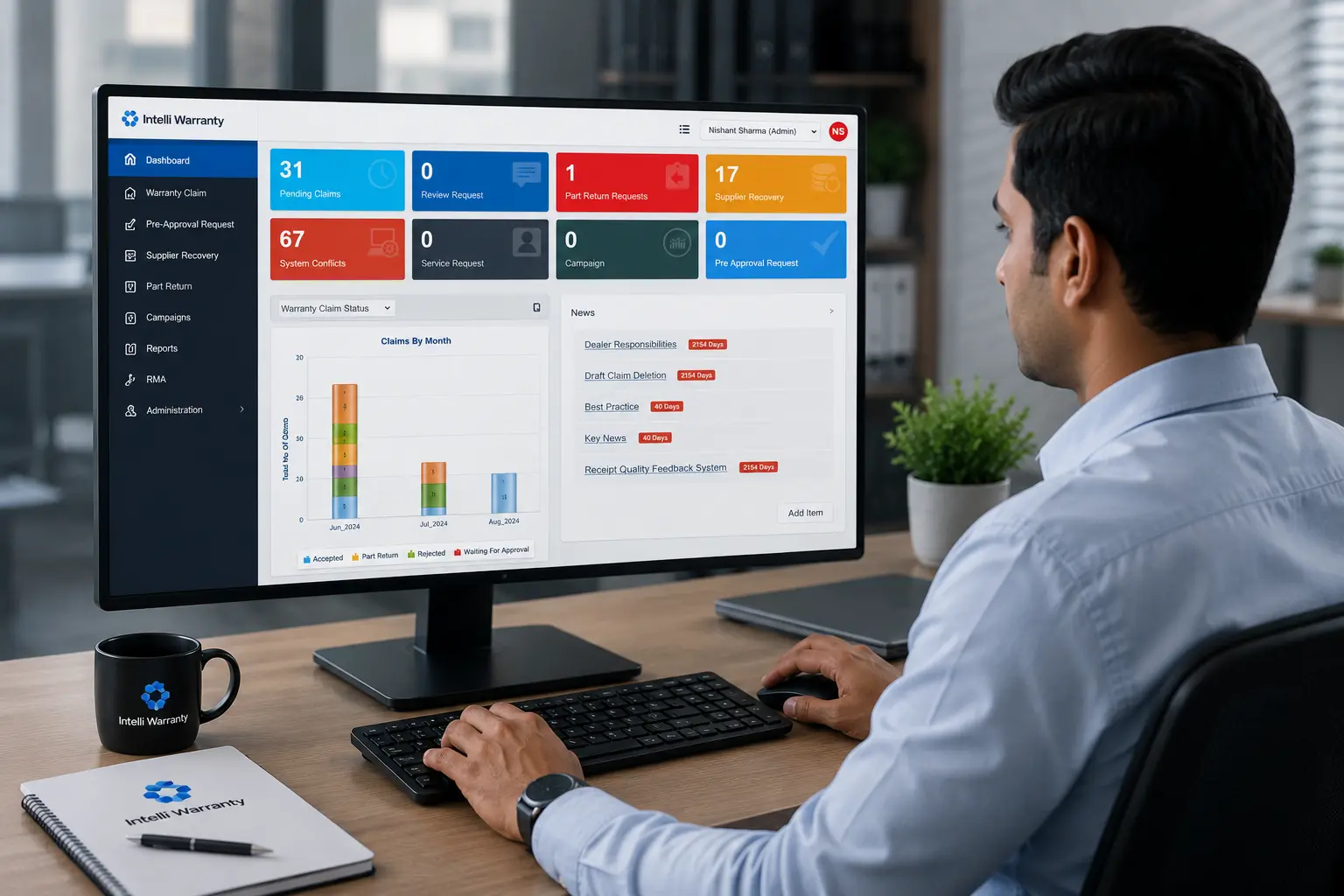
Intelli Warranty (core) offers full claims automation, a three-tier dashboard for OEM, dealer, and supplier users, and automated supplier cost recovery, built for medium and large OEMs.
2. Intelli Warranty Lite
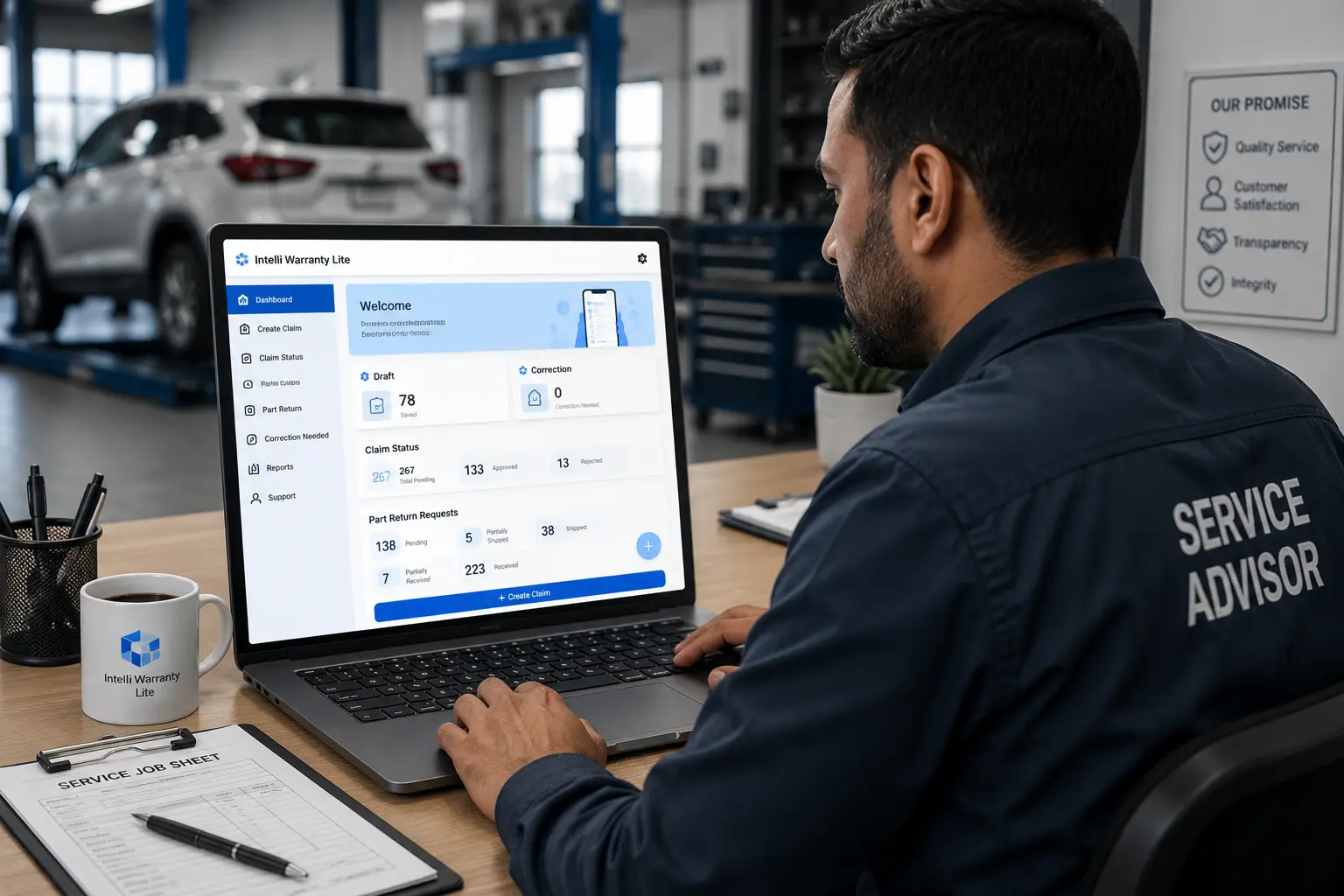
A structured digital warranty process for smaller OEMs, supporting both replacement and reimbursement resolutions with built-in barcode and serial number generation.
3. Intelli Warranty for Consumer Goods OEMs
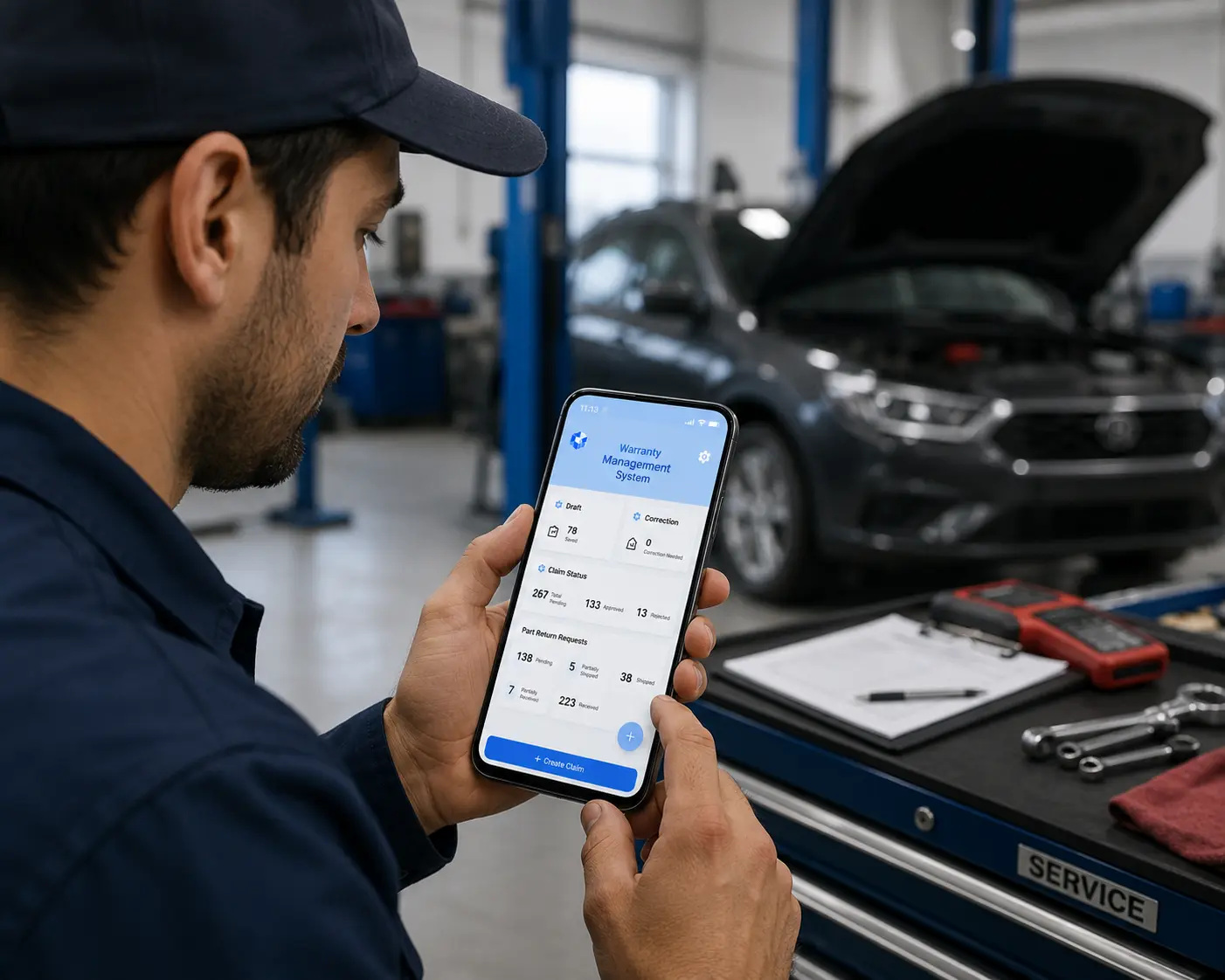
Built for manufacturers selling through multiple channels, combining warranty registration, complaint management, technician dispatch, and invoicing in one system.
Key Capabilities
- Configurable policy administration for coverage terms, component parameters, and reimbursement rates
- Streamlined dealer claim submission with validation checks and document upload
- Support for multiple claim types: spare parts, campaign, OEM PDI, dealer PDI, post-sale, and goodwill
- Multi-format reporting in PDF, Microsoft SSRS, and Excel
- Native SAP integration for parts pricing and supplier data synchronization
- Automated supplier recovery claim generation for approved claims
- Warranty analytics for product quality feedback and trend identification
Intelli Warranty is one part of a broader aftermarket suite.
OEMs running Intelli Warranty alongside Intelli DMS for dealer operations and Intelli Catalog for parts identification get a connected view from parts lookup to claim resolution, instead of three disconnected systems.
Conclusion
Warranty management is a direct lever on profitability, dealer satisfaction, product quality, and regulatory compliance for US OEMs. Manual, spreadsheet-based processes lose money in three consistent places: claims errors, missed supplier recovery windows, and undetected fraud. The best warranty management software addresses each of these directly through claims automation, real-time dashboards, automated supplier recovery, and built-in compliance configuration, and Intelli Warranty was built to cover all four in one system rather than as separate add-ons.
Before selecting a vendor, verify their ERP integration architecture, ask for documented supplier recovery results, and request a go-live timeline from a comparable customer rather than a sales estimate. OEMs that use warranty data as product quality intelligence rather than just a reimbursement workflow are better equipped to improve suppliers' recovery and accelerate claims resolution.
If you are evaluating warranty management software, schedule a personalized demo to see how Intelli Warranty can automate claims, improve supplier recovery, and give you complete visibility across your dealer network.
FAQ
What does warranty management software cost for a mid-size OEM?
Cost depends on claim volume, number of dealers, and which modules you need (claims automation, supplier recovery, analytics). Most vendors, including Intelli Warranty, price by subscription, sometimes combined with a one-time implementation fee. Ask for a quote based on your actual claim volume and dealer count, and compare the total cost against your current cost per claim before deciding.
How long does it take to implement warranty management software?
Implementation typically runs through discovery, configuration, ERP integration, and a phased dealer rollout. The actual implementation timeline depends on the complexity of your ERP environment and the size of your dealer network. Intelli Warranty's team maps this out during discovery, so ask for the go-live timeline from a reference customer similar in size rather than relying on a general sales estimate.
Can warranty management software integrate with SAP or Oracle?
Yes. Intelli Warranty offers native SAP S/4HANA integration, with support for Oracle Cloud and Microsoft Dynamics 365, so parts pricing, supplier data, and reimbursement records stay synced without manual data entry. Ask any vendor for the documented integration architecture rather than a general compatibility claim.
What is supplier recovery in warranty management?
Supplier recovery is the process of recovering warranty costs from the parts supplier whose component caused a failure. It is one of the higher-return activities in warranty operations, but most supplier agreements set a strict filing window. Intelli Warranty flags supplier-attributable claims automatically and generates the recovery claim before that window closes, which manual processes often miss.
How does warranty management software help detect fraud?
It applies pattern analysis to claim data, flagging dealers whose approval rates deviate from the network average, repeat claims on the same serial number or VIN, and claim patterns that match known fraud signatures. In Intelli Warranty, flagged claims go to a human reviewer before approval rather than after, which limits losses compared with manual, after-the-fact fraud reviews.


Explore More Insights





.webp)


About the Author


Chandra Shekhar
Chandra Shekhar is the Senior Manager, Strategy & Business Development at Intellinet Systems. With over a decade of experience in the automotive industry, Chandra Shekhar has led digital transformation and aftersales strategy initiatives for OEMs across multiple markets. His background combines deep industry knowledge with a practical understanding of how technology can solve real operational challenges. He focuses on making complex ideas clear and relevant for automotive and aftermarket professionals navigating ongoing change.


