

Overview: Best warranty management software refers to the platforms OEMs use to run dealer claim submission, warranty policy administration, parts return (RMA) tracking, and supplier recovery from one connected system, rather than spreadsheets, phone calls, and disconnected dealer portals. For an OEM, warranty is not a support function bolted onto sales. It is a claims pipeline that touches parts inventory, dealer payments, supplier chargebacks, and the product quality data that feeds back into engineering.

This guide compares ten warranty management platforms that OEMs across automotive, agriculture, construction, and EV actually evaluate in 2026: what each one does well, where it is built for a different buyer entirely (a D2C ecommerce brand rather than a dealer network, for example), and which platforms fit a franchised or independent dealer network at scale. The short version: OEMs running multi-brand dealer networks need dealer claim submission, ERP or DMS integration, and supplier recovery built for manufacturing, not a returns portal built for online storefronts.
Key Takeaway
- Best for OEM dealer networks across automotive, agriculture, construction, and EV: Intelli Warranty, built for the full claim lifecycle from registration and dealer submission through supplier recovery.
- Best for large OEMs on Salesforce or PTC: Tavant Warranty and PTC Warranty, native extensions of an OEM's existing CRM or PLM environment.
- Best for warranty plus broader service or returns operations: Syncron Warranty (service lifecycle management) and Claimlane (D2C returns and repairs).
- Best for fast, configurable, or AI-driven claims: WarrantyHub (no-code policy builder), ServiceCPQ (AI-powered adjudication), and Appian (custom low-code workflow).
- Best for specialized dealer and supplier networks: Zafire SMART Warranty for agricultural OEMs and LeenWarranty for global dealer and supplier recovery.
What Does Warranty Management Software Actually Do for an OEM?
Warranty management software for OEMs centralizes warranty policy administration, dealer claim submission, claim review and approval, parts return (RMA) tracking, and supplier recovery in one connected system. It replaces the spreadsheets and email threads that typically sit between an OEM’s warranty desk and its dealer network, and it produces the claim-level data that quality teams use to catch recurring failures early.
For an OEM, a warranty claim is a financial and operational event, not a customer service ticket. It starts at the dealer counter or service bay when a technician diagnoses a failure covered under the OEM’s warranty policy. From there it moves through documentation, review by an OEM claims processor, approval or rejection, parts return if the part needs inspection, dealer reimbursement, and, in a meaningful share of cases, a chargeback to the supplier whose component actually failed.
When this process runs on spreadsheets and email, the same problems show up across industries:
- Manual data entry and paper repair histories create errors that surface weeks later as rejected claims or duplicate payments.
- Dealers and OEM warranty processors work off different versions of the same claim, and status gets lost between departments.
- Warranty processors approve similar claims inconsistently without a shared, auditable rule set, creating both customer dissatisfaction and legal exposure.
- Claim volume spikes (a model launch, a seasonal push, a field campaign) overwhelm a team still keying data by hand.
- Without real-time claim visibility, an OEM cannot see a defect trend until it has already cost millions in payouts.
None of this is unique to one industry. It shows up the same way at an automotive OEM running a large dealer network, an agricultural equipment manufacturer with a seasonal claim spike at harvest, and an EV manufacturer scaling a young dealer network faster than its back-office processes can keep up.
It is worth being precise about who does what in this chain, because OEM, dealer, distributor, and independent aftermarket are not interchangeable. The OEM sets warranty policy, funds the warranty reserve, and pays the claim. The franchised dealer performs the repair and submits the claim on the customer’s behalf. A distributor may sit between the two in international or off-highway markets. An independent aftermarket repair shop, by contrast, generally has no access to the OEM’s factory warranty system at all, since it is outside the franchised service network. Warranty management software is built for the OEM-to-dealer relationship; it is a different tool from the parts catalogs and service information systems independent shops rely on.
Best Warranty Management Software Comparison Table for OEM (2026)
The table below lines up all ten platforms against the criteria that matter to an OEM: whether the tool handles dealer claim submission natively, whether it manages supplier recovery, and whether it is a purpose-built warranty system or a warranty module bolted onto an adjacent platform such as a CRM, PLM, or low-code suite.
What OEMs Should Look for in Warranty Management Software?
OEMs should evaluate warranty software on dealer claim workflow, policy configurability, ERP and parts catalog integration, supplier recovery automation, audit trail and fraud controls, mobile access for dealer technicians, and reporting format. A platform that scores well on generic customer support metrics but has no dealer claim model is the wrong tool for an OEM.
The 10 Best Warranty Management Software for OEMs in 2026
Ten platforms come up repeatedly when OEMs evaluate warranty management software in 2026, ranging from purpose-built OEM systems to enterprise suites built on Salesforce or PTC, to platforms designed for D2C returns rather than dealer networks. The right choice depends on factors such as dealer network size, industry requirements, and the existing technology ecosystem.
1. Intelli Warranty: Best for OEM Dealer Networks Across Automotive, Agriculture, Construction, and EV
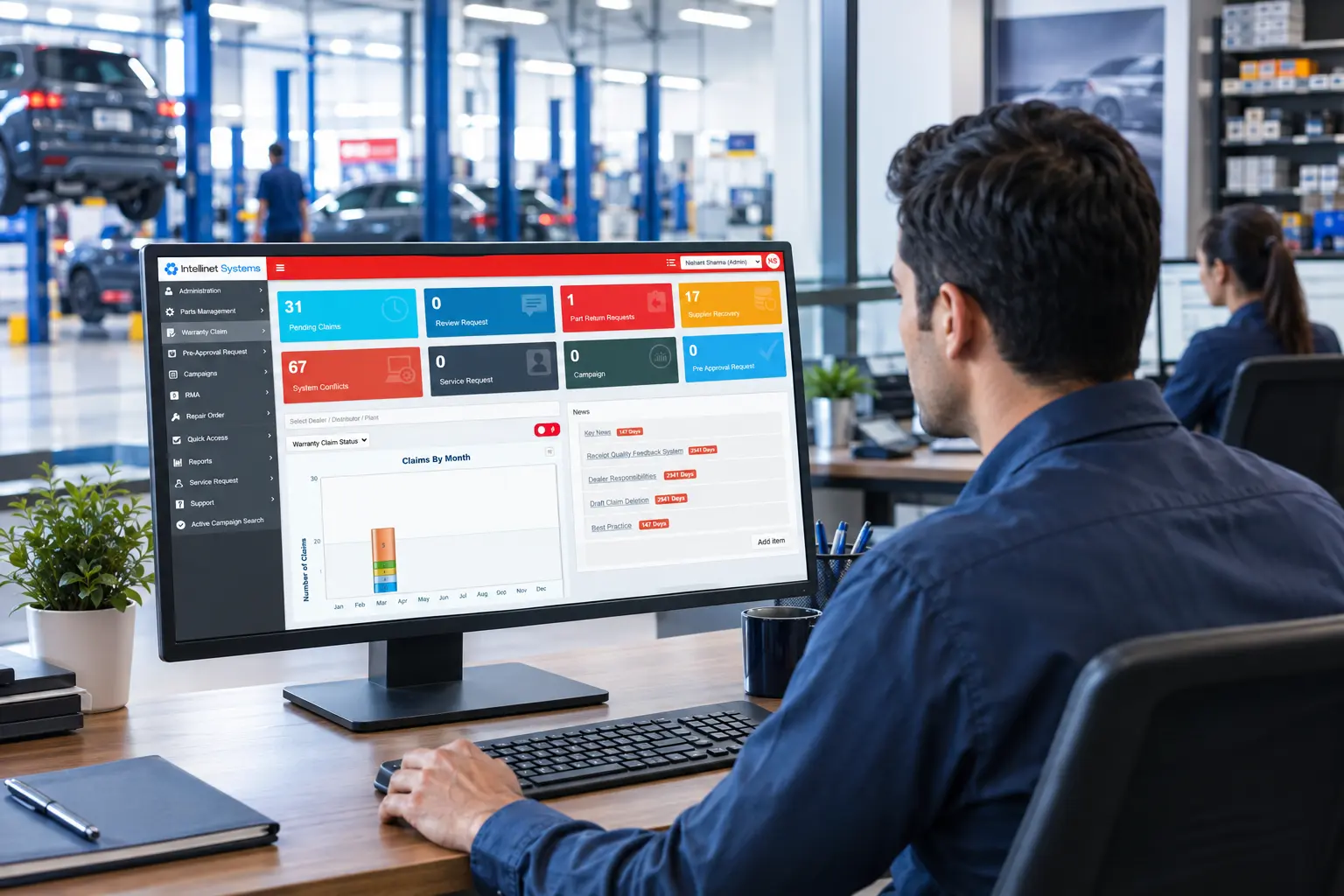
Intelli Warranty is a purpose-built warranty management platform for OEMs, structured around the actual warranty lifecycle rather than a generic case management model. The system separates the process into stages that mirror how an OEM’s own warranty desk works: warranty registration (defining what is covered, for how long, and from what date), stock-in (bringing finished goods into the system with serial or VIN tracking), stock-out (mapping which serial numbers were sold to which dealer or distributor), dealer claim submission, claim review, and RMA if a part needs inspection.
That stock-in and stock-out structure matters more than it sounds. It gives an OEM a live, serial-level record of which unit sits with which dealer, which is the foundation for validating a claim against the actual vehicle or machine that failed, and for handling a field campaign against a known population of units rather than a guess.
On the dealer side, claim submission runs from a mobile app, native Android or iOS, or the web. A technician enters a serial or VIN, most fields prefill from the stock-out record, and the technician selects a claim type, describes the complaint, and attaches photos and videos, or documents before submitting. Intelli Warranty supports six claim types out of the box: OEM PDI, dealer PDI, post-sale, campaign, goodwill, and spare parts, which covers the range most automotive, agriculture, and construction OEMs actually use.
On the OEM side, a warranty processor works from a queue with three outcomes: approve (which triggers a credit entry to the OEM’s accounting system and, if opted, initiates an RMA), reject (with a documented reason and dealer notification by mail), or request correction. Every status change is logged, which creates the audit trail an OEM needs both for internal controls and for defending claim decisions if challenged.
The platform integrates with SAP and other ERP systems for part pricing, supplier data, and EPC catalog validation, and it exports reports to Excel, PDF, and Microsoft SSRS, which matters for OEMs whose finance and quality teams already have reporting built around those formats. It also generates barcodes or serial numbers for products that do not ship with one, which is a real gap for some off-highway and industrial equipment lines.
Pros:
- Built specifically around the OEM-to-dealer claim lifecycle, not adapted from a generic CRM
- Native SAP and EPC integration for part price and supplier validation
- Six claim types cover PDI, post-sale, campaign, goodwill, and spare parts out of the box
- Mobile claim submission with prefilled fields reduces dealer data entry
- Real-time analytics: defect clusters, cost-per-model
- Reporting exports to Excel, PDF, and SSRS to match existing OEM reporting stack
Cons:
- Less suitable for non-OEM warranty operations (retail, home warranty)
- Primarily focused on OEM-dealer-supplier relationships
- Less brand recognition among some Western OEM buyers relative to legacy players like Tavant, Syncron, and PTC, though its client base already spans North America, Europe, the Middle East, and Asia.
2. Tavant Warranty: Best for Large OEMs using Salesforce
Tavant Warranty, marketed as Tavant Warranty On-Demand, is built natively on the Salesforce platform, which is its defining characteristic. For an OEM that already runs Salesforce for CRM, service, or dealer relations, Tavant extends that same environment into warranty claims rather than asking dealers and processors to learn a second system. It covers policy administration, dealer and supplier claim submission, and supplier recovery, and it integrates with SAP, Oracle, and other ERPs through standard APIs.
The tradeoff is the platform underneath it. Adopting Tavant means adopting Salesforce licensing, admin overhead, and integration complexity as a prerequisite, which is a real cost for an OEM running SAP, Oracle, or Microsoft Dynamics with no existing Salesforce footprint.
Pros:
- Deep native integration with Salesforce CRM and service tools
- Established enterprise track record with large automotive and EV OEMs
- AI-assisted claim validation and fraud detection capabilities
Cons:
- Requires Salesforce as the underlying platform, adding licensing and admin cost for OEMs not already on it
- Implementation for a full dealer network rollout typically runs six months or more
3. Syncron Warranty: Best for OEMs Looking for Warranty Plus Broader Service Lifecycle Management
Syncron positions warranty as one module inside its Service Lifecycle Management (SLM) platform, alongside parts pricing, inventory planning, and contract pricing. For an OEM already running or considering Syncron for parts and pricing, adding Syncron Warranty keeps claim data, supplier recovery, and parts planning inside one connected data layer rather than integrating a separate warranty vendor.
That breadth is also the catch. Syncron fits an OEM undertaking a broader aftermarket transformation, not a warranty-only purchase, and implementation timelines run in line with other SLM rollouts, commonly cited around seven months for the full platform.
Pros:
- Warranty data connects directly to parts pricing and inventory planning in the same suite
- Established with long-lifecycle equipment OEMs in trucks, construction, and industrial equipment
- Configurable claim routing and supplier collaboration tools
Cons:
- Best value depends on also adopting Syncron’s other SLM modules
- Implementation timeline suits a planned transformation more than a quick warranty fix
4. PTC Warranty: Best for OEMs Already Invested in the PTC Ecosystem
PTC’s Warranty ties warranty claims, returns, and supplier recovery directly to the Windchill PLM environment, letting an OEM trace a field failure back to the specific engineering change or design record that produced it. That link between warranty data and the engineering record is the platform’s real differentiator, and it is only fully realized for OEMs that already run Windchill for product lifecycle management.
Outside a PTC shop, the integration advantage disappears, and PTC Warranty becomes a warranty point solution competing on the same claim workflow features as everyone else on this list.
Pros:
- Warranty data links directly back to the engineering and quality record in Windchill
- Strong fit for manufacturers already managing compliance and quality through PTC
- Established analytics for defect and cost trend analysis
Cons:
- Value is concentrated in OEMs already running PTC PLM; limited advantage otherwise
- Enterprise licensing and implementation complexity typical of PLM-adjacent platforms
5. Claimlane: Best for Warranty Plus Returns Management
Claimlane is worth including on this list because OEM teams researching warranty software will run into it, but it is important to be precise about what it is built for. Claimlane is a returns and warranty platform built for D2C and ecommerce brands, with customers such as Skechers and Black Diamond, Shopify integration, a self-service consumer portal, and AI-assisted claim triage for product returns.
It does not have a dealer network model, supplier-level ERP integration for OEM parts pricing, or the claim types (PDI, campaign, goodwill) that OEM warranty policies actually use. For an e-commerce brand managing consumer returns and warranty claims together, it is a strong fit. For an OEM running claims through a franchised dealer network, it is the wrong tool.
Pros:
- Combines warranty and returns (RMA) workflows in one consumer-facing platform
- Fast setup and strong Shopify and e-commerce integrations
- AI-assisted claim triage reduces manual review for straightforward cases.
Cons:
- No dealer claim submission model, which is central to how OEM warranty actually works
- Not built for supplier recovery, parts catalog integration, or OEM-specific claim types
6. WarrantyHub: Best for Configurable Warranty Operations
WarrantyHub’s core pitch is a no-code policy builder: a manufacturer can define coverage types, pricing rules, and claim workflows without a developer ticket for every change. It covers manufacturer warranty claims, RMA, and supplier tracking, and a dealer or service-partner portal, with the company citing typical go-live timelines of 30 to 60 days for manufacturer customers.
It is a genuinely configurable mid-market platform, closer in spirit to a modern SaaS build than the legacy enterprise suites on this list, which makes it a reasonable option for a manufacturer that wants OEM-style warranty functionality without a Salesforce, PTC, or SLM commitment first.
Pros:
- No-code policy and workflow configuration reduces dependency on IT for changes.
- Faster stated implementation timelines than the enterprise platforms on this list
- Covers claims, RMA, and supplier tracking in one platform
Cons:
- Setting up custom rules, dealer networks, and systems in WarrantyHub requires significant time and staff effort.
- It may not be the best fit for a very large, complex OEM
7. ServiceCPQ Warranty Claims Management: Best for AI-powered Claims
ServiceCPQ runs claims through a staged AI pipeline: a validation step checks warranty period and usage limits, a document analyzer reviews submitted evidence, a fraud engine scores the claim against multiple risk signals, and an adjudication engine produces line-item cost recommendations for parts, labor, travel, and freight. Supplier recovery claims generate automatically when the pipeline traces a failure back to a purchased component.
It is built specifically for industrial machinery, heavy equipment, and dealer networks that carry multiple OEM brands, which makes it a strong fit for that niche, though OEMs should independently validate any claim-processing time or cost-reduction figures the vendor publishes against their own claim volume and complexity before budgeting around them.
Pros:
- Multi-stage AI adjudication and fraud detection built specifically for equipment warranty claims
- Automatic supplier recovery claim generation when root cause traces to a component
- Dealer-side product also supports multi-brand equipment and truck dealers carrying several OEMs
Cons:
- AI adjudication is only as reliable as the policy and machine data feeding it, and the vendor’s published performance figures have not been independently validated.
8. Zafire SMART Warranty: Best for Agricultural and Industrial OEMs
Zafire’s Smart platform grew out of UK service and repair management software and has been deployed by agricultural OEMs specifically to eliminate paper-based claims. One global agricultural OEM cited by Zafire removed roughly 90,000 paper claims per year, applied warranty rules automatically, and cleared its claims backlog after adopting the platform, reporting an 80% reduction in administrative overhead and claim resolution time.
It is a solid fit for agricultural and industrial equipment manufacturers still running paper or spreadsheet-based claims, particularly given the seasonal claim spikes those industries see around planting and harvest windows.
Pros:
- Proven track record specifically with agricultural OEM claim volumes and paper-based transitions
- Broader service and repair management suite beyond just warranty
- Established in UK and European agricultural and industrial equipment markets
Cons:
- Less name recognition and documented deployment history in the US market compared to domestic platforms
- Supplier recovery and analytics depth are lighter than dedicated enterprise warranty suites
9. LeenWarranty: Best for Global Dealer and Supplier Networks
LeenWarranty, from UK-based LeenTech, is a web-based warranty system built specifically for manufacturers with worldwide dealer and supplier networks, including mining, quarrying equipment, and specifically vehicle manufacturers. Its companion module, LeenRecovery, extends the same system into the supply chain, so warranty claims tied to a supplier-caused defect route into a structured recovery and corrective-action process rather than a manual email exchange with the supplier’s quality team.
It is a smaller, more focused vendor than the enterprise names on this list, offering the advantages of lower costs and more direct support, but with a smaller platform roadmap and ecosystem.
Pros:
- Purpose-built for manufacturers coordinating warranty across global dealer and supplier networks
- LeenRecovery extends warranty into structured supplier corrective-action tracking
- More cost-effective than the large enterprise platforms on this list
Cons:
- Smaller vendor with a narrower feature roadmap than Tavant, Syncron, or PTC
- Less documented presence in large-scale US automotive dealer network deployments
10. Appian Warranty Management: Best for Configurable Workflows
Appian is a low-code process automation platform, not an out-of-the-box warranty product, and its warranty management offering reflects that: OEMs and their implementation partners build the actual claim workflow, approval stages, and integrations using Appian’s platform rather than adopting a pre-built warranty application. For an OEM with in-house development resources or a systems integrator relationship, that flexibility means the workflow can match an unusual internal process exactly.
It also means the OEM is responsible for building and maintaining what a purpose-built warranty vendor would otherwise deliver out of the box, which is a meaningfully different commitment than buying warranty software.
Pros:
- Full control over workflow design, approval stages, and system integrations
- Backed by a large, established low-code platform with strong process orchestration credentials
- Suited to OEMs with complex, non-standard claim approval chains
Cons:
- Requires building the warranty application rather than deploying a ready-made one, which extends time to value
- Ongoing maintenance of a custom-built application sits with the OEM or its integrator, not a warranty-specialist vendor
How to Find the Right Warranty Management Software for Your OEM?
Start with dealer network size and claim volume, then match industry-specific claim types (PDI, goodwill, campaign, spare parts) and existing ERP or CRM investment before comparing feature list. A platform that fits your existing SAP, DMS, or Salesforce environment will go live faster than one that requires adopting a new enterprise system first.
- Assess claim volume and dealer count first. A platform sized for a 50-dealer network and one sized for a 500-dealer network solve different problems even if the feature list looks identical.
- Match the industry vertical. Automotive, agriculture, construction, and EV OEMs each have different claim type mixes, seasonal patterns, and supplier structures.
- Check integration with what you already run. A warranty system that connects to your existing SAP, DMS, or Salesforce environment avoids forcing dealers and processors to learn a second system from scratch.
- Request a live demo built around a real claim. Walk a claim through registration, dealer submission, review, approval, and supplier recovery, and see where the platform’s workflow diverges from your actual process.
- Confirm deployment timelines against business need. A new model launch or a seasonal claim spike does not wait for a twelve-month enterprise rollout.
Conclusion
Warranty management is one of the few OEM functions that touches dealer relations, parts operations, supplier contracts, and product engineering all at once. The platforms compared here solve that problem in different ways. Some are purpose-built for OEM dealer networks, some are warranty modules attached to a broader CRM, PLM, or low-code platform, and a few are built for D2C ecommerce returns and should not be mistaken for OEM warranty systems.
Global automotive OEMs set aside $72.5 billion in warranty accruals in 2024 alone, according to Warranty Week's annual industry report, a reasonable indication of how much is riding on getting this process right. The correct choice comes down to dealer network size, claim volume, industry-specific claim types, and how well a platform fits the ERP or CRM environment already running inside the business, not which vendor has the longest feature list.
Frequently Asked Questions
What is the best warranty management software for OEMs?
The best warranty management software for OEMs depends on dealer network size, industry, and existing systems. Purpose-built platforms such as Intelli Warranty and Zafire SMART Warranty suit mid-market OEMs needing fast deployment. While Tavant, Syncron, and PTC Warranty fit large enterprises already invested in Salesforce, SLM, or PLM ecosystems.
How is OEM warranty software different from D2C returns software?
OEM warranty software manages dealer claim submission, technician labor, parts return, and supplier recovery across a franchised network. D2C returns software, such as Claimlane, manages consumer-facing product registration and returns for ecommerce brands. The two solve different operational problems even though both use the word warranty.
What features matter most for supplier recovery?
Supplier recovery works best when the platform automatically links a failed part's supplier record to the claim, applies liability rules, and generates a chargeback without manual lookup. OEMs should confirm the system tracks part-level supplier data and produces auditable recovery claims, not just a general note field.
How long does warranty software implementation take for a dealer network?
Timelines vary widely. Purpose-built OEM platforms can go live in weeks once dealer data and claim types are configured. Enterprise suites built on Salesforce, PTC, or a broader SLM platform typically require six to twelve months, since warranty gets integrated into a larger existing system.
Can warranty management software reduce warranty fraud for OEMs?
Warranty software can reduce fraud by flagging duplicate serial numbers, unusual claim patterns by dealer, and mismatches between repair history and claimed parts. It does not eliminate fraud on its own; it depends on clean parts and dealer data, and still needs a warranty processor reviewing flagged claims.


Explore More Insights






.webp)


About the Author


Vishakha Singh
Vishakha Singh is a Senior Content Writer with 10 years of experience creating content across technology and automotive aftermarket domains. She specializes in OEM software, dealer operations, spare parts, warranty management, and digital solutions for the automotive aftermarket. Her work focuses on turning complex industry topics into clear, practical, and research-driven content for OEMs, dealers, and aftermarket professionals.


