

Overview: A Unified Dealer Management Platform is a single software system that connects a dealership’s sales and service departments, so a vehicle’s booking, delivery, and repair history live in one place rather than scattered across separate tools. For OEMs, the underlying issue is inconsistent dealer data: without a shared platform, sales and service keep separate records, and network-level reporting on inventory, warranty, and customer experience becomes unreliable. A connected platform gives OEMs comparable data across dealers and gives service advisors visibility into customers’ purchase history. Connecting sales and service is a data and workflow problem before it is a technology purchase.

Key Takeaway
- A Unified Dealer Management Platform links sales records (bookings, VIN, options) with service records (job cards, repair history) inside one system.
- For OEMs, this is mainly a data-standardization problem across dealers, not simply a software feature.
- Disconnected sales and service systems create duplicate customer records and slow warranty and service follow-up.
- The business impact shows up as shorter handoffs and more consistent dealer reporting, not as a guaranteed revenue increase.
Connect sales and service operations with Intelli DMS. Unify customer, vehicle, job card, parts, billing, and warranty data across your dealer network. Book a Demo
What Is a Unified Dealer Management Platform?
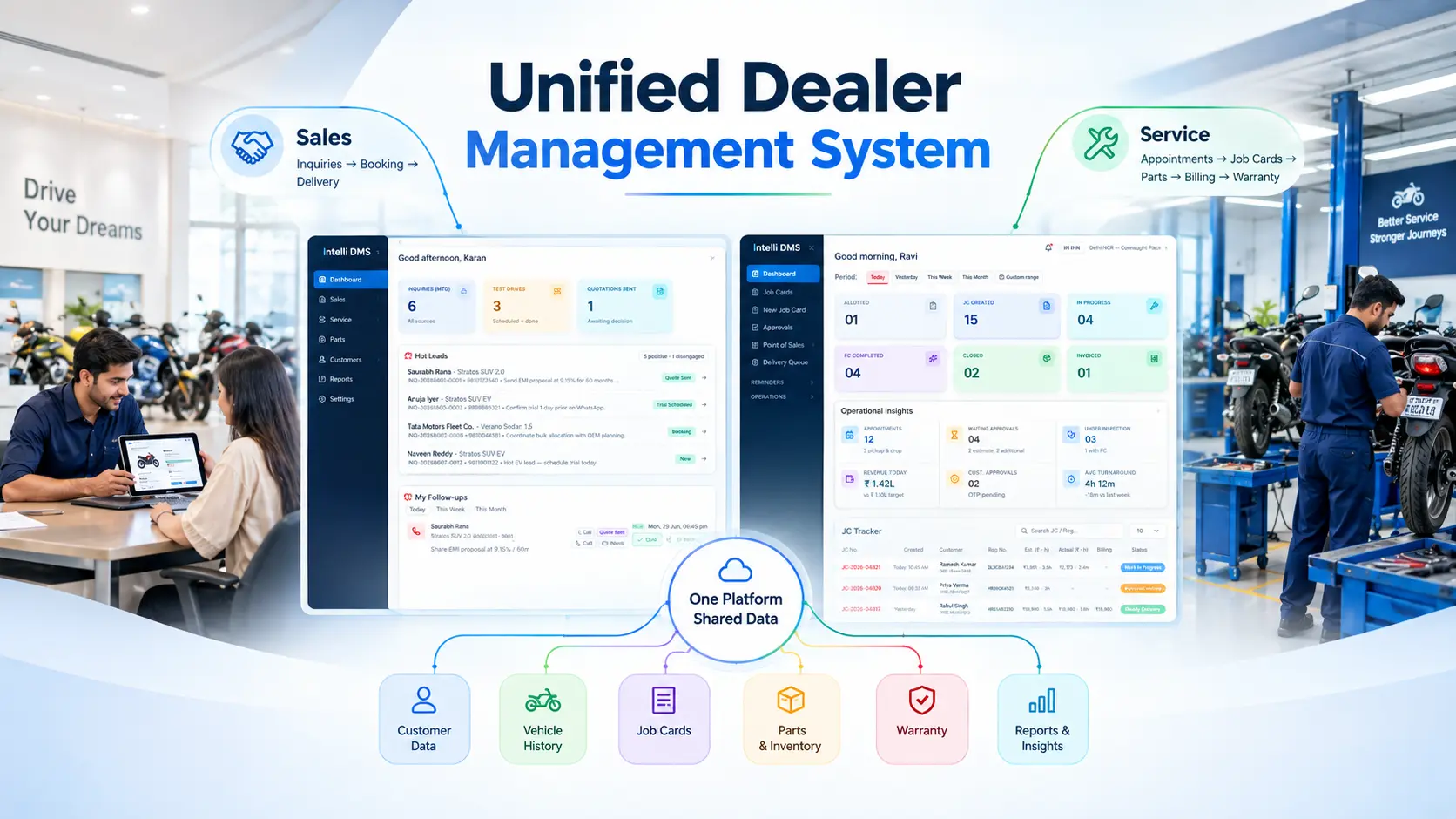
A Unified Dealer Management Platform is dealer software that connects the sales side of a dealership (inquiries, bookings, vehicle delivery) with the service side ( appointments, job cards, parts, warranty) inside one data model, so both departments read from the same customer and vehicle record instead of maintaining separate, disconnected files.
In most dealerships today, sales run on a CRM or booking tool, and service runs on a separate workshop scheduling system, sometimes loosely connected, sometimes not connected at all. A customer who bought a vehicle six months ago may show up at the service counter as a new record that has to be rebuilt from scratch. A Unified Dealer Management Platform closes that gap: the VIN, purchase date, trim, and warranty terms captured at the point of sale carry forward into the service department’s job card, appointment scheduling, and parts request.
Why Do Sales and Service Stay Disconnected at Most Dealers?
Sales and service typically stay disconnected because dealerships add tools department by department: a CRM for sales leads, a separate workshop scheduling tool for service, and often a spreadsheet or messaging app to bridge the two. Each department optimizes for its own workflow, not for a shared customer or vehicle record.
This pattern shows up across OEM networks regardless of brand or region. A sales team tracks a lead through quotation and booking in one system; once the vehicle is delivered, that record effectively ends. The service department starts fresh with a new appointment entry, a new customer lookup, and sometimes a phone call to confirm details the sales team already had on file. Parts counters frequently run their own inventory tool, disconnected from both. None of this reflects a failure of any single department; it is what happens when systems are purchased and implemented separately over several years, often by different people, without a shared data model in mind from the start.
How Does a Unified Dealer Management Platform Connect Sales and Service Operations?
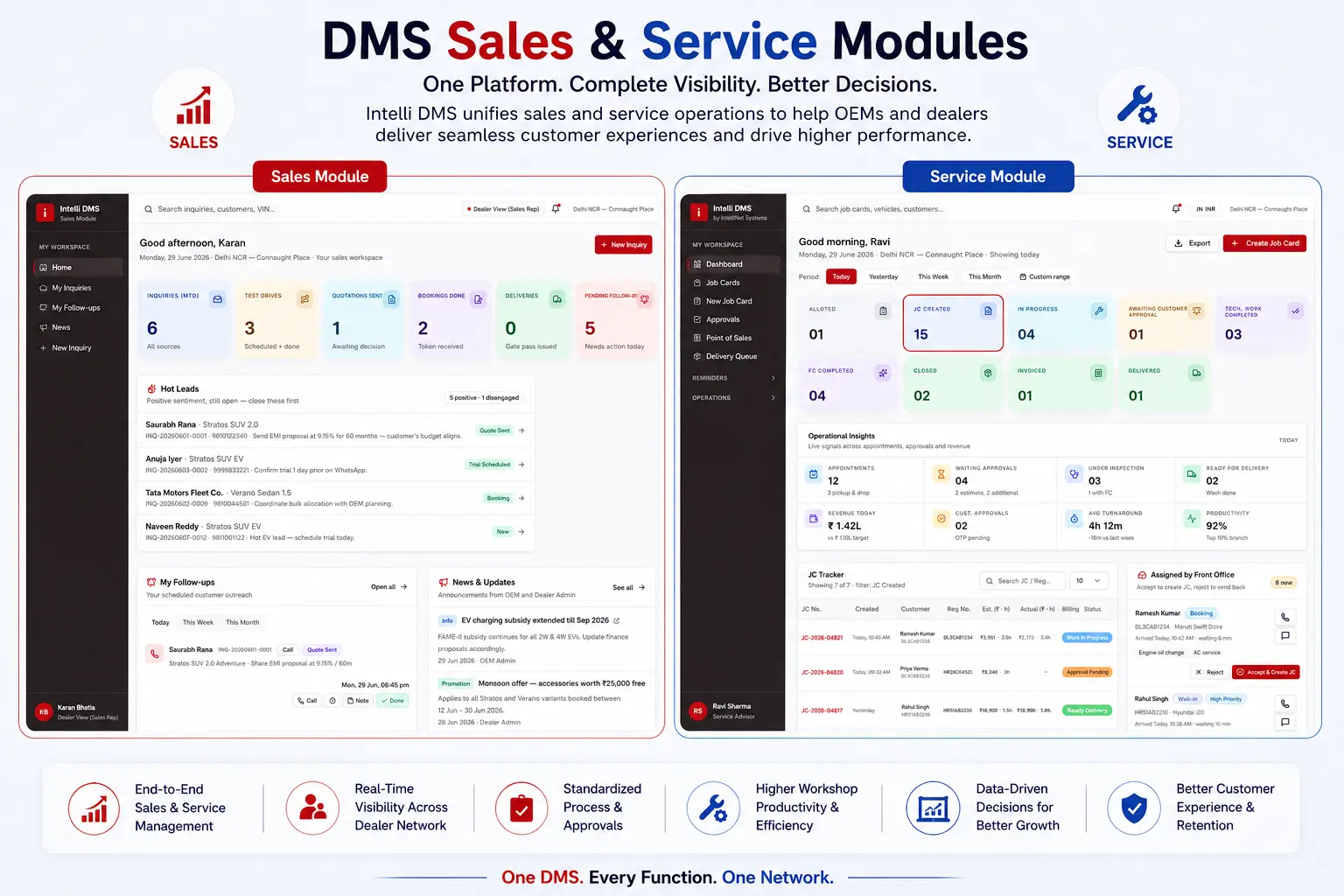
Connected Sales and Service Operations means the data captured at the point of sale, including VIN, trim, options, delivery date, and warranty start, flows directly into the service record, so the first scheduled maintenance, open recalls, and warranty eligibility are already populated when a customer books an appointment, with no re-entry required.
In practice, this changes a handful of specific workflows. A pre-delivery inspection checklist becomes the vehicle’s first service record rather than a paper form that gets filed and forgotten. A trade-in evaluation during a new sale can reference the vehicle’s actual service history rather than relying on the customer’s memory or a visual inspection alone. A service advisor booking a repair can see whether the customer is still within a finance term or an extended warranty window, which affects how the conversation about repair cost gets handled at the counter.
Where Do Sales-to-Service Handoffs Break Down Without a Connected Platform?
Most breakdowns happen at the specific points where a sale ends, and service begins: delivery, the first service visit, a trade-in, or a warranty claim. At each point, the service needs information about sales already captured. When the two systems don’t share that data, the dealership either re-collects it manually or works without it.
What Are the Benefits of a Unified Dealer Management Platform for OEMs?
For an OEM, the primary benefit is comparable data across the dealer network: sales conversion, service turnaround, and warranty costs can be measured the same way at every dealership, rather than reconciling different formats from different tools. This supports dealer benchmarking, warranty cost control, and more accurate demand signals for parts and inventory planning.
- Consistent reporting format across dealers, since sales and service data is structured the same way everywhere the platform is deployed.
- Better warranty cost visibility, since claims reference the same sale and delivery data captured at the point of purchase
- More reliable parts demand signals, since service parts usage connects back to the vehicle configuration captured at sale
- Fewer manual reconciliation cycles for OEM network teams pulling monthly or quarterly dealer reports
Platforms built around this shared data model, such as Intelli DMS, are designed specifically for OEM network use rather than for a single, independent dealership.
A Broader Note on Dealer Network Scale
The scale of the U.S. franchised dealer network is a useful reference point for why data consistency matters to OEMs. According to NADA’s 2025 full-year data, the nation’s 16,990 franchised light-vehicle dealers wrote more than 276 million repair orders and generated over 164 billion dollars in service and parts sales in 2025. At that scale, even small inconsistencies in how individual dealers record sales and service data compound quickly across an OEM’s network-wide reporting.
Where AI Fits in a Connected Platform and Where It Doesn’t?
AI features layered onto a Unified Dealer Management Platform can help surface patterns, such as flagging a customer likely due for service or suggesting parts based on repair history, but they depend entirely on the underlying sales and service data being accurate and connected. AI cannot compensate for missing VINs, inconsistent part numbers, or unlinked customer records.
This distinction matters for OEM decision-makers evaluating vendor claims. A recommendation engine that suggests service reminders is only as good as the delivery date and service interval data feeding it. If sales and service still run as separate systems with manual reconciliation, adding AI on top does not fix the underlying data gap; it produces recommendations built on incomplete information. The sequence that works in practice is to connect sales and service data first, then layer AI-assisted features, such as predictive service reminders or parts suggestions, on top of that connected data.
What Should OEMs Check Before Selecting a Unified Dealer Management Platform?
OEM teams evaluating a Unified Dealer Management Platform should check how sales and service data are structured, whether the platform integrates with existing ERP and warranty systems, and whether historical dealer data can be migrated without losing the sales-to-service linkage the platform is meant to provide.
- Does the platform use one customer and vehicle record for both sales and service, or two separate modules connected by a sync layer?
- Can it integrate with the OEM’s existing ERP, CRM, and warranty systems through open APIs, without a full replacement of those systems?
- What happens to existing service history during data migration: does it map to the new vehicle record, or does the dealership start fresh?
- Does the platform support role-based access, so sales, service, and OEM network teams each see only what’s relevant to their role?
- Is reporting standardized across dealers by default, or does each dealership need separate configuration to produce comparable data?
How Does Intelli DMS Connect Sales and Service Operations?
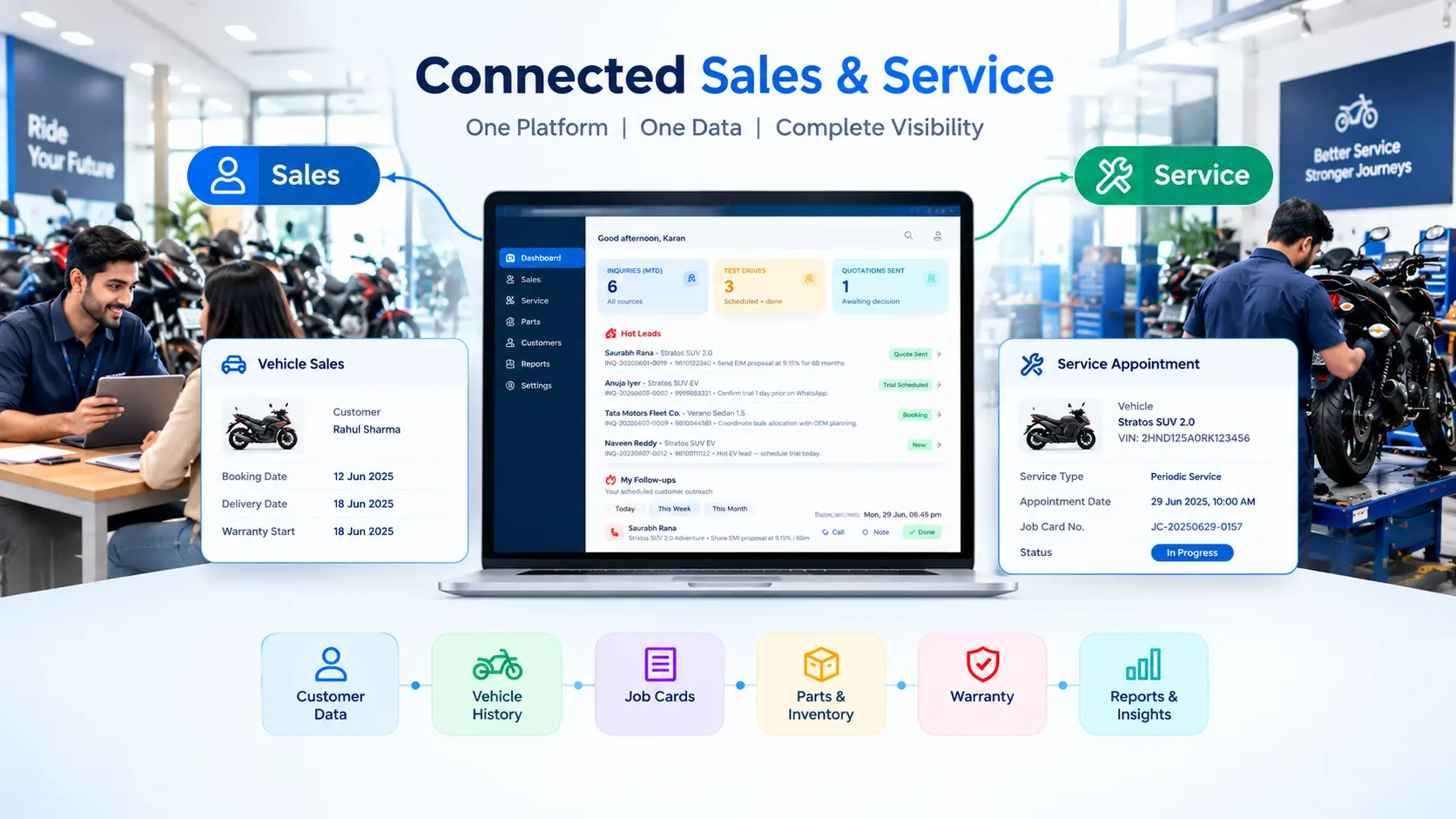
Intelli DMS is a cloud-based dealer management software built around a shared data model for sales and service, covering inquiry-to-booking, vehicle delivery, workshop job cards, parts, billing, and warranty within one system, so an OEM’s dealer network runs sales and service from the same customer and vehicle record.
On the sales side, Intelli DMS tracks a customer from inquiry through test drive, quotation, booking, vehicle allocation, and delivery, with finance and insurance handled in the same workflow. On the service side, it covers appointment scheduling, front-office check-in, job card creation, workshop and technician assignment, parts and inventory, billing, and warranty processing. Because both sides share the same vehicle and customer record, a service advisor working on a repair order can see the original sale details, and a sales rep evaluating a trade-in can see the vehicle’s full service history without switching systems or calling another department.
For OEMs managing multiple dealerships, this shared structure also standardizes how sales and service data is captured and reported across the network, which is the foundation for dealer benchmarking and warranty visibility.
Conclusion
A Unified Dealer Management Platform solves a specific, practical problem: sales and service running on separate records that don't inform each other. For OEMs, the value isn't the platform itself; it's the data consistency it provides, including comparable reporting across dealers, warranty claims tied to accurate sales data, and service departments that don't have to rebuild a customer's history from scratch. Getting sales and service onto one data model is what makes standardized reporting, dealer benchmarking, and reliable warranty tracking possible in the first place. OEMs evaluating a platform for their network should focus first on whether it genuinely shares one data model between departments, not just on whether it offers modules for both.
OEMs looking to connect sales and service data across their dealer network can see how this works in practice with Intelli DMS. Book a demo today.
FAQ
What is a Unified Dealer Management Platform?
A Unified Dealer Management Platform is a single system that connects a dealership’s sales and service operations, so vehicle and customer data captured at the point of sale, such as VIN and delivery date, carries into service scheduling, job cards, and warranty processing without manual re-entry between departments.
How is a Unified Dealer Management Platform different from a regular DMS?
Most Dealer Management Systems include sales and service modules, but not all connect them on one data model. A Unified Dealer Management Platform specifically avoids separate sales and service databases, so both departments reference the same customer and vehicle record rather than syncing data between two systems.
Does connecting sales and service data help with warranty management?
Yes. Warranty claims reference the sale date, delivery date, and coverage terms captured at the point of sale. When service and sales share that data directly, advisors can confirm warranty eligibility before starting work, and OEMs get more consistent claim data for cost tracking across the dealer network.
Can a Unified Dealer Management Platform integrate with an OEM’s existing ERP?
Yes, when built with open APIs. Dealership-level transactions such as billing, parts usage, and warranty claims can sync to the OEM’s ERP for consolidated financial reporting, while the dealership continues to manage day-to-day sales and service operations inside the platform itself.
How does a connected sales and service platform affect customer experience?
Customer benefits from not having to repeat information at the service counter that they already provided during the sale, faster warranty confirmation, and service reminders based on their actual vehicle and delivery date rather than generic intervals.


Explore More Insights







.webp)


About the Author


Nishant Sharma
Nishant Sharma is the Head of Demand Generation at Intellinet Systems, specializing in B2B marketing, sales, digital transformation, and automotive aftermarket solutions. He shares insights on emerging technologies, industry trends, and strategies that help OEMs and businesses improve operational efficiency, customer experience, and aftermarket growth.


