

Overview: A two-wheeler DMS is dealer management software built for motorcycle and scooter dealerships, and Intelli DMS applies that model to high-volume, multi-location two-wheeler networks. Rather than managing sales, service, parts, and billing as separate systems, Intelli DMS connects them on a single platform, helping workshops coordinate workflows, complete jobs on time, and manage growing service volumes more efficiently. This article walks through where high-volume two-wheeler workshops typically lose time and margin, and how Intelli DMS addresses each point directly, from digital job cards and technician scheduling to parts control, customer approvals, invoicing, and OEM-level dashboards.

Key Takeaways:
- Idle technician time, parts-counter delays, and slow customer approvals are the three biggest drains on two-wheeler workshop throughput.
- Intelli DMS replaces paper job cards with digital ones created at check-in, so repair tasks and parts requests move without re-keying.
- Live workshop and technician scheduling in Intelli DMS gives managers real-time visibility into bay status and technician capacity.
- Parts requested in Intelli DMS are linked directly to the job card, giving technicians visibility into stock, reorder requirements, and available alternative parts within the same workflow.
- Automated SMS and WhatsApp updates through Intelli DMS let customers approve estimates without a bay sitting idle on a phone call.
- OEMs get centralized dashboards that turn dealer-level data on turnaround time, technician productivity, and parts usage into network-wide benchmarks.
Improve two-wheeler service operations with Intelli DMS. Connect job cards, technicians, parts, billing, warranty, and OEM dashboards in one platform. Book a Demo
Where Do High-Volume Two-Wheeler Workshops Actually Lose Time?
High-volume two-wheeler workshops typically lose time in three places. First, technicians may sit idle while waiting for paper job cards or verbal assignments. Second, parts requests can stall at the counter when inventory is tracked manually. Third, a completed diagnosis may sit in a bay while someone tries to reach the customer by phone for approval.
None of these three problems is unusual on its own. A busy dealership can absorb some idle time, an occasional parts delay, or a slow callback without much damage. The issue is what happens when the same three gaps repeat across every dealer in a network, every day. Idle time compounds into lower technician utilization. Parts delays compound into missed delivery promises. Slow approvals can keep vehicles waiting in service bays, reducing bay turnover and making it harder for workshops to handle the day’s workload efficiently.
The U.S. powersports industry operates at significant scale. According to the Motorcycle Industry Council, the industry is valued at nearly $48.2 billion and spans more than 10,000 retail outlets across all 50 states. Two-wheeler workshops feel these three gaps more acutely than car dealerships because job cycle times are shorter and daily volume is higher. A ten-minute delay on a car repair is a rounding error; the same delay on a two-wheeler job, repeated across dozens of vehicles a day, is the difference between hitting turnaround targets and missing them.
How Does Intelli DMS Replace Paper Job Cards With a Digital Workflow?
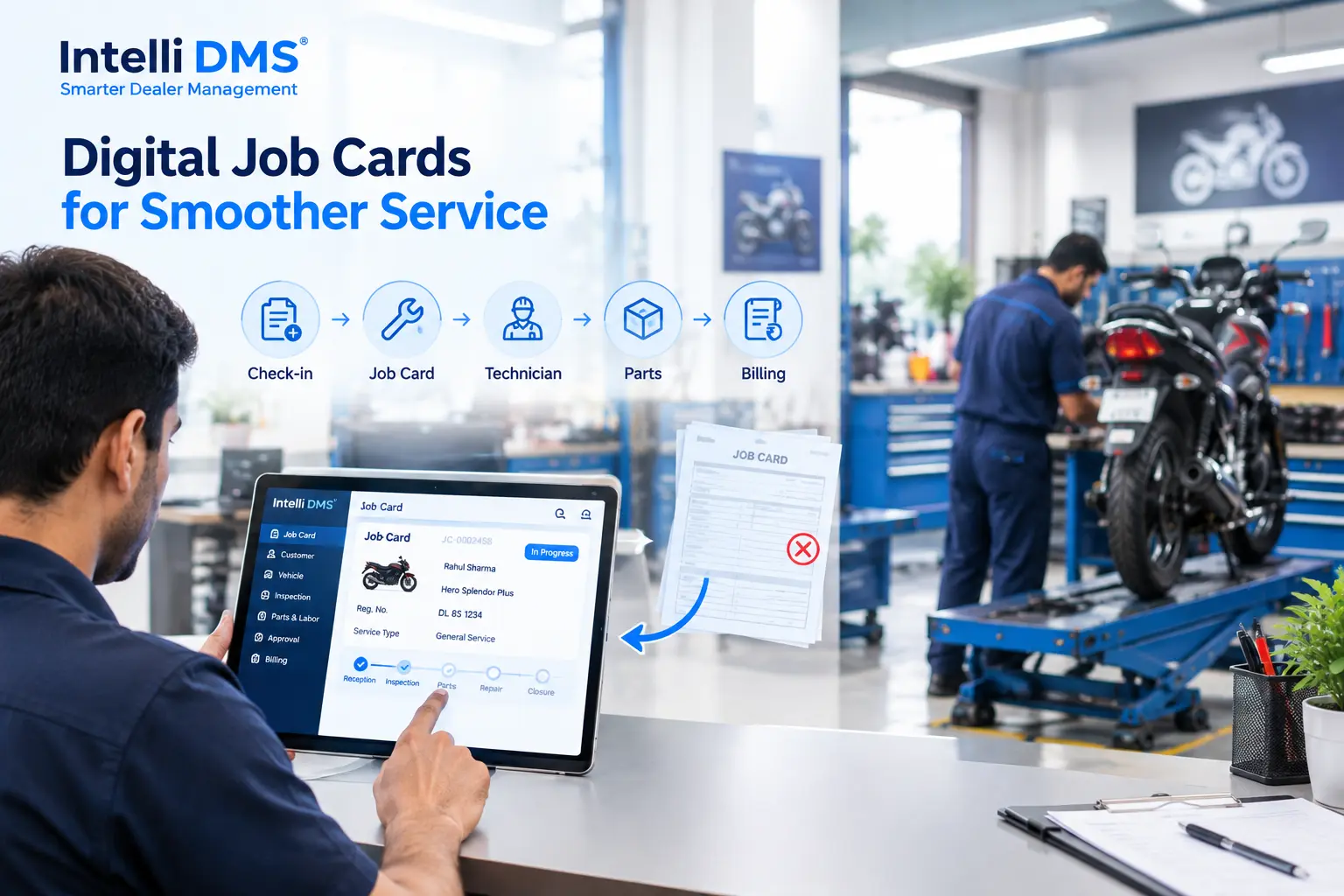
A two-wheeler dealer management system like Intelli DMS removes technician idle time by creating a digital job card as soon as a vehicle is checked in. It captures repair tasks, part requests, and customer complaints in a single record, replacing paper-based forms and keeping the service workflow organized. Information then moves between the service advisor, technician, and parts counter without being re-entered at each handoff.
When a service advisor opens a job card in Intelli DMS at check-in, the technician assigned to that vehicle immediately sees the same record, including the customer’s stated complaints and any inspection notes. There is no separate handwritten sheet to walk across the shop floor, and no gap between when a job is logged and when a technician can start on it.
Because the job card is the single source of truth for that repair, a parts request made from it is already tied to the correct vehicle and job, which removes one of the more common sources of delay: a technician requesting a part with incomplete information and having to go back and forth with the parts counter to clarify it.
How Does Intelli DMS Schedule Workshop Bays and Technicians in Real Time?
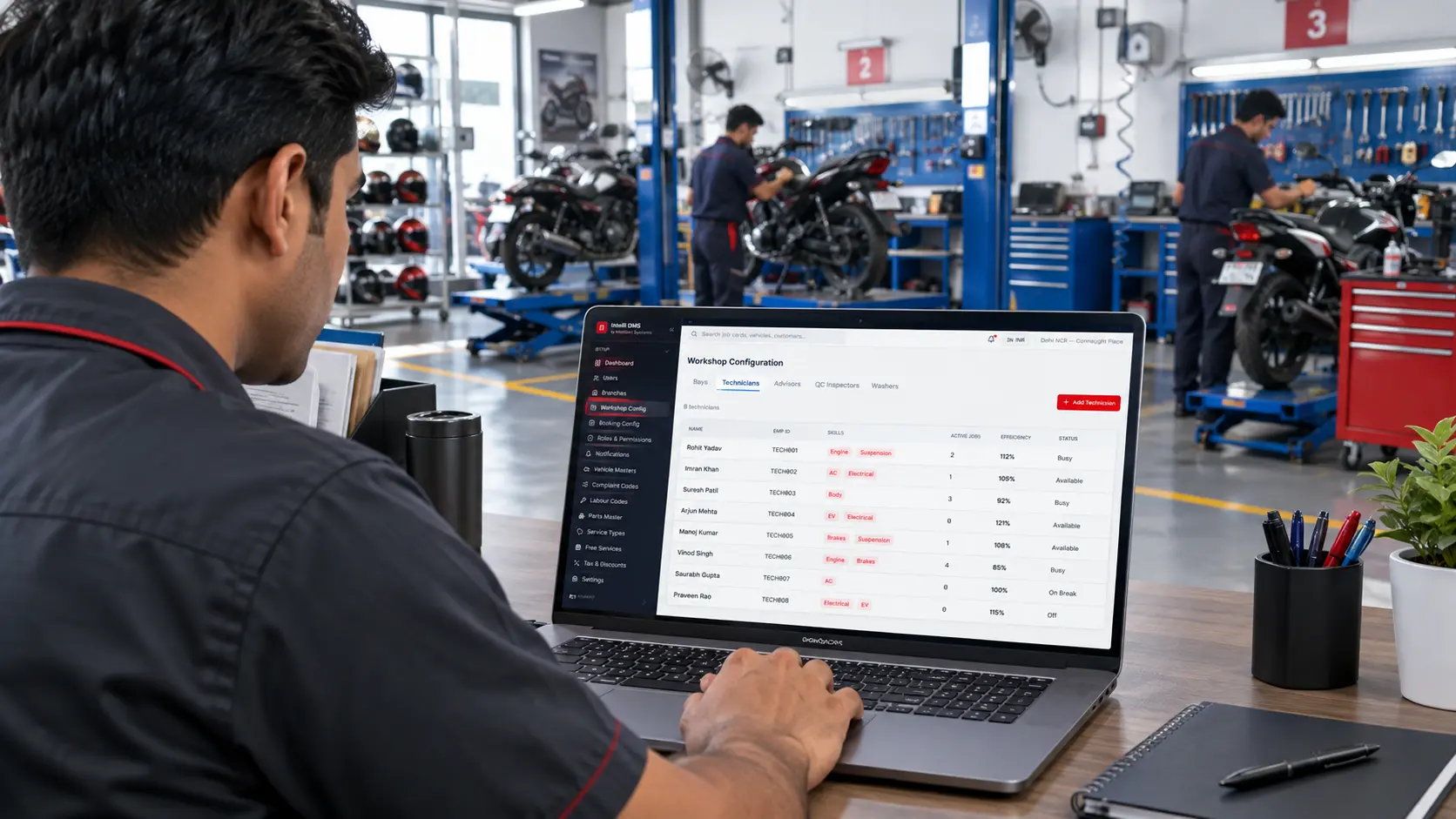
Intelli DMS, a two-wheeler dealership software, replaces manual scheduling boards with a live view of workshop bays and technician availability, so managers assign jobs based on actual capacity and skill match instead of habit or memory. This keeps technicians moving between jobs and cuts idle bay time.
A whiteboard or paper roster can show who is assigned to each job, but it cannot provide real-time visibility into which technician has just finished a job and is ready for the next one, or which bay is about to become available. Intelli DMS gives workshop managers that live picture, so a new job can be routed to whichever qualified technician has capacity right now, rather than whoever the manager happens to remember is available.
For a two-wheeler network running dozens of workshops, this same scheduling logic applied consistently across every location is what makes technician productivity numbers comparable dealer to dealer, rather than dependent on how well each manager tracks capacity manually.
How Does Intelli DMS Close Parts Bottlenecks Before They Stall a Job?
Intelli DMS links parts availability to the service estimate itself, so a technician can confirm stock directly from the job card instead of walking to the counter or calling ahead. Built-in logic flags slow-moving stock, suggests reorder points, and surfaces alternative parts. This reduces parts-related delays by giving technicians visibility into available inventory before work is left waiting for a required part.
Parts-counter delays are not always caused by a genuine stockout. Often, the required part is available somewhere in the network, but the team handling the job cannot see that inventory in real time. Intelli DMS addresses these parts bottlenecks through four connected capabilities:
- Live stock visibility across locations, so a technician or service advisor can see what is available, not just at their own dealership but across the network where relevant.
- Automated reorder suggestions that flag fast-moving parts before they run out, rather than after a job is already stalled.
- Dead stock identification, so slow-moving inventory gets flagged for action instead of sitting on a shelf indefinitely.
- Alternate part suggestions when the exact part is unavailable, which keeps a job moving instead of forcing a full stop while stock is sourced.
How Does Intelli DMS Speed Up Customer Approvals Without Losing Bay Space?
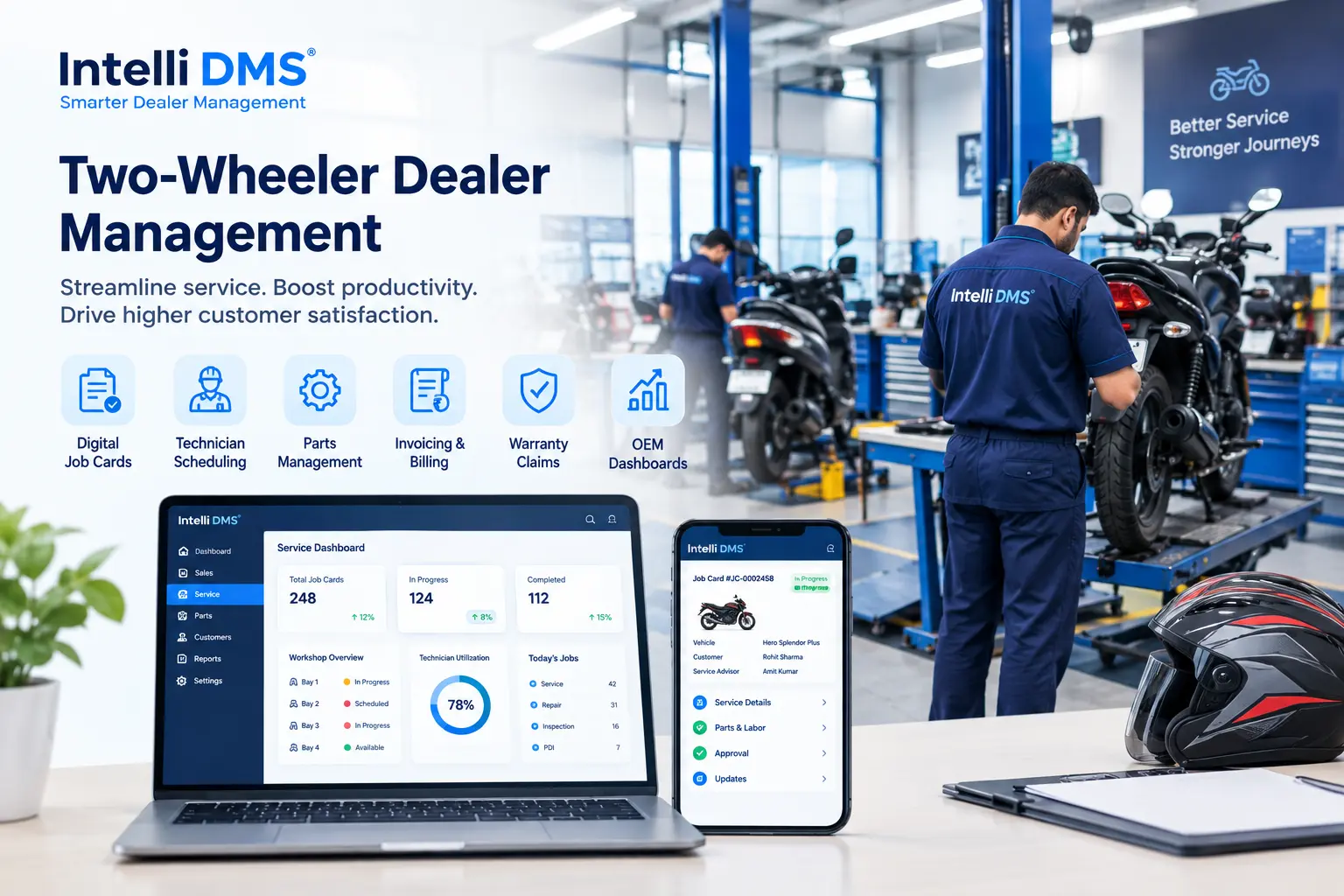
Intelli DMS sends automated status updates and estimate approvals through SMS and WhatsApp, reducing delays caused by waiting for customers to respond by phone. Customers can review and approve estimates directly from their own devices, allowing approved jobs to move forward without unnecessary bay time.
A finished diagnosis that is waiting on customer approval still occupies a bay, which is lost capacity for the rest of the day’s queue. Phone-based approvals depend on the customer picking up, which is not guaranteed during working hours. Routing the same approval through SMS and WhatsApp gives the customer a channel they are more likely to check quickly, and gives the service advisor a digital record of when the estimate was sent and approved, rather than a note based on a phone call that may or may not have happened as described.
How Does Intelli DMS Handle Invoicing and Warranty Claims?
Intelli DMS generates a compliant invoice in one step once a job is marked complete, and supports split billing across the customer, an insurer, and a warranty claim on the same job card. Because the warranty claim is linked directly to the digital job card, this reduces claim leakage and cuts down on manual administrative errors. By pulling claim data directly from the job card rather than reconstructing it after the fact, Intelli DMS shortens warranty claim cycle time and gives OEMs a clearer picture of warranty claim turnaround time across the network.
Split billing is common in two-wheeler service, where a single job might involve a customer-paid portion, an insurance-covered repair, and a warranty-covered part replacement, all on the same visit. Handling this manually across separate invoices increases the chance of an error or a missed reconciliation. Because Intelli DMS ties invoicing back to the same job card used for the repair, the billing breakdown reflects exactly what was done and what was covered under which category, and the warranty claim carries the same repair and parts data rather than being rebuilt separately after the fact.
What Network Visibility Does Intelli DMS Give OEMs?
Intelli DMS gives OEMs centralized, role-based dashboards that turn dealer-level data on turnaround time, technician productivity, and parts usage into a single network view. This lets an OEM benchmark regions, identify underperforming locations, and plan supply chain and staffing decisions off real operating data rather than dealer self-reporting.
The same metric means something different depending on who is looking at it. A dealer’s service manager cares about turnaround time inside their own shop floor. An OEM’s fixed-operations team cares about how that same number compares across a hundred locations. Intelli DMS dashboards serve both views from the same underlying data:
What Should OEMs Evaluate in a Motorcycle Dealer Management System?
When evaluating a motorcycle dealer management system at the final selection stage, OEMs should confirm that workflow connections, parts integration, approval automation, and reporting actually work the way the vendor describes, not just that the features are listed. The table below maps common evaluation criteria to how Intelli DMS specifically addresses each one:
Conclusion
The workshop is where a two-wheeler network either protects its margins or loses them, and the losses usually come from the same three places: idle technicians, parts delays, and slow customer approvals. Intelli DMS, a two-wheeler DMS, addresses each of these directly, with digital job cards, live technician and bay scheduling, integrated parts control, automated approval workflows, and invoicing that ties back to the actual job. For OEMs, the same data that fixes a single dealer's workflow also feeds the network-wide dashboards needed to manage service quality at scale.
Book a demo to see Intelli DMS's job card, workshop scheduling, and OEM dashboard capabilities in more detail.
Frequently Asked Questions
How does Intelli DMS's digital job card differ from a paper job card?
A digital job card in Intelli DMS, a two-wheeler dealer management system, captures repair tasks, parts requests, and customer complaints in a single record that updates in real time. Service advisors, technicians, and parts staff can access the same information simultaneously, eliminating the need to pass paperwork between teams physically. This reduces manual re-entry and prevents the miscommunication that can occur with paper-based job cards.
Does Intelli DMS support WhatsApp and SMS for customer communication?
Yes. Intelli DMS is two-wheeler dealership software that automates status updates and estimate approvals through SMS and WhatsApp, allowing customers to review and approve service estimates from their own devices. This reduces the need for service advisors to make repeated calls and moves approved jobs forward without unnecessary delays.
Can Intelli DMS manage parts inventory across multiple dealer locations?
Yes. Intelli DMS provides live stock visibility across locations, along with automated reorder suggestions, dead stock identification, and alternate part suggestions. As a motorcycle dealer management system, it helps technicians and service advisors access relevant inventory information across dealership locations, supporting smoother parts management and service operations.
What does Intelli DMS give OEMs that individual dealer systems do not?
Intelli DMS aggregates turnaround time, technician productivity, and parts utilization from every dealer into centralized, role-based dashboards. As a two-wheeler DMS, it helps OEM teams benchmark regions and locations against each other using consistent data, rather than relying on figures compiled separately by each dealer.


Explore More Insights








.webp)


About the Author


Nishant Sharma
Nishant Sharma is the Head of Demand Generation at Intellinet Systems, specializing in B2B marketing, sales, digital transformation, and automotive aftermarket solutions. He shares insights on emerging technologies, industry trends, and strategies that help OEMs and businesses improve operational efficiency, customer experience, and aftermarket growth.


