

Overview: Parts data quality is the accuracy, completeness, and consistency of the information inside a parts catalog: fitment, specifications, pricing, part numbers, and images. When that data is incomplete, buyers cannot confirm a part fits before they order it. The result is higher return rates, abandoned carts, more support calls, and lost trust in the brand. This problem compounds across channels, because a single bad record can flow out to dealer portals, ecommerce sites, and marketplace listings at the same time. Aftermarket data errors cost the industry over a billion dollars a year, and fitment mistakes alone account for a large share of all part returns. The fix is not a one-time spreadsheet cleanup. It requires a structured data process supported by electronic parts catalog software that centralizes every part record and distributes verified data across all sales channels from a single source of truth.

Key Takeaways:
- Parts data quality means complete, accurate, and consistent catalog information across every sales channel.
- Incomplete catalog data is a leading cause of wrong-part returns and lost aftermarket sales.
- Data errors cost the aftermarket industry more than a billion dollars a year.
- Poor data management multiplies errors across dealer, distributor, and marketplace channels.
- Electronic parts catalog software centralizes and standardizes part data to cut errors and returns.
- Fixing parts data quality is an ongoing process, not a one-time cleanup.
Centralize, validate, and manage your parts data from a single source of truth to reduce wrong-part orders and support aftermarket growth. Book Your Demo Today
What Is Parts Data Quality?
Parts data quality is the degree to which catalog information, including part numbers, fitment, specifications, pricing, and images, is accurate, complete, and consistent across every system that uses it. High-quality parts data means buyers, dealers, and technicians can trust a listing without needing to verify the information elsewhere.
Good catalog data has four traits: accuracy (the details are correct), completeness (nothing critical is missing), consistency (the same part looks the same everywhere it's listed), and timeliness (updates reach every channel quickly). When any of these elements break down, the catalog fails at its core purpose: helping the right buyer find and trust the right part.
For OEMs and distributors, this is not a back-office concern. The catalog is the product page, the dealer reference, and the search result all at once. If the underlying data is weak, every sales channel built on top of it inherits the same problems.
How Does Incomplete Catalog Data Hurt Aftermarket Revenue?
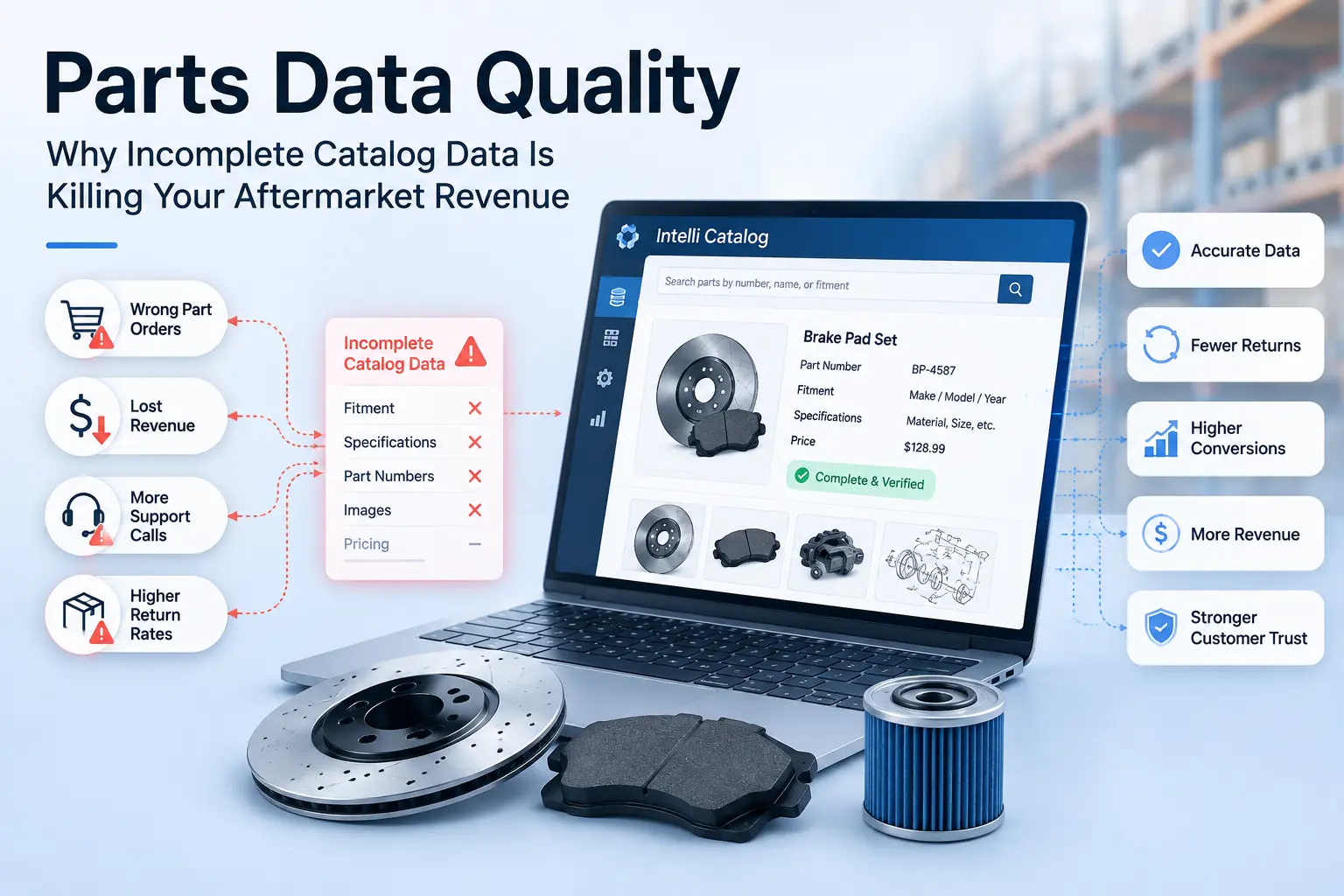
Incomplete catalog data breaks the link between a part number and the vehicle or equipment it fits. Buyers who cannot confirm fitment either abandon the purchase or order the wrong part, and both outcomes turn into lost revenue, a return, or a support ticket.
This shows up in a few common ways:
- Missing fitment details push buyers to search a competitor's site instead.
- Incomplete specifications on B2B catalogs slow down dealer and distributor orders.
- Gaps in structured data hurt search visibility, so the part never shows up for the right query.
- Inconsistent listings across channels erode trust in the brand, not just in the individual product.
None of these show up as a single line item on a report. They show up as lower conversion, higher return rates, and more calls to customer support, all pulling from the same root cause: catalog data that was never complete in the first place.
What Is the Real Cost of Poor Data Management?
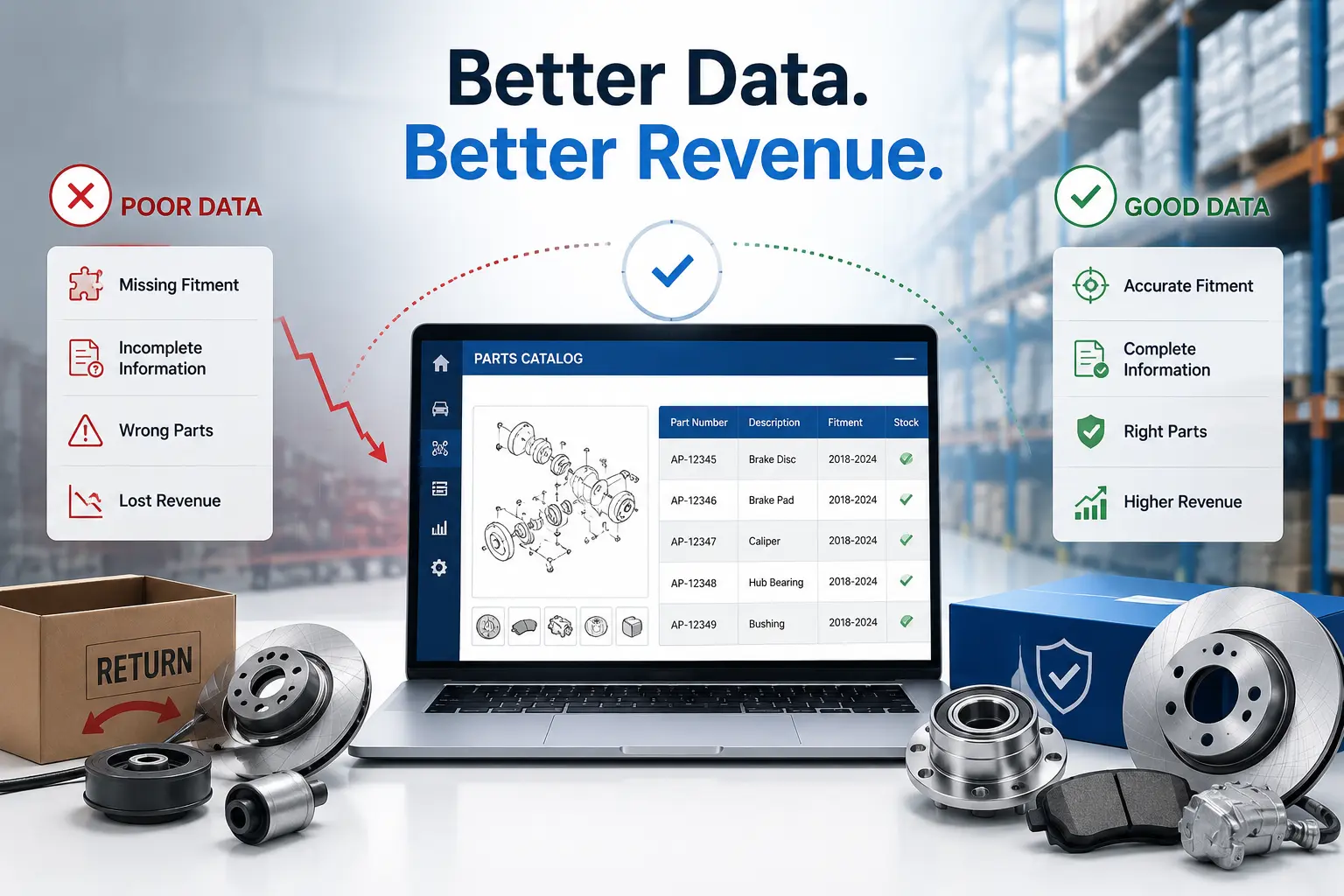
Poor data management is not a minor operational issue; it can directly affect margins through lost sales, returns, and additional support work.
A 2003 study by the Automotive Aftermarket Industry Association (AAIA) estimated that errors in basic product information cost aftermarket suppliers and distributors $1.7 billion annually. The study identified problems including inconsistencies in part numbers, UPCs, units of measure, minimum order quantities, and other product data.
While that figure is historical, the underlying issue remains relevant: poor synchronization and incomplete product information can create additional costs throughout the aftermarket supply chain.
Returns are another measurable cost. The National Retail Federation reported a 19.4% return rate for auto parts in its returns analysis, making auto parts the highest-returning category in the data.
For parts businesses, fitment and product-data errors can add to that burden. When buyers cannot confidently determine whether a part fits, the result can be an abandoned purchase, a wrong-part order, a return, or a customer-service interaction. These costs compound when the same inaccurate record is distributed across multiple sales channels.
Every return can generate reverse-logistics costs, customer-service work, inventory handling, and lost future revenue. Poor data management therefore turns what looks like a catalog problem into an ongoing commercial cost.
What Causes Incomplete Catalog Data?
Incomplete catalog data usually comes from manual processes: spreadsheets passed between departments, disconnected engineering and sales systems, inconsistent supplier formats, and no standard process for updating fitment or specs when a part changes. Without a central system, gaps and errors multiply every time data moves.
- Part records are kept in spreadsheets rather than a managed database.
- Engineering data (CAD, bill of materials) is never mapped to the sales catalog.
- Suppliers send data in different formats, so fields get dropped or mismatched during import.
- There is no owner responsible for keeping fitment and specs current.
- New parts take days or weeks to appear correctly across channels.
Each of these looks small on its own. Together, they explain why a catalog with tens of thousands of SKUs can have a large share of records that are missing a key attribute, an image, or a fitment application.
How to Fix Parts Data Quality Problems
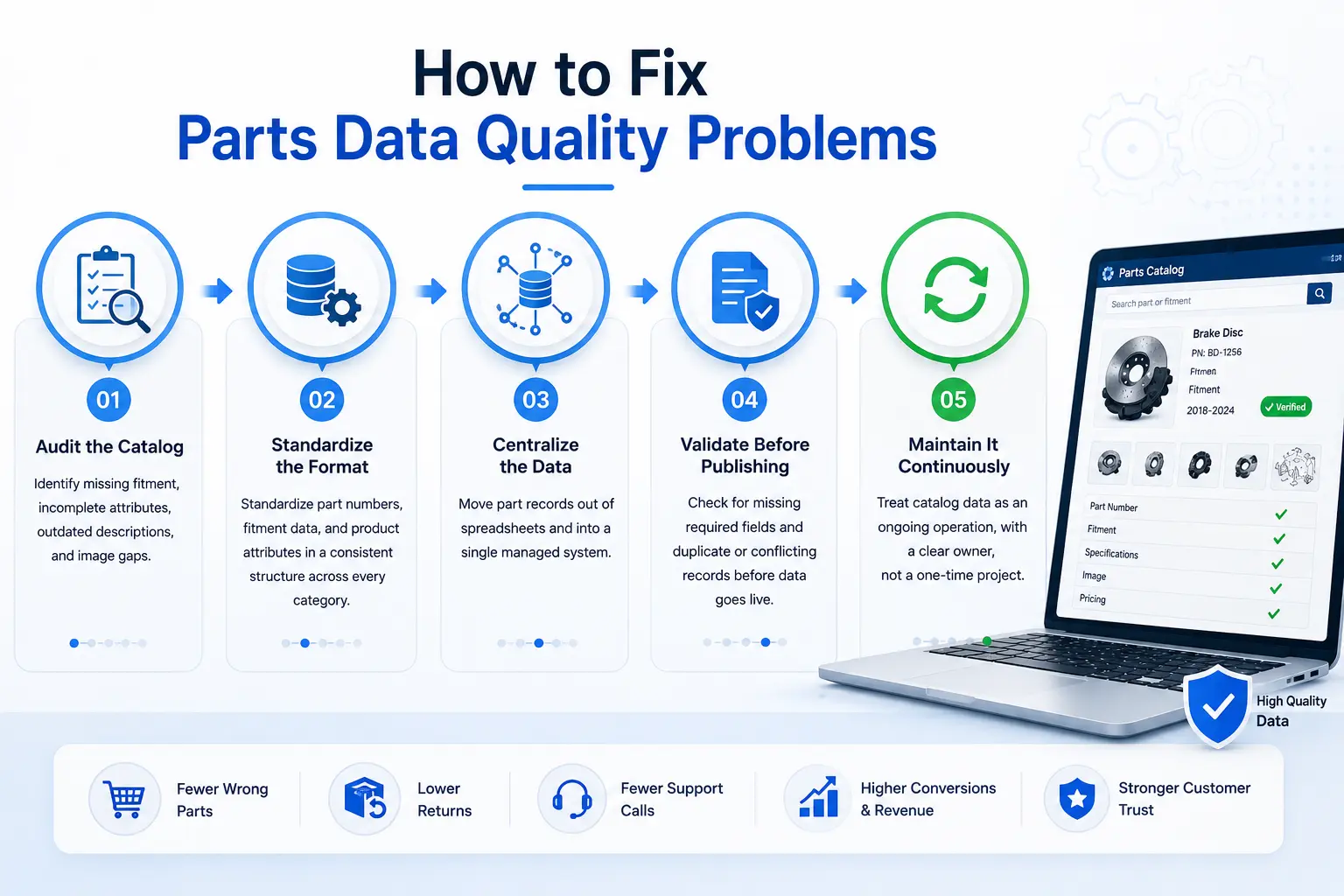
Fixing parts data quality starts with a full catalog audit to find missing fitment, attributes, and images. From there, every record is standardized into a common format, such as ACES and PIES, and centralized in a single system that automatically distributes verified updates across every sales channel.
- Audit the catalog: Identify missing fitment, incomplete attributes, outdated descriptions, and image gaps.
- Standardize the format: Standardize part numbers, fitment data, and product attributes within a consistent structure across every category.
- Centralize the data: Move part records out of spreadsheets and into a single managed system.
- Validate before publishing: Check for missing required fields and duplicate or conflicting records before data goes live.
- Maintain it continuously: Treat catalog data as an ongoing operation, with a clear owner, not a one-time project.
This process turns data quality from a recurring fire drill into a repeatable operation, which is where electronic parts catalog software does the heavy lifting.
How Does Electronic Parts Catalog Software Solve the Data Problem?
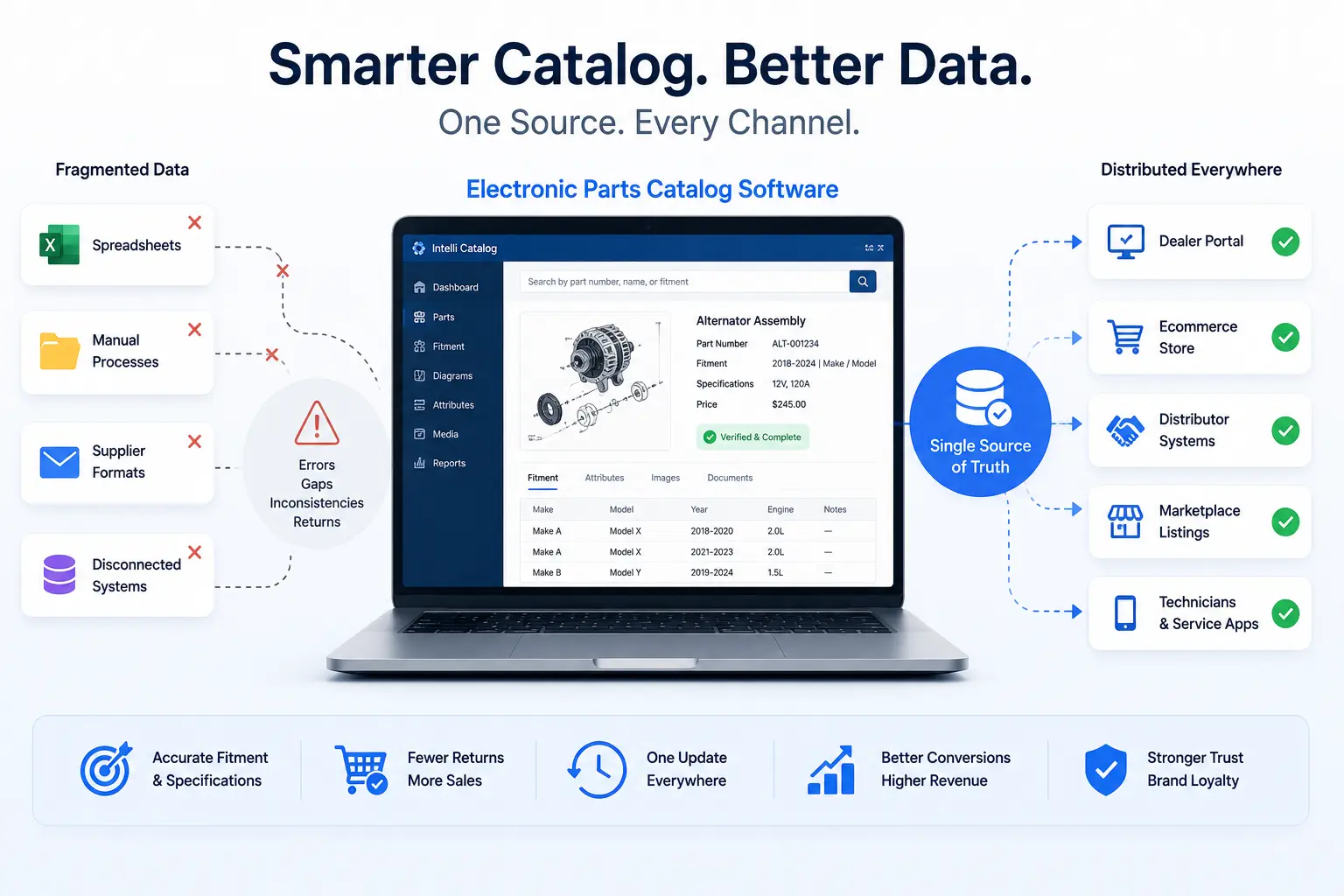
Electronic parts catalog software centralizes part records, fitment, and specifications in one system, so every channel, whether it's a dealer portal, ecommerce site, or distributor feed, pulls from the same verified source. This removes manual re-entry, which is the biggest cause of inconsistent and incomplete catalog data.
Intelli Catalog gives OEMs and distributors a single, structured source of truth for part numbers, fitment data, exploded diagrams, and product specifications. Instead of updating the same part across multiple systems, teams make the change once and automatically distribute it to dealers, technicians, and buyers across every channel.
This matters most at scale. A manual process might hold up for a catalog of a few hundred parts. It breaks down fast once a catalog reaches thousands of SKUs across multiple product lines, which is exactly when the cost of poor data management starts showing up in the revenue numbers.
Conclusion
Parts data quality determines whether a catalog helps a sale or costs one. Incomplete catalog data leads to wrong-part orders, higher returns, and buyers who lose trust and move to a competitor. Poor data management makes the problem worse by spreading the same errors across every channel a catalog feeds. The fix is a structured, ongoing data process built on a centralized system rather than spreadsheets and manual updates. OEMs and distributors that treat catalog data as a core part of the business, not an afterthought, protect their margin, cut returns, and give buyers a reason to keep coming back.
See It In Action
If incomplete catalog data is costing your team sales and driving up returns, it's worth seeing how a centralized system fixes it. Book a demo to see how the Intelli Catalog team can manage fitment, specifications, and part data from one place, across every channel you sell on.
Frequently Asked Questions:
What is parts data quality?
Parts data quality refers to how accurate, complete, and consistent a catalog's information is, including part numbers, fitment, specifications, and pricing. High-quality data means a buyer or dealer can trust the listing without needing to verify it through another source.
Why does incomplete catalog data cause returns?
Incomplete catalog data leaves buyers unable to confirm whether a part fits their vehicle or equipment before ordering. When fitment or specs are missing, buyers guess, order the wrong part, and send it back, which drives up return rates and shipping costs.
How much does poor data management cost the aftermarket industry?
Industry estimates place the cost of aftermarket data errors at roughly $1.7 billion a year, driven by inconsistent formats and unsynchronized data between trading partners. Fitment-related returns add further cost on top of that figure.
How often should a parts catalog be audited?
A parts catalog should be audited at least quarterly, with a lighter check whenever new parts or fitment applications are added. High-SKU catalogs or catalogs that feed multiple channels benefit from more frequent, ongoing checks rather than periodic cleanups.
Can electronic parts catalog software fix incomplete data on its own?
Software alone will not fix bad data, but it gives teams one place to standardize, validate, and publish part records correctly. Paired with a defined data process and clear ownership, electronic parts catalog software reduces the manual errors that lead to incomplete and inconsistent catalogs.


Explore More Insights






.webp)


About the Author


Nishant Sharma
Nishant Sharma is the Marketing & Sales Lead at Intellinet Systems, specializing in B2B sales, digital marketing, and automotive aftermarket solutions. With extensive experience in driving business growth, lead generation, and go-to-market strategies, he is passionate about helping businesses adopt innovative technologies that enhance operational efficiency and customer experience. Through his articles, Nishant shares practical insights on industry trends, emerging technologies, and best practices shaping the future of the automotive aftermarket.


