

Overview: BOM management in the aftermarket is the practice of building and maintaining an accurate bill of materials for every spare part an OEM’s dealers and technicians need after a product is sold. It tracks part numbers, quantities, supersessions, and region-specific variants across years of service life, not just the day a product ships. When handled well, it cuts wrong-part orders, speeds up repairs, protects warranty claims, and keeps OEMs compliant with regional safety and emissions rules. Handled poorly, it leads to mismatched parts, frustrated dealers, and lost repeat business.

Key Takeaways:
- BOM management in the aftermarket is the process of building and maintaining the parts list that dealers and technicians rely on to service a product after it has been sold.
- It differs from a manufacturing BOM because it stays active throughout a product's service life, often 10 to 20 years, rather than ending when production stops.
- Aftermarket BOMs commonly take the form of service, sales, multi-level, region-specific, and engineering-derived structures, and most OEMs use several of these together.
- A complete aftermarket BOM includes ten recurring fields: BOM level, part number, part name, phase, description, quantity, unit of measure, procurement type, reference designator, and notes.
- Ownership is shared across engineering, aftersales, regional compliance, and dealer operations, though a single team usually approves final changes.
- Poor BOM management leads to wrong-part orders, warranty disputes, and dealer frustration, while accurate BOM management protects revenue and compliance.
- Software such as Intelli Catalog centralizes BOM data, tracks supersessions, and automatically adapts parts lists by region.
What is BOM Management in Aftermarket Operations?
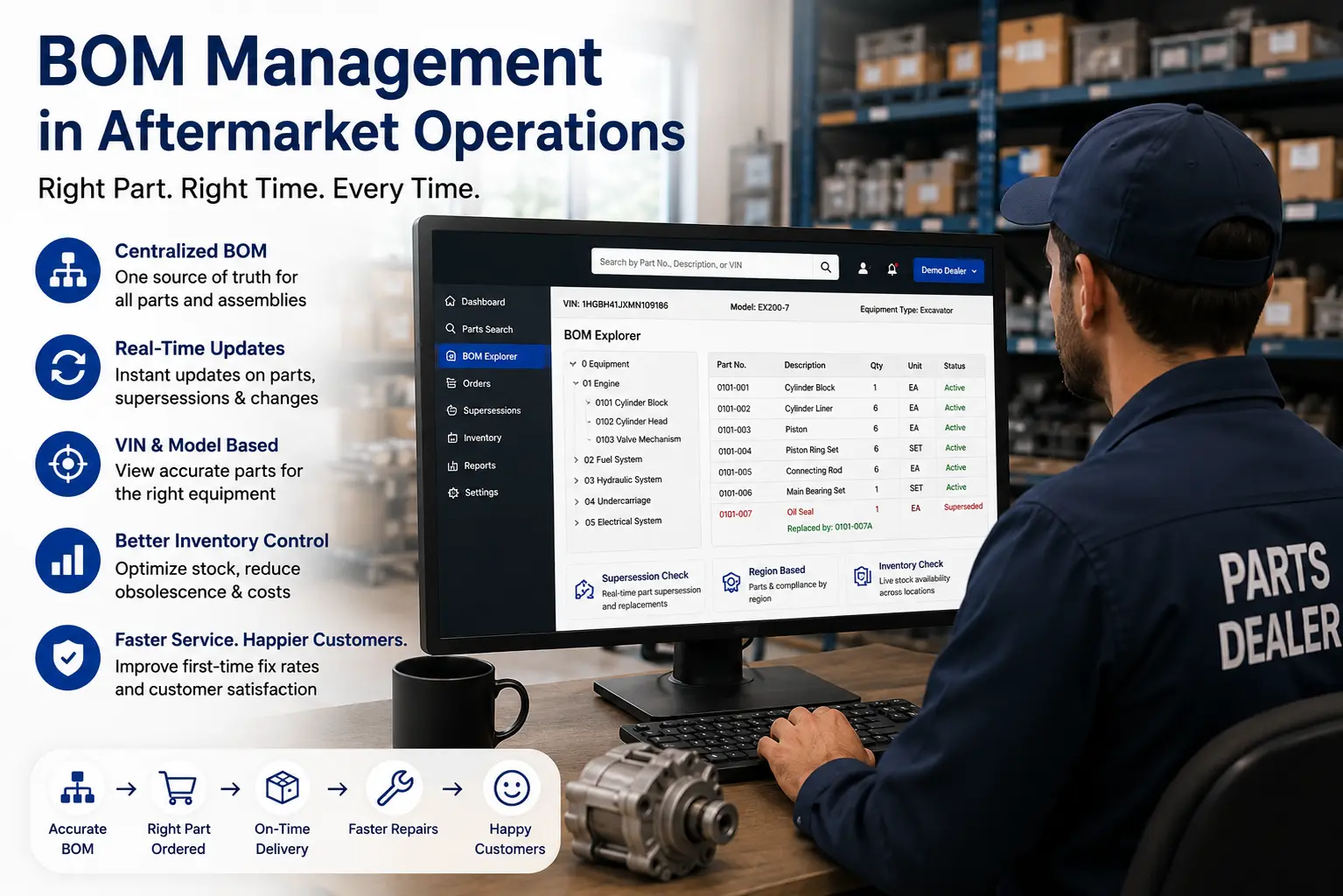
BOM management in the aftermarket is the ongoing process of creating, updating, and distributing the list of spare parts, quantities, and specifications needed to service, repair, or maintain a product after it leaves the factory. It links part numbers to specific vehicle or equipment configurations and keeps every dealer working from one accurate source.
A manufacturing Bill of Materials is built once, to guide the assembly of a new unit. An aftermarket BOM remains active long after a unit ships because vehicles, tractors, and industrial machines require replacement parts throughout their service life, often for a decade or more. As models change, suppliers switch, and parts are superseded, the BOM must be updated continuously so technicians in the field always see the current, correct part.
For a single product line, this list can run into tens of thousands of line items once every variant, trim, and regional configuration is counted. Managing it through spreadsheets or static PDFs quickly becomes unworkable at that scale, which is one reason OEMs are moving BOM management into dedicated software.
Modernize Your Aftermarket BOM Management. Book a Free Demo of Intelli Catalog Today
Why BOM in Aftermarket Operation Differs From a Manufacturing BOM
A manufacturing BOM lists what is needed to build a product once. A BOM in aftermarket operations lists the parts required to repair the same product for years after it is sold, across every model year, trim, and sales region, including replacement parts introduced after the product was originally manufactured.
- Lifespan: A manufacturing BOM is retired once production ends. An aftermarket BOM remains active throughout the product's entire service life, sometimes for 15 to 20 years.
- Audience: Manufacturing BOMs serve engineers and production planners. Aftermarket BOMs provide dealers, technicians, and warranty teams with the information they need to identify the correct part quickly.
- Update frequency: Aftermarket BOMs change constantly as parts are superseded, suppliers switch, or regulations shift, while manufacturing BOMs stay relatively stable once production starts.
- Regional variation: The same vehicle sold in different countries can carry different aftermarket BOMs because of local emission, safety, and sourcing rules, something a manufacturing BOM rarely has to account for.
Types of BOMs Used in Aftermarket Operations
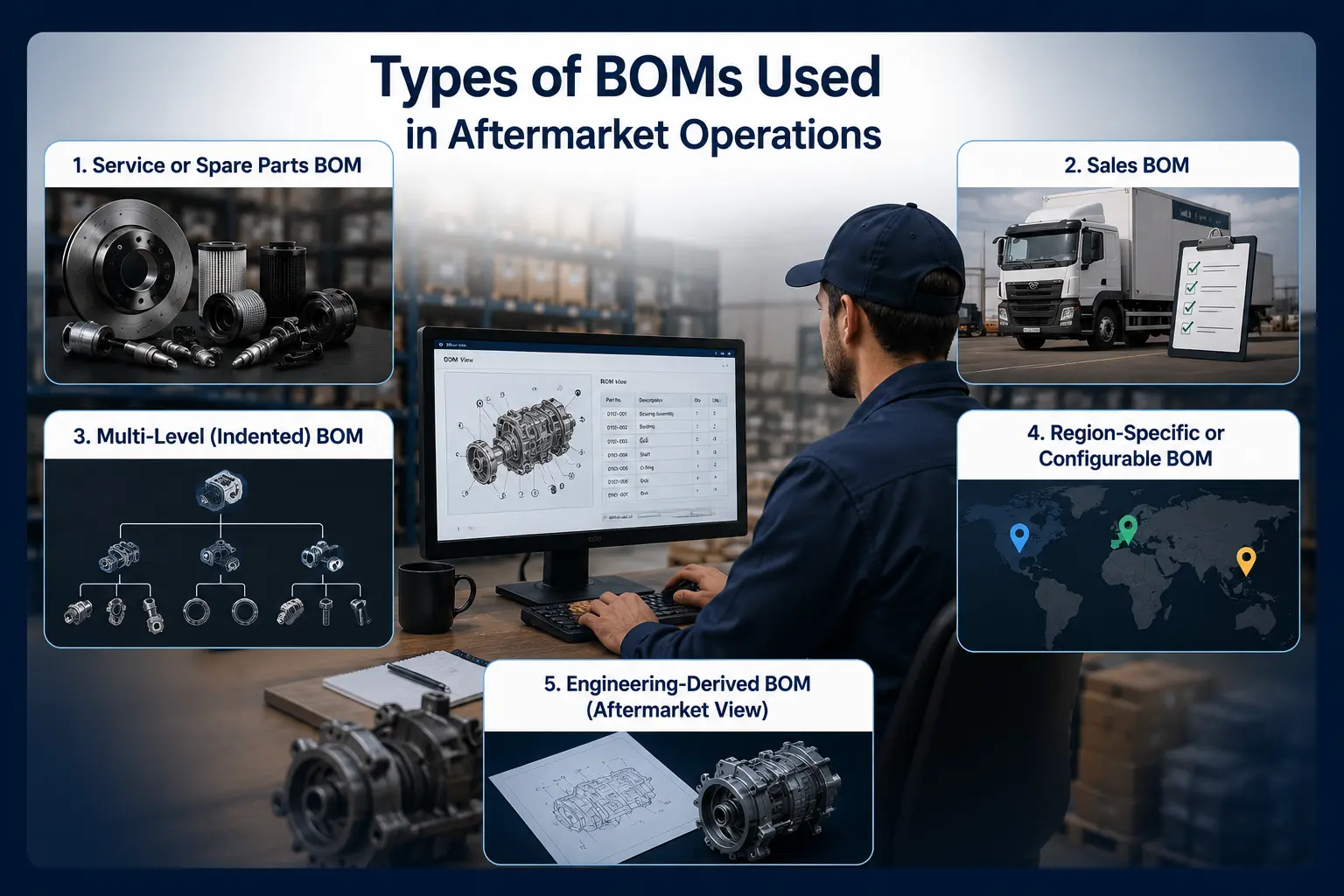
Aftermarket operations typically rely on a service or spare parts BOM, a sales BOM tied to what a customer actually ordered, a multi-level or indented BOM, a region-specific BOM, and a simplified engineering-derived BOM. Most OEMs combine several of these depending on the product, market, and stage of the service lifecycle.
- Service or Spare Parts BOM
This is the core aftermarket BOM used by dealers and technicians day-to-day. It lists every part that could be needed to repair or maintain a product, organized by system or assembly, such as engine, brakes, or hydraulics. A spare parts BOM for a tractor, for example, might group components under fuel system, transmission, and electrical, so a technician can navigate directly to the right section instead of scanning a flat list of thousands of parts.
- Sales BOM
A sales BOM reflects the exact configuration a customer purchased, pulled from the sales order rather than the full engineering design. It narrows the parts list to only what the specific unit actually contains, which speeds up warranty verification and reduces the risk of quoting a part that was never installed on that particular vehicle or machine.
- Multi-Level (Indented) BOM
Multi-level or indented BOMs show parent-child relationships between assemblies, subassemblies, and individual components. For complex aftermarket products like construction equipment, aircraft, or heavy tracks, this structure lets a technician trace a fault from the top-level system down to the exact bolt, sensor, or gasket, rather than guessing from an unstructured list.
- Region-Specific or Configurable BOM
This type adjusts the standard parts list to meet local emission, safety, or sourcing requirements. A single vehicle model may need several region-specific BOM versions at once, for example, a Euro 6 compliant exhaust assembly for Europe and a BS6 compliant version for India, even though the base model and chassis are identical
- Engineering-Derived BOM (Aftermarket View)
Some OEMs also maintain a simplified version of the engineering BOM built specifically for aftermarket use. It strips out manufacturing-only details, such as tooling, jigs, or in-process consumables, so dealers and technicians see only the parts that are actually serviceable or replaceable in the field.
Key Components of an Effective Aftermarket BOM
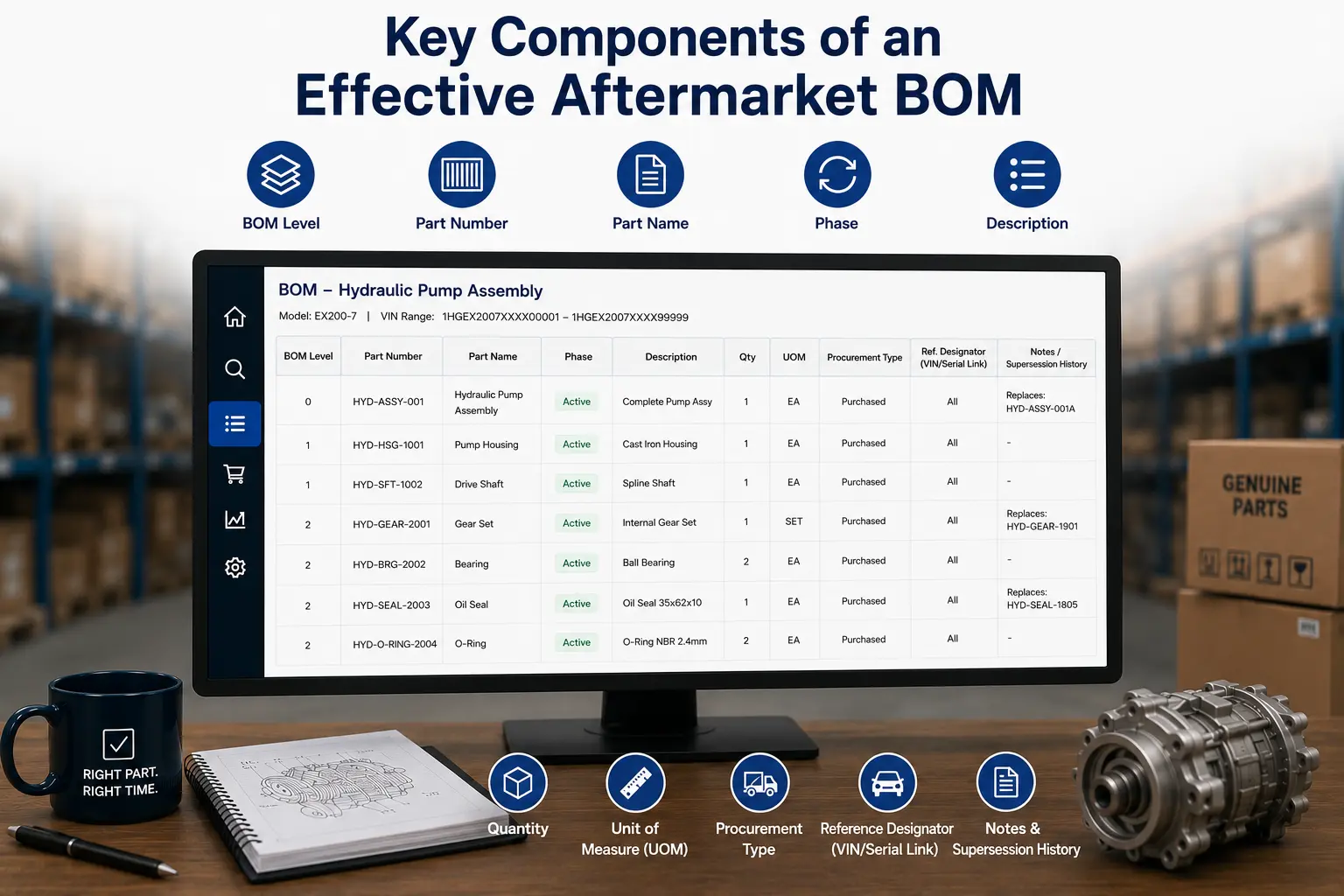
Most aftermarket BOMs are built from ten recurring fields: BOM level, part number, part name, phase, description, quantity, unit of measure, procurement type, reference designator, and notes. Each field plays a specific role in helping a dealer or technician find and order the correct part without guesswork.
- BOM Level
The BOM level shows where a part sits within the product hierarchy, from the finished unit down to individual components. For a truck, the engine might be one level, with fuel injectors and gaskets nested below it. This structure lets a technician start at the system level and drill down to the specific part that failed.
- Part Number
The part number is the unique identifier used to order a component. In aftermarket BOMs, part numbers also carry the weight of supersession history, since a single logical part may have several historical numbers as it gets redesigned or resourced over the years.
- Part Name
The part name gives a quick, human-readable identifier alongside the part number. It helps dealers and technicians recognize a component at a glance, especially when scanning a long parts list under time pressure.
- Phase
Phase indicates where a part sits in its lifecycle, such as active, superseded, or obsolete. In aftermarket operations, phase tracking is critical because ordering an obsolete part wastes time and can delay a repair by days while the correct replacement is located.
- Description
The description adds detail that the part name alone cannot capture, such as size, material, or a specific tolerance. This matters most when several similar-looking parts exist, such as two gaskets that differ only in thickness but fit different engine variants.
- Quantity
Quantity specifies how many units of a part are needed for a given assembly or repair job. Getting this field wrong leads to either an incomplete repair or unused inventory sitting on a dealer’s shelf.
- Unit of Measure
Unit of measure defines how a part is ordered and stocked, whether by each, by foot, or by weight. Wiring, sealant, and adhesives are common examples where the wrong unit of measure causes over-ordering or shortages.
- Procurement Type
Procurement type indicates whether a part is purchased from a supplier, produced internally, or sourced through a subcontractor. For aftermarket operations, this field also flags which parts require longer lead times, helping dealers plan stock levels around slower-moving items.
- Reference Designator (VIN or Serial Link)
In aftermarket use, the reference designator often takes the form of a VIN, chassis, or serial number range that ties a part to the specific units it fits. This is one of the biggest differences from a standard manufacturing BOM, since aftermarket teams need to know exactly which vehicles or machines a part is compatible with, not just which assembly it belongs to.
- BOM Notes and Supersession History
The notes field carries information that does not fit neatly elsewhere, such as alternate suppliers, compliance flags, or a record of which older part numbers a current part replaces. For aftermarket BOMs, suppression history in this field is often the single most valuable piece of data, since it prevents dealers from ordering a part number that no longer exists.
Who Owns BOM Management in Aftermarket Operations?
BOM management in aftermarket operations is a shared responsibility across engineering, aftersales, and part teams, regional compliance, and dealer operations, though most OEMs assign a single owner to approve final changes. Each group contributes different information to keep the BOM accurate as products move from launch through years of field service.
- Engineering: Supplies the original parts breakdown from design and updates it whenever a component or assembly changes.
- Aftersales and parts teams: Adapt the engineering BOM into a serviceable spare parts list and manage supersessions as parts are replaced.
- Regional compliance team: Flags which parts must change to meet local emission, safety, or sourcing rules in each market.
- Dealer operations: Reports mismatches and gaps discovered in the field, feeding corrections back into the central BOM.
Common Challenges in Managing BOM Aftermarket
The most common challenges in BOM management aftermarket are keeping multiple regional versions in sync, tracking part supersessions accurately, and preventing dealers from ordering outdated or incompatible parts. Manual, spreadsheet-based processes make all three worse as a product line grows.
- Multiple BOM versions: A single model can carry a different parts list for Europe, North America, and Asia because of emission and safety rules.
- Mismatched parts during service: Outdated catalogs lead dealers to order parts that do not fit or do not meet local requirements, causing returns and delayed repairs.
- Poor traceability of supersessions: Without clear version control, dealers may order a part number that no longer exists or that fails a current regulation.
- Warranty claims conflicts: Installing the wrong part on a product can void or complicate a warranty claim, adding cost and friction with dealers.
- Manual upkeep: Spreadsheets and static PDFs cannot keep pace with frequent part changes, so errors accumulate over time.
These problems compound at scale. A heavy equipment OEM managing BOMs across 50 countries can end up with thousands of near-duplicate versions if each region edits its own spreadsheet independently, making it nearly impossible to get a single, trustworthy view of what parts exist across the business.
Why BOM Management Aftermarket Matters: The Business Case
BOM Management aftermarket matters because the aftermarket parts business is large and still growing, and every wrong-part order, delayed repair, or compliance miss chips away at that revenue. Accurate BOM management directly reduces returns, speeds up repairs, and protects warranty and compliance outcomes.
The scale makes this worth solving. The global automotive aftermarket is projected to reach about $509.84 billion in 2026, growing toward $643.78 billion by 2033, according to Grand View Research. In the United States alone, the aftermarket parts and components market is expected to reach $238.75 billion in 2026, according to Mordor Intelligence. At this scale, even small BOM errors can lead to costly wrong-part orders, warranty issues, repair delays, and excess inventory.
- Fewer wrong-part orders and returns
- Faster repairs and higher first-time fix rates
- Stronger warranty claim accuracy
- Easier compliance and audit readiness
- Higher dealer confidence and retention
Best Practices Checklist for BOM Management Aftermarket
Strong BOM management aftermarket rests on centralizing data in one system, assigning clear ownership for updates, and tagging every part by region and compliance status. The checklist below covers the practices that keep an aftermarket BOM accurate as a product line scales.
- Centralize BOM data in a single system instead of spreadsheets or static PDFs
- Assign clear ownership for who can edit or approve BOM changes
- Track every supersession and link old part numbers to their replacements
- Tag parts by region, model, and compliance status
- Link BOM entries to VIN, chassis, or serial number where possible
- Integrate the BOM with your parts catalog and dealer management system
- Review and audit BOM accuracy on a regular schedule
How Intelli Catalog Simplifies BOM Management in Aftermarket Operations
Purpose-built electronic parts catalog software centralizes the aftermarket BOM, updates it in real time, and shows each dealer only the parts that fit their region and vehicle. This removes the manual work and guesswork that cause most BOM-related errors.
Intelli Catalog, an electronic parts catalog system, is built for this. It lets OEMs maintain region-specific BOM lists, so a dealer in Germany sees Euro 6-compliant parts while a dealer in India sees BS6-approved parts. It links parts to a vehicle’s VIN or serial number so technicians see only compatible components, tracks supersessions automatically so outdated part numbers point to their replacements, and pushes updates as regulations or suppliers change.
For OEMs managing thousands of BOM variants across multiple markets, this kind of system turns a manual, error-prone process into one that runs quietly in the background and stays current on its own, freeing engineering and parts teams to focus on the parts of the job software cannot do.
Conclusion
BOM management in the aftermarket is not a back-office task. It is what determines whether a dealer finds the right part on the first try or sends a technician back for another visit. An accurate, well-maintained BOM in aftermarket operation keeps dealers confident, repairs fast, and warranty claims clean, while a neglected one quietly drains revenue through returns, delays, and compliance risk.
As aftermarket parts demand continues to grow across a market worth hundreds of billions of dollars, OEMs that centralize and modernize their BOM management, rather than relying on spreadsheets and static documents, are the ones best positioned to keep dealers and customers coming back. Software like Intelli Catalog gives OEMs a practical way to make that shift without adding headcount or complexity.
Simplify Aftermarket BOM Management with Intelli Catalog
Keep every BOM accurate, region-specific, and up to date. Book a demo to see how Intelli Catalog helps OEMs reduce wrong-part orders, improve dealer efficiency, and streamline aftermarket operations.
FAQ
What is a BOM in aftermarket operations?
A BOM in aftermarket operations is a structured list of spare parts, quantities, and specifications a technician needs to repair or maintain a product after it has been sold. Unlike a manufacturing BOM, it stays active for the product’s entire service life and must track supersessions, regional variants, and compliance requirements as they change over time.
How is an aftermarket BOM different from a manufacturing BOM?
A manufacturing BOM is created once to guide the build of a new product and stays fairly stable once production starts. An aftermarket BOM stays active for years after the sale, changes constantly as parts are superseded or regulations shift, and must serve dealers and technicians rather than production engineers.
Why do aftermarket BOMs vary by region?
Aftermarket BOMs vary by region because emission standards, safety codes, and local sourcing rules differ from country to country. A vehicle sold in Europe may need Euro 6-compliant exhaust parts, while the same model sold in India needs BS6-compliant components, so OEMs maintain separate, region-tagged BOM versions for each market.
What software helps manage BOM for aftermarket parts?
Electronic parts catalog software, such as Intelli Catalog, helps OEMs manage aftermarket BOMs by centralizing part data, tracking supersessions, and displaying region-specific parts lists to dealers. These systems link parts to a vehicle’s VIN or serial number, update in real time, and reduce the manual work that leads to wrong-part orders.
How often should an aftermarket BOM be updated?
An aftermarket BOM should be updated whenever a part is superseded, a supplier changes, a product configuration is modified, or regional regulations change. For active product lines, these updates may occur several times a year or more frequently. OEMs using centralized BOM management software can apply updates in real time, ensuring dealers and technicians always access the latest, accurate parts information.


Explore More Insights







.webp)


About the Author


Chandra Shekhar
Chandra Shekhar is the Senior Manager, Strategy & Business Development at Intellinet Systems. With over a decade of experience in the automotive industry, Chandra Shekhar has led digital transformation and aftersales strategy initiatives for OEMs across multiple markets. His background combines deep industry knowledge with a practical understanding of how technology can solve real operational challenges. He focuses on making complex ideas clear and relevant for automotive and aftermarket professionals navigating ongoing change.


