

Overview: Many OEMs lose visibility into inventory, dealer sales, and customer demand once products move through distributors and secondary sales channels. A distributor management system helps bridge this gap by providing real-time insights into channel activity, inventory levels, and sell-through performance, enabling better forecasting, inventory optimization, stronger distributor collaboration, and improved aftermarket profitability.

For most OEMs, the equipment leaves the factory floor with a clear record. After that, products move through regional distributors, sub-dealers, and service partners, each operating on their own systems and timelines. By the time sales data works its way back to headquarters, it is mostly incomplete, delayed, or inconsistent.
This is the structural challenge behind OEM secondary sales networks. As the products move further away from the manufacturer through distributors and dealers, OEMs lose visibility into what is being sold, how much inventory is left, and what customer demand is growing in the market. This blind spot in heavy equipment, automotive, EV, and industrial manufacturing, and other industries is a strategic liability.
The good news is that distributor management systems have matured significantly over the past few years. OEMs that invest in the right platform can gain real-time line-of-sight across their entire channel, without requiring partners to overhaul their local operations.
Why Do OEMs Lose Visibility in Secondary Sales Networks?
OEMs lose visibility in secondary sales networks because distributors, dealers, and service partners often operate on separate systems and share limited transactional data. As products move further from the manufacturer, real-time visibility into sales, inventory levels, and market demand becomes increasingly difficult to maintain.
Most OEMs understand their primary distributor relationship relatively well: the tier-one distributor places an order, invoices are processed, and shipment records are maintained. The problem begins at the next level, where secondary distribution networks operate independently and don't share transactional data unless needed.
In practice, this means an OEM may know how many units or parts were shipped to a regional distributor, but doesn’t have any reliable data on how many parts have been sold through to dealers or end customers. Inventory could be either sitting idle at one distributor location, while another distributor may struggle with stockouts for the same SKU. Moreover, demand signals from the field don't always reach the OEM fast enough to influence replenishment planning or production.
The consequences are predictable: excess inventory in some regions, stock shortages in others, and demand planning based on incomplete information. These challenges are especially significant in aftermarket operations, where profitability is often highest. In its 2017 report, Industrial Aftermarket Services: Growing the Core, McKinsey reported that aftermarket services generate average EBIT margins of 25%, compared with 10% for new equipment. This makes visibility into secondary sales networks a strategic priority for OEMs seeking to protect high-margin revenue streams.
What Problems Are Caused by Poor Secondary Sales Visibility?
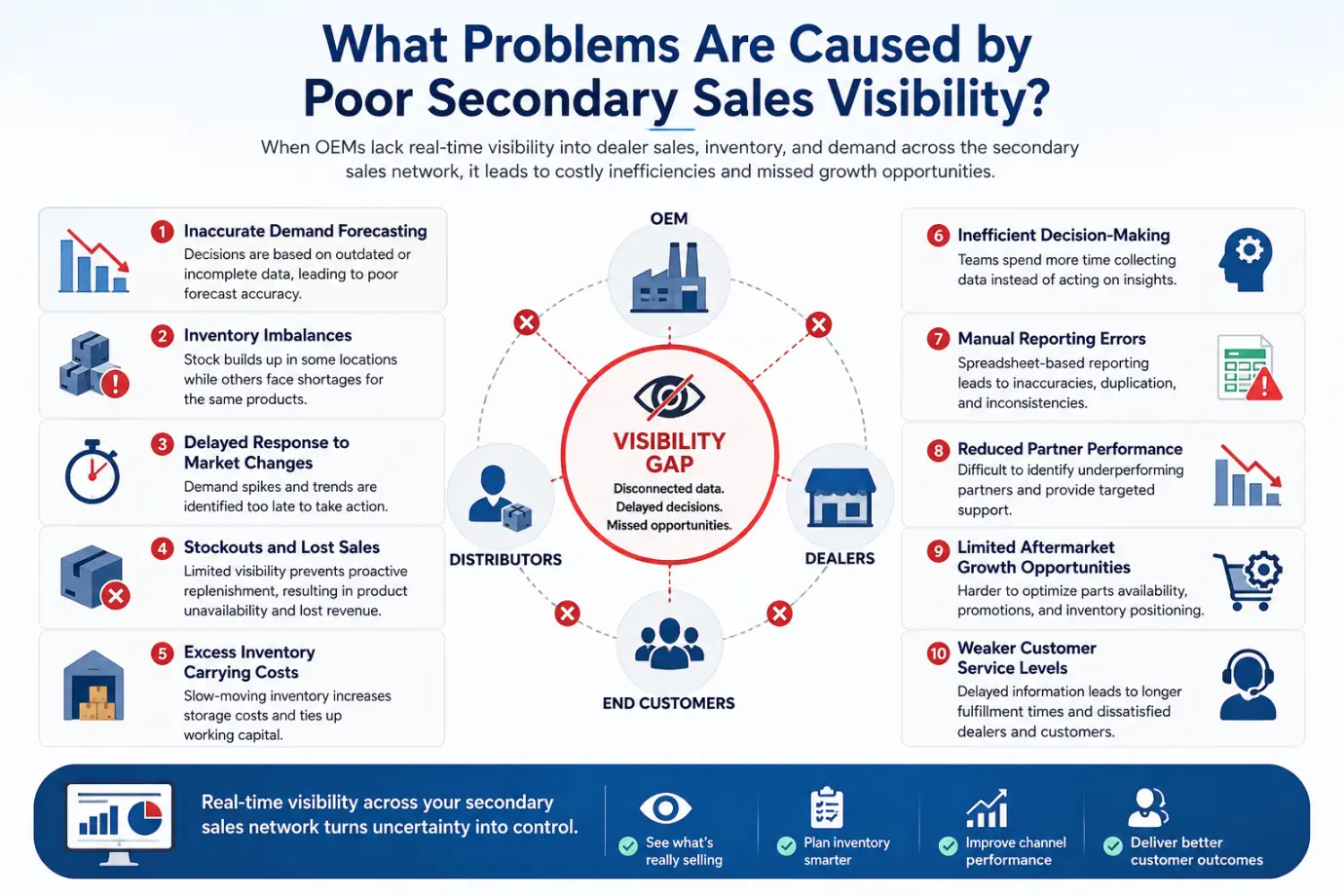
Poor secondary sales visibility makes it difficult for OEMs to track dealer demand, monitor inventory movement, and respond to market changes in time. The result is inaccurate forecasting, inventory imbalances, delayed decision-making, stockouts, excess inventory, and reduced channel performance.
- Regional sales managers often work with outdated data, relying on information that is days or weeks old and manually compiled from emails, spreadsheets, or periodic dealer reports.
- Demand spikes are identified too late, often only after stockouts have already disrupted customer delivery commitments.
- Manual reporting processes consume valuable time, forcing field teams to aggregate and reconcile channel data instead of taking corrective action.
- Spreadsheet-based workflows increase the risk of errors, leading to inconsistent and unreliable sales visibility.
- Decision-making is delayed, as consolidated channel performance data is typically reviewed only during periodic business reviews, long after action could have made an impact.
- Visibility challenges intensify in multi-tier secondary sales networks, where independent channel partners operate with different systems, processes, and commercial priorities.
- OEMs struggle to gain a unified view of sell-through performance, making it difficult to forecast demand, optimize inventory, and respond quickly to market changes.
How Does a Distributor Management System Improve Channel Visibility?

A distributor management system improves channel visibility by giving OEMs real-time access to distributor inventory, dealer sales, order activity, and channel performance data. This enables better forecasting, inventory planning, replenishment decisions, and dealer network management across secondary sales channels.
A distributor management system connects the OEM to its secondary sales network through a shared digital layer. Rather than waiting for partners to file periodic reports, the OEM can see order activity, inventory levels, and sales data as it happens, across every node in the network that is connected to the platform.
The practical shift this creates goes beyond reporting and is fundamentally different from the one most OEM supply chain teams are currently managing. When a distributor places a parts order, the OEM can see not just the order quantity but the on-hand stock at that distributor, the sales velocity of those parts at nearby dealers, and whether a replenishment signal is warranted at adjacent nodes.
Demand forecasting improves considerably when real sell-through data replaces channel estimates. For spare parts distribution, where long-tail SKUs are notoriously difficult to plan, the ability to track actual dealer consumption patterns means the OEM can position inventory closer to actual demand rather than guessing from historical shipment averages.
Dealer network management also becomes more targeted, as OEM commercial teams can identify which partners are performing well, which are carrying excess inventory, and where training or support might improve sales outcomes.
How Do OEMs Track Dealer Sales and Inventory in Real Time?

OEMs track dealer sales and inventory in real time by using a distributor management system that captures order transactions, inventory movements, and sell-through data across distributors and dealers. This provides continuous visibility into demand patterns, stock levels, and replenishment requirements throughout the channel.
One of the most immediate operational benefits of a well-implemented distributor management system is real-time order visibility across OEM secondary sales networks.
Consider an automotive OEM managing spare parts replenishment across a network of sixty regional distributors and several hundred authorized dealers. Without real-time visibility, replenishment is driven by distributor purchase orders, which reflect the distributor's own forecast logic, not actual dealer demand. This shows that the OEM’s manufacturing and logistics planning is not directly connected to real-time market demand.
With real-time order visibility, the OEM can monitor sell-through rates at the dealer level, identify early demand signals before a stockout develops, and trigger replenishment proactively. Seasonal demand shifts, which in agricultural equipment can be dramatic and compressed into short windows, become manageable because the OEM is working from live data rather than trailing indicators.
This is the environment where a centralized distributor management system proves its value beyond the transactional layer. When distributors and dealers are connected through a unified ordering platform, every interaction generates data that feeds back into the OEM's planning and commercial intelligence. Order patterns, cancellations, substitution requests, and backorder queues all become signals that the OEM can act on.
Intelli Commerce, a distributor management software, is built around this principle: connecting the OEM's parts operations to its dealer and distributor network through a single platform that captures order activity in real time, supports replenishment workflows, and provides the visibility layer that planning and commercial teams need to make faster, better-informed decisions.
Why Is Secondary Sales Visibility Critical for Aftermarket Growth?

Secondary sales visibility is critical for aftermarket growth because aftermarket operations generate average EBIT margins of 25% compared with 10% for new equipment, making channel execution one of the highest-stakes areas of the OEM business. Without visibility into dealer and distributor sales, OEMs cannot reliably manage parts availability, protect margins, or respond to demand in time.
OEM aftermarket operations are the highest-margin segment of the business. They are also the segment most dependent on channel execution. An OEM that cannot see what its distributors and dealers are selling, stocking, or struggling to source cannot proactively protect that margin.
Aftermarket visibility allows the OEM to identify genuine parts penetration rates by region and dealer, creating a clearer picture of where third-party parts are taking market share. It enables better pricing and promotion decisions based on actual channel inventory positions. And it supports service-level commitments to end customers, because the OEM knows where parts are in the network before a customer calls about delivery time.
For OEMs operating in agriculture, construction, or industrial manufacturing, equipment downtime is a direct cost to their customers. A customer whose excavator or combine harvester is waiting for a part is a customer at risk of switching allegiance at the next purchase cycle. The OEM's ability to support fast, reliable parts availability at the dealer level depends on having a clear view of the secondary channel, not just the primary distribution relationship.
Channel partner visibility at the secondary level also supports better warranty management, recall coordination, and product feedback loops. When the OEM can trace parts from factory to end use through a connected system, operational issues surface faster, and remediation is more targeted.
How Do OEMs Improve Collaboration with Distributors and Dealers?
OEMs improve collaboration with distributors and dealers by using a distributor management system that provides shared access to sales, inventory, and operational data. This enables all channel partners to work from the same information, coordinate decisions faster, and improve overall channel performance.
Many OEMs have invested in ERP systems or basic dealer portals that handle transactional coordination. What they often lack is the collaboration layer that turns channel data into shared operational intelligence.
A distributor management system is not simply a portal for placing orders; it creates a shared working environment where the OEM and its channel partners can see the same data, respond to the same signals, and coordinate their actions without the back-and-forth of email chains and phone calls. The OEM's commercial team can work directly with a distributor's inventory team to plan a promotional push. The logistics team can identify which distributors have excess stock before committing to a production run. Sales managers can set performance benchmarks by region and track progress without waiting for the end of the quarter.
This operational alignment between the OEM and its channel partners is where distributor management systems deliver compounding value. Secondary sales tracking becomes less of a reporting exercise and more of a planning foundation because the data flows continuously, and both parties can act on it.
See how Intelli Commerce helps OEMs track dealer sales, monitor distributor inventory, improve forecasting accuracy, and strengthen aftermarket performance with real-time channel visibility.
FAQ
What Is a Distributor Management System?
A distributor management system (DMS) is a software platform that helps OEMs manage, monitor, and optimize relationships with distributors, dealers, and channel partners. It centralizes order management, inventory visibility, sales tracking, pricing, promotions, and reporting across the distribution network. By connecting OEMs with their channel partners through a single platform, a distributor management system improves operational efficiency, decision-making, and visibility into secondary sales activities.
How Do OEMs Track Secondary Sales Through Dealers?
OEMs track secondary sales through dealers by collecting dealer-level sales, inventory, and order data through a distributor management system. Instead of relying on periodic reports or manual spreadsheets, OEMs gain visibility into product sell-through, inventory movement, and customer demand in near real time. This allows manufacturers to understand what products are being sold, where demand is growing, and how inventory is moving across the dealer network.
What Causes Inventory Blind Spots in OEM Distribution Networks?
Inventory blind spots occur when OEMs lack visibility into stock levels and sales activity beyond their primary distributors. Since distributors and dealers often operate on separate systems, inventory data is fragmented, delayed, or unavailable. As a result, OEMs may not know whether products are sitting idle in one location while other locations experience stock shortages. These visibility gaps can lead to inaccurate forecasting, excess inventory, stockouts, and slower responses to market demand.
How Does Real-Time Channel Visibility Improve Aftermarket Parts Planning?
Real-time channel visibility improves aftermarket parts planning by providing OEMs with accurate information about dealer sales, inventory levels, and replenishment requirements across the distribution network. Instead of relying on shipment history or distributor forecasts, OEMs can use actual sell-through data to predict demand more accurately, position inventory closer to customers, reduce stockouts, and improve parts availability. This leads to better service levels and stronger aftermarket revenue performance.
What Is Secondary Sales Tracking in OEM Operations?
Secondary sales tracking is the process of monitoring product sales that occur after inventory is sold to distributors. It provides visibility into how products move from distributors to dealers, service centers, or end customers. For OEMs, secondary sales tracking helps measure true market demand, evaluate channel partner performance, monitor inventory movement, improve forecasting accuracy, and make better decisions about replenishment, pricing, and aftermarket support.


Explore More Insights







.webp)


About the Author


Chandra Shekhar
Chandra Shekhar is the Senior Manager, Strategy & Business Development at Intellinet Systems. With over a decade of experience in the automotive industry, Chandra Shekhar has led digital transformation and aftersales strategy initiatives for OEMs across multiple markets. His background combines deep industry knowledge with a practical understanding of how technology can solve real operational challenges. He focuses on making complex ideas clear and relevant for automotive and aftermarket professionals navigating ongoing change.


