

Overview: Parts catalog software for medical equipment helps OEMs manage complex spare parts data, multi-level assemblies, and regulatory compliance requirements through a centralized digital platform. By replacing static catalogs and fragmented systems, it improves parts identification accuracy, reduces dealer ordering errors, strengthens traceability, and provides the governance, visibility, and control needed to support efficient aftersales operations.
Key Takeaway
- Parts catalog software for medical equipment must be evaluated as a data governance platform, not a publishing tool. The compliance requirements of regulated markets demand revision control, change documentation, and an audit-ready part record that standard catalog tools cannot provide.
- Fragmented parts data across ERP, PLM, and aftersales systems is the root cause of most catalog accuracy problems. Implementing a new catalog system without first auditing and cleaning the source data replicates the problem in a more expensive environment.
- Multi-level assembly hierarchies require catalog software that supports exploded-view illustration mapping at each hierarchy level independently. Flat illustration binding creates technician identification errors that generate both service quality issues and regulatory exposure.
- Dealer network adoption is the implementation variable that most directly determines whether the business case is realized. A deployment that achieves 50% active usage in the dealer network delivers 50% of the projected benefit. Plan for structured activation, not passive rollout.
- Compliance and traceability capabilities should be weighted more heavily than UI features in the vendor evaluation. A system that cannot produce an audit-ready change log per part record is not fit for purpose in a regulated market, regardless of other strengths.
- The analytics layer of modern catalog software provides operational intelligence that static catalog tools cannot. OEMs that use this data actively can reduce support call volume and improve catalog continuously.
Modernize Your Medical Equipment Parts Catalog with AI. Request a Free Demo of Intelli Catalog Today
What is Parts Catalog Software for Medical Equipment?
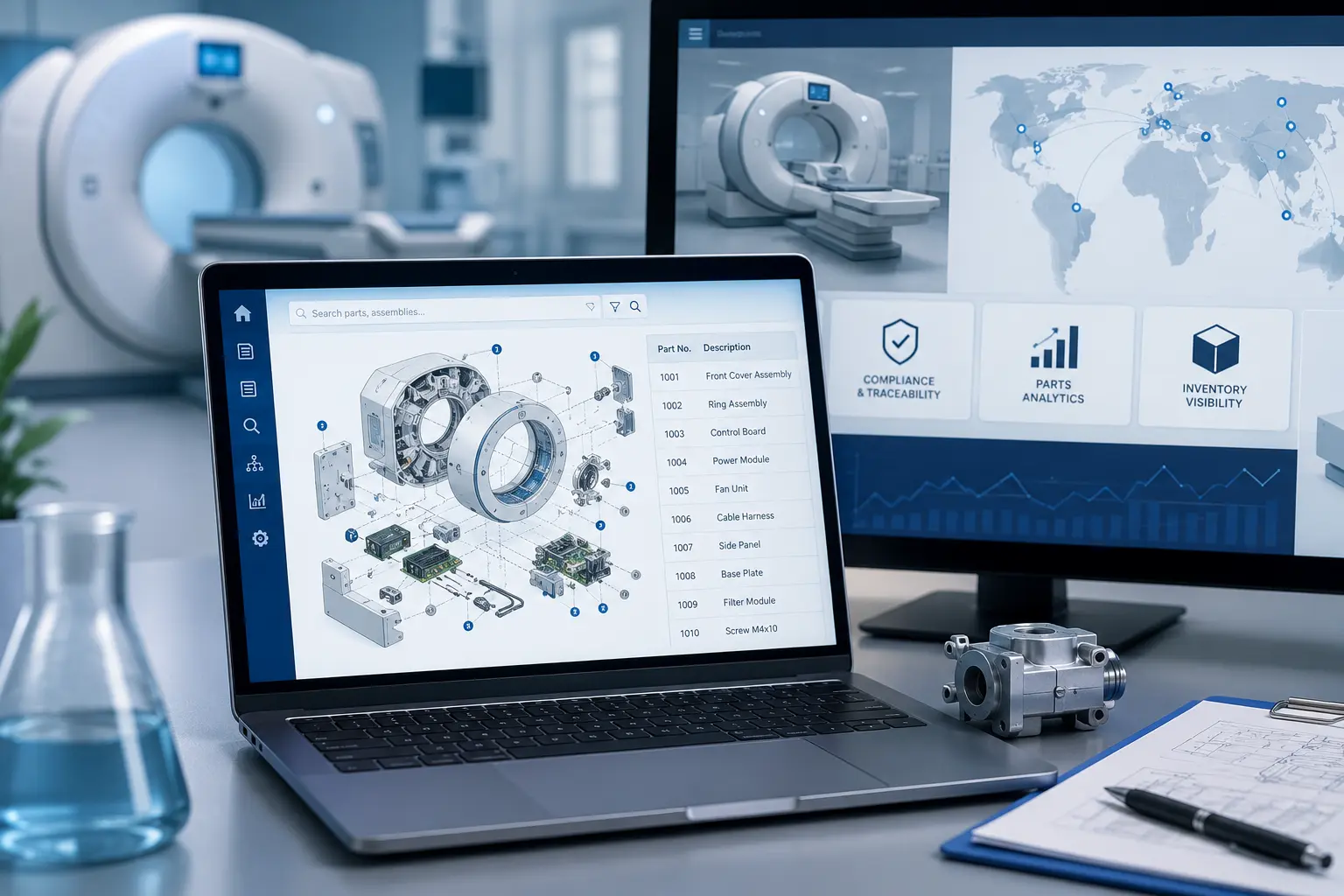
Parts catalog software for medical equipment is a structured digital system that allows OEMs to organize, publish, and maintain illustrated spare parts data across device families, dealer networks, and service channels. It replaces static PDF catalogs and disconnected spreadsheets with a single, governed source of parts information. For medical equipment OEMs, this software must also accommodate regulatory traceability, revision control, and multi-level assembly hierarchies that are far more complex than those in most other equipment industries.
Why is Parts Catalog Management Particularly Difficult for Medical Equipment OEMs?
Parts catalog management for medical equipment OEMs is harder than for most other industries because the combination of strict regulatory requirements, complex device architectures, and multi-tier service networks creates compounding data challenges. A single imaging device may contain thousands of serialized sub-assemblies, each with its own revision history, regulatory classification, and approved-supplier constraint. Managing that data accurately across the full lifecycle of the device is not a documentation task; it is an operational infrastructural problem.
Consider a mid-size diagnostic imaging OEM managing a portfolio of 15 active device families across 450 authorized service providers in 35 countries. Each device family has an average of 3,000 line items in its parts catalog; that is roughly 36,000 SKUs, each of which may have regulatory classifications, supersession chains, regional availability flags, and approved-substitute rules attached. A PDF catalog updated quarterly cannot maintain that level of data integrity.
The business impact of catalog errors in this context goes beyond ordering mistakes. A service technician who installs the wrong revision of a critical component on an active medical device creates a regulatory exposure for the OEM. In regulated markets, that exposure can trigger mandatory incident reporting.
What Are the Core Challenges That Drive OEMs to Evaluate New Catalog Systems?
The five operational pain points that most consistently push medical equipment OEMs toward dedicated parts catalog software are fragmented data, legacy systems silos, complex part hierarchies, compliance and traceability requirements, and supply chain friction with dealer networks. Each of these is solvable, but only if the underlying catalog infrastructure supports structured data governance rather than document management.
- Fragmented Data
Medical equipment OEM employees work across disconnected spreadsheets, PDFs, Excel, email, and disparate systems. Multiple parts records, duplicate data, manual version control, inconsistent naming conventions.
- Legacy System S
Older enterprise systems operating independently. Systems with no integration. Separate databases across divisions: ERP + service, inventory, and catalog systems.
- Complex Part Hierarchies
Engineers navigating deep product structures with hundreds of interconnected parts, assemblies, and options per serial number. Deep product structures and data scalability, navigation, and catalog complexity.
- Compliance & Traceability
Quality equipment regulatory teams track related parts, serial histories, audit records, and service history. Medical instruments require full digital traceability chains and verification checkpoints and compliance indicators.
- Dealer Network Friction
Dealers struggling to identify correct replacement parts, bad communication delays between OEM and dealer, supply chain bottlenecks, difficult identification, and slow technical issue resolution while customer equipment remains offline.
How Does Fragmented and Unstructured Data Affect Catalog Operations?
Fragmented parts data is the foundational problem that makes very downstream catalog tasks harder than they should be. When part descriptions, images, supersession rules, and regulatory flags are maintained in separate systems by separate teams, every catalog update becomes a reconciliation exercise. The result is catalog versions that are internally inconsistent, even when the underlying data is technically correct in each source system.
A capital medical equipment OEM that manufactures ventilators and patient monitoring systems, for example, may maintain parts data in three separate places: the ERP system holds pricing and availability, the engineering Product Data Management (PDM) system holds revision-controlled BOMs, and the after-sales team maintains a manually formatted catalog in a publishing tool. When engineering releases a component revision, that change must be manually propagated to the after-sales catalog. Based on Intellinet Systems' experience across 12 medical equipment OEM catalog implementations, engineering-to-catalog update cycles commonly take four to eight weeks when updates are managed through manual publishing workflows. During that window, service partners are ordering against the stale data.
The business impact is measurable. Parts ordering errors traced to catalog inconsistencies typically require manual intervention by the OEM’s after-sales support team. A team processing 2,000 service orders per month with a 5% error rate attributed to catalog mismatches is spending approximately 100 service orders per month on avoidable rework.
How Do Legacy System Silos Create Operational Bottlenecks in Aftersales?
Legacy system silos force catalog teams to work against their own infrastructure. ERP systems and aftersales portals that were not designed to share structured parts data create integration gaps that the aftersales team fills manually. This is not a technology limitation that improves over time; it worsens as device portfolios grow.
The overlooked bottleneck here is version control. Most aftersales teams running manual catalog processes lack a reliable way to know which version of a parts catalog a specific dealer is currently using. If a dealer bookmarks a PDF six month ago and has not downloaded the updated version, the OEM has no visibility into that. The service partner is ordering from a stale catalog, and the OEM only discovers this when an incorrect part is returned, or a service call is escalated.
Dedicated parts catalog software solves this by maintaining a single published version that all authorized users access in real time. There is no download to manage, no version for the dealer to lose track of. When the OEM updates a part record, every connected user sees the update immediately.
Why Do Complex Hierarchies Create Accuracy Problems in Medical Equipment Catalogs?
Medical equipment devices are architecturally complex. A single MRI system, for example, may have four to six levels of sub-assembly hierarchy before reaching a field-replaceable component. Representing that hierarchy accurately in a parts catalog, while also surfacing the right illustration and the correct ordering code at each level, requires a data model that standard document tools cannot support.
The practical failure mode is illustration misalignment. When an OEM publishes a catalog with a multi-level assembly but uses flat illustration mapping, a technician looking for a gasket in sub-assembly level four may see the correct part number but the wrong callout on the illustration. They order the correct SKU but install it in the wrong location. For general industrial equipment, this creates a return. For active medical devices, it creates a service record discrepancy and a potential compliance event.
Parts catalog software designed for complex assemblies supports hierarchical navigation with illustration-level callout mapping. The technician drills down through the hierarchy, and at every level the correct exploded-view illustration highlights the specific component in context.
How Do Compliance and Traceability Requirements Affect Parts Catalog Design?
Compliance and traceability are non-negotiable constraints for medical equipment OEMs operating in FDA, MDR, or equivalent regulated markets. Every part that enters the service chain must have a documented revision state, an approved-supplier linkage, and an audit trail for any changes to its catalog record. Standard catalog tools do not provide this. They provide publishing capability, not governance capability.
The distinction matters because regulatory inspectors reviewing a field service event do not accept "the technician used the most current catalog" as documentation of part compliance. They require evidence that the catalog record for that part was accurate at the time of service, that the part used was the approved revision, and that the OEM had a controlled process for managing catalog changes.
Medical equipment OEMs that have built this governance manually, typically through a combination of document control procedures and after-sales team oversight, report that maintaining audit-ready catalog records consumes an average of 15 to 20 percent of the after-sales team's bandwidth. That is time not spent on service improvement, field training, or supply chain performance.
How Does Supply Chain and Dealer Network Friction Reduce Aftersales Revenue?
Catalog friction in the dealer network translates directly into lost parts revenue and increased returns. When service partners cannot confidently identify the correct part, they either call the OEM's technical support line for confirmation (increasing inbound support costs) or they order multiple options and return what they do not use (increasing reverse logistics costs).
A medical equipment OEM supporting 300 authorized service partners across a regional market, with each partner placing an average of 40 parts orders per month, is processing 12,000 orders per month. If 8 percent of those orders involve a catalog-related inquiry or error, the OEM is handling 960 avoidable touchpoints per month. At an average cost of 12 to 15 minutes of after-sales staff time per touchpoint, that is 200 to 240 staff hours per month spent managing catalog inadequacy rather than service operations.
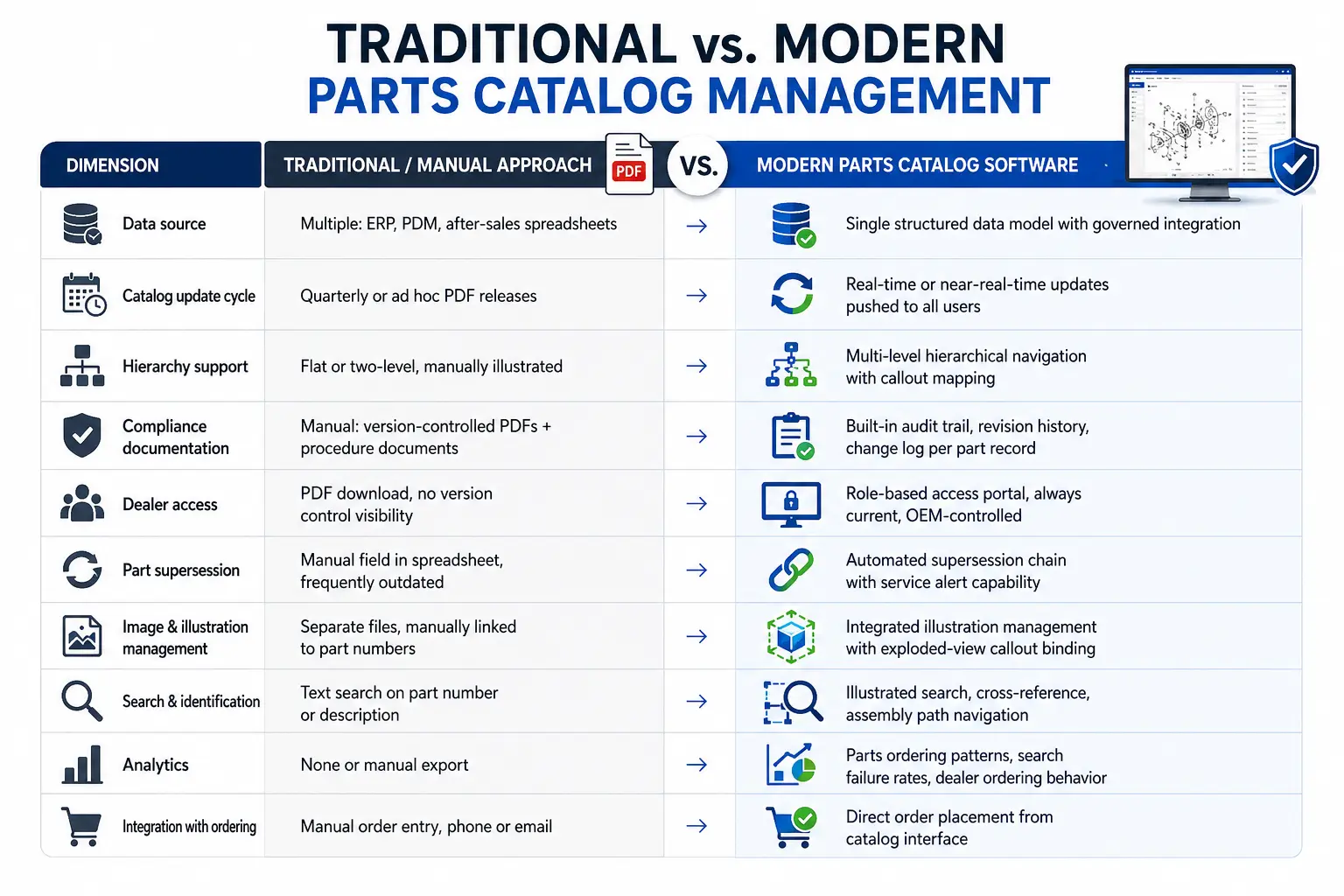
Traditional vs. Modern Parts Catalog Management: What Does the Difference Look Like?
What are the Most Important Functional Requirements for Medical Equipment Parts Catalog Software?
Medical equipment OEMs evaluating catalog software should assess capability across seven functional areas. A vendor that is strong in catalog publishing but weak in compliance governance is not a fit for a regulated manufacturer, regardless of how polished the interface looks.
- Hierarchical BOM support: The system must support at least five to six levels of assembly hierarchy and allow illustration mapping at each level independently.
- Revision and change control: Every part record must carry a revision history. Changes must require an authorized workflow, not a direct edit.
- Regulatory classification tagging: Parts must support regulatory attribute fields (FDA product code, MDR device classification, restricted-use flags) at the SKU level.
- Supersession Chain Management: The system must automatically route ordering to the current approved part when a supersession exists, with visible notification to the user.
- Multi-language and multi-region support: Medical OEMs operating across regulated markets need catalog content in local languages with region-specific part availability logic.
- Integration architecture: The catalog system must be able to consume structured data from ERP and PLM systems without requiring the aftersales team to manually re-enter part records.
- Role-based access and dealer portal: Authorized service partners must be able to access current catalog data through a governed portal, not through file sharing.
What are the Most Common Implementation Mistakes Medical Equipment OEMs Make?
Three implementation patterns consistently cause parts catalog projects to underdeliver in the medical equipment sector. Each is avoidable, but only if it is recognized before the project starts.
Mistake 1: Treating catalog migration as a data-entry project. The most common failure is scoping the catalog implementation as a one-time effort to load existing parts data into the new system. This ignores the structural problem. If the existing data is fragmented, inconsistent, or undocumented in terms of revision state, loading it into a new system replicates the problem in a more expensive environment. The correct approach is a data audit before migration, not during or after. OEMs that skip this step typically spend three to six months post-launch cleaning up catalog errors that should have been resolved in the data preparation phase.
Mistake 2: Configuring the catalog for the engineering team rather than the service technician. This is a counterintuitive finding from implementation projects; catalog systems that are configured to mirror the engineering BOM structure are frequently unusable by field service technicians. Engineers navigate by assembly designation and part number. Technicians navigate by symptom, location, and visual recognition. A catalog that requires a technician to know the engineering assembly path to find a replacement seal kit will generate the same support call volume as the PDF catalog it replaced. Good catalog software supports multiple navigation paths: engineering hierarchy for OEM internal users, illustrated visual navigation for service partners, and cross-reference lookup for experienced technicians.
Mistake 3: Going live without a dealer training and adoption plan. Parts catalog software only reduces ordering errors if the service partners actually use it. Deploying a new portal without a structured onboarding process for the dealer network typically results in a 40 to 60% active usage rate in the first six months, with the remainder of the network continuing to reference old PDFs or calling the OEM support line. The business case for the investment does not materialize until adoption is above 80 percent. This requires a deliberate activation plan: training materials, a transition deadline for the old catalog, and a support mechanism for dealers struggling with the new interface.
What Capabilities Should Medical Equipment OEMs Look for in Parts Catalog Software?
Medical equipment OEMs should prioritize parts catalog platforms that support multi-level hierarchy management, revision control, regulatory traceability, dealer access governance, and integration with ERP and PLM systems. These capabilities address the operational and compliance challenges that traditional catalog tools cannot manage effectively.
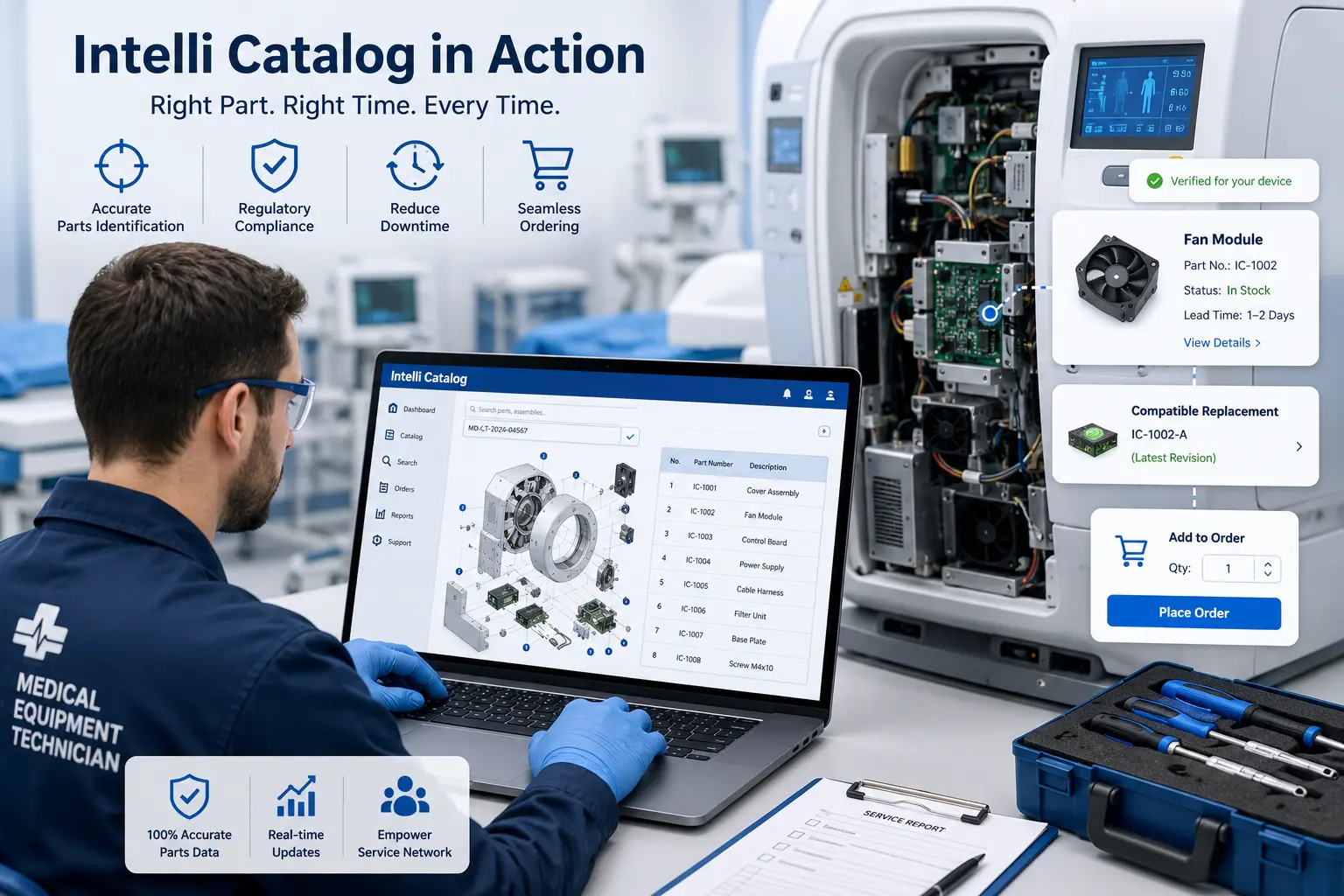
One example is Intelli Catalog, which provides hierarchical navigation, exploded-view illustration mapping, governed change workflows, dealer portal access, and ERP integration capabilities. It is an electronic illustrated parts catalog platform used by OEMs across automotive, industrial, and medical equipment sectors. It is relevant to medical equipment OEMs specifically because its architecture addresses the three structural challenges that standard tools do not: multi-level hierarchy management, real-time data governance, and dealer network access control.
The platform supports hierarchical part navigation with exploded-view illustration binding, allowing a service technician to navigate from device level down to the field-replaceable component while the correct illustration updates at each step. Part records carry structured attribute fields that can be configured for regulatory classification, revision state, and approved-supplier linkage. Changes to part records follow a governed workflow rather than direct editing, which supports the change documentation requirements in regulated market environments.
For dealer network management, Intelli Catalog delivers catalog access through a role-based portal. Service partners always access the current published version. The OEM has visibility into which parts are being searched, where search failures are occurring, and which part categories generate the highest volume of inquiry. That analytics layer is operationally significant: an OEM that can see that a specific sub-assembly generates 15% of all catalog support calls has an actionable signal to improve the illustration or part description for that assembly.
Intelli Catalog integrates with OEM’s existing ERP system through structured data connectors, reducing the manual synchronization burden that aftersales teams typically carry when catalog data lives separately from operational systems.
Conclusion
Parts catalog software for medical equipment is not a digitization project, but an operational infrastructural decision that affects regulatory compliance, dealer network performance, aftersales revenue, and service quality in equal measure.
The five challenges covered in this article- fragmented data, legacy system silos, complex hierarchies, compliance requirements, and dealer network friction are interconnected. Addressing catalog accuracy without addressing the governance layer that maintains accuracy over time produces temporary improvement, not structural change. OEMs that have made this investment successfully share a common characteristic: they scoped the project as a data governance initiative from the start, not as a catalog publishing upgrade.
For aftersales directors evaluating this investment, the business case is straightforward when the true cost of the current approach is visible. Catalog-related ordering errors, support call volume, manual synchronization effort, and compliance document burden are all measurable. The baseline is usually worse than aftersales teams expect when they quantify it explicitly.
The right parts catalog platform does not eliminate all parts management complexity. Medical equipment is inherently complex. What it does is make that complexity governable, auditable, and consistently accurate for every service partner in the network, from initial device sale through the full service lifecycle.
Book a demo to see how AI-powered Intelli Catalog software supports accurate parts search and ordering across medical equipment OEMs.
FAQ
What is parts catalog software for medical equipment, and how is it different from a general spare parts catalog system?
Parts catalog software for medical equipment is a specialized platform for managing, publishing, and governing spare parts data across device families, service networks, and regulatory environments. It differs from general catalog systems primarily in the governance layer: medical equipment catalogs require revision control per part record, regulatory classification attributes, and change documentation that supports regulatory audit requirements. General catalog platforms typically handle description and image management but lack the compliance infrastructure that regulated OEM markets require.
How does parts catalog software handle part supersessions for long-lifecycle medical devices?
Dedicated parts catalog software manages supersession chains as structured data relationships rather than manual notes. When a part is superseded, the system records the replacement relationship and automatically routes a service partner's search to the current approved part, with a visible notification that the supersession exists. For long-lifecycle medical devices that may have 10 to 15 years of active field service, supersession chain management is critical because individual components may have gone through multiple revisions over the device's service life. Systems that manage this manually, through notes fields or spreadsheet lookups, generate ordering errors as chains extend beyond two or three levels.
Can parts catalog software integrate with existing ERP and PLM systems?
Yes, modern parts catalog platforms integrate with ERP and PLM systems through structured data connectors. The integration architecture varies: some platforms use real-time API connectors that pull updates as they occur in the source system, while others use batch synchronization processes that update the catalog on a defined schedule. For medical equipment OEMs where engineering releases a component revision, real-time or near-real-time integration is operationally important because a delay between the engineering release and the catalog update creates a window where service partners are ordering against stale data.
How long does a typical parts catalog software implementation take for a medical equipment OEM?
Implementation timelines vary based on portfolio size, data readiness, and integration complexity. For a mid-size medical equipment OEM with 10,000 to 30,000 active SKUs across four to six device families and integration to one ERP system, a realistic implementation timeline is four to seven months from data audit to live deployment. The largest variable is data preparation. OEMs with well-structured source data in their ERP and PLM systems typically land at the lower end of that range. OEMs that begin the project without a data audit and discover significant data quality issues mid-implementation frequently extend by two to three months.
How does parts catalog software reduce dealer ordering errors in medical equipment service networks?
Catalog software reduces dealer ordering errors through three mechanisms. First, illustrated navigation with exploded-view callout mapping allows technicians to identify parts visually rather than relying on text search of part numbers they may not have memorized. Second, real-time supersession chain management ensures that service partners are always directed to the current approved part, even when they search using an obsolete part number. Third, single-version access through a governed portal eliminates the version control problem created by PDF distribution, where service partners may be working from catalogs that are months or years out of date.


Explore More Insights








.webp)


About the Author


Chandra Shekhar
Chandra Shekhar is the Senior Manager, Strategy & Business Development at Intellinet Systems. With over a decade of experience in the automotive industry, Chandra Shekhar has led digital transformation and aftersales strategy initiatives for OEMs across multiple markets. His background combines deep industry knowledge with a practical understanding of how technology can solve real operational challenges. He focuses on making complex ideas clear and relevant for automotive and aftermarket professionals navigating ongoing change.


