

Equipment manufacturing operations are undergoing a structural shift. IoT sensors, AI-driven automation, cloud platforms, and digital workflow systems are replacing manual processes across production, inspection, service, and aftermarket operations. Now, digital technologies have become an integral part of almost every equipment manufacturing operation, as they simplify claims processing, increase operational efficiency, and reduce service delays and parts identification inefficiencies.
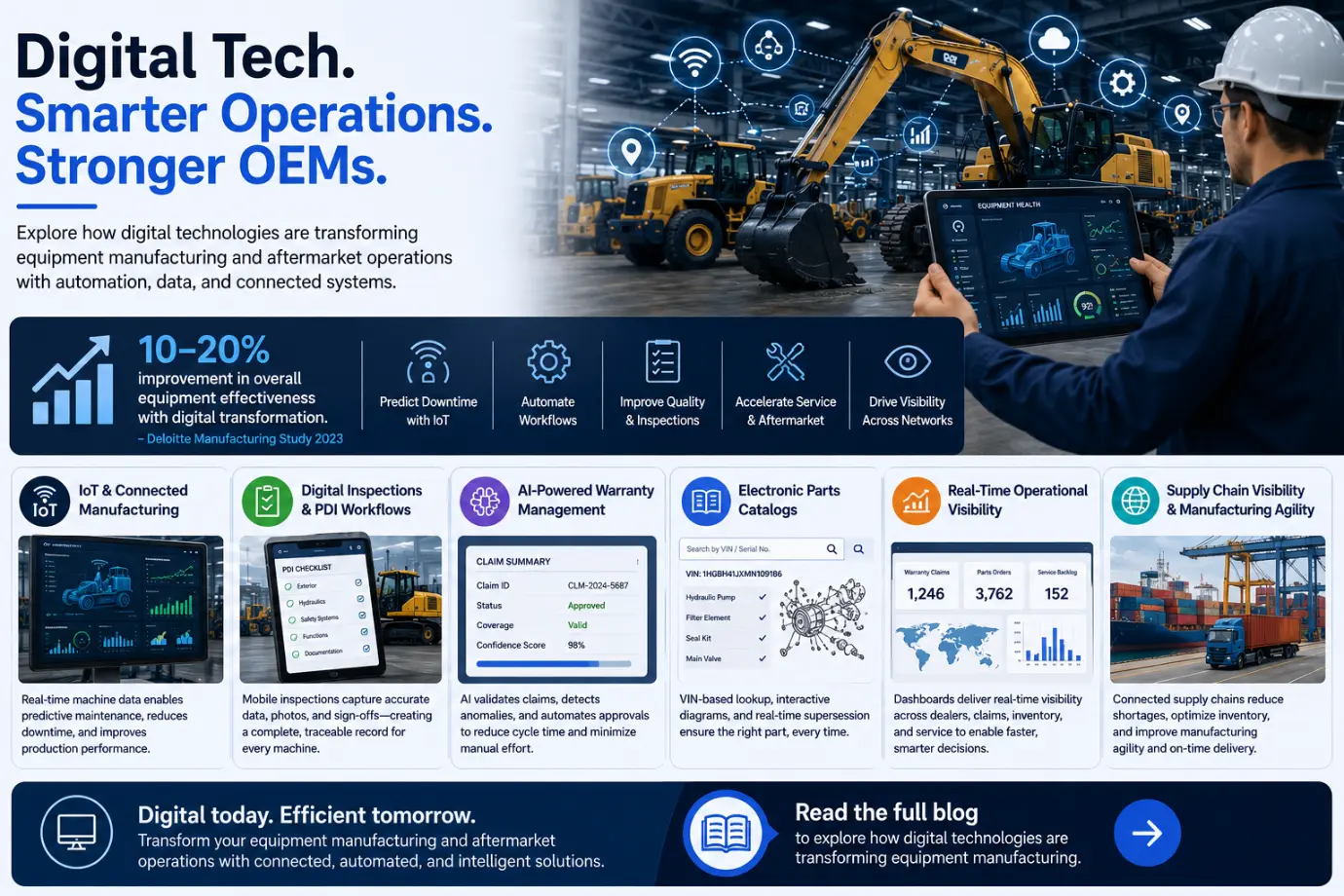
A Deloitte manufacturing study of 2023 shows that manufacturers accelerating digital transformation report 10 to 20 % improvements in overall equipment effectiveness and significant reductions in unplanned downtime. For OEMs managing complex equipment and distributed dealer networks, these numbers show a direct impact on operational costs and service performance.
But to achieve a digital transformation, equipment manufacturing OEMs must grapple with thorny change and process management challenges. A major obstacle is the need to replace legacy solutions like static PDF, manual warranty, and inspection operations that have often been in use for decades, especially if many OEMs still depend on disconnected systems and manual workflows. As a result, the search for the right approach to digital transformation focuses on streamlining automation in equipment manufacturing operations that can drive faster decision-making, reduce operational errors, and provide real-time visibility across manufacturing and aftermarket operations.
What is Digital Transformation in Equipment Manufacturing Operations?
Digital transformation in equipment manufacturing operations refers to the integration of digital technologies, such as warranty management, mobile inspection tools, AI-driven parts identification, Internet of Things (IoT), and data analytics, into all aspects of production and aftermarket operations. This level of integration fundamentally changes how equipment manufacturers operate and deliver value, as well as the way they embrace innovation, efficiency, and competitiveness.
In addition to automating manual processes that are labor- and time-intensive, if not potentially prone to errors, digital transformation has made it possible for equipment manufacturers to predict when equipment will break down, forecast parts demand, standardize inspection and service, and improve visibility into the broader manufacturing process.
IoT and Connected Manufacturing Systems
IoT integration is the foundation of a connected manufacturing system in modern equipment operations. Sensors embedded in excavators, loaders, and mining equipment capture real-time data on hydraulic pressure, fuel consumption, engine temperature, and component wear-and-tear. This data, when fed into manufacturing execution systems and analytics platforms, helps continuously track machine health and production performance.
In construction machinery manufacturing, IoT-enabled monitoring allows OEMs to detect early failure signals in a bulldozer loader or excavator hydraulic cylinder before they generate field failures. Data-driven SLM enables predictive maintenance strategies built on this data to reduce unplanned downtime by identifying service needs before they become operational disruptions.
According to McKinsey Global Institute, IoT-driven predictive maintenance can reduce equipment downtime by 30 to 50 % and lower maintenance costs by 10 to 25 % in industrial manufacturing environments. For heavy equipment OEMs, these operational gains are substantial.
Digital Inspection Workflows and Pre-Delivery Operations
Paper-based inspection workflows remain one of the most persistent sources of operational lag in equipment manufacturing. A crane or wheel loader moving through final assembly and pre-delivery inspection generates multiple paper checklists, manual serial number entries, and handwritten sign-off records, introduces a delay, and creates gaps in the machine's traceable service record.
Digital inspection workflows replace this manual process with mobile-based inspection tools that capture checklist data, photos, VINs, and technician sign-offs directly on the device. These records sync automatically to the OEM's platform, creating a complete, timestamped inspection history for every machine.
Intelli PDI is built for exactly this workflow, which gives OEM dealers and service teams a structured mobile inspection platform tied to individual machine records. When a dealer fleet receives new equipment, the completed digital PDI record becomes the operational baseline for all future warranty and service activity, removing the ambiguity that paper records create.
AI-Driven Warranty Management and Claim Automation
Warranty management is one of the highest-friction areas in OEMs' aftermarket operations. A construction equipment OEM managing 400 or more active dealer relationships processes thousands of warranty claims annually. Manually reviewing each claim against coverage rules, parts eligibility, and machine service history is resource-intensive and slow.
Warranty management software like Intelli Warranty with AI-driven validation solves this at scale. This tool automates claim intake, applies coverage logic against machine-specific data, cross-references inspection records and service history, and routes exceptions like missing documentation, mismatched serial numbers, coverage ambiguity, unusual repair costs, or duplicate claims, etc., for manual review. This means claims meeting all criteria are processed automatically, ensuring dealers receive faster resolution by letting OEM warranty teams focus on exceptions rather than routine claim processing.
Electronic Parts Catalogs and AI-Driven Parts Identification
Parts identification errors create downstream service delays and inventory waste across OEM dealer networks. A dealer service team working on a field-failed backhoe loader needs the correct hydraulic cylinder specification. If the parts catalog is a static PDF without VIN-level filtering, the technician cross-references part numbers manually, risks ordering the wrong component, and triggers a return and re-order cycle that delays the repair.
Electronic parts catalog software with interactive diagrams and serial number-based filtering eliminates this error pattern. When a technician enters the machine's VIN or serial number, the catalog returns parts applicable to that specific configuration, including supersession updates for components that have been revised or replaced across model years.
Intelli Catalog supports this workflow with dynamic BOM structures, interactive parts illustrations, and real-time supersession management. For OEMs with broad equipment lines and frequent engineering changes, keeping parts data accurate and accessible across the dealer network is an operational requirement, not a convenience.
Real-Time Operational Visibility Across Dealer and Distributor Networks
One benefit of connected manufacturing systems and integrated aftermarket platforms is real-time operational visibility. OEM operations teams can monitor open warranty claims across dealer locations, track parts demand patterns by region, identify service backlog concentrations, and measure inspection compliance rates across the dealer network from a single dashboard.
For construction equipment OEMs managing large distributor networks, this visibility enables proactive intervention. If a cluster of excavator hydraulic failures surfaces across a dealer region, the OEM operations team sees it in the data before it becomes a service escalation. Engineering teams receive structured field failure data to inform product improvement cycles.
Supply Chain Visibility and Manufacturing Agility
Digital technologies in equipment manufacturing also extend into supply chain operations. Real-time inventory visibility, connected supplier portals, and demand-driven procurement workflows allow OEMs to reduce component shortages and production stoppages. For OEMs manufacturing complex multi-component equipment like cranes or industrial material handling systems, supply chain visibility directly affects production throughput and delivery schedules.
Cloud-based aftermarket solution tools connect suppliers, production, dealers, and aftermarket operations within a single data environment. Engineering changes, parts revisions, and production updates propagate across the system in real time rather than through batch updates or manual communication channels.
The Operational Shift That Is Already Underway
The transformation of equipment manufacturing operations through digital technologies is not a future scenario. US OEMs are already deploying IoT monitoring platforms, mobile inspection tools, AI-driven warranty systems, and electronic parts catalogs across their production and aftermarket operations.
Connected, automated, and data-driven equipment manufacturing operations outperform manual and disconnected operations on every operational metric: uptime, service cycle time, warranty cost, parts accuracy, and dealer performance.
Ready to see what’s possible? Book a demo with us today, and let’s see how digital technologies are transforming your equipment manufacturing operations.
FAQs
1. How are digital technologies transforming equipment manufacturing operations?
Digital technologies are transforming equipment manufacturing operations by automating production workflows, enabling real-time machine monitoring, improving quality control, and enhancing operational visibility. Solutions like IoT, AI-driven analytics, cloud platforms, and smart manufacturing systems help manufacturers increase efficiency and reduce downtime.
2. How does Intellinet Systems support digital transformation in equipment manufacturing?
Intellinet Systems provides digital solutions that help equipment manufacturers streamline operations, manage inspections, improve aftermarket service, optimize spare parts management, and automate workflows. These technologies help businesses improve productivity, traceability, and decision-making across manufacturing and service operations.
3. Why is digital transformation important for equipment manufacturers?
Digital transformation is important because it helps equipment manufacturers improve operational efficiency, reduce manual errors, increase production visibility, and respond faster to market demands. It also supports predictive maintenance, better asset management, and improved customer service through connected and data-driven operations.


Explore More Insights






.webp)


About the Author


Chandra Shekhar
Chandra Shekhar is the Senior Manager, Strategy & Business Development at Intellinet Systems. With over a decade of experience in the automotive industry, Chandra Shekhar has led digital transformation and aftersales strategy initiatives for OEMs across multiple markets. His background combines deep industry knowledge with a practical understanding of how technology can solve real operational challenges. He focuses on making complex ideas clear and relevant for automotive and aftermarket professionals navigating ongoing change.


