

When a field technician leaves the service bay, most OEMs lose visibility. Phone check-ins replace structured reporting. WhatsApp messages replace formal job status updates. Spreadsheets capture what happened yesterday, not what is happening right now.
For OEMs managing hundreds of dealers and field service engineers across geographies, this visibility gap is not a minor inconvenience. It directly drives delayed issue resolution, missed SLAs, inflated service costs, and the kind of recurring field problems that should have been caught, documented, and closed weeks earlier.
Field Technical Report Software solves this by replacing fragmented, manual reporting with a structured digital workflow that gives OEM service leaders real-time visibility into every technician, every job, and every open issue across their entire field network. When combined with Technical Assistance Reports (TARs) and a centralized helpdesk, it transforms field service from a reactive function into a managed, measurable operation.
This blog covers why field technician visibility is a growing challenge for OEMs, how Field Technical Report Software closes the gap, and what operational outcomes OEMs should expect when they make the shift.
Key Takeaways
- Field Technical Report Software gives OEMs real-time visibility into technician location, job status, and issue resolution across dealer and field service networks.
- Manual reporting- phone calls, spreadsheets, and PDF-based forms create delays, data gaps, and SLA breaches that compound over time.
- Digital TAR and FTR workflows connect dealers, service managers, back-office teams, and suppliers in a single resolution loop, eliminating handoff failures.
- Mobile-first reporting ensures accurate field data collection from technicians, regardless of location or connectivity.
- Real-time dashboards and SLA tracking give OEM leadership the operational control needed to prevent escalations before they impact customers.
What Is Field Technical Report Software?
Field Technical Report (FTR) Software is a digital platform that enables OEMs to capture, track, manage, and resolve field service issues reported by dealers and technicians through a structured workflow. It replaces paper-based and email-driven reporting with a real-time system that connects all stakeholders, dealers, service managers, back-office teams, and suppliers in a single, traceable resolution loop.
Unlike generic helpdesk tools or CRM systems, Field Technical Report Software is purpose-built for OEM service networks. It captures issue data at the VIN or serial number level, routes cases through defined escalation paths, enforces SLA timelines, and builds a searchable knowledge base from resolved cases that reduces repeat escalations.
How It Differs from Traditional Reporting Methods
- Phone and email reporting: Unstructured, untraceable, and dependent on individual follow-up. No audit trail, no SLA enforcement, no pattern visibility.
- Spreadsheet tracking: Captures historical data, not live status. Cannot support multi-stakeholder workflows or automated escalation.
- PDF-based forms: Static, version-prone, and disconnected from ERP, parts, or warranty systems.
- Field Technical Report Software: Structured digital workflows with real-time status tracking, mobile access, automated SLA alerts, and analytics that surface recurring failure patterns.
Why OEMs Struggle with Field Technician Visibility
The visibility problem in the OEM field service is structural, not incidental. It is built into how field operations have traditionally been organized, and it persists because the manual workarounds in place feel functional until the cost becomes undeniable.
Limited Real-Time Information
OEM service managers have no live view of what their field technicians are doing between check-ins. A technician who left for a site visit at 9 AM may or may not have arrived, started work, or completed the job and there is no way to verify without a phone call that interrupts both parties.
Manual Reporting Delays
When field reports are written manually after the fact at the end of a shift, or when the technician returns to the service center, the data is stale. Issues that require escalation have already been sitting unresolved for hours. Patterns that need supplier attention don't surface for weeks.
Inefficient Technician Allocation
Without real-time job status data, dispatch decisions are made on incomplete information. Technicians sit idle waiting for parts while a nearby job goes unassigned. Service managers cannot optimize routes or redistribute workloads dynamically because they cannot see the current state of their team.
Lack of Service Status Updates
Dealers waiting for field service resolution have no structured channel to check job progress. They call service managers, who call technicians, who report verbally. This loop consumes time on all sides and produces status information that is already outdated by the time it is communicated.
Poor Communication Between Field and Office Teams
When dealers submit technical issues through disconnected channels, email, WhatsApp, or phone, those issues do not automatically reach the right back-office team with the right supporting data. VIN numbers get transcribed incorrectly. Symptom descriptions are incomplete. The back-office team asks for information that the dealer already provided, adding days to the resolution cycle.
Difficulty Tracking Technician Productivity
Without structured job records, evaluating technician performance means relying on self-reported data or anecdotal feedback. OEM service leaders cannot identify training gaps, high-performing technicians, or recurring resolution failures without investing significant time in manual analysis.
What Happens When OEMs Lack Field Visibility?
The consequences of poor field technician visibility are not isolated; they compound across every dimension of service operations.
- Delayed Service Response: Issues escalate from minor to major because no one intervenes early. A technician's delay on a previous job causes a downstream service appointment to miss its SLA, triggering a customer complaint that could have been avoided with real-time reallocation.
- Increased Operational Costs: Redundant site visits, emergency parts procurement, and overtime labor are all downstream costs of poor visibility. Aberdeen Group research shows that companies with best-in-class field service visibility reduce their cost per service call by up to 15%.
- Lower Technician Productivity: Without structured job management, technicians spend an estimated 20–30% of their working day on non-productive activities travel inefficiency, waiting for parts information, and paperwork that digital field reporting eliminates.
- Missed SLAs: OEMs with contractual service-level commitments to dealers or end customers face financial penalties and reputational damage when SLA breaches occur that real-time monitoring could have prevented.
- Inaccurate Workforce Planning: When field data is incomplete or delayed, workforce planning is based on guesswork. OEMs overspend on technician capacity in some areas and underserve demand in others.
How Field Technical Report Software Provides Real-Time Visibility
The operational shift that Field Technical Report Software enables is not simply digitizing existing paperwork. It restructures how field issues are reported, routed, tracked, and resolved, creating a closed-loop system where every stakeholder has the information they need, at the moment they need it.
Live Technician Location Tracking
GPS-integrated mobile apps allow OEM service managers to see technician location in real time on a centralized map view. Dispatch decisions, route optimization, and workload rebalancing can all be made based on live position data rather than last-known-location assumptions.
Digital Work Status Updates
Field technicians update job status directly from their mobile devices as work progresses Assigned, In Progress, On Hold, Completed, or Escalated. Service managers see these transitions in real time, eliminating the need for status check-in calls and ensuring accurate service records without end-of-day data entry.
TAR and FTR Digital Workflow
In Intelli Desk, the workflow begins when a dealer submits a Technical Assistance Report (TAR) capturing problem observations against a specific VIN or serial number. Service managers review the TAR and, where needed, consolidate related issues into a Field Technical Report (FTR) for structured back-office review. This two-layer workflow ensures that issues are captured with precision at the dealer level and escalated with full context to the teams that can resolve them.
Centralized Field Operations Dashboard
OEM service leadership sees a single-screen view of all active jobs, open TARs and FTRs, SLA countdown timers, technician availability, and regional performance metrics. This replaces the fragmented picture assembled from email threads and phone calls with a live operational dashboard that enables faster, better-informed decisions.
Automated SLA Alerts and Escalations
Color-coded SLA tracking with automated alerts ensures that approaching deadline issues are flagged before they breach, not after. Service managers receive escalation notifications with enough lead time to intervene, reassign, or escalate to suppliers before the customer is impacted.
Key Features That Enable Real-Time Field Visibility
- GPS and Location Tracking: Real-time technician positioning for dispatch optimization and accountability.
- Mobile Field Reporting App: iOS and Android support for technicians to update job status, capture observations, and submit reports from anywhere.
- TAR and FTR Creation Workflows: Structured digital forms linked to VIN or serial number records ensure accurate, complete issue capture from the first submission.
- Photo and Document Uploads: Technicians attach images, videos, and supporting documents directly to job records, giving back-office teams the evidence they need to analyze and resolve without additional site visits.
- Technician Attendance Tracking: Geotagged attendance verification eliminates false visit claims and provides OEMs with a defensible record of field activity.
- Transaction Color Master (Dynamic SLAs): Administrators configure color-coded SLA priorities based on task type and urgency, with live Turn Around Time (TAT) monitoring that keeps all stakeholders aligned on resolution expectations.
- Wiki Knowledge Base: Resolved issues are added to a searchable knowledge base accessible by dealers, enabling self-service resolution of recurring problems without raising a new TAR.
- Performance Dashboards and Analytics: Real-time and historical reporting across technician productivity, resolution times, first-time fix rates, and SLA compliance.
Benefits of Real-Time Field Technician Visibility for OEMs
Faster Service Response Times
When job status, technician location, and issue data are visible in real time, service managers intervene earlier. Problems that would previously sit unresolved for 48–72 hours are addressed within the SLA window because the visibility to act exists before the deadline is missed.
Improved Technician Utilization
Real-time job monitoring enables dynamic workload distribution. Technicians completing jobs ahead of schedule can be assigned to nearby open jobs rather than returning to base for redeployment. Studies show that field service organizations with real-time visibility improve technician utilization rates by 15–25%.
Higher First-Time Fix Rates
When technicians arrive on-site with a complete issue history, prior TAR documentation, and parts availability confirmed in advance, they resolve the problem in a single visit more often. Higher first-time fix rates reduce repeat visits, dealer dissatisfaction, and the cumulative cost of unresolved escalations.
Reduced Travel Time and Fuel Costs
GPS-based route optimization and real-time dispatch reduce unnecessary travel, overlap, and empty runs across the field network, a direct reduction in operational cost per service event.
Enhanced Dealer Communication and Satisfaction
Dealers with access to live job status through a structured portal stop calling service managers for updates. Communication is replaced by transparency, which builds trust in the OEM's service network and reduces the friction that leads to escalations and disputes.
Greater Operational Control for OEM Leadership
Service directors and aftermarket heads can monitor field performance, SLA compliance, and issue resolution trends across the entire network from a single dashboard without needing to compile data from multiple sources or wait for weekly reports.
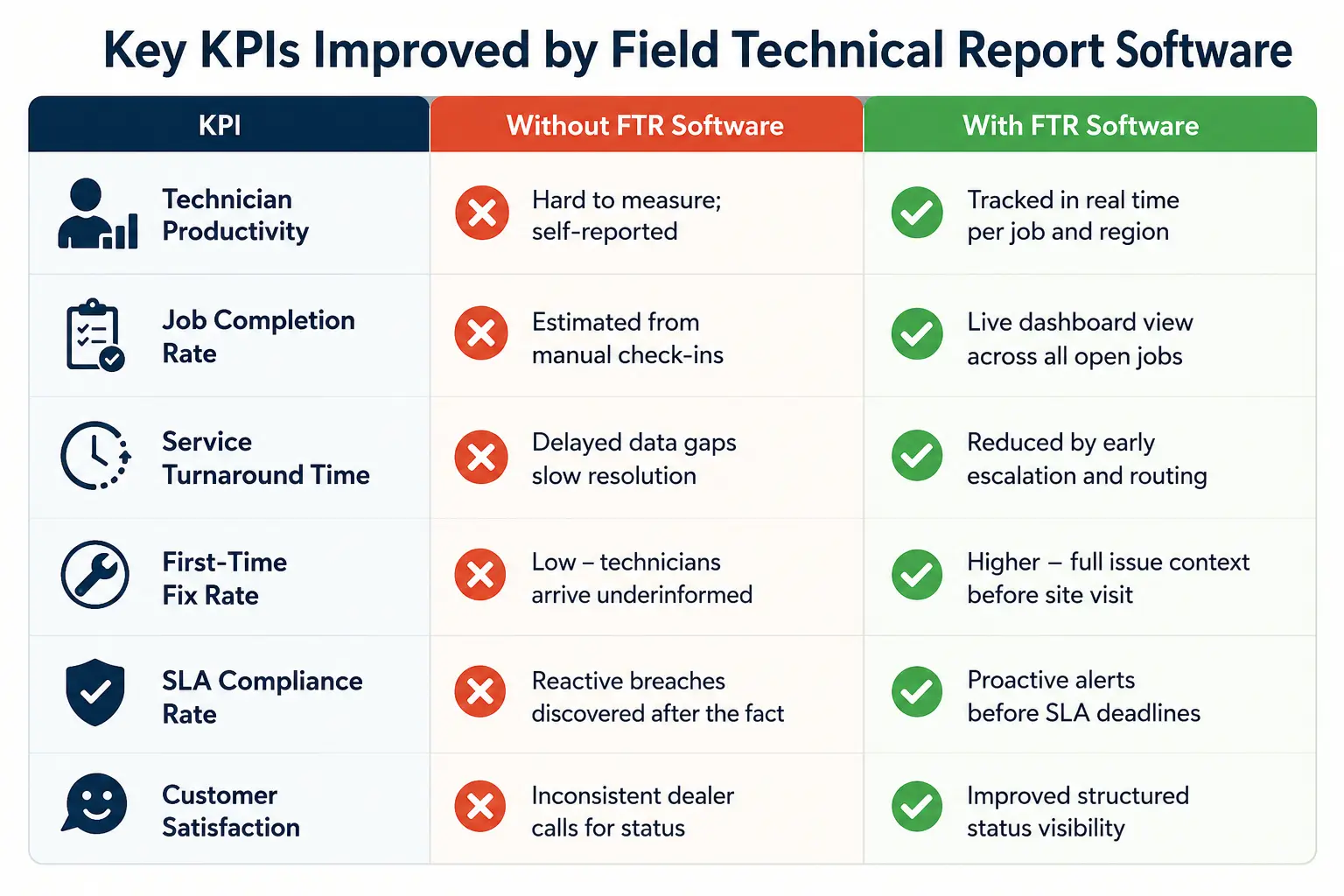
Key KPIs Improved by Field Technical Report Software
Real-World Use Cases Across Manufacturing Industries
Automotive OEM Field Service Operations
Automotive OEMs with dealer networks spanning hundreds of service centers use Field Technical Report Software to manage technical complaints reported from the field, track escalation to engineering or supplier teams, and build a knowledge base that allows dealers to self-resolve recurring fault codes without raising a new TAR. This directly reduces the volume of escalations reaching back-office teams and shortens dealer response times.
Construction Equipment Service Networks
Construction equipment service events are often time-critical equipment downtime on an active project site has direct cost implications for the end customer. Field Technical Report Software enables service managers to track technician status in real time, prioritize emergency dispatch, and ensure that suppliers are notified instantly when a component failure pattern requires a corrective action bulletin.
Agricultural Machinery Service Operations
Seasonal demand spikes during planting and harvest create peak service pressure on agricultural OEM field teams. Real-time technician visibility allows service managers to deploy resources to the highest-priority calls, track job completion against SLAs, and capture field data that feeds into parts planning for the next season.
Industrial Equipment Service Teams
Industrial equipment OEMs managing service across multiple plant sites use TAR and FTR workflows to ensure that field issues are captured with the specificity required for root cause analysis, VIN or serial number, failure code, environment conditions, prior service history and escalated to the engineering team with a complete evidence package rather than a verbal description.
How to Choose the Right Field Technical Report Software
Not all field reporting platforms are built for OEM service network complexity. When evaluating options, OEM service and IT leaders should assess against these criteria:
- Mobile Accessibility: Technicians should be able to submit reports, update job status, and access issue history from any smartphone, without a desktop session required.
- Ease of Use: Complex interfaces slow adoption. Platforms that require training weeks before field teams use them effectively defeat the purpose of digitization.
- TAR and FTR Workflow Structure: The platform should support the two-layer TAR-to-FTR escalation workflow that reflects how OEM field issues actually move from dealer observation to back-office resolution.
- SLA Configuration and Alerting: Dynamic SLA setup with priority-based color coding and automated escalation alerts is essential for OEMs with service-level commitments to dealers or end customers.
- Knowledge Base Integration: Resolved cases should feed into a searchable wiki that dealers can use for self-service resolution, reducing future TAR volumes.
- Offline Functionality: Field technicians work in locations with limited connectivity. The platform must support offline data capture with automatic sync when the connection is restored.
- ERP and Warranty System Integration: Field issue data has downstream value in warranty claims management and supplier recovery. Platforms that integrate with existing ERP and warranty systems, like Intelli Warranty, multiply their operational value.
- Scalability: The platform should handle multi-region, multi-tier dealer network complexity without requiring custom development for each new geography or product line.
How Intelli Desk Delivers Field Technical Report Capability for OEMs
Intelli Desk is Intellinet Systems' advanced technical helpdesk software for OEMs, built specifically to manage end-to-end field issue reporting and resolution across dealer networks, service managers, back-office teams, and suppliers.
Its core workflow is organized around three connected modules that together provide the real-time visibility and resolution structure that OEM service operations require.
- TAR Creation: Dealers submit Technical Assistance Reports directly in the platform, capturing problem observations against VIN or serial numbers. TARs are routed automatically to the assigned service manager for review and action.
- FTR Creation: Service managers consolidate dealer-reported TARs into Field Technical Reports for structured back-office review. FTR data is analyzed by OEM teams to generate service manager training calendars and initiate supplier collaboration where component failures are involved.
- Transaction Color Master: Administrators configure dynamic SLA timelines using color-coded priority levels, with real-time Turn Around Time tracking for all open issues. Escalation alerts prevent SLA breaches before they occur.
- Wiki Knowledge Base: Resolved issues are added to a searchable knowledge base accessible to dealers for independent self-service resolution, reducing repeat escalations and building dealer capability over time.
Intelli Desk integrates with Intellinet system's broader OEM software ecosystem, including Intelli Warranty for warranty claim linkage and Intelli Catalog for parts identification, creating a connected data architecture where field issue data directly improves warranty cost management and supplier recovery outcomes.
The Future of Field Service Visibility
AI-Powered Technician Scheduling
AI scheduling systems will analyze technician skills, current workload, real-time location, and issue complexity to automatically assign the best-matched technician to each job without dispatcher intervention.
Predictive Field Service Management
As field issue data accumulates, AI models will identify failure patterns at the VIN level before the dealer reports a problem enabling OEMs to proactively dispatch technicians to at-risk vehicles before breakdown occurs.
IoT-Connected Service Operations
Connected equipment that transmits fault codes and performance data in real time will automatically generate TARs when defined thresholds are exceeded, removing the dependency on human observation and manual issue reporting.
AI-Assisted Reporting and Recommendations
Rather than technicians writing narrative service reports, AI will generate structured documentation from structured inputs failure codes, photos, parts used and recommend resolution steps based on the closest matching resolved cases in the knowledge base.
Conclusion: Visibility Is the Foundation of Field Service Control
For OEMs managing extended dealer networks and field service teams across geographies, visibility is not a reporting preference, it is the foundation of operational control. Without real-time data on technician status, job progress, and issue resolution, every service decision is made with incomplete information, and every SLA breach is discovered too late to prevent.
Field Technical Report Software closes this gap by replacing fragmented manual processes with a structured digital workflow that gives every stakeholder, including dealers, service managers, back-office teams, and OEM leadership, the information they need, when they need it. The result is faster resolutions, fewer repeat escalations, stronger SLA compliance, and a field service operation that improves continuously as resolved issue data builds the knowledge base that future technicians depend on.
OEMs that treat field visibility as a managed function rather than an aspiration managed through phone calls build a structural service advantage that is measurable in response times, technician efficiency, dealer satisfaction, and warranty cost outcomes.
Gain Complete Visibility into Your Field Service Operations
Schedule a personalized demo today to see Intelli Desk in action across a live OEM field service workflow.
Frequently Asked Questions
What is Field Technical Report Software?
Field Technical Report Software is a digital platform that enables OEMs to capture, track, and resolve field service issues through structured TAR and FTR workflows. It connects dealers, service managers, back-office teams, and suppliers in a single real-time resolution loop, replacing manual reporting with traceable digital processes.
How does field reporting software improve technician productivity?
It eliminates non-productive time spent on paperwork, status phone calls, and manual route planning. Technicians receive job assignments, access issue history, and submit reports from a mobile app, while managers dispatch and reallocate based on live status data improving the proportion of working time spent on actual service.
Can OEMs track field technicians in real time?
Yes. Field Technical Report Software with GPS integration provides live technician location data on a centralized dashboard, enabling real-time dispatch decisions, route optimization, and geotagged attendance verification.
What are the benefits of mobile field reporting?
Mobile reporting ensures that job status updates, issue observations, and supporting photos are captured immediately at the point of service rather than retrospectively at the end of the day. This produces more accurate data, faster escalations, and shorter resolution cycles.
How does GPS tracking improve field service management?
GPS tracking gives service managers a real-time view of technician distribution relative to open jobs, enabling dynamic workload rebalancing, reduced travel time, and verifiable records of technician visits that eliminate disputes over service delivery.
What industries benefit from Field Technical Report Software?
Automotive OEMs, construction equipment manufacturers, agricultural machinery OEMs, industrial equipment manufacturers, and consumer durable goods companies all benefit from structured field issue reporting and real-time technician visibility any industry where field service quality directly affects product reputation and warranty costs.
Can Field Technical Report Software work offline?
Purpose-built field reporting platforms support offline data capture with automatic sync when connectivity is restored, ensuring that technicians in low-connectivity environments can still submit reports, update job status, and access issue history without interruption.
How does it improve customer service?
Faster issue resolution, proactive SLA management, and dealer access to self-service knowledge reduce the time between problem occurrence and resolution. Dealers experience fewer escalation delays and more predictable service timelines which translates into better end-customer experience and lower churn.


Explore More Insights







.webp)


About the Author


Chandra Shekhar
Chandra Shekhar is the Senior Manager, Strategy & Business Development at Intellinet Systems. With over a decade of experience in the automotive industry, Chandra Shekhar has led digital transformation and aftersales strategy initiatives for OEMs across multiple markets. His background combines deep industry knowledge with a practical understanding of how technology can solve real operational challenges. He focuses on making complex ideas clear and relevant for automotive and aftermarket professionals navigating ongoing change.


