Overview: Commercial vehicle dealerships manage complex repair orders, fleet accounts, heavy-duty parts and time-sensitive service operations. Standard automotive software lacks in terms of operational workflows or visibility needed to handle these requirements. Commercial vehicle dealership software should connect workshop service operations, parts, invoicing and warranty. It should also give OEMs a consolidated view of dealership performance. Intelli DMS helps implement all these through a common dealer management platform.

Although both passenger car dealerships and commercial vehicle dealerships sell vehicles, manage service operations and maintain spare parts inventory, the similarities largely end there.
A passenger car dealership mostly deals with individual customers, schedules service activities and manages repair orders. A commercial vehicle dealership, on the other hand, deals with fleet operators, transport companies and logistics businesses.
For these customers, a truck sitting in a workshop means more than a delayed repair. The outcome of such a situation would mean missed deliveries, disputed schedules and lost revenue. Every hour of additional downtime just keeps adding to these woes.
Such a situation changes how dealerships should manage service appointments, repair orders, parts availability, service technician allocation, warranty claims and customer billing.
Despite this fact, many dealerships continue their reliance on standard automotive software designed for passenger vehicle retail operations. Although these systems are quite adept at managing basic sales and service operations, they are unable to provide adequate support for the increased complexity of commercial vehicle operations.
A specialised commercial vehicle dealership requires software that takes into consideration the complexities of fleet servicing, repair workflows and the importance of vehicle uptime.
This article highlights why standard automotive software falls short and what suitable solution should be implemented by commercial vehicle dealerships and OEMs.
Key Takeaways:
- Businesses operating commercial dealerships cater to transport fleets that place maximum emphasis on continuous vehicle uptime rather than mere task fulfilment.
- Standard dealer management systems might not be adequate in supporting multi-line repair orders and complex workshop service operations.
- Fleet billing often comes with its own complex activities in terms of purchase orders, negotiated rates, and multiple payment responsibilities.
- Accurate identification based on vehicle and part specifications is required for heavy-duty parts.
- Meeting service-level agreements requires precise time tracking, updated repair tracking, and clear documentation regarding any operational delays.
- Network-wide visibility is required by OEMs to improve service turnaround, parts availability and warranty performance.
- Intelli DMS helps connect job cards, workshop activities, parts, billing and dealer reporting in a unified platform.
Manage commercial vehicle service operations with greater visibility and control using Intelli DMS. Book a Free Demo
Why Standard Automotive Software Struggles with Commercial Vehicle Dealerships
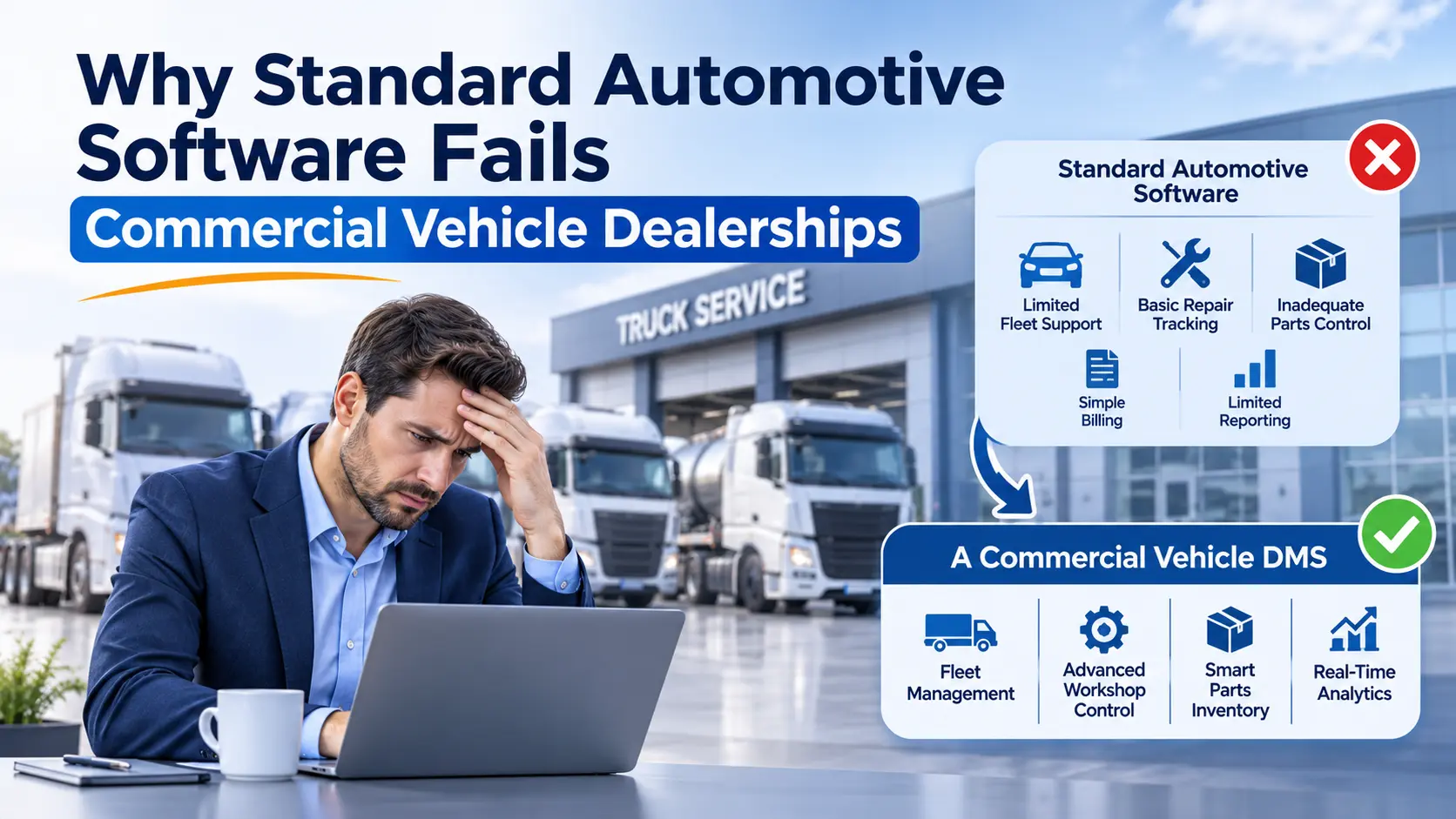
Standard automotive dealership software mostly handles passenger vehicle sales, individual customer records, service activities and billing.
Commercial vehicle dealerships operate with a different approach. They mostly handle trucks, buses, trailers and specialised vehicles. Instead of individual customer records, they manage customers who operate large fleets across multiple locations.
A single customer account here could mean dozens or hundreds of vehicles, and each vehicle may come with a different maintenance schedule, service history, part configuration and warranty details.
Commercial dealerships also have to coordinate technicians, parts availability, repair approvals and fleet billing activities.
When commercial dealerships use standard automotive dealership software, it often fails to deliver the results they expect. This is because it is not designed around these workflows. This often results in dealership teams relying on spreadsheets, phone calls and manual updates.
The holistic result for both OEMs and dealers here is fragmented information, longer repair cycles and limited visibility into dealership performance.
7 Reasons Standard Automotive Software Fails Commercial Vehicle Dealerships

1. It Is Not Designed Around Fleet Customers and Vehicle Uptime
Dealerships dealing with passenger vehicles usually deal with individual customers who bring in their vehicles for maintenance or repair activities.
Commercial vehicle dealerships, on the other hand, often deal with fleet managers who are responsible for multiple vehicles in operation. There is a difference in the priorities of these two customer groups and dealerships.
A logistics company might have a schedule for preventive maintenance of vehicles, while there could be another unexpected breakdown. In such a situation, the dealer must be able to manage both situations without causing additional disruptions in the fleet’s schedule.
As fleet managers operate with dozens of vehicles, they expect regular updates regarding the repair process, parts availability and expected completion time.
While standard automotive software can log basic service appointments and generate repair orders, it fails to support the overall operational complexities of managing broader fleet accounts.
Below are the expectations of commercial vehicle dealerships:
- Fleet-level customer and vehicle information.
- Service history linked with each vehicle.
- Scheduling preventive maintenance.
- Visibility into open repair jobs.
- Clear communication about repair jobs.
- Reporting that helps monitor service activities.
A commercial vehicle dealership management system should enable dealers to manage individual repair activities while maintaining a broader view of the customer’s fleet.
2. It Cannot Adequately Handle Complex Repair Orders
A passenger car repair generally requires a relatively small number of parts and labour.
On the other hand, a commercial vehicle repair could require more labour and parts compared to passenger vehicles.
A truck arriving with an engine issue would require diagnostic work, parts replacement, further investigations and additional repairs during the repair job.
In such cases, the repair order could be open for several days with new findings added as technicians investigate the issue.
This makes understanding the full repair scope and current status of each job hard
What commercial vehicle dealers need:
- Multi-line repair orders.
- Digital job cards with details of inspections.
- Repair details linked with labour and parts.
- Technician assignment with progress tracking.
- Approval records
- History of repair work done.
How Intelli DMS helps: Intelli DMS helps service advisors and technicians work from a shared repair record by supporting digital job cards and workshop training. With this, job progress tracking and service documentation maintenance become easy.
3. Heavy-Duty Parts Require More Accurate Identification and Stock Management
One of the biggest challenges in a commercial vehicle dealership is the management of parts.
Depending on its model and precise specifications, a commercial truck often features distinct engine, transmission, axle, and component setups. Consequently, pinpointing the exact replacement part demands more than just relying on a standard registration lookup or basic vehicle model.
Selecting the wrong part can delay the repair process, result in unnecessary returns and increase workshop costs.
Another major concern is the availability of parts. A dealership’s workshop bay could be occupied by a vehicle waiting for a part available at a different dealership within the same region.
Standard automotive inventory software often fails to showcase this level of identification of parts, connectivity with an electronic catalogue, and the required job-linked stock visibility.
What commercial vehicle dealers need:
- Look-up of parts based on accurate vehicle and part information.
- Integration of an electronic parts catalogue.
- Visibility into stock availability.
- Parts requests linked to repair orders.
- Tracking of parts issued, returned or transferred.
- Alerts for shortages affecting open jobs.
How Intelli DMS helps: Intelli DMS links parts inventory supervision with electronic catalogue queries and workshop job card processes. This provides real-time stock visibility and flags component deficits for active repairs, enabling service teams to resolve delays proactively.
4. It Does Not Adequately Support Fleet Billing and Contract-Based Work
Commercial vehicle dealerships often work with business customers with large fleets under negotiated commercial agreements.
This arrangement is unlike a straightforward retail service invoice. A fleet order could have purchase order numbers, agreed labour rates, contract pricing and multiple payment responsibilities.
Consider a service job involving out-of-pocket customer expenses, manufacturer warranty coverage, and distinct third-party vendor charges. To maintain operational accuracy, the dealership must capture each line item precisely and route the invoices to the respective responsible entities.
When the software is designed around individual retail transactions, these requirements can often lead to manual workarounds and increased administrative efforts.
This challenge increases the possibility of incorrect invoices, delayed payments, and disputes with fleet customers.
What commercial vehicle dealers need:
- Fleet customer account management.
- Purchase order reference tracking.
- Configurable billing rules.
- Support for multiple players wherever needed.
- Linking repair orders with invoices.
- Accurate tax and accounting records.
An ideal truck dealer management software should connect workshop activities with financial processes rather than treating billing activity as a separate task altogether.
5. It Cannot Properly Track Service-Level Agreements
Commercial fleet customers have expectations around response times, repair progress and vehicle release as they operate multiple commercial and heavy-duty vehicles.
These expectations are formalised through service level agreements (SLAs).
However, the measurement of an SLA cannot be done accurately if the dealership fails to record when each stage of a repair process occurs.
The following reasons could lead to delays in the repair process:
- The vehicle is waiting for diagnosis.
- Additional work is not approved by the customer.
- A replacement part is unavailable.
- A specialist technician is required.
- The repair is complete, but the vehicle is awaiting a final inspection.
It becomes challenging to establish where the time was lost if the dealership doesn’t keep timestamps and document reasons for the holdup.
A commercial vehicle DMS should be able to capture the movement of a repair order from check-in to release and include the stages and reasons for delays.
What commercial vehicles need:
- Timestamped repair order status.
- Visibility into pending approvals.
- Parts availability linked to open jobs.
- Documented reasons for delays.
- Repair turnaround reports.
- SLA performance monitoring based on the agreed definitions.
This enables service managers to identify operational bottlenecks and gives more reliable updates to fleet customers.
6. It Does Not Provide Enough Visibility Into Technician and Workshop Performance
Commercial vehicle workshops manage a mix of scheduled maintenance work, breakdown repairs and complex diagnostic jobs.
As every technician has a different set of skills and experience, not every job can be assigned to any available technician.
It becomes the responsibility of the workshop manager, as they need to understand which jobs are pending, which technicians are assigned and where additional support may be required.
A basic service scheduling tool may not be able to provide ample information required to manage these activities effectively.
In the absence of a structured workshop tracking system, jobs can remain pending without clear ownership, and service managers may struggle to identify capacity constraints.
What commercial vehicle dealers need:
- Assignment of technicians based on skills, expertise and availability.
- Job status and progress tracking.
- Visibility into pending work.
- Workshop workload tracking.
- Labour and repair activity record.
- Reporting on technician productivity and turnaround times.
How Intelli DMS helps: Intelli DMS streamlines technician allocation, real-time job progress tracking, and workshop workload visibility. This empowers service managers to optimize daily operations, resolve bottlenecks, and monitor all active repairs effectively.
7. It Cannot Give OEMs a Consistent View Across the Dealer Network
When an OEM manages multiple commercial vehicle dealerships, the limitations of standard automotive software become even more visible.
Each dealer may use a different system, follow different definitions of repair status or even maintain its own reporting format.
This increases the challenges for an OEM to compare dealer performance accurately.
For example, one dealer could report turnaround time from vehicle check-in to completion of repair, whereas another dealer could calculate it from job card creation to invoicing.
Even if both the measurements report a figure in hours or days, the underlying measurement metric is different.
What OEMs need is comparable information to understand how their service network is performing.
Here are some important network-level metrics:
- Repair turnaround time.
- First-time fix rate.
- Parts fill rate.
- Warranty claim processing time.
- Preventive maintenance completion.
- Technician productivity.
- Open repair orders by dealers.
- Service revenue and invoicing.
These metrics become useful for OEMs only when dealers capture information consistently and follow common reporting definitions.
How Intelli DMS helps: Intelli DMS delivers OEM-level analytics that centralise network service, component inventory, and financial billing data. This equips original equipment manufacturers with a unified perspective across dealership networks, making it straightforward to highlight facilities requiring operational assistance.
What Should a Commercial Vehicle Dealership Look for in a DMS?
Choosing software for commercial vehicle dealerships requires more than checking its capabilities for connecting sales, inventory and billing modules.
The platform should support and incorporate the way truck and fleet service operations actually work.
Fleet and Vehicle-Level Records
The commercial vehicle dealership software should maintain customer, fleet and individual vehicle information, including service history and relevant vehicle details.
Advanced Workshop Management
OEMs and commercial vehicle dealerships should look for digital job cards, multi-stage repair tracking, technician assignment and visibility into pending work.
Parts Catalogue and Inventory Connectivity
The commercial vehicle DMS should support accurate parts identification and be able to connect inventory information with service jobs.
Fleet Billing and Financial Workflows
Commercial vehicle OEMs and dealerships should evaluate purchase order tracking, contract pricing, multiple payer support and invoice management.
SLA and Service Performance Reporting
It is important to check whether the commercial vehicle dealership software can capture repair status timestamps, monitor turnaround and report on agreed service targets.
OEM Network Visibility
For OEMs, the DMS should be able to provide consolidated reporting across dealers and also support common operating processes.
How Intelli DMS Supports Commercial Vehicle Dealerships
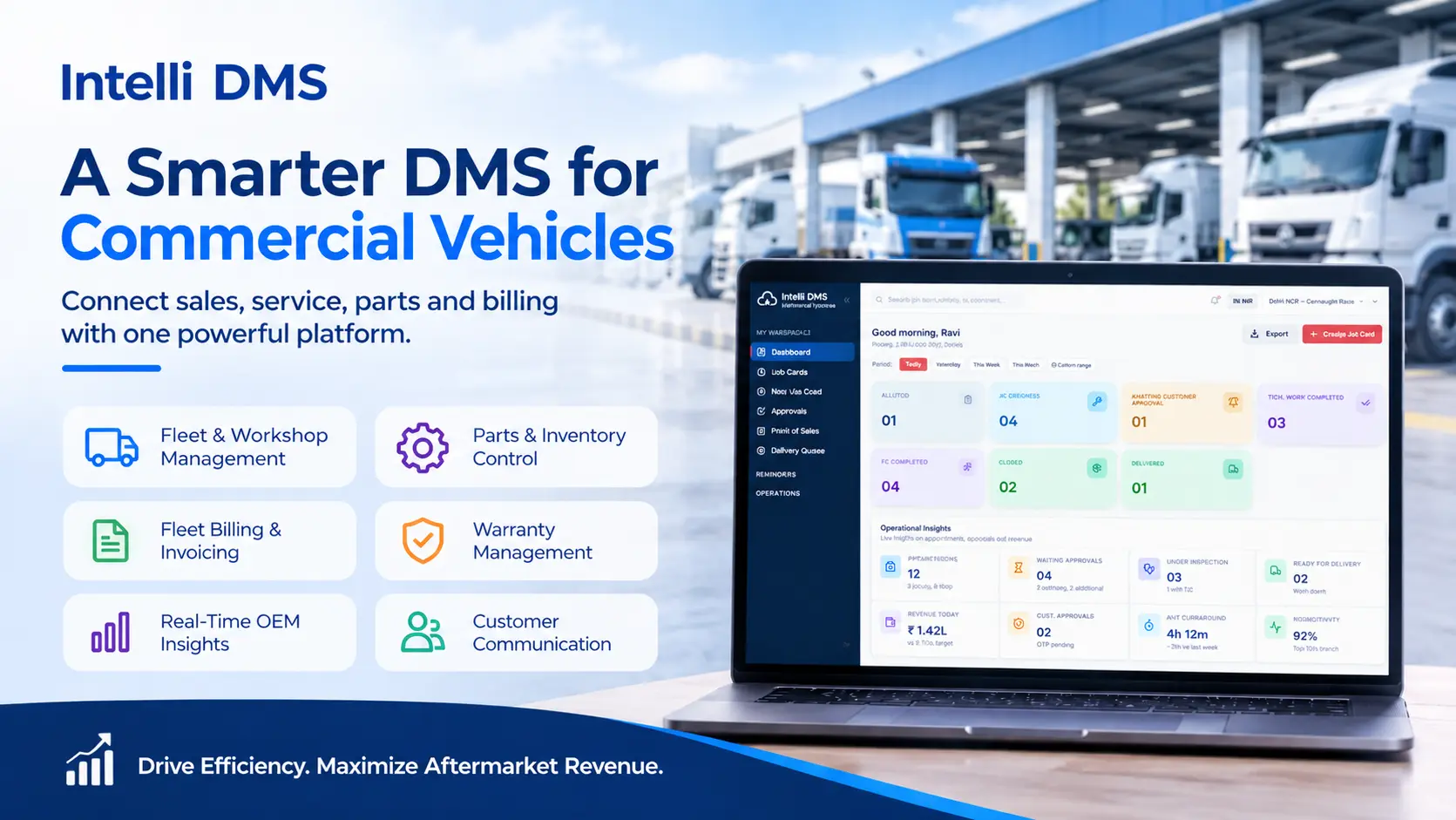
Intelli DMS is a dealer management platform that is designed to connect OEMs with their dealer networks across industries, including commercial vehicles and trucks.
Intelli DMS brings sales, service, parts, billing and customer records into a common operating environment.
The key capabilities for commercial vehicle dealerships are:
- Digital job cards: Intelli DMS enables technicians to record vehicle details, odometer readings, fuel levels, capture photographs, and record labour and repair information.
- Workshop tracking: It enables dealerships and service managers to manage technician assignments, repair progress and pending jobs.
- Parts and inventory: With Intelli DMS, dealerships can track stock availability, parts requests, issues, returns and transfers, along with electronic catalogue integration.
- Billing and invoicing: Intelli DMS connects approved repair work with invoicing and supports relevant billing workflows.
- Warranty management: It links job card information with warranty-related processes.
- Customer communication: It maintains service history and supports reminders through SMS, WhatsApp and email.
- ERP integration: It connects with platforms such as SAP, Oracle and Microsoft Dynamics, subject to implementation requirements.
- OEM reporting: Intelli DMS provides network-level visibility into service turnaround, technician productivity, parts usage and warranty performance.
Intelli DMS also supports web, Android and iOS access, with both on-premises and Microsoft Azure deployment options.
Crucially, software platforms alone cannot resolve component deficits, delayed customer authorisations, or workshop labour bottlenecks. Furthermore, delivering actionable analytics relies heavily on dealership teams consistently capturing work progress, operational holdups, and current stock details.
For OEMs and commercial vehicle dealers seeking to connect workshop operations with parts, billing and network reporting, Intelli DMS provides a unified platform.
Explore Intelli DMS and schedule a free, live demo: Dealer Management System.
Conclusion
Commercial vehicle dealerships operate under different conditions compared to passenger car retailers. They have to manage fleet customers, complex repair orders, heavy-duty parts, contract-based billing and service expectations where vehicle uptime directly has an effect on business performance.
While standard automotive software can handle basic dealership transactions and operations, it often lags when more specialised workflows become part of everyday operations.
An ideal commercial vehicle DMS should connect workshop activities, technician allocation, parts availability, billing and warranty processes. It should also provide a consistent view of dealer network performance to OEMs.
Intelli DMS brings all these activities together through a shared platform for dealer operations and OEM reporting. For OEMs that are looking to improve visibility and standardise commercial vehicle aftersales processes, implementing a DMS aligned with workshop requirements is a crucial step.
To give your dealership teams and OEM network better visibility into repair progress, parts availability and service performance. Speak to our consultant
Frequently Asked Questions
What is a commercial vehicle dealership management system?
Designed specifically for heavy-duty automotive retailers, a commercial vehicle dealership management system consolidates sales activities, workshop service workflows, component inventory, warranty claims, billing processes, and fleet customer records into a unified operational platform.
Why is standard automotive software not suitable for every truck dealership?
Standard automotive software is designed around activities associated with passenger vehicle sales and service. Truck dealerships, on the other hand, often require additional capabilities for fleet accounts, complex repair orders, heavy-duty parts, multiple payment responsibilities and service operations focused on vehicle uptime.
Is Intelli DMS suitable for commercial vehicle dealerships?
Intelli DMS supports commercial vehicle dealer operations through digital job cards, workshop activity tracking, parts and inventory management, billing, warranty-related workflows, and OEM reporting.

Nishant Sharma is the Head of Demand Generation at Intellinet Systems, specializing in B2B marketing, sales, digital transformation, and automotive aftermarket solutions. He shares insights on emerging technologies, industry trends, and strategies that help OEMs and businesses improve operational efficiency, customer experience, and aftermarket growth.